
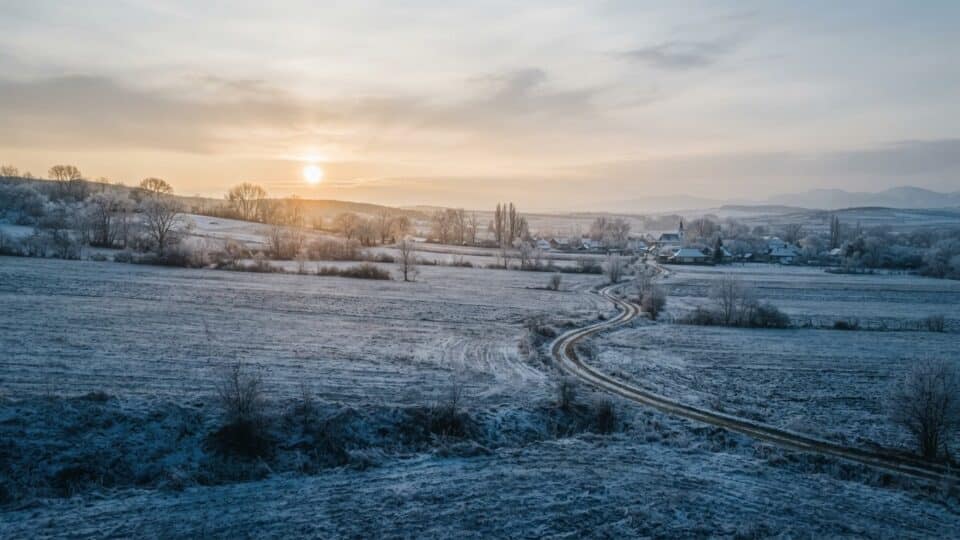
The 2026 winter solstice occurs on Monday, 21 December, at 22:50 in Romania, marking the start of astronomical winter in the Northern Hemisphere. It is the year’s shortest day: daylight lasts about 8 hours and 52 minutes in Constanța, and 8 hours and 50 minutes in Bucharest. Here are sunrise and sunset times in six cities, why the Sun is so low in the sky, and why days begin to lengthen after the solstice even though mornings may still become darker.
Winter solstice 2026: exact date and time for Romania
The 2026 winter solstice occurs on Monday, 21 December, at 22:50 Romanian time (EET, UTC+2). This corresponds to 20:50 UTC. It is an astronomical event marking the beginning of astronomical winter in the Northern Hemisphere, not a period lasting several days or a sudden change in air temperature.
The calculation is confirmed by timeanddate’s 2026 solstice calendar and the United States Naval Observatory, after converting the time to Romania’s time zone. Romania uses standard time, UTC+2, in December, rather than daylight-saving time. The exact moment occurs after sunset in every city in the country.
Why 21 December is the shortest day of the year
Near the December solstice, the Northern Hemisphere is tilted away from the Sun. In a city such as Bucharest, the Sun follows a shorter apparent arc across the sky and remains above the horizon for less time. As a result, the interval between sunrise and sunset reaches its annual minimum: about 8 hours and 50 minutes in the Romanian capital.
Astronomically, the minimum daylight duration occurs around the date of the solstice. In tables published to the nearest minute, two consecutive days may appear identical because the actual difference is measured in seconds. In 2026, for example, timeanddate gives Bucharest 8:50:09 on both 21 and 22 December at the displayed level of rounding.
Earth’s axis: the scientific explanation for the seasons
The axis around which Earth rotates is tilted by about 23.4 degrees from the perpendicular to the plane of its orbit. As the planet moves around the Sun, the axis’s approximately fixed orientation in space means that each hemisphere receives sunlight at different angles over the course of the year.
In December, the Northern Hemisphere is tilted more away from the Sun: light arrives at a lower angle and days are shorter. The reverse happens in the Southern Hemisphere. The US Naval Observatory and NOAA explain why axial tilt, rather than distance from the Sun, is the main mechanism behind the seasons.
The solstice is a moment, not a full day of “stillness”
The word solstice comes from a Latin expression evoking the Sun’s apparent standstill. It does not mean that the Sun stops moving across the sky or that Earth slows its rotation at a particular time. It is the moment when the Sun’s apparent declination reaches its annual southern extreme, around −23.4°.
On days around the solstice, the change in the Sun’s declination becomes very small. This gave early observers the impression that the extreme position of sunrise or sunset remained almost unchanged. A sundial or careful observation over several weeks can show the effect, but there is no dramatic visible event precisely at 22:50.
How long daylight lasts on 21 December 2026 in six Romanian cities
Day length varies with latitude. More northerly cities have a shorter solar arc in December, while more southerly places receive slightly more daylight. Sunrise and sunset times also depend on longitude, which is why Iași can have an earlier clock-time sunset than Timișoara even though both are in the same time zone.
The data in the table are for Monday, 21 December 2026, expressed in Romanian local time and rounded to the nearest minute. They were checked against solar calendars for timeanddate — Bucharest, Constanța, Cluj-Napoca, as well as comparative astronomy tables for the other cities. Actual observation may differ slightly because of terrain, altitude and atmospheric conditions.
| City | Sunrise (21 Dec.) | Sunset (21 Dec.) | Day length |
|---|---|---|---|
| Constanța | 07:37 | 16:29 | 8 h 52 min |
| Bucharest | 07:48 | 16:38 | 8 h 50 min |
| Brașov | 07:55 | 16:36 | 8 h 41 min |
| Timișoara | 08:13 | 16:53 | 8 h 40 min |
| Cluj-Napoca | 08:07 | 16:39 | 8 h 32 min |
| Iași | 07:53 | 16:22 | 8 h 29 min |
Constanța: 8 hours and 52 minutes of daylight on the shortest day
In Constanța, the Sun rises on 21 December 2026 at around 07:37 and sets at around 16:29. The astronomical interval between sunrise and sunset is about 8 hours and 52 minutes. At the June summer solstice, the same city has about 15 hours and 31 minutes of daylight, around 6 hours and 39 minutes more.
Its geographical position and openness towards the Black Sea can give some areas a clearer visual horizon, but do not change orbital geometry or the theoretical length of the day. An observer standing between buildings or behind a hill may lose sight of the solar disc before the time calculated for an ideal horizon.
Bucharest: sunrise at 07:48 and sunset at 16:38
For Bucharest, the solar calendar gives a sunrise of around 07:48 on 21 December, sunset at 16:38, and a day length of 8 hours, 50 minutes and 9 seconds. Whole minutes are used in comparisons, but the seconds explain why day-to-day changes can be too small to show on an ordinary clock.
In the capital, solar noon occurs at around 12:13, rather than necessarily at 12:00. At that point, the Sun rises to about 22° above the horizon, much lower than in summer. This low elevation creates long shadows even in the middle of the day and changes the intensity of solar energy reaching a horizontal surface.
Iași and Cluj-Napoca: why the north has a shorter day
In Iași, on 21 December 2026, sunrise is around 07:53 and sunset around 16:22, leaving about 8 hours and 29 minutes between them. In Cluj-Napoca, sunrise is around 08:07, sunset around 16:39, and the day lasts about 8 hours and 32 minutes.
The fact that sunrise in Iași appears earlier on the clock than in Cluj is also related to longitude: Iași lies farther east. Day length, by contrast, is determined mainly by latitude at this time of year. For meaningful comparisons, it is therefore better to consider the total daylight interval, not sunset time alone.
Timișoara and Brașov: same date, different local times
In Timișoara, the 21 December 2026 solstice brings sunrise at around 08:13 and sunset at around 16:53, with about 8 hours and 40 minutes of daylight. In Brașov, the indicative times are 07:55 and 16:36, giving about 8 hours and 41 minutes.
These differences do not mean that the Sun “moves more slowly” in one city. All these places have the solstice on the same date and in the same time zone, but sit at different geographical coordinates. For outdoor activities, it is useful to check the solar calendar for the precise locality rather than automatically using Bucharest times.
How day length is calculated: sunrise, sunset and refraction
In tables such as these, “day length” means the period between the Sun’s apparent sunrise and sunset. Sunrise is generally defined as the time when the upper edge of the solar disc becomes visible at the horizon, and sunset as the time when it disappears. Calculations use a standard value for atmospheric refraction, the phenomenon through which light is bent in layers of air.
For this reason, a strictly geometrical calculation for the centre of the Sun can differ from the displayed sunrise time. Reflections from the sea, buildings, mountains or the atmosphere’s actual refraction can alter local observation. timeanddate explains its methodology and the limits of its calculations. The tables have stated mathematical precision; they do not promise that the solar disc will be visible through clouds.
Is night almost 15 hours long? The difference between no Sun and total darkness
If Bucharest has about 8 hours and 50 minutes between sunrise and sunset, the remaining 24-hour period is about 15 hours and 10 minutes during which the solar disc is below the horizon. This is a valid calculation of the time without the Sun above the horizon, but it does not mean the entire interval is completely dark.
There is dawn before sunrise and twilight after sunset. In Bucharest on 21 December, civil twilight ends at around 17:12, although the Sun sets at around 16:38. The distinction matters for photography, transport and outdoor activities. The sky does not instantly change from light to darkness at sunset.
The earliest sunset does not occur at the solstice
One of December’s more surprising features is that the earliest sunset occurs about one to two weeks before the solstice, depending on the location. In Bucharest, 2026 calendars indicate sunset at around 16:35 around 9–10 December, while on 21 December the Sun sets at around 16:38.
The day nevertheless continues to shorten until the solstice because sunrise moves to progressively later times. After the solstice, the two do not reverse simultaneously. The explanation lies in the difference between apparent solar time and civil time, described by the United States Naval Observatory.
| Date in Bucharest | Sunrise | Sunset | Day length |
|---|---|---|---|
| 9 December 2026 | 07:39 | 16:35 | about 8 h 56 min |
| 21 December 2026 | 07:48 | 16:38 | about 8 h 50 min |
| 31 December 2026 | 07:51 | 16:45 | about 8 h 53 min |
Why the latest sunrise comes after 21 December
Near the solstice, total daylight is at its minimum, but solar noon gradually shifts later relative to clock time. This shift means sunset starts occurring later before sunrise starts occurring earlier. In Bucharest, the latest sunrise comes in the first days of January.
The effect can seem paradoxical: after 21 December, the day gets longer, but mornings may still seem darker. There is no contradiction. Two changes are occurring together: the length of time between sunrise and sunset, and the movement of solar noon. Timeanddate explains this apparent mismatch.
The equation of time, without complicated formulas
The apparent solar day, measured by the Sun’s position, is not exactly the same length on every day of the year. Earth’s orbit is elliptical and its axis is tilted; together, those features mean solar noon does not always coincide with 12:00 on a clock running at a uniform pace. The difference is called the equation of time.
In December and January, this variation causes sunrise and sunset to shift at different clock times even when the interval between them is nearly constant. The US Naval Observatory provides an explanation in its guide to sunrise and sunset near the solstices. The equation of time should not be confused with the official clock change, which takes place at other times of the year.
How much days start to lengthen after the winter solstice
In the first days after 21 December, the gain in natural light is very small. For Bucharest, a solar calendar gives approximately 8:50:09 on both 21 and 22 December 2026, with the difference below an easily noticeable interval. By 31 December, the day reaches about 8 hours and 53 minutes. The gain becomes clearer in the following weeks.
It is not correct to say that from the first day after the solstice, daylight automatically increases by one minute each day. The rate of change is small near the annual minimum and increases later. At the same time, cloudy days can make light seem weaker, but the astronomical interval between sunrise and sunset continues to follow its annual cycle.
Why January and February can be colder even as days lengthen
The solstice marks the minimum day length, not necessarily the coldest day of the year. Land, water and the atmosphere have thermal inertia: accumulated and lost energy does not immediately balance out as the Sun’s height changes. That is why, in many Northern Hemisphere regions, the coldest periods come after the solstice, during calendar winter.
There is no universal date for the temperature minimum in all cities. Weather is influenced by atmospheric circulation, cloud cover, wind, proximity to the sea and any snow cover. The solstice can be calculated astronomically well in advance, but it does not allow a forecast of the temperature in Constanța or Bucharest on 21 December 2026.
Winter is not caused by Earth being farther from the Sun
The idea that winter is caused mainly by Earth moving farther from the Sun is incorrect for the ordinary seasons. The planet approaches perihelion, its closest point to the Sun, in the first days of January. Yet the Northern Hemisphere is in winter and the Southern Hemisphere in summer.
The difference in orbital distance has a small effect on the total energy received, but axial tilt controls day length and the angle of light in each hemisphere. The explanation is set out by the National Weather Service and the US Naval Observatory. Climatic variations should not be confused with astronomical distance.
Why the Sun looks so low in the sky in December
Near the winter solstice, the Sun’s apparent path above the horizon is low. At solar noon in Bucharest, an elevation of about 22° creates long shadows and a much lower angle of illumination than in summer. In Iași, the Sun’s solar-noon position is lower still, around 19–20°, because the city lies at a more northerly latitude.
The Sun’s low position also affects how surfaces are heated and illuminated. The actual output of a photovoltaic installation, however, cannot be calculated from the solar angle on a single day alone: orientation, cloud cover, shading, temperature and the total duration of the season all matter. A clear day should not be interpreted as proof of performance throughout the winter.
Sunrise towards the south-east and sunset towards the south-west
In Romania at the winter solstice, the Sun generally rises in the south-east and sets in the south-west, rather than exactly east and west. In Bucharest on 21 December 2026, calculations indicate a direction of about 123° at sunrise and 237° at sunset, measured in degrees from north.
For a sunrise photograph, find an open horizon towards the south-east and observe safety precautions near water, on a seafront promenade or in mountain areas. Do not look at the Sun through binoculars or a telescope without certified solar filters: the intensity of the light can damage the eyes. The Sun’s position can also be observed through shadows or ordinary tripod-mounted photographs, without looking through magnifying optical instruments.
Why the same day is not the same length across Romania
Romania spans several degrees of latitude. A city closer to the north of the country receives less time with the Sun above the horizon in December. Iași, for example, has around 8 hours and 29 minutes on 21 December, compared with about 8 hours and 52 minutes in Constanța: a difference of roughly 23 minutes.
Latitude chiefly affects the duration of daylight, while longitude shifts local solar time relative to the shared clock of the time zone. Altitude and terrain alter the apparent horizon, sometimes significantly in mountain valleys. A single chart for the whole country should therefore be labelled a generalisation, not an exact timetable for every locality.
The December solstice is the summer solstice in the Southern Hemisphere
At the moment when the Northern Hemisphere has its shortest solar arc, the Southern Hemisphere is tilted more towards the Sun and experiences its summer solstice. For countries such as Australia, South Africa and Argentina, December brings longer days, depending on latitude. The same astronomical event therefore has opposing seasonal names.
Near the Equator, day length varies far less than in Europe, while polar latitudes experience extremes such as polar night or the midnight Sun in the opposite season. These differences reflect the global geometry of illumination, not a sudden variation in the Sun’s activity.
What polar night is, and why it does not occur in Romania
Beyond the Arctic Circle, on certain days around winter, the Sun does not rise above the horizon. This phenomenon is called polar night. Its duration varies according to how close a place is to the North Pole and to the local horizon. It does not mean the entire period has no light of any kind: twilight and other light sources may be present.
Romania lies well south of the Arctic Circle, so even at the winter solstice the Sun does not disappear for a full day. Even in northern localities, it rises and sets every day in December, although the daylight interval is shorter than in the south.
Solstice versus equinox: the two terms are not interchangeable
At the solstices, the Sun’s apparent declination reaches its northern or southern extremes. Around the equinoxes, the centre of the Sun crosses the celestial equator, and day length approaches night length in many regions. Even at an equinox, there are not necessarily exactly 12 hours between sunrise and sunset because of the Sun’s apparent diameter and refraction.
For further explanation, see InfoBuz’s analysis, Autumn Equinox 2026: Why the Day Is Not Exactly 12 Hours Long. Confusion often arises when the year’s four astronomical markers are presented in simplified form, without distinguishing between the Sun’s position and local civil time.
Astronomical and meteorological winter begin on different dates
In the Northern Hemisphere, astronomical winter 2026–2027 begins at the December solstice and ends at the March 2027 spring equinox. Meteorological winter, by contrast, is defined as the months of December, January and February, beginning on 1 December. This convention makes climate statistics easier to compare.
As a result, a report referring to the “first day of winter” may give either of two dates without necessarily being wrong, provided it specifies the definition used. When referring to the solstice’s exact time, this article means the astronomy of the Sun’s position; when discussing winter temperature averages, meteorological statistics often use calendar months.
What a student can observe at home: noon shadows
A simple experiment can demonstrate the changing solar angle. In a safe place where the Sun is visible, place a stable vertical object and measure the length of its shadow near solar noon. Repeat the measurement in the same location on clear days, for example in December, March and June. Use the same object height and the same measurement method.
The noon shadow is generally longer near the winter solstice than in summer at the same latitude. Do not use the experiment to calculate the solstice’s exact time or to predict future weather: observations are affected by the horizon, the object’s tilt and the selected time. Do not look directly at the Sun through optical instruments without specialist protection.
Why the solstice does not fall on exactly 21 December every year
The calendar year usually has 365 days, while the year of the seasons is not exactly that long. The Gregorian calendar uses leap years to keep the seasons roughly in the same months. In addition, the moment of the solstice can fall on different civil dates depending on the observer’s time zone.
In Romania, the winter solstice usually falls on 21 or 22 December, depending on the year and the event’s exact time. In 2026, it is Monday, 21 December, at 22:50. Do not automatically use the previous year’s calendar to announce the time, as the minutes and sometimes the civil date change.
Myths about the shortest day of the year
Myth 1: “The Sun stands still at 22:50.” False: the term describes the slowing variation in apparent declination, not a halt in Earth’s rotation. Myth 2: “21 December must be the coldest day.” False: temperatures depend on weather and thermal inertia. Myth 3: “Winter begins because Earth is farthest from the Sun.” False: the planet is relatively close to the Sun in January.
Myth 4: “The latest sunrise and earliest sunset happen simultaneously at the solstice.” False, because of the equation of time. Myth 5: “From 22 December, we immediately gain a minute of daylight every day.” False: the initial change may be only a few seconds. Myth 6: “It is instantly completely dark after sunset.” False: twilight follows.
What the solstice means for daily routines and outdoor activities
The most practical effect is the short period available between sunrise and sunset. If planning a walk, hike or an activity that depends on daylight, check sunset time for the precise locality and allow a margin of time. In mountainous terrain, the landscape can hide the Sun earlier than tables calculated for an open horizon suggest.
The solstice does not automatically bring a cold spell or unusual weather conditions. For forecasts of temperature, snow and wind, consult meteorological services rather than an astronomical calendar. The latter can explain daylight duration, not cloud types or the probability of precipitation.
Winter traditions and the cultural significance of lengthening days
Solstices have been observed by many cultures as useful markers for orientation, seasons and activity cycles. In various traditions, the approach of the shortest day has been associated with the renewal of light, fire or community gatherings. A general symbolic connection, however, does not demonstrate that every modern celebration comes directly from a single ancient ritual.
For a science article, it is useful to separate the observable description of the sky from religious and folkloric interpretations. In 2026, the astronomical date can be calculated precisely, while cultural practices may differ greatly by region, community and period.
Frequently asked questions about the 2026 winter solstice
When is the 2026 winter solstice in Romania? Monday, 21 December, at 22:50 EET. Is this the shortest day? Yes, the annual minimum in daylight duration in the Northern Hemisphere occurs around the solstice. How long is the day in Constanța? About 8 hours and 52 minutes. And in Bucharest? About 8 hours and 50 minutes.
Do days start to get longer after 21 December? Yes, initially very slowly. Why does the earliest sunset come before that date? Because of the equation of time. Does the solstice coincide with the coldest day? Not necessarily. Is a special phenomenon visible in the sky at 22:50? No: the moment is geometrically defined, and it is night in Romania at that time.
Useful links from the InfoBuz archive
For a complementary explanation of celestial mechanics, read what would happen if Earth’s rotation stopped for one second. For the difference between the astronomical description and popular interpretations of planetary motion, see also Mercury retrograde, explained without myths. These guides do not replace sunrise and sunset calculations for your city.
Sources, astronomical calculation and editorial methodology
For the event date and time: timeanddate – Equinoxes and Solstices 2026 (UTC) and US Naval Observatory – Earth’s Seasons 2026. For sunrise, sunset and day length: Bucharest, Constanța, Cluj-Napoca, Timișoara, and a comparative table for Romanian cities.
For the explanation of seasons and the early-sunset paradox: USNO – Seasons and Orbit, USNO – Sunrise and Sunset Near the Solstices, NOAA – What Is a Solstice? and timeanddate – Earliest Sunset. Times are calculated for a standard astronomical horizon and rounded to the nearest minute, with conventional refraction. Editorially checked on 22 November 2026. The table is not a weather observation conducted by InfoBuz.


Discuția cititorilor
Ai o opinie sau o întrebare despre acest articol? Spune-ne ce crezi.
Fii primul care deschide discuția.
Te rugăm să păstrezi un limbaj civilizat și să discuți la subiect. Comentariile spam sunt filtrate automat.