
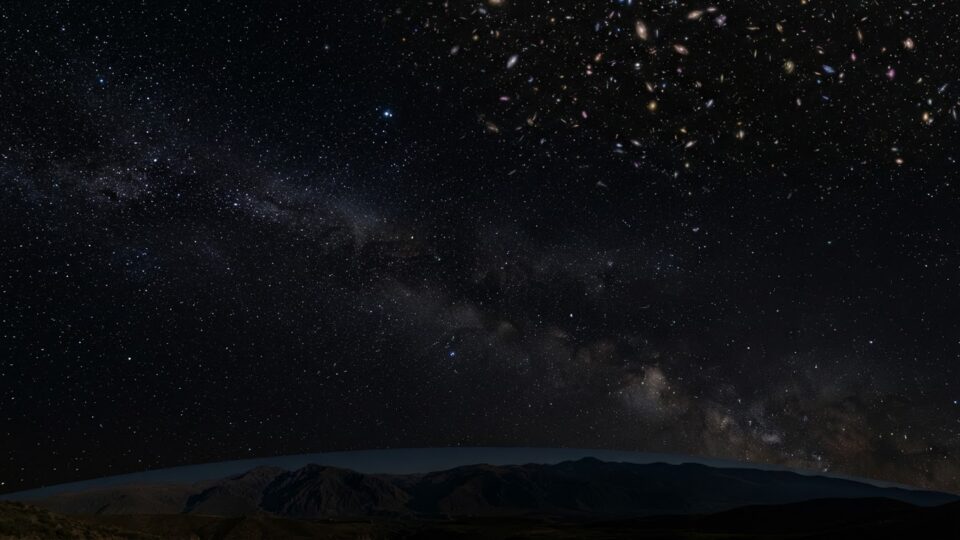
Why is the night sky dark if the Universe contains an enormous number of stars and galaxies? The question may seem straightforward, yet it became one of cosmology’s classic problems: Olbers’ paradox.
If the Universe were infinite, eternal, static and uniformly filled with stars, every line of sight should, sooner or later, meet the surface of a star. In that model, the night sky should be almost as bright as the Sun’s surface. The fact that it is not tells us something fundamental about the real Universe.
Why the night sky is dark: Olbers’ paradox
The problem has been framed in several forms throughout history, and the German astronomer Heinrich Wilhelm Olbers popularised it in the 19th century.
The idea is simple:
- assume an infinite Universe;
- assume that stars exist everywhere;
- assume that the Universe has always existed;
- assume that stars are distributed roughly uniformly.
Then every direction in which you look should end at the surface of a star.
The entire celestial sphere should therefore be very bright.
But night is dark.
Why distance alone does not solve the problem
The first response is simple: very distant stars are fainter.
Correct.
A star’s light decreases with the square of the distance.
But in an infinite Universe, an interesting compensation arises.
At ever greater distances, the area of a spherical “shell” around us also increases with the square of the distance.
That means a shell twice as far away has individual stars that are four times fainter, but it may contain roughly four times as many stars.
In the idealised model, the contributions add up.
If shells extend to infinity, the total brightness no longer converges on a dark sky.
The real Universe is not eternal
Here is the first important part of the solution.
NASA estimates that the Universe is approximately 13.8 billion years old.
That means light has not had infinite time to reach us.
Some regions are so distant that their light has not yet had time to reach us since the beginning of cosmic evolution.
We therefore cannot see an infinite number of stars in every direction.
“The Universe is 13.8 billion years old” does not mean we can see only 13.8 billion light-years away
An important distinction is needed here.
If space were static, it would be tempting to say that the greatest visible distance was simply 13.8 billion light-years.
But space has expanded over time.
As light travels towards us, the distance between regions changes.
That is why cosmology distinguishes between:
- light travel time;
- the object’s current distance;
- comoving distance;
- redshift.
For Olbers’ paradox, the essential point remains that there is a time limit on the light that could have reached us.
The Universe is expanding
The second major part of the solution is cosmic expansion.
As space expands, the wavelength of light travelling through the Universe is stretched.
This phenomenon is called cosmological redshift.
Light initially emitted at shorter wavelengths can reach us shifted towards:
- red;
- infrared;
- microwaves;
- other regions of the electromagnetic spectrum.
NASA explains, for example, that light from very distant objects is stretched to longer wavelengths as it travels through expanding space.
Redshift reduces the energy of the light we receive
A photon with a longer wavelength has less energy.
In addition, cosmic expansion dilates the rate at which photons arrive.
That means very distant sources contribute less to the visible brightness of the sky than they would in a static Universe.
Expansion therefore not only shifts light towards red; it also reduces the observed energy density.
But what if the Universe is full of old light?
It is, in fact.
The Universe has a “background” of light from the epoch when matter had cooled enough for light to travel freely.
This is the cosmic microwave background, or CMB.
NASA describes it as the oldest observable light in the Universe.
But we do not see it with our eyes.
The expansion of the Universe has stretched this light so much that it is now in the microwave range.
Would the sky be “bright” if we had eyes for microwaves?
In one sense, yes.
The cosmic microwave background comes from practically every direction.
Instruments such as WMAP and Planck can measure this radiation across the entire sky.
But its temperature is very low, about 2.7 kelvin, and its energy is not in the visible range.
For the human eye, the sky remains dark.
Cosmic dust is not the main explanation
Another historical solution was that perhaps the light of distant stars is absorbed by dust and gas.
The problem is that in an eternal, static Universe, matter that permanently absorbed radiation would heat up.
Eventually, it would re-emit the absorbed energy.
Dust therefore does not resolve the paradox in an eternal, static model.
ESA explains precisely this problem in its cosmology materials: absorption alone cannot “hide” stellar energy indefinitely.
The small size of stars does not solve the problem either
Stars are extremely small compared with the distances between them.
Yet in an infinite, eternal Universe with constant density, a line of sight continued far enough would eventually be likely to intersect a star.
The paradox does not depend on how small each star is, but on the combination of:
- an infinite number;
- infinite time;
- a static distribution;
- a Universe without evolution.
Stars have not always existed
The early Universe was not full of mature stars.
After the Big Bang, there were periods when stars did not yet exist.
NASA describes an epoch called the “Dark Ages” — the cosmic Dark Ages — between the formation of atoms and the appearance of the first stars.
The first generations of stars appeared later.
This matters greatly for the paradox: there is no infinite history of stellar emission.
Stars also have finite lifetimes
A star does not shine forever.
Its lifetime depends mainly on its mass.
Very massive stars live much shorter lives than small, cool stars.
Over time, stars:
- form;
- evolve;
- use up their fuel;
- become white dwarfs, neutron stars or black holes, depending on their mass.
The Universe is not a static backdrop full of light bulbs that remain switched on forever.
But galaxies contain hundreds of billions of stars
They do, and the observable Universe contains an enormous number of galaxies.
Even so, most of the sky between galaxies remains dark in visible light.
The reason is that:
- the Universe has a finite age;
- light has a finite speed;
- expansion shifts light towards longer wavelengths;
- stars and galaxies have evolved over time;
- matter is not distributed uniformly on small scales.
Why the daytime sky is bright
During the day, the sky is bright not because there are more stars, but because the atmosphere scatters sunlight.
Molecules in the atmosphere scatter shorter wavelengths of sunlight more efficiently, contributing to the sky’s blue colour.
At night, the Sun is below the horizon, and that vast source of direct light no longer illuminates the atmosphere above us.
In space, the sky is black even near the Sun
Photographs taken by astronauts show a black sky even when objects are strongly illuminated by the Sun.
The reason is that space has no dense atmosphere to scatter light in all directions towards the eye.
The Sun can be extremely bright while the background around it remains black.
Why we cannot see all stars with the naked eye
The human eye has limited sensitivity.
In good conditions, without light pollution, a few thousand stars can be seen with the naked eye from a given place at a given time — not billions.
Telescopes collect much more light and can see far fainter objects.
But even very deep images of the sky do not turn every point into a continuous stellar surface.
Light pollution hides part of the Universe
In cities, the sky can appear bright at night for an entirely local reason: artificial light is scattered by the atmosphere.
This glow reduces contrast and hides faint stars.
That is why Olbers’ paradox is most intuitively understood from a place with a very dark sky.
Even there, the background between the stars remains black.
What an observer would see in an eternal, static Universe
Let us construct the classic model:
- an infinite Universe;
- infinite age;
- no expansion;
- uniformly distributed stars;
- stars that have existed forever.
In that case, every line of sight would eventually reach a star.
The sky would have an extreme brightness.
The fact that our Universe does not look like this shows that at least some of these assumptions are wrong.
A conceptual case for an evolving Universe
Olbers’ paradox is not an independent measurement of the Big Bang, but it is a powerful illustration that the Universe cannot be simultaneously:
- static;
- eternal;
- uniform;
- infinitely populated by unchanging stars.
Modern cosmology resolves the problem through a Universe with history, expansion and evolution.
Edgar Allan Poe anticipated part of the solution
A surprising historical detail is that Edgar Allan Poe, known for his literature, suggested in the 19th century that the Universe might not be old enough for light from all distant stars to have reached us.
ESA mentions this insight in its material on Olbers’ paradox.
Poe did not have modern cosmology, but he touched on one of the solution’s fundamental components: the finite travel time of light.
What the speed of light has to do with it
Light does not travel instantaneously.
In a vacuum, its speed is approximately 299,792 km/s.
When we observe a very distant galaxy, we do not see it “now”, but as it was when its light left it.
The farther we look, the further into the past we see.
This limit turns the telescope into an observational time machine.
James Webb sees very close to the beginnings of galaxies
The James Webb Space Telescope can observe galaxies whose light has travelled towards us for more than 13 billion years.
For more on astronomy, see also James Webb captured light from a possible supernova dating back 12.5 billion years. What astronomers discovered, which provides complementary details on this subject.
NASA has already confirmed galaxies with very high redshifts, whose light began its journey when the Universe was extremely young.
These observations do not “break” the paradox.
On the contrary, they show directly that we see the Universe at different stages of its history.
Why we cannot see beyond the cosmic microwave background
In the first several hundred thousand years after the Big Bang, the Universe was so hot and dense that light was constantly scattered by charged particles.
Only when atoms formed, about 380,000 years after the Big Bang, did the Universe become transparent to light.
The radiation released then is what we detect today as the CMB.
In electromagnetic light, it effectively acts as an observational “wall” of the early Universe.
Would the sky be brighter if we looked in infrared?
Yes, in certain regions and with the right instruments.
The Universe looks entirely different depending on the wavelength being observed.
There is:
- the cosmic microwave background;
- infrared radiation from dust and galaxies;
- radio emissions;
- X-ray radiation;
- gamma rays.
A “black” sky is primarily a statement about what the human eye sees in the visible range.
Why the sky is not completely black, even at night
Even in a place without light pollution, the sky’s background has several faint sources of light:
- atmospheric airglow;
- zodiacal light produced by dust in the Solar System;
- very faint stars;
- distant galaxies;
- diffuse interstellar and extragalactic light.
Night-time “darkness” therefore does not mean zero photons.
It means that total visible brightness is extremely low compared with daytime brightness.
Olbers’ paradox and the idea of infinity
The paradox is an excellent example of how misleading intuitive extrapolation to infinity can be.
A Universe infinite in space need not also be infinite in time.
And even if space is very large, or even infinite, what we can observe is limited by:
- the age of the Universe;
- the speed of light;
- the expansion of space.
Could something exist beyond the observable Universe?
Yes. Cosmology readily allows for the total Universe to be larger than the observable region.
We do not directly know what exists beyond our cosmic horizon because light from there has not had time to reach us.
Olbers’ paradox does not require the total Universe to be finite in space.
It is enough that the luminous history accessible to observation is finite and that the Universe evolves.
Links to other cosmic questions
If you enjoy thought experiments about the physics of Earth and the Universe, InfoBuz has separately explained what would happen if Earth’s rotation stopped for one second.
Also in the astronomy series, you can read why Mercury sometimes appears to move “backwards” in the sky and what retrograde motion means in astronomy.
Why the night sky is dark: the conclusion
The answer is not “because the stars are too far away”.
In an infinite, eternal and static Universe, distance alone would not be enough.
The night sky is dark because the real Universe:
- has a finite age of approximately 13.8 billion years;
- has not always been full of stars;
- is expanding;
- stretches light towards longer wavelengths;
- contains stars and galaxies that form and evolve.
Olbers’ paradox turns an ordinary observation — that night is dark — into a window onto the history of the entire Universe.
Frequently asked questions
Why is the sky not full of light from all stars?
Because the Universe has a finite age, light has a finite speed, and cosmic expansion shifts and weakens radiation from very distant objects.
What is Olbers’ paradox?
It is the question of why the night sky is dark if we assume an infinite, eternal, static Universe uniformly populated with stars.
Does cosmic dust block the light from distant stars?
Dust can absorb light locally, but in an eternal, static Universe it would heat up and re-emit the energy. It is not the fundamental solution to the paradox.
Does the Universe have an edge?
We do not know whether the total Universe has an edge. What we do know is that the observable region is limited by the age of the Universe and the speed of light.
Why does the cosmic microwave background not light the sky for our eyes?
Because the Universe’s expansion has stretched that radiation into the microwave range, outside the visible spectrum.
Sources: NASA – What is the Universe?; NASA – Overview of the Universe; ESA – Cosmology, Olbers’ Paradox; NASA Webb – observable Universe and cosmological redshift.


Discuția cititorilor
Ai o opinie sau o întrebare despre acest articol? Spune-ne ce crezi.
Fii primul care deschide discuția.
Te rugăm să păstrezi un limbaj civilizat și să discuți la subiect. Comentariile spam sunt filtrate automat.