
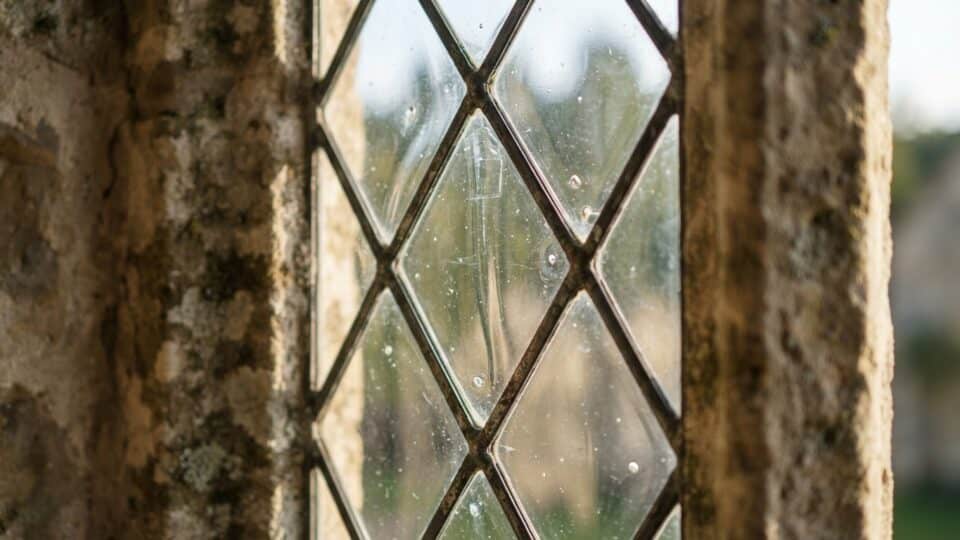
Old glass in some historic windows is thicker at the bottom, giving rise to a famous myth: that panes are liquids slowly flowing over hundreds of years. Research on glass viscosity and museum documentation points elsewhere. In reality, differences in thickness are mainly related to the way glass sheets were made and cut. This article explains what the studies show, how craftspeople worked, and what can genuinely change in medieval stained glass.
Old glass has not flowed to the bottom of the window
The sight of an old window, with subtle ripples and uneven edges, has fuelled the same story for generations: glass is an extremely viscous liquid that slowly moves downward under its own weight. The claim may seem intuitive when the lower part of a pane is thicker. Yet that very observation has been misinterpreted.
The research-supported answer is that glass in historic windows does not flow visibly over the course of centuries. Differences in thickness were already present when the glass was manufactured and cut. The Corning Museum of Glass addresses the myth directly, while research published in the Journal of the American Ceramic Society quantifies why deformation by flow would be negligible at room temperature.
Why some medieval panes are thicker at the bottom
Before modern industrial technologies, glass sheets were made by blowing and shaping them by hand. The thickness of a disc or cylinder was not perfectly uniform. When a craftsperson cut a panel from such a sheet, the resulting fragment could have one edge significantly thicker than the other. That difference remained after installation.
It is plausible that, in many cases, pieces were installed with the sturdier side at the bottom, for apparent stability and to reduce the risk of damage. This should not, however, be presented as a universal rule: not all historic windows are thicker at the bottom, and not every workshop or installer worked in the same way. Uneven thickness alone does not reliably reveal a piece’s original orientation.
Crown glass: a bubble turned into a disc
One historic technique was crown glass. The craftsperson blew molten glass into a bubble, fixed it to a metal rod called a pontil, opened the form and spun it until it became a disc. Rotation stretched the material, but did not distribute it perfectly evenly. The centre of the disc could remain thicker than its outer sections.
Fragments for windows were subsequently cut from the disc, retaining slight ripples, variations in thickness and sometimes traces of the process. The Victoria and Albert Museum describes this as one of the two important methods used to produce sheets for medieval stained glass. Some discs had the so-called central “eye”, which was less suitable for uniformly transparent surfaces.
The cylinder method: how a blown form was opened out
Another technique was known as broad sheet, muff glass or, in some variants, cylinder glass. The artisan blew an elongated mass of glass, formed the bubble into a cylinder, removed its ends, cut it lengthwise, then reheated and flattened it into a sheet. Temperature and thickness were controlled with far more limited means than in today’s industrial processes.
The resulting sheets could have slightly thicker areas, curvature, small bubbles and visual imperfections. These characteristics do not show that a pane slowly deformed while in a building; they may result from manufacturing technology. This technique is also documented by the V&A, including in the context of medieval stained-glass production.
Is glass a solid or a liquid? What modern physics says
Ordinary window glass is described in materials science as an amorphous solid. It is rigid and retains its shape under ordinary conditions, but lacks the ordered, repeating arrangement characteristic of a crystal. Its atoms are arranged disorderly, in ways that resemble liquids in some respects, but this does not make a cold pane a liquid that can pour.
The popular description “supercooled liquid” is a simplification that becomes misleading when used to explain medieval windows. The material can undergo structural relaxation under certain conditions, but that property is not equivalent to macroscopic flow observable over a few centuries. CORDIS, the European Commission’s service, explains the distinction between internal disorder and the myth of “melted” windowpanes.
Why glass can be shaped when hot but does not flow when cold
At high temperatures, glass becomes deformable enough to be blown, cast or drawn into sheets. As it cools, structural movement slows sharply and resistance to deformation rises dramatically. The transformation does not in every respect resemble water suddenly freezing into a crystal; temperature and cooling history matter.
Accordingly, the fact that artisans could turn an incandescent bubble into a disc does not show that the same disc will flow down a wall at 20°C. The behaviour of a material at very different temperatures must be compared. That is why the concept of glass transition matters for windowpanes and for many other amorphous materials.
How much could old glass flow over a billion years?
A 2017 study of medieval glass compositions by Ozgur Gulbiten, John Mauro, Xiaoju Guo and Olus Boratav estimated a room-temperature viscosity on the order of 10²⁴–10²⁵ Pa·s, under the conditions and models examined. Using calculations of deformation under gravity, the researchers obtained an upper order-of-magnitude estimate of around one nanometre in one billion years.
A nanometre is one billionth of a metre. This figure is not a direct measurement of a window that had remained installed for one billion years, and it should not be mechanically applied to every glass composition. It is a scientific estimate for the conditions studied, presented by the American Ceramic Society and in the academic paper indexed by Penn State. That timescale rules out an explanation based on visible thickening over a few hundred years.
Why there is no single viscosity for all window glass
Medieval and modern glass do not always have the same chemical composition. The proportions of silica and alkali or alkaline-earth oxides affect the material’s behaviour. How the glass was heated and cooled also matters. A value from one paper therefore cannot be said, without exception, to describe every window in the world.
This is an important detail in the research: even where certain medieval compositions have an estimated viscosity far lower than some older models for modern glass, the value remains high enough that it cannot explain macroscopic deformation of panes during the lifetime of a building.
What researchers had shown before the 2017 study
In 1998, researcher Edgar Dutra Zanotto published Do cathedral glasses flow? in the American Journal of Physics. He compared potential flow in materials with different compositions and showed that the times required for visible changes vastly exceed human history. Other mathematical analyses have addressed the same question of a pane deforming under its own weight.
It is more accurate to say that the myth has been examined and rejected through several independent approaches, rather than that one photograph or one measurement “definitively disproved” it. Reference: Zanotto, American Journal of Physics, 1998; overview: Scientific American.
If glass flowed visibly, what other evidence should exist?
A sound scientific explanation must be tested against independent observations. If all historic panes visibly thickened at the bottom solely through gravity, there should be a systematic, predictable pattern related to the age and orientation of the pieces. In addition, much older glass objects — vessels, containers and other artefacts — should display compatible effects.
Yet numerous archaeological pieces retain their overall form. The Corning Museum of Glass highlights precisely this contradiction in the legend. A thick edge on a windowpane is a real observation, but attributing it to flow would first require ruling out manufacturing variation, installation, frame deformation and later damage.
Not all old windows are thicker at the bottom
The legend often begins with a few photographed windows or examples shown on guided tours, rather than a representative inventory of all historic glass. Thickness could vary from piece to piece and even within the same sheet. Some fragments were cut and oriented according to design, availability and installation requirements.
So if a fragment is thicker on the left, right or upper side, there is no need to invent “lateral flow” to explain the distribution. Local variations may come directly from the shape of the original disc or cylinder. Any assessment of a historic object needs the context of its production and restoration.
Where the ripples and bubbles in historic glass come from
A hand-blown pane may have slightly curved surfaces, varying thicknesses and small bubbles trapped in the material. These features make straight lines seen through the glass appear wavy, and cause light to reflect differently than it does from an industrially made sheet. This is one reason many architects and conservators value the visual effect of original panes.
Ripples are not in themselves a sign of deterioration or risk, but neither do they guarantee age: modern glass can also be made to reproduce a historic appearance. Dating is carried out in context, through analysis of the window type, documentation, profiles and, where needed, the material by specialists.
What can genuinely change after hundreds of years: the glass surface
Historic glass is not entirely immune to its environment. Some compositions can undergo surface alteration due to moisture, pollutants and temperature cycles. Crusts, deposits, staining, changes in transparency or weakened layers may appear. Medieval stained glass has often been repaired, replaced or restored during its lifetime.
These chemical and mechanical processes are real, but they differ from the supposed flow of a cold panel. The Victoria and Albert Museum explains that certain kinds of medieval wood-ash glass were not always highly weather-resistant. CORDIS likewise describes the long-term degradation of stained glass without confusing it with fluidity.
Table: how to interpret visible features on a historic pane
| What you see | What it may mean |
|---|---|
| One edge thicker than another | Variation arising during manufacture or cutting of the sheet; orientation during installation may matter |
| Wavy reflections | Uneven flatness associated with hand production, not proof of flow |
| Small bubbles in the material | Possible traces of the glassmaking process |
| Staining, crusts or altered transparency | Possible surface alteration, not gravitational migration of the entire pane |
| A bowed stained-glass assembly | May require a conservator to assess the frame, joints and supports |
Sometimes the frame deforms, not the glass
In an old glazed assembly, glass is not the only material affected by time. The lead cames holding pieces of stained glass together, putty, wood, metal and masonry can deteriorate or require reinforcement. A window may appear bowed or tilted because its supporting structure has changed.
That observation does not prove that the glass has begun to flow. When conservators assess stained glass, they examine separately the integrity of the panes, joints, frames and anchors. This is why online photographs showing a “sagging” window are not informative enough to identify the actual mechanism of deformation.
Why medieval stained glass should not be confused with modern window glass
Stained-glass windows combine separate pieces of coloured or painted glass set into a network of supporting elements. Colours may be produced through compositions and metal oxides, while installation and restoration can alter the appearance of the whole. A transparent domestic windowpane generally has different requirements for surface quality, size, safety and performance.
A photograph of stained glass in a cathedral cannot be compared with a current sheet of glass without accounting for their purpose and technology. The V&A separately documents methods for producing sheets and the processes by which glass was coloured and assembled.
How modern window glass is made much more uniformly
Today’s flat-glass industry commonly uses the float process, in which a ribbon of molten glass is formed on the surface of a bath of molten metal, then cooled and processed under controlled conditions. The method produces sheets that are flatter and far more uniform than those made by hand centuries ago.
This does not mean modern glass is perfectly identical at a microscopic level, or that every new pane has identical properties. It means industry has much more precise methods for controlling thickness, flatness, composition and finish. Double- and triple-glazed windows add further layers and technologies for insulation and safety.
Why preserving old glass can matter in a historic building
In a heritage building, the ripples and imperfections of an original pane can have historic and aesthetic value. Replacing it with a perfectly flat modern sheet may alter the way light enters the interior and erase traces of traditional manufacturing techniques. Restoration should therefore be decided in relation to the architectural whole, rather than the appearance of a single piece.
Do not try to remove or aggressively measure a stained-glass window or protected historic window. A conservation specialist can determine whether additional protection, structural repair or targeted replacement of a piece is needed. In ordinary buildings, thermal-efficiency concerns should be assessed separately from the myth of flowing glass.
If an old window loses heat, “flowing glass” is not the cause
Energy losses are affected by single glazing, window sealing, thermal bridges and air infiltration. A wavy piece of glass does not by itself justify the conclusion that the material has flowed or that a gap has appeared. For a home, it is worth assessing the condition of seals, the frame and the assembly before changing the glass.
For practical checks, read InfoBuz’s guide to energy loss in the home and its explanation of condensation after installing insulated windows. At historic monuments, interventions are subject to special rules and should be undertaken in collaboration with specialists.
A small visual experiment: how to observe without damaging the glass
Look at an old window from a safe distance and compare the reflection of a straight outline — the edge of a building, for example — across several panes. If the line appears slightly wavy in some places, that indicates optical irregularity. If possible, compare it with the reflection in a smooth modern pane. Do not touch, press on or try to remove the pieces.
The exercise shows differences in flatness, not a pane’s exact age, the precise cause of every ripple or, still less, centuries-long flow. Suitable methods and a qualified operator are needed to measure actual thickness without removing a piece from its frame. Any historical conclusion must be supported by information about the object.
Five common myths about old glass
Myth 1: Glass is really very thick water. False: it is an amorphous solid, not an ordinary liquid. Myth 2: All medieval windows are thicker at the bottom. False: examples vary. Myth 3: Glass flows over the centuries. Not in a way that explains the observed thickness. Myth 4: Ripples show that a pane is melting. No: they can result from manufacture.
Myth 5: A pane with bubbles must be very old. No: contemporary decorative techniques can reproduce imperfections. Documentation and analysis of the whole assembly are important in distinguishing a genuine historic piece from a modern one. A single photograph is not a dating assessment.
Frequently asked questions about “flowing” windows
Is theoretical deformation of glass under gravity possible? Models describe very slow processes, but they do not explain the thickening observed over a few centuries. Why are many panes thicker at the bottom? Because of uneven manufacture and, in some cases, the orientation of fragments during installation. What is the difference between glass and a crystal? Amorphous glass lacks the periodic atomic lattice of an ordinary crystal.
Why are some stained-glass windows bowed? Installation, deterioration of the assembly and restoration may all have effects; no conclusion can be drawn from a photograph alone. Can glass deform at high temperature? Yes, when thermal conditions allow shaping. Can I check the thickness of stained glass myself? Intervention on a heritage object is not recommended; seek an assessment by a conservator.
Scientific sources and methodology
1. Corning Museum of Glass – FAQ, explanation of the glass-flow myth. 2. Victoria and Albert Museum – Stained glass: an introduction, the historic crown and broad-sheet processes. 3. American Ceramic Society, estimates of medieval glass viscosity and deformation rate.
4. Gulbiten et al., Viscous flow of medieval cathedral glass (2017). 5. Zanotto, Do cathedral glasses flow? (1998). 6. CORDIS / European Commission – Is glass really a slow-moving liquid?. Evergreen science explainer, checked on 22 November 2026. The explanations are derived from research and museum sources, not from InfoBuz’s own laboratory tests.


Discuția cititorilor
Ai o opinie sau o întrebare despre acest articol? Spune-ne ce crezi.
Fii primul care deschide discuția.
Te rugăm să păstrezi un limbaj civilizat și să discuți la subiect. Comentariile spam sunt filtrate automat.