
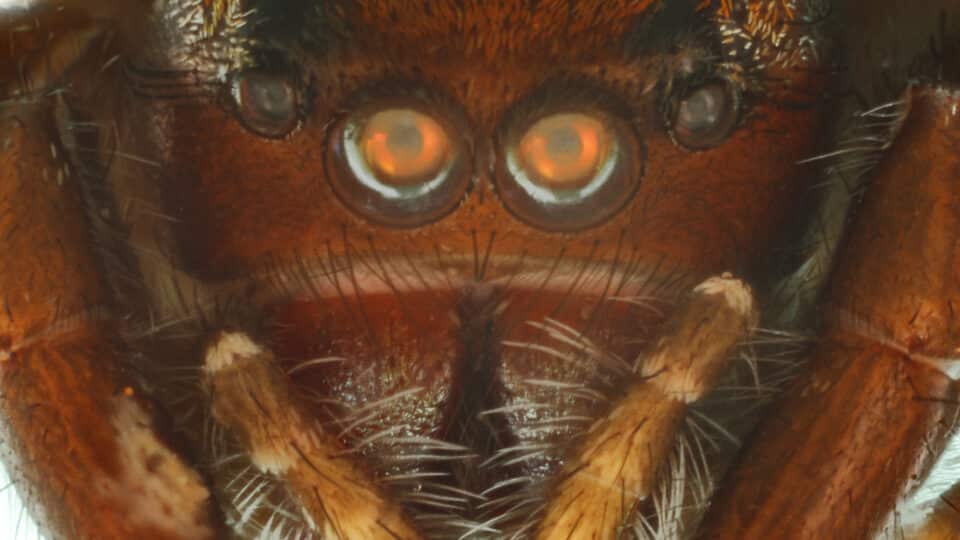
Spiders do not simply “stay still” at night. A new study finds that at least one species of jumping spider enters two distinct sleep states, one of which bears a striking resemblance to vertebrate REM sleep.
The research, conducted on Portia fimbriata, provides the strongest evidence so far that spiders have biologically regulated sleep, including a phase characterised by retinal movements, muscle twitches and a higher arousal threshold.
What researchers found
The study, published in Proceedings of the National Academy of Sciences, tracked the Australian jumping spider Portia fimbriata under controlled light and dark conditions. Researchers identified a sleep architecture with two distinct behavioural states.
- a “quiet” sleep state, with reduced activity;
- a REM-like state, during which retinal movements and small muscle contractions occur.
Crucially, the study went beyond observing unusual movements. The team also tested the classic behavioural criteria used to define sleep.
How do we know it is actually sleep?
To show that the observed rest was sleep rather than mere inactivity, the researchers examined several key indicators.
- Circadian rhythm: the spiders showed regular periods of activity and rest.
- Higher arousal threshold: during the REM-like phase, they responded less readily to stimuli.
- Sleep rebound: after sleep disruption, the animals later made up some of the lost time.
- Repeating structure: the sleep states occurred in an organised, rather than random, pattern.
These criteria matter because, in animals, sleep is not defined solely by posture or a lack of movement, but by a combination of behaviours and regulatory mechanisms.
What “REM-like” means in a spider
REM stands for “rapid eye movement” and is one of the well-known stages of human sleep. It involves rapid eye movements, intense brain activity and, often, vivid dreams.
Spiders are different. Their eye lenses do not move as human eyes do, but jumping spiders can move their retinas internally to direct their gaze. Those retinal movements allowed researchers to observe behaviour functionally comparable to rapid eye movements.
Small limb twitches and other muscle contractions were also observed during the REM-like phase. These resemble the involuntary movements seen during REM sleep in many vertebrates.
Where the hypothesis began
In 2022, a study of another jumping spider species, Evarcha arcuata, reported regular episodes of retinal movement during nocturnal rest for the first time. Very young spiderlings have exoskeletons transparent enough for researchers to see the retinal tubes directly.
That study suggested the existence of a REM-like state, but had not yet demonstrated that this form of rest met the full behavioural criteria for sleep.
This is precisely where the new 2026 study goes further: it shows that Portia fimbriata not only displays REM-like movements, but has regulated sleep, with an altered arousal threshold and recovery after deprivation.
How long REM-like episodes last
Earlier studies of jumping spiders found that episodes of retinal movement can last around one minute and may recur at regular intervals through the night. In the 2022 research, the median episode lasted approximately 77 seconds, while the median interval between episodes was about 17 minutes.
These figures should not be interpreted as identical to human REM sleep, but they indicate that the phenomenon has a repeating structure and is not purely random.
Do spiders dream?
The accurate answer is: we do not know.
The presence of a REM-like phase does not automatically prove the existence of dreams. In humans, dreams are reported through subjective experience, something that cannot be measured directly in a spider.
Researchers can measure behaviour, responses to stimuli, retinal movements and, in the future, possibly neural activity. But the claim that spiders “dream” remains a hypothesis for now, not a scientific conclusion.
Why Portia fimbriata is so interesting
Portia fimbriata is a jumping spider known for unusually sophisticated hunting strategies. Species in the genus Portia prey on other spiders as well, and can alter the vibrations produced in a web to mislead their prey.
Their learning and problem-solving behaviours had already made them of interest in research into invertebrate cognition. Sleep now adds another dimension.
Why the finding matters
Sleep has been studied mainly in mammals and birds. In recent decades, however, researchers have identified sleep or sleep-like states in an expanding range of groups: reptiles, cephalopods, insects, nematodes and even cnidarians.
If sleep states with distinct phases also occur in animals with very different nervous systems, there are two intriguing possibilities: either certain components of sleep are evolutionarily very old, or evolution independently arrived at similar solutions in several animal lineages.
Sleep may serve a universal function
The fact that sleep occurs in such different animals suggests it is not simply a “luxury” of complex brains. The biological cost of sleep is clear: a sleeping animal is less alert to predators and less able to search for food.
If evolution has nevertheless retained sleep across so many groups, its benefits must be important. Functions discussed in biology include memory consolidation, regulation of neural circuits, energy conservation and cellular repair processes.
What remains unknown
- whether all spider species sleep in the same way;
- whether the REM-like state has exactly the same function as vertebrate REM sleep;
- what happens in a spider’s brain during these phases;
- whether there are processes comparable to dreaming;
- how sleep differs between laboratory animals and spiders in the wild.
Frequently asked questions
Do spiders sleep?
Yes. At least for Portia fimbriata, the new study provides strong behavioural evidence for biologically regulated sleep.
Do spiders have REM sleep?
Researchers use the term REM-like, because the behaviour resembles vertebrate REM sleep, but the underlying neural mechanisms have not been shown to be identical.
Do spiders dream?
There is no direct evidence. Retinal movements and muscle twitches are intriguing, but they cannot confirm that dreams occur.
Why does the retina move rather than the eye?
Jumping spiders have fixed lenses, but can move their retinal tubes internally to change the direction of their gaze.
Conclusion
The discovery challenges the simplistic view that complex sleep is reserved for animals with large brains. A coin-sized spider may have a sleep architecture with two distinct phases and measurable REM-like behaviour.
For more information on spiders, see Spider sleep: two phases identified in Portia fimbriata. What we know about dreams, which provides complementary details on the subject.
We still do not know whether spiders dream, but science has established something more important: their sleep is regulated, structured and includes a specialised state that resembles REM sleep. This opens a new window onto the evolution of sleep across the animal kingdom.
Scientific sources
- Geiger et al. – Behavioral evidence for two-stage sleep in spiders, PNAS, 2026
- Rößler et al. – REM sleep-like state in jumping spiders, PNAS, 2022
- University of Bonn – How deeply do spiders sleep?
- Leibniz Institute – Spiders have different sleep phases
InfoBuz material updated on 7 November 2026. The article presents the conclusions of the available studies and distinguishes experimental evidence from hypotheses about dreaming.









Discuția cititorilor
Ai o opinie sau o întrebare despre acest articol? Spune-ne ce crezi.
Fii primul care deschide discuția.
Te rugăm să păstrezi un limbaj civilizat și să discuți la subiect. Comentariile spam sunt filtrate automat.