
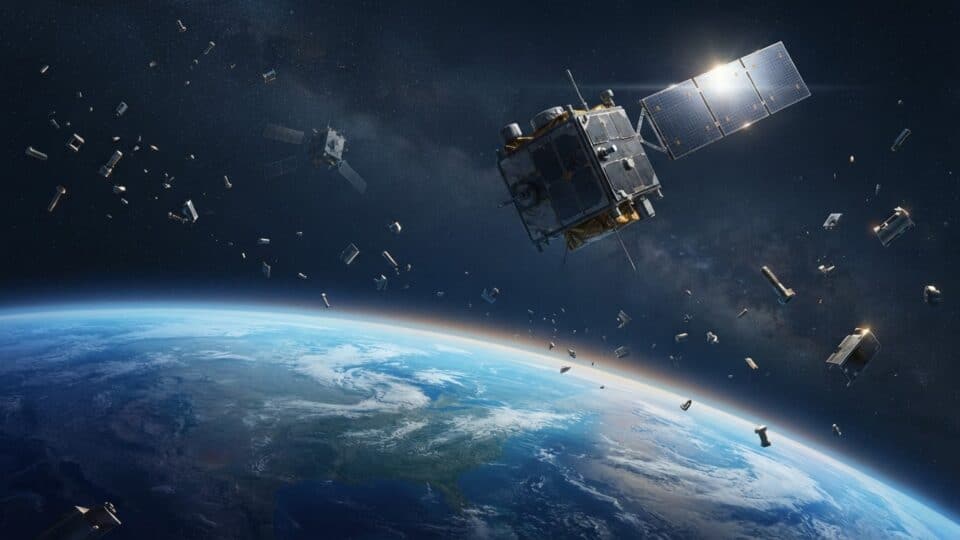
An infrastructure few people ever see is being built around Earth: satellites for communications, weather forecasting, observation and digital services. But that infrastructure shares orbital space with old rocket stages, defunct satellites and fragments produced by collisions or explosions. In its report published on 14 September 2026, the European Space Agency (ESA) warns that pressure on the orbital environment is increasing even as debris-disposal practices improve.
This is not a story about an imminent “end of the internet”. It is about a cumulative technical risk that is difficult to reverse, and that could make space missions more expensive and some orbital regions more hazardous. InfoBuz reviewed the ESA report to distinguish the figures, scenarios, technical measures and frequent exaggerations. Updated: 17 November 2026.
What ESA’s 2025 data, presented in the 2026 report, show
- More than 300 launches took place in 2025, putting more than 4,000 payloads into orbit, according to ESA.
- Activity reached a rate of roughly ten objects launched a day, amid the growth of constellations and multi-satellite launches.
- More than three intact objects a day, on average, re-entered the atmosphere, also reflecting the faster rate at which satellites are being disposed of at the end of their operational lives.
- ESA records a net increase in the debris population and warns that, without further measures, collisions can produce further collisions.
Sources: ESA Space Environment Report 2026 and ESA charts on launches and objects. The activity data refer to 2025, although the report was published in 2026.
Why a very small piece of debris can pose a very large danger
In orbit, the problem is not only a fragment’s mass, but also the relative speed at which it encounters a satellite. Two objects travelling in different orbits can have a relative velocity high enough for even a small fragment to cause serious damage. At many altitudes, the atmosphere is too thin to slow all fragments quickly.
Operators try to avoid dangerous encounters through tracking, orbital predictions and manoeuvres. But sensors do not perfectly identify every fragment. ESA notes that the number of detected objects whose origins cannot be reliably attributed is increasing as monitoring intensifies. Seeing more objects does not mean their source is immediately known.
Orbit is not a single route: three layers with different problems
Below roughly 600 km: congestion, but also manoeuvrable satellites
ESA describes an increasingly busy zone where many active satellites can adjust their trajectories. Coordination, information-sharing and collision avoidance are essential. A satellite’s ability to manoeuvre does not make it immune to fragments.
Between roughly 600 and 1,100 km: historic debris and difficult-to-control objects
ESA identifies this region as especially challenging because it also contains debris accumulated over decades. The design of new constellations must take account of the existing population, not only today’s active satellites.
Above roughly 1,100 km: objects that may remain for a very long time
At high altitudes, natural orbital decay can take centuries. A satellite’s end-of-life plan therefore cannot be postponed until it stops working. Deorbiting technologies and design decisions matter even before launch.
Context: ESA — Changing orbital landscape.
What the Kessler syndrome is — and why it does not mean a total disaster has already begun
The Kessler syndrome describes a mechanism: one object strikes another, the impact creates fragments, and those fragments increase the likelihood of further impacts, which in turn produce more debris. In an adverse scenario, the process could become self-sustaining over the long term in certain orbital regions.
ESA says its simulations show that the debris population could grow even if future launches ceased, when collisions and fragmentations exceed the natural rate of removal. This is a warning about how the situation may develop over time, not confirmation that all low-Earth orbits are already unusable.
Source: ESA — Collisions lead to collisions.
An ESA indicator rose from roughly 4 to 50. What does it represent?
The report describes a Space Environment Health Index that summarises the lasting pressure exerted by missions and objects on orbital sustainability, compared with a baseline set in 2014. ESA reports an increase from roughly 4 to 50 from one edition to the next.
It does not mean there is a “50% chance of collision”, nor that space is 50 times more dangerous for every satellite. It is a composite indicator of stress on the orbital environment, defined by ESA’s model, rather than an individual probability of impact. Any accurate presentation must retain that distinction.
Which Earth-based services may depend on satellites — and what should not be overstated
Satellites provide data for weather forecasting, environmental and disaster observation, communications and various location services. Damage to a constellation, or an inability to operate in a particular orbit, may affect the continuity, cost or redundancy of some services.
However, not all constellations and navigation systems operate at the same altitudes. It is not accurate to say that a hazard observed in low Earth orbit would automatically shut down GPS, all internet networks and banking services worldwide. The consequences depend on the system, altitude, redundancy and scale of the incident.
Why bringing a satellite back into the atmosphere is both a solution and a problem
An important practice is to shorten the period for which an inactive satellite remains in orbit. ESA highlights the change in the low-Earth-orbit disposal target from 25 years to five years. Controlled re-entries and designing components to disintegrate as completely as possible reduce certain risks.
But re-entry is not entirely without consequences. In the 2026 edition, ESA also introduces an indicator covering the risk to people on the ground from fragments that survive re-entry. The agency stresses that the likelihood of such an incident remains low compared with everyday risks, but that the trend requires monitoring. The impact on the atmosphere of particles produced by re-entries is also an area of research.
Solutions under consideration
- Preventing fragmentation: passivating tanks and remaining energy sources to reduce explosions after a mission ends.
- Designing for disposal: enabling deorbiting at the end of operational life or controlled re-entry.
- Coordinating space traffic: sharing orbital data, alerts and manoeuvre procedures among operators.
- Active debris removal: demonstration missions such as ClearSpace-1, which ESA says is under development.
- In-orbit servicing and reuse: repairing, refuelling or extending the lifetime of some platforms where this is technically and economically feasible.
ESA’s Zero Debris programme aims to substantially reduce the creation of new debris in the agency’s and its partners’ missions by 2030. It is a policy and engineering target, not a promise that existing debris will automatically disappear.
Frequently asked questions
Is it dangerous to look at the sky or travel by plane because of orbital debris?
ESA describes the direct risk to the public from fragments reaching the ground as low. The main issue addressed here is the sustainability of orbital operations and collision risk.
Could all launches be stopped to solve the problem?
ESA simulations indicate that the debris population could continue to grow without new launches if existing fragments cause further collisions. Prevention must be complemented by management of debris already in orbit.
Can orbit be “cleaned up” like an ocean?
Removing an orbital object requires identification, trajectory matching, capture and complex manoeuvres. Projects are under development, but no universal solution is already available at large scale.
Does the 2026 report describe objects launched in 2026?
The main retrospective statistics presented here cover activity through the end of 2025; the report was published on 14 September 2026.
Space debris: how to interpret ESA’s index
Space debris is not the same thing as operational satellites. ESA’s 2026 report records more than 300 launches and 4,000 payloads in 2025; those payloads should not automatically be presented as 4,000 pieces of debris. They do, however, add to activity and congestion in certain orbital regions.
According to ESA, the Space Environment Health Index rose from roughly 4 to 50 in one year. This is a long-term sustainability score measured against a reference scenario, not the number of collisions that have occurred or the likelihood that a person on Earth will be injured. Source: ESA Space Environment Report 2026.
The Kessler syndrome describes possible chain reactions: collisions create fragments that raise the risk of further collisions. The severity varies by altitude and over long periods; it does not mean that all communications on Earth will suddenly stop. Part of the digital infrastructure is terrestrial, while possible responses include orbital-traffic coordination, avoidance manoeuvres, deorbiting and the active removal of certain large objects.
See also InfoBuz’s article on fibre-optic cables used to detect earthquakes and other phenomena, another form of critical infrastructure that is rarely visible.
Sources and methodology
- ESA Space Environment Report 2026 — published on 14 September 2026.
- ESA — Payloads and objects.
- ESA — Changing orbital landscape.
- ESA — Collisions lead to collisions.
InfoBuz editorial note: observed data, modelling scenarios and interpretations of potential effects on services are identified separately. No long-term simulation is presented as an inevitable or imminent collision.





Discuția cititorilor
Ai o opinie sau o întrebare despre acest articol? Spune-ne ce crezi.
Fii primul care deschide discuția.
Te rugăm să păstrezi un limbaj civilizat și să discuți la subiect. Comentariile spam sunt filtrate automat.