
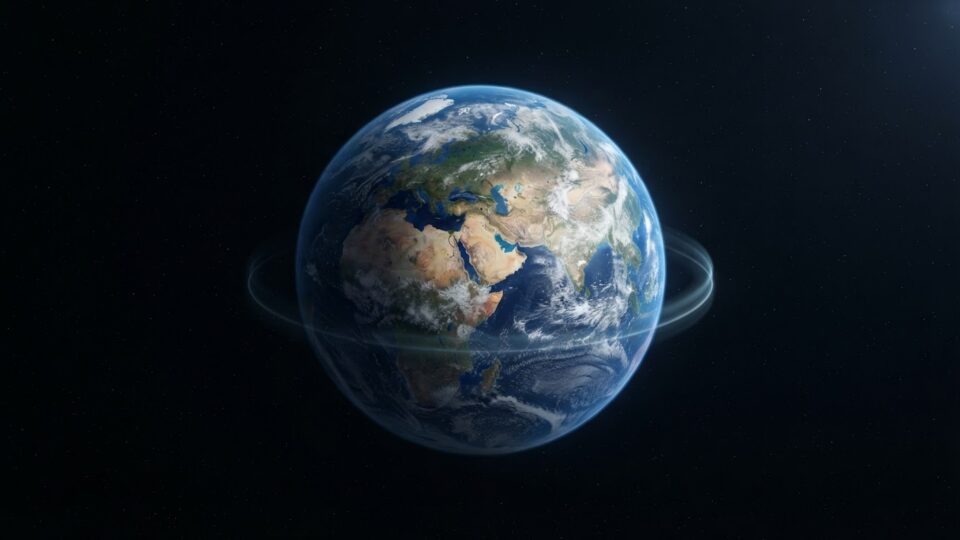
If Earth’s rotation stopped for just one second, the main problem would not be that the Sun would “freeze” in the sky. One second is far too short for dramatic astronomical changes. The catastrophe would come from inertia: the planet’s surface would stop, while the atmosphere, oceans and anything moving with Earth would tend to retain their speed.
This is a thought experiment, not a physically realistic scenario. No known mechanism could instantly stop the rotation of the entire planet and restart it a second later. That is precisely why it is necessary to specify what is being “stopped”: only Earth’s crust and solid body, or—by some magical means—the atmosphere, oceans and everything on the surface as well.
How fast are we moving now?
Earth completes one rotation in about 23.9 hours, according to NASA. At the equator, its circumference is about 40,000 km, which produces a rotational speed of more than 1,600 km/h.
NOAA offers a particularly intuitive reference point: at the equator, a point on Earth’s surface travels at nearly 1,040 miles per hour—about 1,670 km/h—simply because the planet rotates.
That speed falls as one moves towards the poles.
- at the equator: about 1,670 km/h;
- at 45° latitude: about 1,180 km/h;
- at Romania’s latitudes: about 1,100–1,200 km/h;
- at the poles: effectively 0 km/h in the east–west direction.
The difference exists because the circle travelled in a day becomes progressively smaller closer to a pole.
Inertia is the first thing that matters
Imagine travelling at high speed in a car that brakes instantaneously.
The car stops, but your body tends to keep moving forwards.
The same principle would apply on a planetary scale.
If the ground stopped abruptly, objects at the surface would briefly retain their eastward component of velocity.
At the equator, that would be about 465 metres per second.
At 45° latitude, it would be about 330 metres per second.
That means that, in an idealised model with no air or obstacles, an object at Romania’s latitude would continue moving hundreds of metres eastward relative to the suddenly stationary ground during the first second.
You would not be “thrown into space”
This is one of the most common exaggerations.
The rotational speed at the equator is high, but it is far below Earth’s escape velocity.
NASA gives escape velocity as about 11.2 km/s, or more than 40,000 km/h.
The rotational speed at the equator is about 0.465 km/s.
So you would not fly into space.
The problem would be violent horizontal movement relative to the ground.
What would happen to the atmosphere?
At present, the atmosphere largely rotates along with Earth.
If the solid surface stopped instantaneously, the air would not automatically receive the same instruction.
Because of inertia, the atmosphere would continue moving eastward.
In the first moments, the difference in speed between the ground and air could be on the order of hundreds of metres per second at low and middle latitudes.
It would not, however, be accurate to say that the entire planet would simply and uniformly experience “1,600 km/h winds”.
Terrain, friction, pressure differences, mountains, continents and turbulence would very quickly turn that motion into an extremely complex system.
But the central point remains: the atmosphere would have enormous inertia relative to the stopped surface.
Why would the winds be so destructive?
Winds of 100–150 km/h can already cause serious damage.
In this thought experiment, the initial relative speed could be many times greater in some regions.
Buildings, forests, infrastructure and any exposed object would be subjected to forces they were not designed to withstand.
As the air interacted with the surface, kinetic energy would be transferred through:
- friction;
- turbulence;
- shocks;
- the deformation and destruction of structures.
The oceans would keep moving too
Ocean water also takes part in Earth’s rotation.
If the ocean floor and continents stopped, the water would continue moving through inertia.
It would not be one simple “single wave”.
The response would depend on:
- latitude;
- depth;
- the shape of ocean basins;
- coastlines;
- undersea terrain;
- friction.
In coastal areas, the violent movement of enormous volumes of water would produce flooding and catastrophic waves.
Would it be like a tsunami?
Not exactly.
An ordinary tsunami generally occurs when a large volume of water is displaced by a sudden movement of the ocean floor, a landslide or another geological event.
Here, the mechanism would be different: the water itself would retain its rotational momentum while the ocean basin stopped.
The result could include enormous waves and flooding, but the term “global tsunami” oversimplifies a far more complicated dynamic.
What would happen to aircraft?
An aircraft in flight already has velocity relative to the air, while the air itself has the velocity associated with planetary rotation.
If the ground stopped, the aircraft and atmosphere would not remain suspended above a “parked” planet.
They would continue to carry the momentum they had before the stop.
The main problem would be an atmosphere made extremely turbulent and the impossibility of maintaining normal flying conditions.
What would happen at the poles?
The poles are an interesting exception.
Exactly at the geographic pole, the linear velocity associated with rotation is almost zero.
That means the direct inertial effect of a stop would be much smaller there than at the equator.
But the poles would not automatically be “safe places”.
The global atmosphere and oceans would react, and the planet would undergo an extreme disturbance.
What would happen to gravity?
Gravity would not disappear.
In fact, you would weigh slightly more at the equator if rotation stopped permanently, because the centrifugal component associated with rotation would no longer slightly reduce effective weight.
The difference is small—on the order of a few tenths of a percent—compared with the inertial effects of an abrupt stop.
So this is not a scenario in which “we lose gravity”, but almost the opposite: gravity remains, while horizontal momentum becomes the problem.
Earth is slightly flattened by rotation
NASA explains that rotation contributes to Earth’s slightly oblate shape: its equatorial radius is greater than its polar radius.
NASA data give approximately:
- equatorial radius: 6,378 km;
- polar radius: 6,357 km.
The difference is about 21 km.
The planet would not become a sphere in one second
If rotation vanished for only one second and then returned, Earth’s shape would not have time to fully readjust.
Redistributing the planet’s mass and oceans is a geophysical process far slower than one second.
This is why scenarios claiming that “the oceans would instantly rush to the poles” ignore the timescale involved.
What would happen to the Coriolis effect?
NOAA explains that the Coriolis effect arises from Earth’s rotation and influences the paths of air masses and ocean currents.
If rotation stopped, the Coriolis effect associated with rotation would disappear in the new stationary system.
But during a stop lasting only one second, there would be no time for global atmospheric circulation to reorganise into a new stable regime.
The mechanical shock of stopping and restarting would entirely dominate that second.
What if Earth remained stopped?
That would be a completely different scenario.
If Earth no longer rotated relative to the stars but continued orbiting the Sun, the day–night cycle would change radically.
The Sun would cross the sky about once a year rather than once every 24 hours.
That would mean very long periods of illumination and darkness, with major effects on temperatures and atmospheric circulation.
Those are consequences of a permanent stop, however, not of one second.
One extra second in the “day” would be almost irrelevant
If the mechanical catastrophe is set aside and only the Sun’s apparent motion is considered, a one-second pause would lengthen that day by about one second.
Astronomically, this is a very small change.
The dramatic answer, then, does not come from light and darkness but from momentum and energy.
How much energy is involved in Earth’s rotation?
Using the mass, radius, rotation period and moment-of-inertia factor published by NASA, Earth’s rotational kinetic energy is on the order of 2 × 1029 joules.
This is an order-of-magnitude calculation, not a prediction of the energy that would be “released” in a particular scenario.
To physically stop the planet, that energy and angular momentum would have to be transferred somewhere.
Where and how they would be transferred depends on the mechanism—and that is exactly where the thought experiment becomes unrealistic.
Restarting after one second would create a second shock
The scenario is sometimes put simply:
“Earth stops for one second and then carries on as before.”
But that assumes two instantaneous changes:
- braking from its present speed to zero;
- accelerating back to the same speed one second later.
Each would require a gigantic impulse.
If the first stop set the atmosphere and oceans in motion relative to the ground, restarting would not neatly undo the chaos. It would add a new shock to an already disturbed system.
The magical scenario in which absolutely everything stops
Now suppose an impossible force simultaneously stops:
- the mantle and crust;
- the oceans;
- the atmosphere;
- people;
- buildings;
- vehicles.
In that case, there would be no initial difference of hundreds of metres per second between the ground and air, or between the ground and people.
But achieving that result would require simultaneously removing the momentum of every particle in the system.
It is an artificial condition: effectively a “magic rule” of the thought experiment.
Why the conditions must be defined in questions like this
“What if?” questions are useful precisely because they reveal physical principles.
But the answer depends enormously on the assumptions.
“Earth stops” can mean:
- only the ground stops;
- all terrestrial matter stops;
- rotation slows gradually;
- rotation vanishes instantaneously;
- the stop lasts one second;
- the stop is permanent.
Each version produces a different outcome.
Myth: all buildings would fly east at 1,600 km/h
Not exactly.
Speed depends on latitude.
It is greatest at the equator and declines towards the poles.
Buildings are also mechanically connected to the ground. If the imagined force stopping the planet acts on the foundations as well, the way a structure fails would depend on how momentum is transmitted.
The atmosphere and water, by contrast, would have an extremely violent fluid response.
Myth: gravity would disappear
False.
Gravity is produced by Earth’s mass, not its rotation.
Rotation only slightly alters effective weight, especially at the equator.
Myth: Earth would fall into the Sun
False.
Rotation on its own axis and revolution around the Sun are different motions.
If the planet stopped its axial rotation, its orbital speed could remain unchanged.
NASA gives Earth’s average orbital velocity as about 29.8 km/s.
Myth: the magnetic field would instantly disappear
There is no reason to assume that a one-second stop would make the magnetic field vanish instantaneously.
The geomagnetic field is linked to processes in the liquid outer core and to the geodynamo, rather than to the simple rotation of the surface like a rigid disc.
Over a one-second interval, the dominant effect of the thought experiment would remain mechanical.
Why this impossible experiment is still useful
It shows how easily we forget that we are “standing still” only in relation to the objects around us.
In reality, we simultaneously have:
- Earth’s rotational speed;
- orbital speed around the Sun;
- the Solar System’s motion through the galaxy.
We do not feel these speeds because the motion is nearly uniform and shared with the surrounding environment.
What we feel strongly is a change in speed—acceleration.
The link to the Coriolis effect
For another example of how rotation changes the way we interpret motion in the sky, InfoBuz has separately explained what really happens when Mercury appears to move retrograde.
And for a different thought experiment involving real planetary-scale consequences, read InfoBuz’s analysis of what humanity can do if it discovers a dangerous asteroid only a few months before impact.
If Earth stopped rotating: the conclusion
A one-second halt in rotation would not be dangerous because “the day would stop”.
It would be dangerous because the planet and everything on it currently carry enormous momentum.
If the ground stopped instantaneously while the atmosphere, oceans and unsecured objects retained their motion, speed differences would be on the order of hundreds of metres per second in many regions.
At the equator, the surface now moves at more than 1,600 km/h. At Romania’s latitudes, the speed is around 1,100–1,200 km/h.
One second is astronomically very short, but it is extremely long if the environment around you is moving at hundreds of metres per second relative to the ground.
Frequently asked questions
Would we fly into space if Earth stopped?
No. The rotational speed at the equator is far below escape velocity. The main danger would be violent horizontal movement relative to the surface.
How fast is Earth at the equator?
About 1,670 km/h, according to the values NOAA uses to explain the Coriolis effect.
How fast are we moving in Romania because of Earth’s rotation?
About 1,100–1,200 km/h, depending on latitude.
Would gravity disappear?
No. Gravity comes from Earth’s mass. Without rotation, effective weight at the equator would increase only very slightly.
Would the Coriolis effect disappear?
If rotation ceased permanently, yes: the Coriolis effect associated with Earth’s rotation would disappear. During a pause of only one second, atmospheric systems would not have time to reach a new equilibrium.
Sources: NASA – Facts About Earth; NASA – Earth Fact Sheet; NOAA – What Is the Coriolis Effect?; NASA – Earth rotation and reference systems.


Discuția cititorilor
Ai o opinie sau o întrebare despre acest articol? Spune-ne ce crezi.
Fii primul care deschide discuția.
Te rugăm să păstrezi un limbaj civilizat și să discuți la subiect. Comentariile spam sunt filtrate automat.