
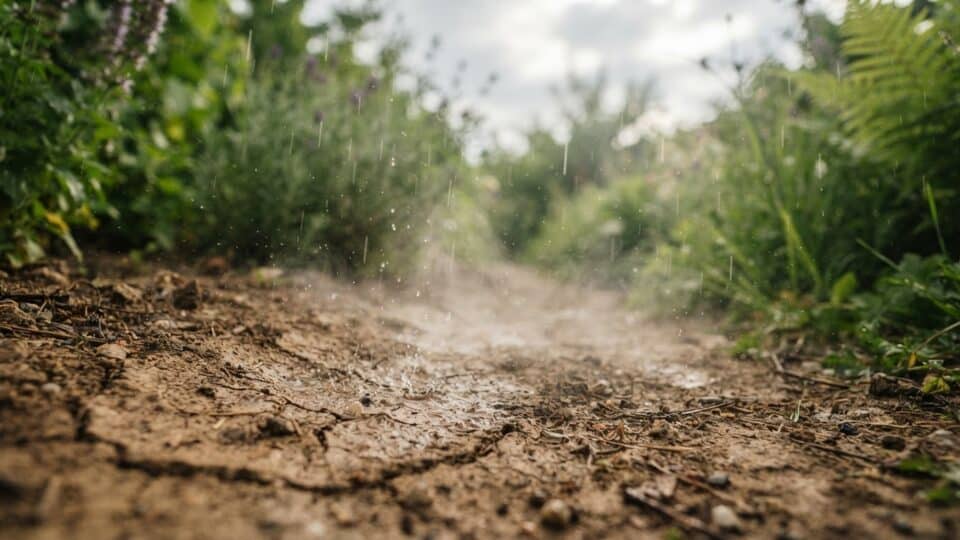
The smell of rain that appears when the first drops strike dry ground has a surprisingly evocative name: petrichor. It is not a scent produced simply by water, but the result of an interaction between soil, microorganisms, plant compounds and the impact of raindrops. Why is it so noticeable after a drought, and why can light rain smell stronger than a downpour? The explanation includes research published by CSIRO, MIT and the American Chemical Society.
The smell of rain: what we actually smell when the ground gets wet
The first drops of water do not themselves have a universal earthy scent. The characteristic smell arises when moisture mobilises compounds already present in soil and on natural surfaces, carrying them into the air. This combination of sensations is commonly known as petrichor. The effect is especially recognisable after a hot, dry spell.
This is not one molecule, nor is it an infallible weather signal. Depending on the setting, the scent may carry notes of earth, leaves, wood, plants or electrically charged air before a storm. Each category has different causes, which is why the same rain smells different in a forest, a garden and on asphalt.
What petrichor means and who coined the term
The term was introduced into scientific literature by Australian researchers Isabel Joy Bear and Richard Thomas in a study published in Nature in 1964. It combines the Greek petra, meaning stone, and ichor, the mythological substance associated with the gods. The name evokes the aroma released from rocks and soil after moisture—not a supernatural substance.
Australia’s CSIRO has published the story of the discovery, describing how the researchers examined the distinctive smell of dry soils and clays, long familiar before it was given its modern name. Their later 1966 study, Genesis of petrichor, explored the processes by which mineral surfaces retain and then release odorous compounds.
Three phenomena that can contribute to the scent of rain
Plant-derived compounds can build up on dry surfaces and contribute to the scent released by moisture. Geosmin, a molecule with a strong earthy odour, is produced by certain microorganisms and is another major component. Near storms, some people also notice a different note, sometimes associated with ozone or with the mix of air carried by the storm.
Although popular accounts group all these smells under the label “the smell of rain”, they are not the same thing. Petrichor chiefly describes the familiar aroma of wetted soil, whereas air perceived before a storm may have other sources. Distinguishing between the phenomena helps avoid the simplistic explanation that rain directly “makes” the smell.
Geosmin: the molecule that makes earth smell earthy
Geosmin is an organic compound produced, among other organisms, by certain soil bacteria, particularly microorganisms in groups of actinobacteria. The molecule is associated with the earthy smell of freshly turned soil and can also be detected after watering. Its name derives from Greek elements referring to earth and smell.
The human nose can detect extremely small amounts of geosmin. The American Chemical Society describes sensitivity at levels below ten parts per trillion under some conditions. This is an order of magnitude used to explain that sensitivity, not an identical threshold for every person, context or mixture of odours.
Where the plant substances that complement petrichor come from
Plants can release organic compounds and lipid materials that may become retained on mineral particles or nearby surfaces. During dry periods, chemical changes and the accumulation of these materials can contribute to the aroma perceived as humidity rises and rain begins. Some components have little odour at first, but their degradation produces volatile molecules that are easier to detect.
Bear and Thomas’s research described the role of minerals, humidity and the transformation of organic compounds in forming the aroma. It would not, however, be accurate to say that all plants secrete the same substance in the same quantity, or that every post-rain smell comes exclusively from plant oils.
Why the scent is stronger after a dry spell
When surfaces remain dry, certain odorous materials can accumulate or be retained in soil pores and on particles. The first wetting changes how these substances are released. That is why, after weeks with little rainfall, some people notice a more pronounced aroma than after several rainy days.
Its intensity is not determined by the length of the dry spell alone. Soil type, vegetation, wind, temperature, moisture history and the force of the rain all matter. There is no universal formula by which the number of rainless days can predict exactly how strong petrichor will be.
The MIT finding: how raindrops turn soil into an aerosol source
In 2015, researchers at the Massachusetts Institute of Technology experimentally described part of the transport mechanism. Using high-speed cameras, they tracked drops striking porous surfaces. On impact, small air bubbles can form beneath the water, rise and burst, releasing very fine liquid particles—known as aerosols—into the atmosphere.
These microscopic droplets can carry components present in the surface material, including substances that contribute to the smell. The MIT News report, “Rainfall can release aerosols”, and the original Nature Communications article explain the phenomenon. It is a mechanism demonstrated in experiments, not proof that every rain event disperses the same amount of particles.
Why light rain can smell stronger than a heavy downpour
MIT researchers found that aerosol generation depends on droplet speed and surface properties. Under the conditions tested, impacts associated with light or moderate rainfall could produce substantial aerosol releases. Heavy rain does not automatically mean a higher concentration of airborne compounds.
This finding should not be turned into a rigid rule for every type of terrain. A gust of wind, preceding humidity and impermeable asphalt can substantially alter the result. The study explains why some short, gentle rains seem highly fragrant, but it does not allow every storm to be classified by smell alone.
Soil, stone, forest or asphalt: why the aroma is not identical
In a damp forest, the scent may include components associated with soil, leaves and wood. In a cultivated garden, geosmin and other soil substances may dominate perception. On urban surfaces, water interacts with asphalt, dust, plant debris and other materials, creating a different mixture.
The familiar smell of earth should therefore not be confused with the distinct smell of hot asphalt after a shower. Cities have their own surface chemistry. Some notes may come from materials and pollution particles, without smell alone being able to identify which substances, or which concentrations, are present.
Why we sometimes smell something different before a storm begins
Some people describe the air before a storm as sharp, metallic or slightly pungent. One compound that can contribute under certain conditions is ozone, a form of oxygen made up of three atoms. Electrical discharges and atmospheric processes can affect air chemistry, while air movement changes what reaches ground level.
It is important to distinguish this sensation from petrichor produced when rain hits dry surfaces. University of Illinois Extension explains the difference. Smell is not a reliable detector of lightning, ozone or an approaching storm; for safety, follow weather warnings rather than olfactory impressions.
Can watering a garden with a hose produce the same effect?
Yes, under certain conditions: the smell of wet earth can also be noticed after irrigation, because the mechanism that releases compounds from soil is not exclusive to water falling from clouds. A bucket or a hose can bring water into contact with materials that generate the characteristic aroma.
Watering does not, however, fully reproduce the impact, aerosol dynamics, wind and air chemistry of natural rain. If a very clean surface, or one entirely unlike soil, is watered, the effect may be almost absent. The smell depends more on the surface and substances already present than on where the water comes from.
Why we recognise the aroma so quickly: sensitivity and memory
The olfactory system detects volatile molecules that reach the nasal cavity. For geosmin, perception thresholds can be very low, which helps explain why the aroma can seem intense even when the amount of the compound is small. Sensitivity varies from person to person, and a smell can be perceived differently depending on its context and on other substances in the air.
Smells are often associated with autobiographical memories and emotions. For one person, the first rain may evoke holidays at their grandparents’ home; for another, a watered field or a summer walk. There is no evidence, however, that everyone loves petrichor or that it necessarily produces a particular psychological state.
Does petrichor mean clean air? Not necessarily
A pleasant smell can be perceived in a place where pollutants are also present, and the absence of a smell does not prove that air is free of particles. The nose does not measure concentrations of PM2.5, PM10, ozone or other substances relevant to health. Moreover, aerosols lifted by raindrop impacts are suspended particles whose composition varies by environment.
There is no need to avoid the ordinary smell of wet earth, but do not use the aroma as a safety indicator. If the air has a strong, irritating or unusual chemical smell, move away from the source and follow the authorities’ recommendations. Pollution assessment depends on measurements, not olfactory impressions.
Can the smell of rain predict the weather?
Noticing a change in smell may coincide with changes in humidity and with wind carrying substances from another area. Even so, there is no simple relationship that can tell you precisely when rain will begin, how long it will last or how intense it will be. Soil may be wetted locally by irrigation, and wind can carry a smell from a distance.
Forecasting requires meteorological observations and models, not a single sensory cue. For an explanation of why forecasts can be revised even a day beforehand, see InfoBuz’s guide to ECMWF and GFS models, and weather uncertainty.
A simple experiment without a laboratory: compare three surfaces
On a dry day, you can observe the phenomenon using three separate, clean containers holding a little garden soil, clean sand and gravel. Add a small amount of water to each separately, then note whether you detect a smell and how quickly it appears. This is an observational exercise, not an experiment for chemical identification. Avoid directly inhaling dust or mould, and children should be supervised.
As far as possible, keep the amount of water and the observation distance constant. A difference in aroma does not demonstrate which bacteria are present, nor does it quantify geosmin. You can repeat the exercise after a wet period and compare observations; results depend on the actual materials and testing conditions.
What the finding means for microbiology and the environment
Studies of odorous compounds show that soil is a chemically and biologically active environment, not merely a passive surface. Microorganisms, plants, minerals and water interact, and smell is one detectable outcome of those processes. Geosmin is also being investigated for its effect on the taste and odour of water.
At the same time, the aerosolisation mechanism shows that the impact of rain can alter the transfer of some materials from soil to the atmosphere. The environmental and health implications depend, however, on particle composition and exposure; the observation that aerosols arise should not be turned into a claim that every rainfall event automatically spreads dangerous microorganisms.
Five myths about the smell of rain
“Rainwater always has a scent of its own.” No: the earthy aroma results largely from compounds already present in the environment. “Petrichor is only geosmin.” No: plant-derived substances can also play a part. “The harder it rains, the stronger it smells.” Not always: impact and soil structure matter.
“If you can smell it, rain must start within minutes.” No: wind and other sources can explain the sensation. “A pleasant smell proves the air is unpolluted.” False: olfactory perception is not a substitute for air-quality monitoring.
Frequently asked questions about petrichor
What is the smell of earth after rain called? Petrichor is the term commonly used for the aroma of rain on dry surfaces. Why does it smell stronger after a drought? Moisture can mobilise substances that have accumulated or been retained on surfaces. Why do I smell something similar in the garden after watering? Water can release compounds from soil whether it comes from clouds or a hose.
Are ozone and petrichor the same thing? No; ozone can contribute to a different smell, sometimes associated with the air before storms. Is light rain more fragrant? Aerosol experiments explain why it can be under certain conditions, without guaranteeing this everywhere. Can I identify geosmin by smell? You may suspect the presence of an earthy aroma, but reliable chemical identification requires analysis.
Primary sources and editorial methodology
1. CSIRO – The smell of rain, the history of the term introduced in 1964. 2. Bear & Thomas, Genesis of petrichor (1966), the mechanisms behind formation of the aroma. 3. American Chemical Society – What’s in the smell of first rain, geosmin and plant compounds.
4. MIT News and Joung & Buie, Nature Communications (2015), aerosol generation on impact. 5. University of Illinois Extension, the distinction between the aroma of soil and the smell associated with storms. Evergreen explanatory article, editorially reviewed on 22 November 2026; it does not present findings from measurements conducted by InfoBuz.


Discuția cititorilor
Ai o opinie sau o întrebare despre acest articol? Spune-ne ce crezi.
Fii primul care deschide discuția.
Te rugăm să păstrezi un limbaj civilizat și să discuți la subiect. Comentariile spam sunt filtrate automat.