
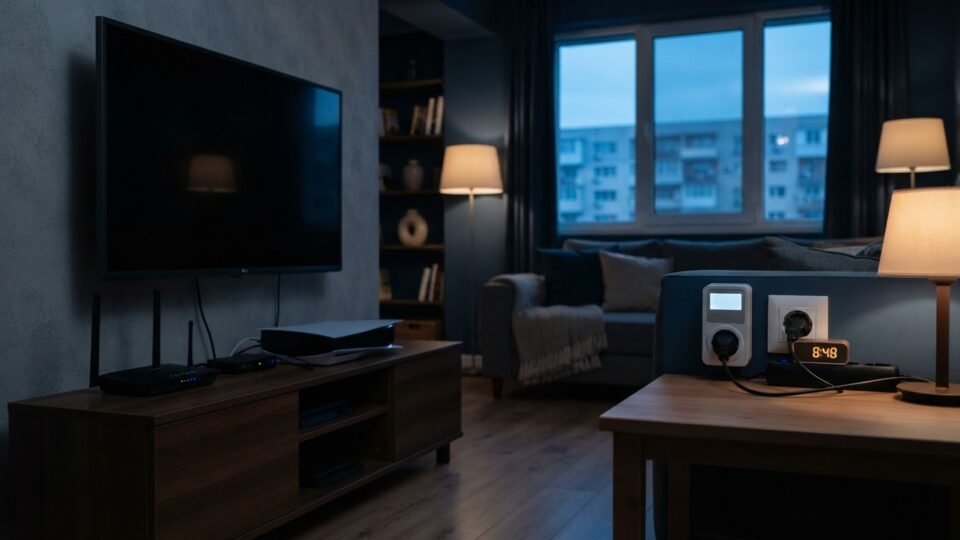
A standby power draw of just a few watts may seem negligible, but when it is continuous, it adds kilowatt-hours to a household’s annual consumption. What do TVs turned off with the remote, games consoles or chargers left plugged in really cost? This guide sets out clear formulas in Romanian lei, comparison tables, a method for measuring with a plug-in power meter, and the European limits applicable in 2026–2027—without confusing standby with appliances that need to run continuously.
Standby power: what it means to pay for a device that appears to be off
When a television is switched off with its remote control, it may still power the receiver for commands, clock circuits, memory or network connections. Depending on the exact technical mode, this is called standby or networked standby. It can use very little power, but a small, constant draw accumulates over a year. Not all devices indicate this activity with an LED.
At the same time, the idea that “all switched-off appliances steal electricity” is an exaggeration. Some products have almost undetectable consumption, while others enter modes that need to be distinguished from standby. The aim is not to turn the home into an experiment in randomly unplugging sockets, but to identify devices worth measuring and habits that can reduce energy use without compromising safety or functionality.
Off mode, standby, networked standby and active operation: four distinct situations
Off mode, in European terminology, can mean a product that is plugged in but is not performing its main function. Standby retains the ability to reactivate the product, an indicator or a display. Networked standby allows functions to resume after a signal received through a network connection. Active operation means the appliance is performing at least one of the functions for which it was designed.
The distinction matters. A router delivering internet in the home is not simply a standby consumer; it is providing an active service. A refrigerator maintaining its temperature may alternate periods with the compressor on and off without becoming an unnecessary appliance. The technical definitions are set out in Regulation (EU) 2023/826. A mode marketed as “eco” is not automatically equivalent to any of these legal categories.
Why a red light does not tell you how much electricity a device uses
An indicator light shows that a circuit is receiving power, not the consumption of the entire device. Two TVs with the same LED may have different network, update and quick-start functions. Some power supplies can consume electricity without a visible indicator. Simply observing a light therefore cannot establish whether consumption is 0.2 W, 2 W or more.
For meaningful measurements, you need a device that displays power in watts and, preferably, cumulative energy in kilowatt-hours. Do not confuse a label with the maximum output of a power supply: if a charger says “65 W”, that does not mean it continuously draws 65 W from the socket, including when no phone is connected.
EU Regulation 2023/826: power-consumption limits applicable in 2026
The European Union has ecodesign rules for categories of household and office equipment within the scope of Regulation (EU) 2023/826. The main rules have applied since 9 May 2025. For covered appliances, the current general limits are 0.5 W in off mode, 0.5 W for reactivation standby and 0.8 W for standby with an information or status display, subject to the specific provisions and exemptions in the regulation.
For networked standby, the framework includes different limits: under the conditions set out in the rules, generally 2 W for equipment without HiNA functions and 8 W for certain HiNA equipment, with explicit exemptions. Do not read these figures as meaning that “every router must use less than 2 W while distributing internet”. The reference source is the European Commission page on standby.
| Mode / period | Stated general limit for covered products |
|---|---|
| Off mode, from May 2025 | 0.5 W |
| Standby with reactivation, from May 2025 | 0.5 W |
| Standby with display, from May 2025 | 0.8 W |
| Networked standby, 2025 | 2 W for non-HiNA equipment; 8 W for HiNA equipment, under the conditions of the act |
| Off mode, from May 2027 | 0.3 W |
| HiNA networked standby, from May 2027 | 7 W under the conditions of the act |
What changes in the European rules from 2027
For equipment regulated by the European act, from May 2027 the general off-mode limit falls to 0.3 W. Requirements remain for simple standby and standby with a display, while some networked-standby limits become stricter—including a reduction from 8 W to 7 W for the relevant HiNA category. The details depend on the product and the applicable specific requirements.
The rules concern the placing on the market or putting into service of products within their scope; they do not require every appliance bought 10 years ago to be replaced immediately. Some product families are covered by their own regulations, rather than this horizontal act. For the consolidated version and application date, see EUR-Lex, Regulation 2023/826.
The exact formula: from watts to kWh and then to lei
For an appliance with approximately constant power, annual energy (kWh) = power (W) × number of hours per year ÷ 1,000. If it remains in the same mode 24 hours a day, an ordinary year has 8,760 hours. The estimated cost is found by multiplying the energy by the effective price, in lei/kWh, relevant to electricity bought from the grid.
For example, an appliance using an average of 5 W continuously uses 5 × 8,760 ÷ 1,000 = 43.8 kWh per year. At a strictly illustrative price of 1.10 lei/kWh, the result is 48.18 lei per year. This price is not presented as a current tariff from any Romanian supplier: check the price that applies under your own contract and bill.
Table: the cost of a constant draw of 0.3, 1, 5 or 20 W
The table uses 8,760 operating hours per year and a hypothetical price of 1.10 lei/kWh to make the differences easy to understand. The figures are mathematical scenarios, not measurements of specific models. The same appliance may spend a day in several modes, in which case a weighted average must be calculated.
A 0.3 W draw alone does not justify an expensive investment to save energy. A constant draw of 20 W is worth investigating, but first establish whether it supports a necessary function, such as communications or home safety.
| Constant power | Consumption per year (8,760 h) | Annual cost at 1.10 lei/kWh (hypothetical) |
|---|---|---|
| 0.3 W | 2.63 kWh | 2.89 lei |
| 0.5 W | 4.38 kWh | 4.82 lei |
| 1 W | 8.76 kWh | 9.64 lei |
| 3 W | 26.28 kWh | 28.91 lei |
| 5 W | 43.80 kWh | 48.18 lei |
| 10 W | 87.60 kWh | 96.36 lei |
| 20 W | 175.20 kWh | 192.72 lei |
Why high bills are not automatically explained by standby
A 1,500 W heater, an electric water heater or an air-conditioning unit can use substantially more energy in one hour of operation than a 1 W device uses over an entire day. It is not efficient to hunt endlessly for fractions of a watt while ignoring high-power appliances and how long they are actually used.
That is why a home audit begins with changes in kWh on bills, heating, hot water, refrigeration appliances, cooking and then idle consumption. InfoBuz’s guide to energy losses in the home also addresses insulation, habits and equipment efficiency. Properly measured standby consumption adds to that analysis; it does not replace it.
Household example: 30 W consumed continuously in the background
Imagine a home with a combined 30 W of background consumption from several appliances and pieces of equipment. If this average power is present 24 hours a day, the energy use is 262.8 kWh/year. At the illustrative price of 1.10 lei/kWh, the theoretical cost is 289.08 lei/year. This is an invented average used for explanation, not a finding about homes in Romania.
Not all of that amount could be eliminated. If 12 W belong to a router and a security system that need to operate, they are not wasted consumption simply because no appliance visibly appears to be on. The maximum realistic saving requires separating avoidable loads from necessary services. An appliance that is permanently active should be compared with alternatives that deliver the same function, not with the complete absence of that service.
How to measure with a plug-in power meter without intervening in the electrical installation
Choose a meter intended for household use that is compatible with Romanian sockets and voltage, and with the protections and load limits specified by its manufacturer. Plug the meter into an accessible socket and connect only one piece of equipment with a suitable plug, without improvised adaptors. Record the displayed power after the device has entered the stable mode you want to check.
For a TV, you can measure active mode, standby immediately after switching it off, and its stabilised mode after a few minutes separately. If quick start or an internet connection changes consumption, note the setting. The US Department of Energy explains the IEC 62301 principles and the importance of stable conditions when measuring very low power draws.
Why a device showing 0 W does not necessarily use zero electricity
Power meters vary in sensitivity, resolution, measurement range and how they calculate active power. Some affordable consumer devices display “0.0 W” if power is below their useful threshold or if the signal is difficult to measure. For very low loads, an instantaneous reading may be insufficient.
An alternative is to let the instrument accumulate energy over a sufficiently long period, if it has a kWh counter with suitable resolution. For example, 0.5 W over 48 hours is only 0.024 kWh. If the instrument rounds energy to 0.1 kWh, you may not be able to distinguish that consumption in such a short test. Do not interpret the meter’s limit as zero consumption.
Watts, VA and power factor: which figure to use for a household bill
Active power in watts (W) is relevant to the accumulated active energy in kWh normally used on a residential electricity bill. Apparent power in VA is a different quantity; electronics can have variable power factor and unusual waveforms. A simple instrument can be inaccurate at low loads if it does not measure voltage and current appropriately.
Do not calculate cost by simply multiplying the amps displayed on an adaptor by 230 V without accounting for the power factor and operating mode. If you need precise measurements or suspect an issue with the meter, use suitable equipment or a licensed electrician. For ordinary use, cumulative energy from a good power meter is more useful than a fluctuating instantaneous value.
Appliances with cycles must be measured over longer periods
A refrigerator, freezer, dehumidifier and some heating systems do not draw the same power every minute. When the compressor stops, an appliance may continue to consume power for control or protection functions. When it starts, power increases. A 10-minute measurement may capture only part of the cycle and will not correctly estimate kWh over 24 hours.
For such products, the useful analysis is energy accumulated over one or more days, without switching them off arbitrarily or compromising food safety. Use only measuring equipment compatible with the load and the appliance’s start-up cycles. If the socket is difficult to access, do not dismantle the installation or furniture just for an experiment; seek qualified assistance.
Wi-Fi router, modem and alarm system: necessary consumption or waste?
A router providing permanent internet supports an active service. Likewise, an alarm system, some cameras, monitoring equipment or a smart-home gateway may require continuous power. Switching them off at a smart socket every night can remove remote access, recordings, notifications or security functions.
You can compare the efficiency of models or their configuration, but only after understanding their consumption and functions. If a router uses, for example, 9 W in continuous active operation, its mathematical annual energy use is 78.84 kWh, and the cost at 1.10 lei/kWh would be 86.72 lei. This is not a certified typical value for all routers, but an illustration of the difference between active operation and standby.
TV, console and set-top box: where settings can change consumption
Smart TVs, consoles and set-top boxes may keep network connectivity, command reception, software updates or scheduled recordings available. A mode called “instant on” or “quick start” may have a different power draw from a deep energy-saving mode. There is no universal figure for every product generation.
Check menus for functions active while idle, measure before and after a change, and see whether necessary updates or recordings continue to work. With a highly efficient TV, the financial difference may be small, whereas an older accessory may matter more. Prioritise measurement, rather than assumptions about a brand.
Phone chargers left plugged in: how much do they really waste?
A power supply with no phone connected may consume a small amount of energy, but the figure depends on its design, age and quality. A “20 W” or “65 W” marking expresses its capacity to power a device, not its constant no-load consumption. A modern, safe charger may have a very low no-load draw.
You can unplug power supplies when they are not needed, particularly if you notice unusual heating, an odour, damaged cables or products of uncertain origin. If a power supply overheats or a socket shows burn marks, do not treat the problem solely as an energy-saving issue: stop using it safely and seek a technical inspection.
Microwave, espresso machine and permanent displays
A permanently lit clock, a status screen or circuits waiting for a command can maintain a low draw even when the appliance is not heating anything. A coffee machine may have automatic heating, temperature maintenance, a timer or only standby; these functions can result in very different consumption.
For that reason, before buying a programmable socket, check the product menu and the instructions for switching off. A properly configured energy-saving mode is sometimes a better solution than abruptly cutting power. For appliances that run automatic hygiene or maintenance programmes, interrupting power may be inadvisable.
Does a smart plug save energy, or does it use energy too?
A smart plug has its own electronics, sometimes a Wi-Fi or Zigbee connection, as well as a relay or measuring system. These features use electricity even when the connected equipment is switched off. The net saving is not automatically equal to the standby draw of the disconnected appliance: the consumption of the automation device must be subtracted.
Hypothetical example: an appliance uses 0.5 W in standby, while the smart plug itself uses 1 W continuously. In a configuration where it remains connected all the time, total consumption may increase, rather than fall. The result may differ for a console with a higher idle draw. Read the actual specifications and measure, rather than automatically buying automation products solely for a claimed saving.
When a switched socket or switchable power strip is worthwhile
For a group of devices that do not need to run overnight, an accessible switch can eliminate idle loads without installing additional software. But only where manufacturers allow power to be cut and where updates, schedules, remote start or cooling processes are not needed. A group of devices must not be connected through an undersized power strip.
Before installation, check the maximum load marked on the product, the integrity of the cables and compatibility with the socket type. Do not daisy-chain extension leads or connect high-power appliances to uncertified accessories. Electrical Safety First details the risks of overloading, overheating and incorrectly used extension leads.
Why you should not automatically disconnect a fridge, boiler or medical equipment
A refrigerator and freezer must maintain food-storage temperatures. A boiler, anti-freeze systems, detectors, medical equipment, alarms or controls for installations may have essential protective functions. A smart plug scheduled for “savings” can disable a necessary function even when the apparent consumption looks low.
Do not use a simple timer to interrupt safety or continuity functions. If you suspect abnormal consumption from an important appliance, compare it with the manufacturer’s documentation and seek a technical assessment. Saving a few kilowatt-hours does not justify a risk to health, food, the installation or the home.
How to interpret background consumption in a home with solar panels
In a home with solar photovoltaic panels and possibly batteries, the energy used by a permanently powered device may at times come from solar generation, the battery or the grid. The device’s energy consumption remains calculable in kWh, but the additional cost on the bill may differ from kWh multiplied by the final price of purchased electricity.
If the appliance is powered from the battery at night, there are conversion losses and an opportunity cost for stored energy. If that energy would otherwise have been exported, the value of the compensation mechanism must be understood, without assuming that every self-consumed kWh has the same cost as an imported one. For the difference between self-sufficiency and savings, see InfoBuz’s analysis of prosumer batteries.
The main meter shows 100 W: does that mean you have 100 W of standby?
Not necessarily. If you look at the meter when you believe every appliance is switched off, there may be hidden active loads: the refrigerator, router, pumps, a ventilation system, automation systems, batteries charging or other circuits. The power shown at a given moment is a snapshot of the household, not a sum exclusively of standby modes.
In a home with solar panels or storage, import and export readings on the meter should be interpreted alongside inverter data, if it is available and accurate. An import reading close to 0 W does not prove that household appliances are not consuming: electricity may be supplied locally. Do not interfere with the electrical panel to “isolate” a circuit unless you are qualified.
Which price from your electricity bill should you use in the calculation?
For a simple comparison, use the final price applicable to your consumption, taking account of the energy component and the other variable components charged for each kWh, according to your contract and bill. Do not confuse an advertised active-energy price with the effective cost of a kWh bought from the grid. At the same time, a fixed monthly component does not necessarily disappear if you reduce consumption.
A consumer who is not a prosumer can calculate an estimate using the final marginal price relevant to reducing consumption. For a bill with time-differentiated tariffs, allocate hours by period. Do not present an illustrative price such as 1.10 lei/kWh as the “national 2026 tariff”: contracts and billing situations may differ.
How to choose what to switch off: a utility, consumption and risk matrix
Classify devices using three questions: how much do they consume when measured while not in use, how long do they remain in that mode, and what happens if their power is interrupted? A media accessory with high measured standby consumption, used rarely and with no scheduled functions may be a priority. A router used for remote work or an alarm system may consume more but still need to operate continuously.
For the decision, also note the cost of automation equipment and the time needed to manage it. An 80 lei investment to avoid 5 lei a year pays back theoretically in 16 years, before including the device’s own consumption and replacement. This is a hypothetical calculation illustrating why savings should be assessed against total cost, not solely through the performance of one LED.
| Situation | What to measure | Recommended decision |
|---|---|---|
| TV switched off with the remote | W after stabilisation; quick-start mode on/off | Compare settings and annual savings |
| Console with automatic updates | W and required network functions | Change the mode only if no services are lost |
| Wi-Fi router and alarm | kWh per day during active operation | Do not disconnect if they support required functions |
| Refrigerator / pump / dehumidifier | kWh over 24–72 hours, in similar conditions | Assess cycles, not just a single moment |
| Added smart plug | Its own consumption + consumption avoided | Calculate the net, not gross, gain |
| Switch for media accessories | Idle W × avoidable hours | Priority only if switching off is safe |
A seven-day experiment: a method you can repeat at home
On the first day, record total energy from your bill or meter app and identify appliances that remain permanently connected. On days 2 and 3, measure individual devices with a compatible power meter and record the settings used. On days 4 and 5, test changes allowed by the manufacturer, such as disabling quick start or using a switch for a non-essential accessory. On day 6, check whether functionality remains adequate. On day 7, compile the results.
Do not compare two days with very different temperatures as though every other consumption source were identical. Compare kWh for measured modes and time formulas; for appliances that operate in cycles, use longer intervals and similar conditions. Do not assume that a reduction in imported energy equals a reduction in total consumption in a home with solar panels.
Checklist for safely reducing standby power
Identify the models and manuals; separate appliances with permanently necessary functions; check the meter at low power levels; record the power in the mode being analysed, its duration and the applicable price; calculate annual savings first; check whether an internal setting solves the issue; compare the consumption of any smart device added; keep safety systems powered; avoid dubious electrical accessories and overloaded sockets.
Finish the audit only after confirming that TVs, consoles, network systems, alarms and other devices retain the functions you need. Do not pursue a universal “0 W”. An efficient home is one where consumption is understood and controlled, not one in which every piece of equipment has been switched off regardless of the consequences.
Five common myths about devices left plugged in
Myth 1: every 65 W charger constantly uses 65 W. False: the marking may indicate maximum output power. Myth 2: an LED that is on automatically means a large bill. False: the consumption of the whole appliance must be measured. Myth 3: every smart plug delivers savings. False: it uses energy itself. Myth 4: a router that is on is in standby. Not when it is actually providing connectivity.
Myth 5: the European regulation requires every old appliance to consume no more than 0.5 W. False: there is a scope, mode categories and rules for placing products on the market, with exemptions and other specific regulations. For a decision, what matters is the model, its function and measurement—not a general slogan about “phantom power”.
Frequently asked questions: standby, power meters and bills in lei
How much does 1 W used continuously consume in a year? Approximately 8.76 kWh. How much does 5 W cost? Approximately 48.18 lei/year at the hypothetical price of 1.10 lei/kWh. Why does my power meter display 0 W? The draw may be below the device’s resolution limit. Is it worth unplugging a TV? It depends on measured standby consumption, functions and how often it is used.
Can I switch off the router at night? Only if necessary services, including security or remote work, do not depend on it. Will a smart plug help me save? Only if the saving exceeds its own consumption and cost. Does the 2027 regulation apply to my old refrigerator? Do not assume so automatically; check the scope and the acts specific to the product. Can I estimate savings in a home with solar panels? Yes, but consumed, imported and potentially exported energy must be separated.
Complementary guides and relevant InfoBuz articles
For broader measures, including those that do not require renovation, see 33 measures to reduce your household bill. For automation that makes sense beyond savings, see 15 useful smart-home automations. This guide separately covers standby-power measurement and ecodesign limits.
These links are complementary. Not every smart-home solution is suitable for every household. Before changing a setting, check the manufacturer’s manual and the functions you need. If there is unexpectedly high consumption at the installation level, ask a qualified person to inspect the equipment and circuits, without improvised intervention.
Official sources and editorial methodology
Main sources: European Commission — Standby, networked standby and off mode; Regulation (EU) 2023/826, consolidated version; US Department of Energy — Measuring Standby Power, IEC 62301 guide; Electrical Safety First — extension-lead safety.
The calculations use 8,760 hours for an ordinary year and an illustrative price of 1.10 lei/kWh; they do not represent an offer or an official bill in Romania. Nor are the example power draws the results of tests conducted by InfoBuz on real models. The number of hours in a leap year would differ. Evergreen technical article checked on 22 November 2026; EU limits are presented only for equipment and modes within the scope of the regulation.


Discuția cititorilor
Ai o opinie sau o întrebare despre acest articol? Spune-ne ce crezi.
Fii primul care deschide discuția.
Te rugăm să păstrezi un limbaj civilizat și să discuți la subiect. Comentariile spam sunt filtrate automat.