
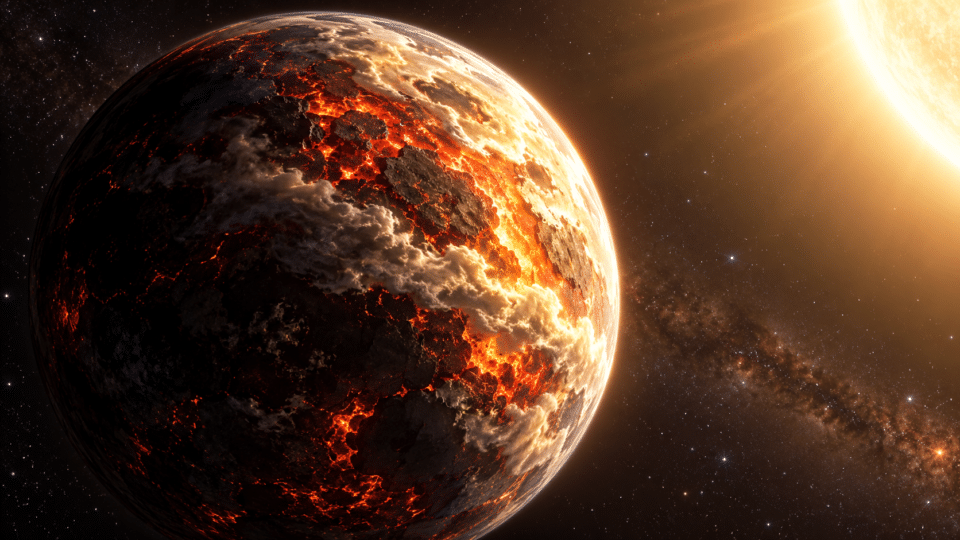
TOI-561 b’s atmosphere may be able to survive in an environment where a rocky planet is exposed to extreme stellar radiation. An analysis of James Webb observations, presented by the University of Birmingham on 27 October 2026, supports the presence of a reflective atmosphere. Silicate clouds are one possible explanation for how the planet handles the energy it receives from its star. The university’s announcement notes that the nature of the atmosphere has yet to be determined.
The story is compelling because it brings together two ideas that seem difficult to reconcile: a world of molten rock and a gaseous envelope that has not disappeared. The observations are not a photograph of clouds, however, and the existence of an atmosphere does not imply conditions suitable for life.
To understand what the data suggest about TOI-561 b’s atmosphere, it is necessary to follow the path of energy. How much light is reflected before it can heat the planet? How much heat moves to the dark side? And how can these things be inferred from roughly 280 light-years away?
A planet with a year shorter than 11 hours
TOI-561 b belongs to the category of planets with extremely short orbital periods. NASA described it in December 2025 as having a radius about 1.4 times that of Earth and completing an orbit in less than 11 hours. Its proximity to its star means that the same side permanently faces the source of light and heat.
The term “super-Earth” refers to properties such as size or mass, not to a landscape resembling our planet’s. In this case, the image of a somewhat larger Earth would be misleading: this is an extremely hot world associated with an ocean of magma.
Rocks and gases behave differently when temperature and pressure change drastically. Comparisons with familiar objects should therefore be used with care. The word “cloud” describes particles in an atmosphere; it does not guarantee liquid water, rain or an Earth-like climate.
TOI-561 b’s atmosphere: what is new in the 2026 analysis
There had already been indications of a gaseous envelope. The new element in the analysis is the use of changing light throughout the orbit to constrain the behaviour of the entire planet. The team worked with 37 hours of continuous observations, covering nearly four revolutions around the star. The paper by Samuel Boucher and colleagues explains the method.
The chronology matters. NASA presented the first atmospheric findings in December 2025, based on Webb observations from May 2024. The preprint of the orbital analysis became public in August 2026, and Birmingham’s announcement appeared in October. The arXiv version history makes it possible to check the dates. This was not a planet discovered on 27 October.
One set of observations can produce several papers because the questions and analyses differ. At first, researchers can assess the signal emitted by the dayside. They can then use the full observation span to investigate how the emission changes as other regions of the planet come into view.
How to observe a planet without photographing its clouds
In such a system, the star dominates the observed light. Astronomers track very small changes in the combined signal. When the planet passes behind the star, its contribution is temporarily hidden. Comparing the periods before, during and after this event helps isolate the planet’s emission.
Over the course of the orbit, observers see different proportions of the illuminated and dark hemispheres. The graph of this variation is called a phase curve. NASA’s explanation of this technique shows how the temperature distribution can be investigated without an image that resolves the surface in detail.
The distinction between a map and a photograph is essential. A map inferred from data depends on a model and its assumptions. It can be highly informative, but it must be accompanied by uncertainties. Researchers test whether other combinations of properties could produce a similar signal.
What the NIRSpec spectrograph adds
The observations were made with NIRSpec, an instrument that separates light into wavelengths. The European Space Agency explains that spectroscopy can provide information on temperature and composition. For this analysis, the researchers studied emission in the region of approximately 3–5 micrometres.
A single brightness value leaves many possible explanations. A spectrum offers more points of comparison because materials do not absorb and emit identically at every wavelength. But more data do not mean automatic identification: instrument sensitivity, noise and the star’s contribution must also be assessed.
For additional background, see The invisible UV-light-activated tattoo: how PhotoTat works and its potential medical applications, an article that examines an aspect directly related to this subject.
The same ability to extract information from light underpins very different Webb results. InfoBuz has covered an analysis of a possible supernova in the early Universe and the identification of the host galaxy of a fast radio burst. The questions are distinct, and the type of observation must be specified in each case.
Heat can be missing for two different reasons
Suppose a planet appears cooler on its dayside than a model of dark, airless rock would predict. One possibility is that it absorbs energy and transports some of it to the nightside. Another is that it reflects a large share of the light before it is absorbed. Both reduce local heating, but they leave different signatures.
This is where observing the full orbit becomes useful. If heat transport alone explained the difference, the nightside should emit accordingly. In the team’s interpretation, the nightside signal is not sufficient to support that mechanism on its own. High reflectivity becomes an important part of the explanation.
Birmingham summarises the result as an estimate of around three-quarters of the starlight being reflected. This is a property inferred from the energy-balance analysis and models, not a percentage read directly from a photograph. The researchers’ explanation also describes the transport of some heat between the hemispheres.
TOI-561 b’s atmosphere and the silicate-cloud hypothesis
Silicates are materials familiar from the composition of rocks. Under the conditions modelled for this world, researchers are investigating whether particles such as silicon dioxide and magnesium silicate could form reflective clouds. The simulations presented in the study identify regions where such particles could exist.
This hypothesis must be kept separate from measurement. The telescope provides light, and researchers test which atmosphere could produce the signal. The fact that a particular model can reproduce it is evidence in its favour. By itself, it does not amount to the identification of every proposed material.
| Element of the result | What it supports | What remains open |
|---|---|---|
| Changes in light over the orbit | Constraints on emission from both hemispheres. | The precise interpretation of some differences between detectors. |
| Energy balance | High reflectivity is important in the model. | The exact value and its dependence on assumptions. |
| Cloud simulations | Silicates are plausible candidates. | The actual composition and distribution of clouds. |
| Evidence of an atmosphere | The planet appears more complex than an exposed rock. | The composition of the gases and how they evolve over time. |
Where the gases might come from
An atmosphere subjected to intense radiation raises a question about the balance between loss and replenishment. In the scenario discussed by the researchers, the molten interior can exchange volatile substances with the atmosphere. Gases may be released, and some may return to the interior. NASA’s presentation of the initial findings describes this possible connection.
In this scenario, TOI-561 b’s atmosphere would be part of an evolving system. The atmosphere seen at any given time would not necessarily be the envelope preserved intact since formation. Reconstructing its history requires models of the interior, initial conditions and the loss of gases into space.
The questions surrounding TOI-561 b’s atmosphere explain the scientific interest, but they do not yet establish a single mechanism. Several planetary histories could lead to similar properties today. The next step is to narrow down those possibilities through further observations.
What needs to be checked before drawing a firmer conclusion
The study discusses differences between the results from the two detectors, as well as the possibility of residual contributions from the star or the instrument. The authors propose observations at longer wavelengths, including with MIRI, for independent checks. The section on limitations and future observations explains why.
An independent check is valuable precisely because it uses different sensitivities and different sources of noise. If the same interpretation withstands different tests, confidence increases. If discrepancies emerge, they may point either to a property of the planet or to an assumption that needs improvement.
Frequently asked questions about TOI-561 b
Have the planet’s clouds been photographed?
No. Their existence is a hypothesis tested through models based on light and energy balance. Images showing the planet as a globe with clouds are artists’ interpretations, not photographs of its surface.
Does an atmosphere mean the planet could be habitable?
No. The presence of gases does not establish suitable temperatures, liquid water or other conditions needed for known life. TOI-561 b is described as an extremely hot world with molten rock.
Is this the first evidence concerning TOI-561 b’s atmosphere?
No. Findings were presented in 2025. The analysis discussed in 2026 uses observations throughout the orbits to better understand reflectivity and the distribution of heat.
What observation could clarify the situation further?
Measurements at other wavelengths, with an independent check of dayside and nightside emission. They could help distinguish atmospheric compositions and assess instrumental effects.
Why this world is worth watching
TOI-561 b’s atmosphere offers a test of how rocky planets are understood under extreme conditions. The question is which processes can preserve or replenish a gaseous envelope. Reflective clouds are a promising hypothesis; the next observations will need to show how well it holds up.
Sources and further reading
- University of Birmingham: Shiny lava planet challenges astronomers’ expectations — 27 October 2026
- Boucher and colleagues: A Highly Reflective Atmosphere on the Lava World TOI-561b — preprint revised on 28 August 2026; accepted for The Astronomical Journal
- NASA: Webb Detects Thick Atmosphere Around Broiling Lava World — 11 December 2025
- NASA: Diagram of an Exoplanet Phase Curve — 17 November 2021
- ESA/Webb: the NIRSpec instrument — accessed 28 October 2026
Representative image: AI-generated editorial illustration for InfoBuz.


Discuția cititorilor
Ai o opinie sau o întrebare despre acest articol? Spune-ne ce crezi.
Fii primul care deschide discuția.
Te rugăm să păstrezi un limbaj civilizat și să discuți la subiect. Comentariile spam sunt filtrate automat.