
How do you negotiate the price of a used car using the faults you find? Not by simply asking the seller to lower the price, but by setting out a clear list of problems, estimated costs and risks that you will have to take on immediately after purchase. Good negotiation does not mean inventing faults; it means turning every genuine issue into a financial argument.
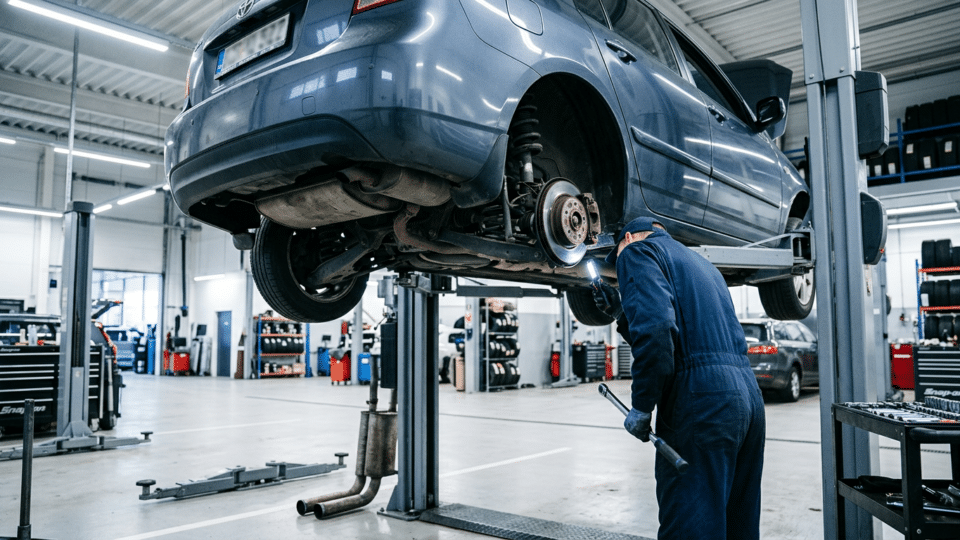
In 2026, a thorough pre-purchase inspection should include the VIN history, RAR Auto-Pass, diagnostic testing, an underbody inspection on a lift, a test drive and document checks. Romania’s vehicle authority, Registrul Auto Român (RAR), also recommends authenticity certification before payment for vehicles already registered in Romania. RAR recommendations; RAR Auto-Pass information.
How to negotiate a used car price: the basic rule
Do not negotiate on instinct. Make a list of:
- the fault identified;
- the likely cost of parts;
- labour;
- the risk that the problem is more serious;
- how urgently it needs to be repaired;
- whether it affects safety or only comfort.
Your offer should begin with the asking price, less the real costs, and less an allowance for risks that the seller will no longer bear after the sale.
1. Worn tyres
Tyres are among the simplest negotiating points because their prices are easy to check.
If the car has four tyres close to the wear limit or that are very old, the issue is not whether they might last another season. It is the real cost of a new set.
In the same context, see Modern headlights: Halogen vs Xenon vs LED vs Matrix LED – which technology provides the best light?, which sets out further relevant information.
On a car with large wheels, the difference can amount to several thousand lei.
2. Brake discs and pads
Brakes are an immediate expense and affect safety.
If the discs have a pronounced lip, cause vibration or are below the thickness limit, negotiate on the full cost of:
- discs;
- pads;
- sensors;
- labour;
- and, where applicable, seized calipers.
Autovit explicitly recommends using problems with brakes and shock absorbers as genuine negotiating arguments. Autovit’s inspection guide.
3. Timing system with no proof of replacement
If the seller says it has been replaced but there is no invoice, label or service record, treat the timing system as an unknown.
On belt-driven engines, the cost of a complete kit with a water pump can be significant.
On chain-driven engines, if there are noises or no maintenance history, the risk may be greater still.
4. DSG or automatic-transmission oil with no history
For an automatic transmission, the lack of proof of servicing is a serious argument.
You are not negotiating over only an oil change, but over the cost of a full service:
- the correct oil;
- filter;
- seals;
- labour;
- diagnostic testing;
- and, potentially, adaptations.
If there are also symptoms such as jolting, a delay when selecting Drive or Reverse, or slipping, the matter moves beyond maintenance and into the risk of a major repair.
5. Clutch and flywheel
On a manual or DSG-equipped car, vibration, noises and slipping can mean high costs.
A clutch-and-flywheel kit can entirely change the economics of a purchase.
Do not accept the argument that “they all do that” without having it checked.
6. Suspension: arms, bushings and shock absorbers
Play in joints, leaking shock absorbers and cracked bushings are faults that can be readily demonstrated on a lift.
The negotiation should cover the assembly, not only the visibly faulty part.
If one control arm has play, ask the mechanic whether the rest of that axle has similar wear.
7. Oil and coolant leaks
An oil stain is not a diagnosis. Its source needs to be established.
It could come from:
- a valve-cover gasket;
- an oil seal;
- the oil pan;
- the turbocharger;
- the oil cooler;
- the gearbox;
- the power steering system.
The difference in cost can be enormous.
Autovit recommends an inspection on a lift specifically to identify hidden leaks and structural problems. Autovit’s inspection guide.
8. Thermostat and temperature problems
If the engine does not reach normal operating temperature, or the temperature fluctuates, negotiate only after a clear diagnosis.
A thermostat may be inexpensive, but a cooling-system problem may also involve the water pump, radiator, EGR cooler or other components.
9. DPF and EGR
On a diesel car, DPF readings should be checked through diagnostic testing.
What matters includes:
- soot mass;
- calculated ash content;
- differential pressure;
- the frequency of regenerations;
- temperatures;
- stored fault codes.
A DPF nearing the end of its service life may justify a substantial reduction.
10. Turbocharger
Oil in the intake, excessive whistling, loss of power or incorrect boost pressure can point to a problem.
Do not negotiate the price of a turbocharger based on sound alone. Confirm the issue through diagnostic testing and inspection.
11. Non-functioning air conditioning
“It just needs refrigerant” is one of the most common explanations.
If it only needed refrigerant, why has it not been recharged?
The problem could be with the:
- condenser;
- compressor;
- sensor;
- valve;
- a leak in the system;
- climate-control module.
12. Xenon, LED or adaptive headlights
Modern headlights can be expensive.
Check for:
- condensation;
- clouded lenses;
- AFS;
- levelling;
- ballasts;
- LED modules;
- fault codes in diagnostic testing.
A pair of premium headlights may justify serious negotiation if they have problems.
13. Cracked or chipped windscreen
On modern cars, a windscreen is not just glass.
It may include:
- an ADAS camera;
- a rain sensor;
- heating;
- a head-up display;
- calibration after fitting.
The full cost needs to be calculated.
14. Sensors and warning lights
A warning light on the dashboard should not be ignored.
Even if the seller says it is “only a sensor”, diagnostic testing must be carried out before the final negotiation.
An ABS warning light may mean an inexpensive sensor or an expensive module.
15. Battery and alternator
On modern cars, an AGM or EFB battery can be a significant expense.
Test:
- resting voltage;
- CCA;
- alternator charging;
- the start-stop system;
- battery-management fault codes.
16. Rust
Cosmetic rust is not the same as structural rust.
Rust on:
- structural sills;
- chassis rails;
- mounting points;
- the subframe;
may be a reason to walk away, rather than merely negotiate.
17. Paint-shade differences and repainting
A repainted panel does not automatically mean a serious accident.
But the following can point to more substantial repairs:
- differences in paint shade;
- overspray;
- disturbed bolts;
- poor panel alignment;
- thick body filler.
18. Paint thickness
A paint-thickness gauge can help, but its readings should not be interpreted in isolation.
A wing repainted after a scratch is very different from a chassis rail repaired after an impact.
19. Excessive interior wear relative to the mileage
The steering wheel, driver’s seat, pedals and buttons may suggest more wear than the displayed mileage would imply.
They are not conclusive evidence, but they should be compared with the official history.
20. RAR Auto-Pass
RAR Auto-Pass officially costs 42 lei and is issued exclusively by Registrul Auto Român. The document includes verifiable information about the vehicle’s history, with particular emphasis on mileage. RAR Auto-Pass: official information and fee.
Before negotiating, check whether the Auto-Pass data are consistent with what the seller says.
21. Vehicle Identity Card and authenticity
RAR recommends that imported used vehicles have the necessary documents before payment. For a car already registered in Romania, it recommends authenticity certification.
RAR also stresses that used vehicles offered for sale must have a Vehicle Identity Card (CIV), and that the buyer should check that the documents match. RAR recommendations for buying a used vehicle.
22. Refusal of an inspection at a workshop
This is one of the biggest warning signs.
If the seller refuses:
- an inspection on a lift;
- diagnostic testing;
- a test drive;
- a VIN check;
then the issue is no longer negotiation, but trust.
Autovit explicitly recommends reconsidering the purchase if the seller refuses an independent inspection. Autovit’s inspection guide.
How to turn faults into an offer
Suppose the car costs €10,000.
You have found:
| Problem | Estimated cost |
|---|---|
| Tyres | €600 |
| Front and rear brakes | €500 |
| DSG service | €300 |
| Timing system with no proof of replacement | €500 |
| Headlight with condensation | €300 |
The total is €2,200.
That does not automatically mean you should offer €7,800. Some work is routine maintenance and may already be reflected in the price.
But it gives you a factual basis for an offer of, for example, €8,500–€9,000, depending on the market and how urgently the problems need to be addressed.
Do not deduct 100% for every fault
If the tyres are halfway through their usable life, do not deduct the cost of a full new set.
If the timing system has a documented 40,000 km remaining, do not treat it as though it needs to be changed tomorrow.
Credible negotiation is proportionate.
Cosmetic defects are negotiated differently
Scratches, kerbed wheels and small parking dents are useful negotiating points, but they have a lower priority than:
- brakes;
- the timing system;
- the gearbox;
- structural rust;
- airbags;
- the DPF;
- leaks.
Use real service estimates
The strongest wording is:
“The workshop quoted me 3,200 lei for the brakes and 2,500 lei for the timing system. I like the car, but these are immediate costs. I can offer X.”
That is much more effective than asking the seller to reduce the price by €1,000.
Do not show all your arguments at once
Set out the important problems, then make the offer.
If you begin with 20 minor faults, the discussion can become defensive and the seller may feel that you are simply trying to tear the car apart.
Negotiate after the inspection, not before
An initial discussion of the price can be indicative.
The final offer should be made after:
- the test drive;
- diagnostic testing;
- the lift inspection;
- the history check;
- document checks.
Do not get attached to the car
The biggest mistake is deciding that you are going to buy it before the inspection.
Once you become emotionally attached, you lose your negotiating advantage.
When to walk away rather than negotiate
Some issues are not worth turning into a discount:
- a suspicious VIN;
- unclear documents;
- inconsistent mileage;
- missing airbags;
- severe structural rust;
- poorly carried out major repairs;
- refusal of an independent inspection.
A high-risk car does not become a good purchase simply because it is cheap.
The final negotiating formula
An effective approach is to:
- confirm that you like the car;
- set out the three to five main problems;
- show the costs;
- make a clear offer;
- stay quiet and wait for the response;
- avoid negotiating against your own offer.
Example dialogue
“I like the car and I am ready to buy it. The inspection found issues with the tyres, brakes and transmission service, and there is no documentation for the timing system. The costs are around 7,000 lei. At the asking price, the numbers do not work for me, but I can complete the purchase today at €8,700.”
It is brief, calm and justified.
For a quick check before you get to the negotiation stage, see InfoBuz’s guide to the 15-minute filter that tells you whether a used car is worth taking to a workshop.
Check the market before making an offer
Compare:
- year;
- engine;
- gearbox;
- mileage;
- specification;
- history;
- condition.
Autovit notes that price differences can arise from history, specification and technical condition, and recommends comparing similar listings before negotiating. Autovit’s inspection guide.
Conclusion
How do you negotiate the price of a used car using the faults you find? By translating problems into real costs, rather than impressions.
Tyres, brakes, the timing system, gearbox, suspension and headlights can justify a lower price. Structural rust, unclear documents and a questionable history can justify walking away altogether.
Good negotiation is not aggressive. It is documented.
Frequently asked questions
How much should you deduct for faults?
There is no universal percentage. Calculate the real costs and adjust according to the urgency of the repair and how well the price is already positioned against the market.
Can I negotiate over tyres and brakes?
Yes. They are real costs, easy to estimate, and directly affect safety and your budget immediately after purchase.
Is RAR Auto-Pass worth it?
Yes. It officially costs 42 lei and can provide useful information on a vehicle’s history and mileage. RAR Auto-Pass: official information and fee.
What if the seller refuses a workshop inspection?
It is a warning sign. Autovit recommends reconsidering the purchase in this situation. Autovit’s inspection guide.
What is the strongest negotiating argument?
A genuine workshop estimate or a problem confirmed through diagnostic testing and inspection.
Sources: RAR – recommendations for buying a used vehicle; RAR Auto-Pass – official information and fee; Autovit – guide to checking a car at a viewing.


Discuția cititorilor
Ai o opinie sau o întrebare despre acest articol? Spune-ne ce crezi.
Fii primul care deschide discuția.
Te rugăm să păstrezi un limbaj civilizat și să discuți la subiect. Comentariile spam sunt filtrate automat.