
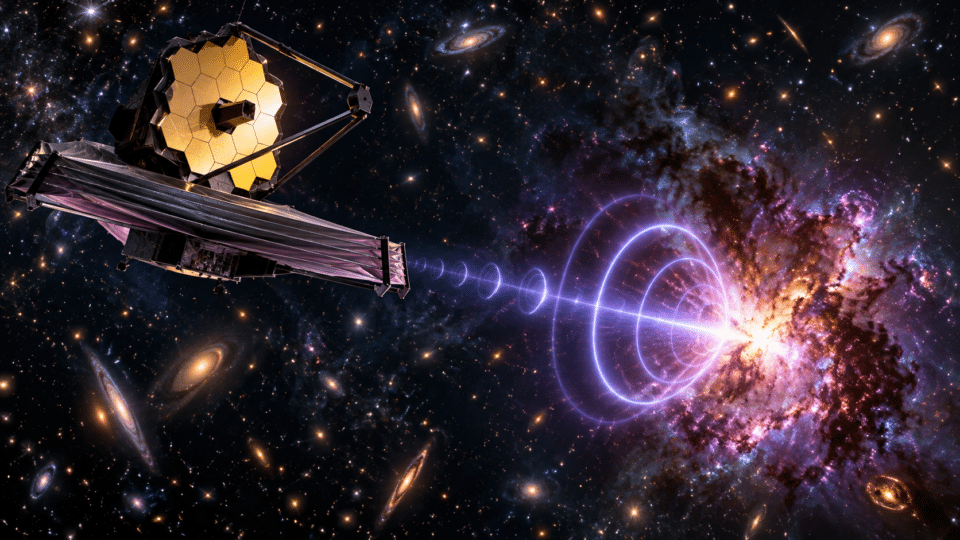
The James Webb Space Telescope has identified the host galaxy of FRB 20240304B, a radio pulse detected at a spectroscopic redshift of 2.148. In the precise terms of the record, it was the most distant fast radio burst (FRB) to have been localised and associated with a known host galaxy when the results were published. The galaxy’s light began travelling towards us more than 10.7 billion years ago, when the Universe was about three billion years old.
For more on astronomy, see James Webb traced the most distant known radio burst, which provides complementary details on the subject.
The discovery does not mean that Webb “saw” the radio pulse, nor that astronomers imaged the compact object that produced it. The MeerKAT radio telescope detected the burst, which lasted a few milliseconds, on 4 March 2024 and determined its position in the sky. Webb took the next step: it observed a galaxy consistent with that position and measured its spectrum. NASA’s official account of the Webb observations clearly distinguishes these two roles.
FRB 20240304B’s host galaxy is both the record and the new question
An FRB is an extremely brief outburst of radio waves. It can last only milliseconds, yet release an enormous amount of radio energy in that tiny interval. Most FRBs are detected just once, although some sources repeat. The physical nature of all such events has not yet been established.
In the case of FRB 20240304B, the team associated the radio position with a very faint galaxy, described in the technical paper as small, actively forming stars and metal-poor relative to the Sun. NIRCam observations helped detect the galaxy, while NIRSpec measured its redshift of 2.148. The study, published in Science, describes the result as an FRB observed only about three billion years after the Big Bang.
Redshift is not simply a label for “distance” in the way distance is represented on a map. It measures how far light has shifted to longer wavelengths as the Universe expanded. For such a remote object, it is therefore more accurate to state both when its light was emitted and that any interpretation of its distance in light-years depends on the cosmological model used.
| Stage | Instrument | What the observation supports |
|---|---|---|
| Detection of the pulse | MeerTRAP on MeerKAT | An FRB was recorded on 4 March 2024. |
| Localisation in the sky | MeerKAT | The radio position narrowed the area in which the host could be sought. |
| Identification of the galaxy | Webb / NIRCam | A faint galaxy was observed at a consistent position. |
| Measurement of the cosmic epoch | Webb / NIRSpec | The galaxy’s spectroscopic redshift is z = 2.148. |
| Exact origin of the FRB | No instrument, so far | A young magnetar is a favoured explanation, not a direct identification. |
Why it matters that the host is small and star-forming
A galaxy with active star formation produces massive stars that rapidly exhaust their fuel and can leave behind compact objects, including neutron stars. A magnetar is a type of neutron star with an exceptionally powerful magnetic field. Magnetars are leading candidates for at least some FRBs because a magnetar in the Milky Way produced a radio burst in 2020 resembling extragalactic events.
The host galaxy’s young environment is therefore consistent with the idea of a relatively recently formed magnetar. It is not, however, direct proof that a magnetar produced FRB 20240304B. The signal was too brief, and the individual compact source was not observed. Other formation channels, including some involving neutron-star systems, are not ruled out by a single galactic association.
This is why careful wording matters: the galaxy’s properties favour progenitors with a short interval between star formation and the FRB, but do not conclusively identify the progenitor.
A dwarf galaxy challenges the statistical picture of FRBs
The most interesting aspect of the case is not distance alone. In an independent study published in Nature in 2024, researchers analysed 30 FRB host galaxies localised by DSA-110 and reported an underrepresentation of low-mass galaxies; in that sample, FRBs appeared to occur preferentially in massive, star-forming galaxies. The finding on a preference for massive star-forming galaxies is not overturned by FRB 20240304B.
One extreme case cannot by itself rewrite a statistical trend. But it can expose its limits. At high redshift, a dwarf galaxy is faint and difficult to detect or characterise from ground-based observations. Webb, which observes in the infrared and has the sensitivity needed for very distant objects, may add hosts to the sample that were previously invisible or insufficiently characterised.
There are at least three possible, non-exclusive explanations:
- FRB 20240304B may be a genuine exception in a population dominated by massive hosts;
- the host population may evolve with cosmic epoch, and the Universe at a redshift of around 2 is not equivalent to the local Universe;
- available samples may be affected by selection biases: bright, massive or nearby galaxies are easier to find.
The final possibility has methodological support. Another Nature study warned that source selection can distort conclusions about the FRB population. The analysis of selection bias in the discovery of FRB sources does not say that all small hosts have been missed, but that the distribution of observed hosts should not automatically be mistaken for the full distribution of existing hosts.
The appropriate comparison is with FRB 20220610A
Before FRB 20240304B, the benchmark for a very distant FRB that had been localised and linked to a galaxy was FRB 20220610A, at a redshift of about 1. In that case, the ASKAP radio telescope detected the event and the Very Large Telescope helped associate it with a galaxy about eight billion light-years away. ESO documented the previous record and the association with FRB 20220610A.
The new case’s redshift of 2.148 is more than twice that benchmark. This makes it possible to study FRBs in an era close to the cosmic peak of star formation, when galaxies were growing and forming stars at a different rate from that seen in today’s cosmic neighbourhood.
A radio pulse can also reveal something about matter between galaxies
FRBs are useful for more than the question of what object produces them. Radio waves at different frequencies do not arrive simultaneously after travelling through the diffuse plasma between galaxies. The difference in arrival time, called the dispersion measure, carries information about the electrons encountered by the signal along its path.
In principle, this turns an FRB into a probe of ionised baryons — ordinary matter made up of protons, neutrons and electrons — in intergalactic space. It is not a direct map of dark matter, and a single FRB cannot perfectly separate the contribution of the Milky Way, the host galaxy, the source environment and foreground structures. For FRB 20240304B, interpretation is complicated in part by structures along the line of sight.
The value of such a distant event lies precisely in the combination of these two kinds of information: the host provides context for the source, while the radio pulse supplies data on the material it travelled through before reaching Earth.
What future observations may clarify
Further FRBs localised at comparable redshifts will matter more than simply extending a record. Astronomers need a sufficiently large sample of faint, distant hosts to determine whether FRB 20240304B is an anomaly, evidence of a more diverse progenitor population, or the effect of an observational window that Webb has only just opened.
For now, the robust conclusion is narrower and more useful: MeerKAT localised a radio pulse from the early Universe, and Webb linked that pulse to a small, active host galaxy. The link constrains origin scenarios, but does not yet solve the mystery of all fast radio bursts.
Frequently asked questions
What is a fast radio burst (FRB)?
An FRB is a very brief, intense pulse of radio waves, usually observed from distant galaxies. It can last only a few milliseconds.
Did James Webb observe the FRB 20240304B radio burst?
No. MeerKAT detected and localised the radio pulse. Webb observed the galaxy consistent with its position and measured that galaxy’s redshift.
Has it been confirmed that a magnetar produced FRB 20240304B?
No. The host galaxy’s properties are consistent with a young magnetar, but the compact object that produced the pulse was not observed directly.
Why are FRB host galaxies important?
They show the environment in which fast radio bursts occur and can constrain hypotheses about the objects that produce them. They also make it possible to interpret more accurately the plasma through which the signal travelled.
Sources consulted
- A fast radio burst at redshift 2, three billion years after the Big Bang — Science
- Webb Measures Distance to Farthest Fast Radio Burst, Suggesting Origin — NASA
- Astronomers detect most distant fast radio burst to date — ESO
- Preferential occurrence of fast radio bursts in massive star-forming galaxies — Nature
- Selection bias obfuscates the discovery of fast radio burst sources — Nature


Discuția cititorilor
Ai o opinie sau o întrebare despre acest articol? Spune-ne ce crezi.
Fii primul care deschide discuția.
Te rugăm să păstrezi un limbaj civilizat și să discuți la subiect. Comentariile spam sunt filtrate automat.