
Anton Pann connects Romania and Bulgaria through a life that crossed places, occupations and cultural traditions. Born in Sliven, in what is now Bulgaria, and established in the Romanian cultural sphere, he left behind books, songs and work as a printer that deserve to be considered together. That cultural meeting is at the centre of a symposium announced by the National Museum of Romanian Literature for 30 October 2026.
His story becomes more interesting once it moves beyond the formula of a name learned at school. A song may exist before it is printed. A proverb may circulate across several communities. A book may preserve a voice while changing its audience. In this world of transmission, the writer, performer and publisher take part in the same work.
Why Anton Pann is back in focus
The first edition of the symposium is scheduled for Friday, 30 October 2026, from 10:00, at the National Museum of Romanian Literature, 8 Nicolae Crețulescu Street, Bucharest. The organisers say researchers and cultural representatives from Romania and Bulgaria will take part. Partners include the Anton Pann Association for Culture and Tradition, the Ti si Sliven Association, and the Dr Simeon Tabakov Regional History Museum. The official programme explicitly frames the subject as a shared literary, musical and spiritual heritage.
The event offers a starting point for a question that remains relevant after it has ended: how is a culture formed through contact between people? For the public, the discussion may open a route into early music, the history of printing, and texts whose humour endures even when their vocabulary needs explanation.
From Sliven to Bucharest: a biography of landmarks and uncertainties
His birthplace was Sliven, then part of the Ottoman Empire. The precise year of his birth is uncertain. An article published by the Library of the Romanian Academy in the January 2024 issue of Tezaur shows that biographers have worked with conflicting testimonies and estimates. Descriptions such as “born at the end of the 18th century” are therefore more cautious than presenting one year as an established fact.
This uncertainty should be kept in proportion. It does not negate his work or prevent the study of his mature activity. It shows instead that a historical biography is built from documents of varying precision. A date stated on an overview page and a question debated by researchers do not always carry the same weight.
It is equally important not to project today’s borders and identities automatically onto the early 19th century. Saying where an author was born and the language in which he worked answers two distinct questions. The shared interest of Romanian and Bulgarian institutions is documented by the partnership announced for the symposium.
| Place | Relevant connection | What it helps us examine |
|---|---|---|
| Sliven | Birthplace | His geographical origins and local memory in Bulgaria. |
| Bucharest | His house, printing press and much of his mature activity | The relationship between writing, music, publishing and the public. |
| Brașov | Gheorghe Ucenescu and documents discussed in the history of the national anthem | The circulation of repertoires and the limits of attributing a melody. |
| Râmnicu Vâlcea | Memory of the events of 1848 | The distinction between commemoration, testimony and historical interpretation. |
This table is a reading map, not a complete itinerary of his life. For the latter two landmarks, the Mureșenilor House Museum presents documents and interpretations that need to be read together, rather than compressing the entire debate into a single sentence.
Anton Pann worked on the physical book, not only the text
Testimonies by Gheorghe Ucenescu, presented by National Museum of Romanian Literature curator Mădălina Șchiopu, show Pann selling copies of his books and correcting work coming off the presses. Ucenescu lived for a time with his teacher’s family after arriving from Brașov to study church music. The account has the value of close testimony, even if it does not provide a neutral view of every day.
The detail of the printing press changes the perspective on the author. Between an idea and a reader stood paper, type, proofreading, money and distribution. The person who selected and published a repertoire also helped determine how it would be preserved. A printed page could reach beyond the circle of people who had heard the song or story.
Seen this way, Pann’s activity resembles a network of mutually supportive trades. The teacher passes on a technique. The performer makes it heard. The publisher fixes it in a reproducible object. The writer gives it form for an audience. This perspective explains why a list of works alone says too little about the influence of a man of letters.
Povestea vorbii: how an old expression can remain alive
In the Bucharest house he bought in 1848, works including the second edition of Povestea vorbii, Nezdrăveniile lui Nastratin Hogea and O șezătoare la țară sau Călătoria lui Moș Albu were prepared, according to the memorial house’s presentation. Their titles suggest a closeness between conversation, storytelling and observation of social life.
A reading today can begin with a simple question: what makes a saying memorable? Sometimes it is rhythm. At other times, an unexpected image or a contradiction we immediately recognise. To appreciate an older text, it is worth following the human situation it constructs, then the words that make it work.
This can also be a useful family reading exercise: a short passage, an explanation of unfamiliar terms and a discussion of the situation described. The question, “Do we still recognise this behaviour?” may open up more than memorising a date. It is a way of approaching the text without claiming that the present-day experience is identical to that of two centuries ago.
Nastratin and heritage that travels between communities
The character Nastratin broadens the perspective. In 2022, UNESCO inscribed the tradition of telling Nasreddin anecdotes through a joint nomination by several states, from Türkiye to countries in the Caucasus and Central Asia. The organisation describes local versions of the name and stories, alongside shared functions: humour, social observation and transmission through speech or texts.
That inscription concerns the traditions nominated in that particular dossier; it is not a separate inscription of the Romanian work. Its relevance to reading Pann is different: a character may have an extensive life, and local adaptations deserve study without reducing them to a contest over ownership. For each story, its exact route must be demonstrated separately.
A comparable cultural mechanism can also be traced in the culinary traditions of Dobruja: circulation and adaptation can produce recognisably local forms while retaining links to a wider region.
Secular music and the memory of an era
Spitalul amorului sau cântătorul dorului brings together songs and poems associated with the sensibility of its time. The National Museum of Romanian Literature’s presentation highlights the collection’s ability to preserve a social and emotional repertoire. For a reader today, the volume can be approached both as literature and by listening to documented performances.
A melody conveys more than its text. The manner of performance, ornamentation, rhythm and audience all alter the experience of it. Two versions of the same song can therefore become a starting point for questions, without their differences automatically amounting to error.
Today, music-platform algorithms play a part in the circulation of repertoires. The comparison with printing in the past has limits, but it raises a shared question: who selects what reaches the public, and what forms survive once a fashion has passed?
Anton Pann and Romania’s national anthem: official attribution and what remains debated
In official communications, the music of Romania’s national anthem, “Deșteaptă-te, române!”, is attributed to Anton Pann, while the lyrics are attributed to Andrei Mureșanu. This is also the wording used in a Ministry of National Defence statement of 28 July 2026. The history of the melody, however, involves a more complex discussion than the ceremonial formula.
The Mureșenilor House Museum examines testimony from the Mureșanu family, Ucenescu’s account and the circulation of an earlier melody. Its material questions a simple attribution of composition and also discusses the location of the first performance. This is a documentary position that should be presented as such, without turning one hypothesis into a consensus that does not exist.
Here, the distinction matters between composing a melody, collecting it, publishing it, adapting it and performing it. These roles can overlap, but they are not proven by the same evidence. An official commemoration has its own history, while research into a song’s origins may leave questions open.
For a cultural article, retaining this distinction makes the author more interesting. The reader can see how research works: a document is identified, a claim is attributed, and the limits of the evidence remain visible.
How to discover him beyond a symposium
The memorial house in Bucharest is at 20 Anton Pann Street and offers a starting point for encountering the literature and music of the period. The museum’s page publishes seasonal opening hours and visiting conditions, which should be checked before travelling. The memorial house is at a different location from the 30 October symposium.
A meaningful exploration can combine three experiences: visiting a memorial space, reading an annotated passage and listening to a musical performance. Each answers a different question. The house provides material context, the page preserves the wording, and the performance sets in motion what notation alone can leave abstract.
Shared heritage becomes easier to understand through such concrete encounters. In Anton Pann’s case, the route between Sliven and the Romanian cultural sphere remains an invitation to examine connections: what is transmitted, who transforms it, and how it reaches a new audience across generations.
Frequently asked questions
Where was he born, and why do different years appear?
He was born in Sliven, in the Ottoman Empire, in what is now Bulgaria. His exact birth year is debated by biographers. Documentation from the Library of the Romanian Academy shows that conflicting testimonies exist, which is why a single date should not be presented as conclusively established.
Did he compose the music of Romania’s national anthem?
The official attribution of the music is to Pann, while the lyrics are by Andrei Mureșanu. Research into the melody’s history, however, includes competing hypotheses and testimonies presented by the Mureșenilor House Museum. The official formula and the analysis of the anthem’s origins should be distinguished.
Which books are suitable as an introduction?
Povestea vorbii, Nezdrăveniile lui Nastratin Hogea and Spitalul amorului sau cântătorul dorului offer different entry points: social observation, humorous storytelling and a musical repertoire. An annotated edition helps readers understand the language and context.
Where will the 30 October 2026 event take place?
The symposium begins at 10:00 at the National Museum of Romanian Literature, 8 Nicolae Crețulescu Street, Bucharest. This is the address in the official programme and is distinct from the memorial house. For any programme changes, the organiser’s announcement remains the reference point.
Sources and documentation
- National Museum of Romanian Literature — Cultural programme, 26 October–1 November 2026 — 26 October 2026.
- Library of the Romanian Academy — Tezaur, January 2024, pages 4–5 — January 2024.
- National Museum of Romanian Literature — Anton Pann Memorial House — accessed 28 October 2026.
- National Museum of Romanian Literature — Gheorghe Ucenescu’s testimonies — accessed 28 October 2026.
- National Museum of Romanian Literature — Spitalul amorului sau cântătorul dorului — accessed 28 October 2026.
- Ministry of National Defence — National Anthem Day — 28 July 2026.
- Mureșenilor House Museum — The story of the national anthem — 3 September 2013.
- UNESCO — Tradition of telling Nasreddin anecdotes — inscribed in 2022; accessed 28 October 2026.
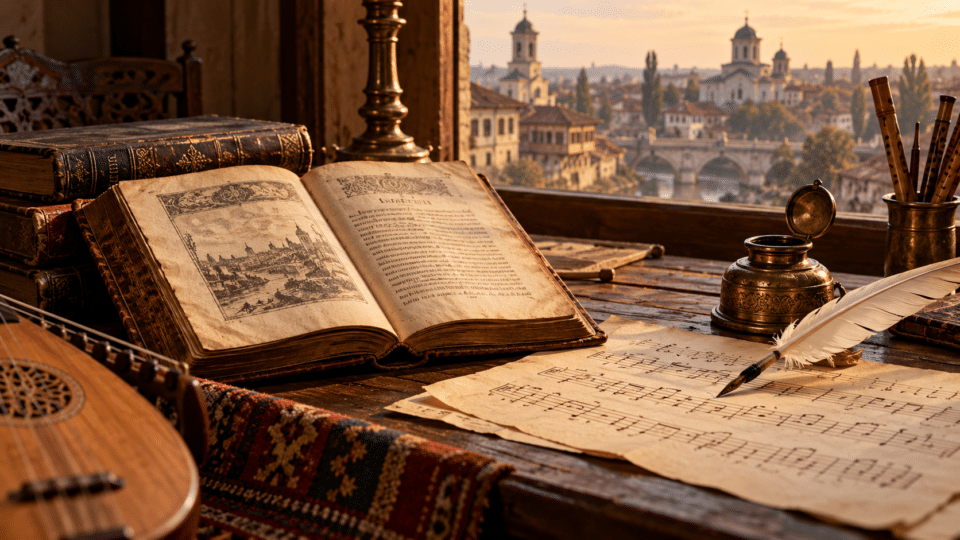
Featured image: AI-generated editorial illustration for InfoBuz.




Discuția cititorilor
Ai o opinie sau o întrebare despre acest articol? Spune-ne ce crezi.
Fii primul care deschide discuția.
Te rugăm să păstrezi un limbaj civilizat și să discuți la subiect. Comentariile spam sunt filtrate automat.