
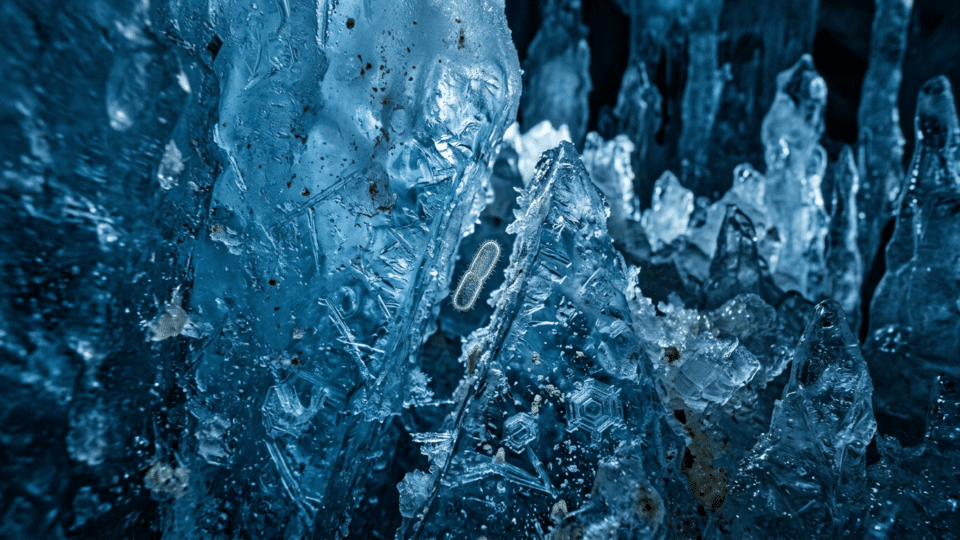
A bacterium isolated from an ice layer approximately 5,335 years old in Scărișoara Ice Cave resisted 10 of the 28 antibiotics tested under laboratory conditions. The same microorganism inhibited the growth of some of the bacteria used in another experiment. The findings are real and noteworthy, but they do not mean that Romania has discovered either a “superbug” that threatens people or a new antibiotic ready for use.
The strain is called Psychrobacter sp. SC65A.3. A study published on 17 February 2026 in Frontiers in Microbiology describes its isolation, genome sequencing and functional profiling. The research involves specialists from the Romanian Academy’s Institute of Biology Bucharest and draws attention to one of Romania’s most unusual natural archives: the layered ice of Scărișoara Ice Cave.
In brief: the bacterium from Scărișoara ice displayed an experimentally measured resistance profile, but its clinical relevance for people remains unclear. The researchers did not show that the strain causes disease, spreads in nature or transfers resistance genes to pathogenic bacteria. Nor did they identify a molecule that could be called a medicine.
The Scărișoara ice bacterium: the sample researchers examined
SC65A.3 was cultured from a sample collected at a depth of 1,706–1,716 centimetres in a 25.33-metre-long ice core. The authors assign an age of 5,335 ± 54 years to the layer from which the sample came. The bacterium was isolated at 4°C, then grown and analysed in the laboratory.
For additional context, see Cellular rejuvenation enters human trials: how close are we to turning back the biological clock?, an article that explores an aspect directly related to this subject.
An apparently subtle distinction matters here. The figure of around 5,335 years refers to the age of the ice layer, established through the chronology of the core; it is not proof that every cultured cell remained unchanged and active for five millennia. A bacterium isolated today from that layer is a strain recovered and cultured under modern laboratory conditions.
Scărișoara’s ice is nevertheless more than a natural freezer. An earlier study of the same core used 26 AMS radiocarbon dates and an age-depth model to construct a chronology of the deposit. The research showed that ice layers can preserve traces of microbial communities and environmental changes over very long periods. The 2019 study of the Scărișoara ice microbiome provides this context, but is not an independent replication of the experiments subsequently conducted on SC65A.3.
What “resistant to modern antibiotics” actually means
The authors tested the strain against 28 antibiotics from 17 classes and reported resistance to 10 compounds from eight classes: ceftazidime, cephalothin, ciprofloxacin, spectinomycin, rifampicin, trimethoprim, clindamycin, lincomycin, vancomycin and metronidazole.
This is a laboratory observation, not the outcome of an infection treated in a patient. The authors also note an important methodological limitation: there are no clinical breakpoints specific to the genus Psychrobacter. A breakpoint is the threshold used to interpret an inhibition zone or minimum inhibitory concentration as medically relevant susceptibility or resistance.
For classification, the team used thresholds and recommendations developed for other bacterial genera, including Acinetobacter, Moraxella catarrhalis and Pseudomonas, and, in some cases, Escherichia coli or Staphylococcus aureus, as well as the scientific literature. Such extrapolation can be useful when exploring a rare bacterium, but it limits the clinical conclusion.
EUCAST standards for interpreting susceptibility tests are designed for microorganism-antibiotic combinations and test conditions for which sufficient data exist. When a bacterium has no breakpoints of its own, the straightforward label “clinically resistant” should be used cautiously.
The experimental conditions also matter. SC65A.3 was incubated at 15°C for 48 hours on Mueller-Hinton agar, whereas the control strains, E. coli and S. aureus, were incubated at 37°C. For a cold-adapted bacterium, temperature, culture medium and the concentrations of certain ions can alter the response observed in testing.
| Claim | What the study supports | What it does not demonstrate |
|---|---|---|
| Resistance to 10 of 28 antibiotics | An experimental antibiotic susceptibility profile under the test conditions | A clinically validated antibiogram for human Psychrobacter infections |
| Resistance-associated genes | Potential mechanisms identified through genomic analysis | That every gene is active, produces its presumed effect or can be transferred to other bacteria |
| Inhibition of other bacteria | In vitro antimicrobial activity against some of the strains tested | The existence of a purified antibiotic that is safe and effective in people |
Why resistance can exist before modern medicine
Antibiotics used in hospitals are modern, but chemical competition between microorganisms is much older. Bacteria and fungi produce substances that help them compete for food and space, while other microorganisms may evolve defence mechanisms against them. Finding resistance mechanisms in an old environment is therefore not, in itself, a paradox.
The present public-health issue is different: resistance genes can be selected and amplified through antimicrobial use, and some can reach pathogenic bacteria circulating among people, animals and the environment. The World Health Organization treats antimicrobial resistance as a major threat to the treatment of infections. The Scărișoara case does not demonstrate such transfer and should not be confused with the phenomenon seen in hospitals.
The age of the ice alone cannot establish when each gene or mutation detected in the strain emerged. It indicates the age of the layer in which the sample was found. Additional comparative analyses would be required to reconstruct the precise evolutionary history of a resistance determinant.
The genome provides clues, not a verdict
The strain’s circular genome has 3,046,103 base pairs, with 2,602 coding sequences, 15 rRNA genes, 50 tRNA genes and one CRISPR locus. Genomic analysis placed the isolate in the genus Psychrobacter, close to the P. cryohalolentis group. The accurate designation remains Psychrobacter sp. SC65A.3, rather than the name of a formally confirmed new species.
An important difference between the figures arises here. The study reports two resistance genes detected in the genome representation through the CARD database, while also discussing more than 100 “resistance-associated” genes identified through functional annotation. The two figures cannot be added together and do not have the same meaning.
A resistance-associated gene may have a sequence or presumed function compatible with a defence mechanism, such as an efflux pump or an enzyme. Establishing that the gene directly explains the observed resistance generally requires expression testing, gene knockout or introduction experiments, and assessment of the effect under controlled conditions.
The authors discuss candidate genes including ampC, gyrA, gyrB, parC, parE, dfrA, rpoB, tetA, tetC and mcr-1. This inventory is a research map, not proof that all the genes are expressed, cause the observed phenotype or can reach a pathogen. For example, the study did not test SC65A.3’s susceptibility to colistin, so the mere mention of a candidate gene associated with this resistance cannot be turned into a conclusion about colistin.
It inhibited some bacteria, but not all
In a separate test, the researchers assessed the strain’s antimicrobial activity against two ATCC strains and 20 clinical strains. An inhibitory effect was observed in 14 of the 22 strains included. The bacteria for which inhibition occurred included some isolates of Enterococcus faecium, Enterobacter cloacae, Pseudomonas aeruginosa and Klebsiella pneumoniae.
The result has clear limits, however. Some MRSA strains were not inhibited, and the Acinetobacter baumannii strains included in the experiment showed no inhibition. Saying that the bacterium “fights superbugs” would excessively compress a mixed result obtained in a laboratory test.
For a genuine antibiotic candidate, the next steps would include isolating and identifying the active molecule, measuring the minimum inhibitory concentration, confirming the mechanism of action, conducting toxicity tests in cells and model organisms, stability studies and, much later, clinical assessments. None of these stages is equivalent to simply observing a zone of inhibition on a culture medium.
A nearer application: enzymes that work in the cold
For now, the most concrete biotechnological direction associated with SC65A.3 is not an anti-infective treatment. It is enzymology. The bacterium displayed activities including lipase, esterase and alkaline phosphatase, characteristics of interest for processes carried out at low temperatures.
A separate paper, published in 2024, characterised a recombinant lipase derived from this strain, called PSL2. The enzyme was tested as a biocatalyst for the acylation of silybin, a compound from milk thistle. The study of the cold-active PSL2 lipase does not propose a new medicine, but shows an experimental use of an enzyme in biocatalysis.
Enzymes active at moderate or low temperatures can be useful in industry and research because certain reactions become more selective and energy use may be reduced. Here too, a promising result remains a long way from a commercial process, requiring technical optimisation, independent validation and economic assessment.
What to watch next
The study raises a relevant microbiological question: how is antimicrobial resistance preserved and expressed in a cold, isolated and ancient ecosystem? Firmer answers would benefit from replication of the antibiogram in an independent laboratory, testing with quantitative methods, culture conditions adapted to a psychrophilic bacterium, and experiments linking candidate genes to specific biological effects.
For readers, the cautious conclusion is straightforward. SC65A.3 is a valuable scientific signal from a Romanian natural archive, not an epidemiological alert. It may help research into natural resistance, antimicrobial compounds and cold-active enzymes. But many steps still separate a profile observed on a laboratory plate from a health risk or a medicine.
Research method: this article synthesises the primary study on SC65A.3, earlier work on the ice and microbiome of Scărișoara Ice Cave, antimicrobial-susceptibility interpretation standards, and a separate paper on a lipase derived from the strain. Claims about medical applications are limited to results demonstrated in vitro.
Frequently asked questions
Is the Psychrobacter SC65A.3 bacterium from Scărișoara dangerous to people?
The study presents no evidence that SC65A.3 causes infections in people, spreads outside the laboratory or transfers resistance genes to pathogens. Some species in the genus Psychrobacter have rarely been reported in clinical settings, but this does not allow risk to be automatically assigned to this strain.
Why can a bacterium from old ice be resistant to modern antibiotics?
Defence mechanisms against antimicrobial molecules have existed in nature for a long time because microorganisms compete with one another and produce antimicrobial compounds. The age of the ice layer does not, however, show when each gene or mutation in the isolated bacterium emerged.
Was a new antibiotic discovered at Scărișoara?
No. The study observed in vitro inhibition of some of the bacteria tested, but it did not identify and purify an active molecule or establish its dose, toxicity or effectiveness in people. For now, the strain’s cold-active enzymes represent a more concrete biotechnological avenue.
What does the absence of breakpoints for Psychrobacter mean?
Breakpoints are thresholds used to interpret antibiotic-susceptibility tests for clinical purposes. Without breakpoints specific to Psychrobacter, the susceptible/resistant classification was based on criteria for other bacteria and should be read as experimental guidance, not a definitive clinical verdict.
Sources consulted
- First genome sequence and functional profiling of Psychrobacter SC65A.3 preserved in 5,000-year-old cave ice: insights into ancient resistome, antimicrobial potential, and enzymatic activities
- Total and Potentially Active Bacterial Communities Entrapped in a Late Glacial Through Holocene Ice Core From Scarisoara Ice Cave, Romania
- Cold-Active Lipase from the Ice Cave Psychrobacter SC65A.3 Strain, a Promising Biocatalyst for Silybin Acylation
- EUCAST Clinical Breakpoint Tables and interpretation
- Antimicrobial resistance — World Health Organization


Discuția cititorilor
Ai o opinie sau o întrebare despre acest articol? Spune-ne ce crezi.
Fii primul care deschide discuția.
Te rugăm să păstrezi un limbaj civilizat și să discuți la subiect. Comentariile spam sunt filtrate automat.