
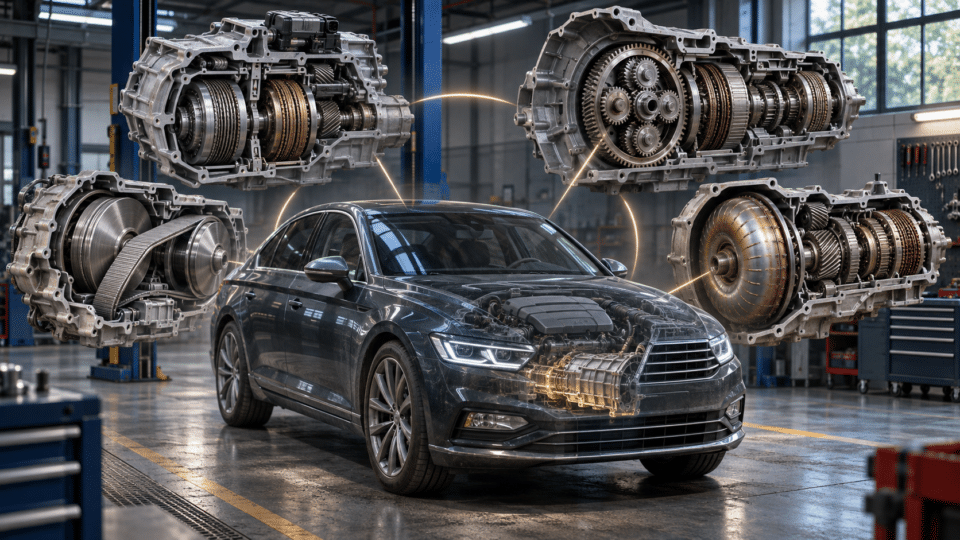
An automatic transmission at high mileage needs to be assessed differently from one that is nearly new, particularly after 150,000 km. At this point, its service history, operating temperature, driving style and transmission type matter more than the badge on the casing. DSG, ZF, CVT and conventional torque-converter automatics can all cover 200,000–300,000 km without difficulty, but only if the correct oil, filter and service procedure are used.
The “lifetime oil” myth has done considerable harm. ZF, one of the largest automatic-transmission manufacturers, also recommends regular oil changes according to the transmission and operating conditions; for many 8HP units, it indicates a change at around 150,000 km, or earlier under demanding use.
High-mileage automatic transmissions: what to check first
Before any oil change, it is worth checking:
- the service history;
- the exact transmission code;
- the fluid specification;
- the level and any leaks;
- adaptations and fault codes in the transmission control module;
- oil temperature;
- symptoms when cold and when warm.
Two identical transmissions can reach 150,000 km in very different condition. One may have been used largely on motorways, while another has spent its life in city traffic, with thousands of stop-start cycles.
DSG and other dual-clutch transmissions
DSG is the Volkswagen Group name for dual-clutch transmissions. Depending on the code, they may use wet or dry clutches.
Well-known examples include:
- DQ250 – 6 speeds, wet clutches;
- DQ381 – 7 speeds, wet clutches;
- DQ500 – 7 speeds, for higher torque outputs;
- DQ200 – 7 speeds, dry clutches.
In wet-clutch transmissions, the oil is critical to lubrication, cooling and mechatronic operation. For many DQ250 applications, the conventional service interval is around 60,000 km, including an oil and filter change.
What happens when a DSG has not been serviced on time
After 120,000–180,000 km with no clear history, the following may appear:
- abrupt shifts;
- hesitation when pulling away;
- vibration during 1–2 or 2–1 shifts;
- a jolt when selecting D or R;
- slipping;
- pressure or temperature fault codes;
- wear to the clutches and mechatronic unit.
An oil change will not repair worn clutches or a faulty mechatronic unit, but it may prevent further deterioration if the transmission is still mechanically sound.
DSG: a standard oil change or a flush?
For wet DSG units, the manufacturer-specified procedure is generally recommended: draining, replacing the filter where applicable, filling with the correct fluid and setting the level at the specified temperature.
For more on car maintenance, see Diesel vs petrol vs hybrid vs electric in 2026: total cost over 200,000 km, which provides complementary information on this subject.
An aggressive “power flush” is not the same as standard servicing and should not be mistaken for the correct oil-change procedure.
DSG after 150,000 km: what to check on a test drive
On a used car:
- pulling away should be smooth;
- there should be no strong vibrations;
- D and R should engage without a substantial delay;
- shifts under light load should be almost imperceptible;
- there should be no slipping under hard acceleration;
- the transmission should not enter limp mode.
ZF 8HP: a highly regarded modern automatic
The ZF 8HP is an 8-speed torque-converter automatic transmission used by BMW, Audi, Jaguar Land Rover, Alfa Romeo, Jeep and many other brands.
ZF states that the transmission uses specially developed fluids and recommends periodic servicing. For many 8HP versions, the company has indicated an oil change at around 150,000 km; a shorter interval may make sense in high-temperature use, towing or sporty driving.
In 2026, ZF Aftermarket again stressed that regular oil changes help prevent wear and costly failures.
What proper ZF 8HP servicing includes
Depending on the version, the oil pan may incorporate the filter. A full service may include:
- the correct ZF LifeguardFluid;
- a new oil pan/filter;
- a gasket and bolts where specified;
- filling at the correct temperature;
- observing the specified tightening torques;
- checking the fluid level in line with the ZF procedure.
ZF explicitly warns that an incorrect fluid level can damage the transmission.
ZF 8HP: symptoms worth investigating after 150,000 km
- a jolt during 2–1 or 3–2 shifts;
- light vibration as the torque converter locks up;
- a delay in selecting D/R;
- harsh shifts when cold;
- slipping under load;
- running noises or droning.
In some cases, the issue may be no more than degraded fluid or adaptations, but it can also point to internal wear or a problem with the torque converter.
CVT: sensitive to the correct fluid
A CVT operates differently from a DSG or a conventional automatic. Its ratio changes continuously through a belt or chain and variable pulleys.
CVT fluid is highly specific. It must provide lubrication, hydraulic pressure and the correct friction coefficient between the transmission components at the same time.
Nissan, for example, specifies regular inspections for certain modern models and, under severe use, replacement of the fluid at about 60,000 miles, or around 96,000 km.
CVT after 150,000 km: suspicious symptoms
- engine revs rise but the car accelerates slowly;
- shuddering when pulling away;
- a constant droning noise;
- a delay in selecting D or R;
- overheating;
- protection warnings or limp mode.
In a CVT, ignoring degraded fluid can accelerate wear to the belt, chain, pump and pulley cones.
Conventional torque-converter automatic
This category includes numerous Aisin and ZF transmissions, Mercedes 7G-Tronic/9G-Tronic units and others.
The torque converter’s advantage is exceptionally smooth pull-away and its ability to cushion shocks. Its drawback is that the ATF is subjected to intensive hydraulic and thermal work.
After 150,000 km, aged ATF can contribute to:
- slower shifts;
- jolts;
- slipping;
- lock-up vibrations;
- accelerated valve-body wear.
“Do not change the oil if it has never been changed” — myth or fact?
This is one of the most widespread claims heard in repair shops. The reality is more nuanced.
If a transmission works properly and its oil is old, a correctly performed change using the right fluid does not “damage” the transmission. What sometimes happens is that a transmission which was already worn begins to show problems immediately after servicing, and the oil change is blamed.
In reality, the wear was already present.
However, a very neglected transmission with burnt oil, metal filings and serious symptoms should be diagnosed first. An aggressive flush can dislodge deposits and is not always recommended.
Partial or complete oil change?
It depends on the transmission’s design and the manufacturer’s procedure.
Some transmissions allow a large proportion of the oil to be drained and the filter replaced. In others, a significant quantity remains in the torque converter and circuits.
Repeated changes at short intervals can gradually replace a larger proportion of the fluid without aggressive procedures.
What “lifetime” oil means
The term “lifetime” does not necessarily mean the transmission’s maximum physical lifespan. It may reflect the service interval envisaged by the manufacturer for the vehicle’s operating cycle or warranty period.
ZF explains that oil ages naturally, especially at high temperatures, during towing and in sporty driving.
Temperature is the main enemy
ATF ages faster at high temperatures. City traffic, towing, long climbs, sporty driving and high ambient temperatures all increase the thermal load.
That is why the same interval is not ideal for every car.
What is a reasonable interval after the first service?
As a practical rule, rather than a universal specification:
| Transmission type | Indicative interval |
|---|---|
| Wet DSG | About 60,000 km, depending on the application |
| ZF 8HP | About 80,000–150,000 km, depending on use and the exact recommendation |
| CVT | About 60,000–100,000 km, depending on model and operating conditions |
| Conventional Aisin / Mercedes automatic, etc. | About 60,000–100,000 km, according to the manufacturer |
The car’s manual and the transmission documentation take precedence over any general rule.
What the service invoice should show
- the exact fluid code;
- the quantity used;
- the filter or oil pan replaced;
- gaskets;
- mileage;
- date;
- where applicable, the filling temperature and procedure used.
Diagnostics before buying
For an automatic car with more than 150,000 km, it is worth scanning the transmission control module.
The checks include:
- pressure fault codes;
- excessive temperature;
- adaptations;
- slipping;
- input and output speeds;
- a history of limp mode, where available.
A 10-minute test drive is not enough. The transmission should be tested both cold and warm.
After 200,000 km, maintenance matters even more
A healthy transmission can go well beyond this point. But after 200,000 km, seals, the valve body, torque converter, clutches and bearings may have accumulated wear.
InfoBuz has separately explained which car components age after 200,000 km even when everything appears to be fine.
Verdict: what to do with an automatic transmission at 150,000 km
If the history is complete, continue with the manufacturer’s specified interval.
If the history is unknown and the transmission works well, carry out diagnostics, identify the correct fluid and service it according to the prescribed procedure.
If serious symptoms are present, begin with mechanical and electronic diagnostics. An oil change should not be used as a universal cure.
An automatic transmission after 150,000 km is not automatically “tired”. But it is old enough for correct maintenance to make the difference between another 150,000 km of operation and a major repair.
Frequently asked questions
Does DSG oil need changing?
Yes. Many wet-clutch DSG transmissions have clear service intervals, often around 60,000 km. The transmission code must be checked.
Does the ZF 8HP have lifetime oil?
ZF has used the term “lifetime fill” in certain documentation, but it recommends an oil change according to use and has indicated a benchmark of about 150,000 km for many 8HP units, earlier in demanding conditions.
Is it dangerous to change the oil after 200,000 km?
Not automatically. If the transmission is healthy, the correct procedure and an approved fluid are beneficial. If severe wear is already present, an oil change will not repair the problem.
Does a CVT need special oil?
Yes. CVTs use fluids with specific properties and must not be filled with generic ATF unless the manufacturer approves it.
Which is better: DSG or a torque converter?
It depends on the use. DSG offers fast shifts and efficiency, while a torque converter usually provides smoother pull-away and good tolerance of traffic and load.
Sources: ZF Aftermarket – 8HP service information; ZF Aftermarket – 2026 maintenance recommendations; Nissan – 2026 CVT intervals. For each vehicle, the manufacturer’s manual and the exact transmission code take precedence.


Discuția cititorilor
Ai o opinie sau o întrebare despre acest articol? Spune-ne ce crezi.
Fii primul care deschide discuția.
Te rugăm să păstrezi un limbaj civilizat și să discuți la subiect. Comentariile spam sunt filtrate automat.