
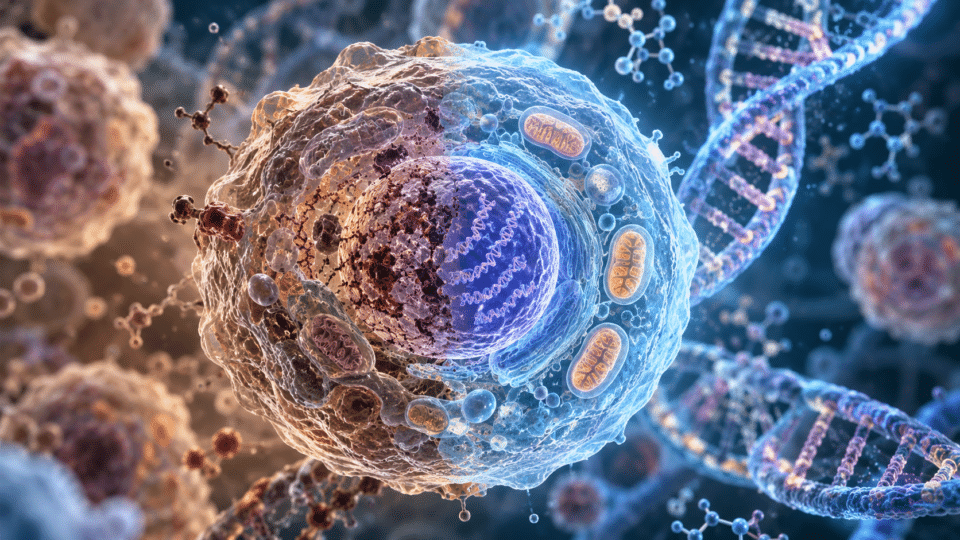
Cellular rejuvenation reached a milestone in 2026 that the longevity field had awaited for years: a therapy based on partial epigenetic reprogramming entered a human clinical trial for the first time. The idea sounds almost impossible—persuading an aged cell to function again like a younger one without erasing its identity—but that is precisely the aim of a new generation of experiments.
Results so far have been striking enough to fuel headlines about “turning back the biological clock”. In the laboratory, researchers have produced human cells with transcriptomic and epigenetic signatures tens of years “younger”, while animal models have reported improvements in tissue function, memory and some frailty measures. But there is a vast difference between rejuvenating molecular markers and safely rejuvenating an entire human body.
That is why the right question is not whether an 80-year-old could biologically become 20 tomorrow. It is whether medicine can learn to selectively reset some age-associated changes in a specific tissue, without causing cancer, loss of cellular identity or difficult-to-control side effects. In 2026, that question is beginning to be tested clinically for the first time.
What cellular rejuvenation actually means
A cell does not have an “age counter” equivalent to a person’s chronological age. As the body ages, changes occur in gene expression, chromatin structure, DNA methylation, metabolism and stress responses. Some of these changes can be measured and converted into so-called biological or epigenetic clocks.
These clocks do not precisely tell us how many years a person has left to live. They are statistical models that compare particular molecular signals with patterns observed at different ages. An analysis published in Nature Aging in 2026, based on more than 15,000 methylation profiles from 17 human tissues, found both shared signals of ageing and important differences between organs. In other words, “biological age” is not a single universal number for the whole body.
This is where the promise of epigenetic reprogramming lies: if some age-associated changes are reversible, a cell could potentially be nudged towards a younger functional state without altering its DNA sequence. It is a radical idea, but one with a solid experimental basis.
Yamanaka factors: the discovery that changed cell biology
The starting point is the reprogramming factors associated with the work of Shinya Yamanaka. The classic combination of OCT4, SOX2, KLF4 and c-MYC, abbreviated as OSKM, can transform specialised adult cells into induced pluripotent stem cells. In effect, the cell’s mature identity is erased far enough for it to return to a stem-cell-like state.
The problem is the method’s very power. Full reprogramming can cause a cell to lose its identity and, in certain experimental settings, may promote the formation of teratomas. For an anti-ageing therapy, the goal is not for a nerve cell to forget that it is a neuron, or for a skin cell to become pluripotent again. The aim is to recover some youthful functions without crossing the dangerous threshold of dedifferentiation.
This led to the concept of partial reprogramming: the factors are activated for a limited period or in a controlled combination, then switched off before cellular identity is completely lost.
The study that turned back molecular age by about 30 years
One of the most widely cited results came in 2022 from a team led by researchers at the Babraham Institute. They applied a method called maturation phase transient reprogramming to human dermal fibroblasts from middle-aged donors.
After temporary reprogramming, the researchers reported that the cells’ transcriptome—the pattern of active genes—showed rejuvenation of about 30 years according to a transcriptomic clock. Similar changes were observed in epigenetic markers, while the cells produced more youthful levels of collagen and showed a partial improvement in migration speed.
This is the origin of many popular claims that “researchers rejuvenated cells by decades”. But an essential clarification is needed: they did not rejuvenate a person by 30 years. The study was conducted on cells grown in the laboratory, and “30 years” represents the estimated change in particular molecular models, not a clinical transformation of an organism.
InfoBuz previously explained how epigenetic markers can track the pace of ageing in other organisms, including its analysis of why large dogs age molecularly faster than small ones. In both cases, an epigenetic clock is a measurement tool, not a verdict or a complete definition of biological age.
Cells from a 94-year-old donor were also tested
In 2023, another team explored a different route: reprogramming with combinations of small molecules, without directly introducing the classic Yamanaka factors. The study included human fibroblasts from a 22-year-old donor, a 94-year-old donor and a 14-year-old patient with Hutchinson-Gilford progeria syndrome.
Certain chemical cocktails shifted several gene-expression indicators towards patterns associated with young cells. This is an important result because it suggests that reprogramming effects could be achieved through mechanisms other than gene therapy. However, the experiment does not show that a 94-year-old cell simply became “a 20-year-old cell”, and the authors stressed the need for further validation in living organisms.
The 2026 milestone: the first therapy of its kind enters human testing
The most important development in 2026 is the move from preclinical experiments to a phase 1 clinical trial. The experimental therapy ER-100, developed by Life Biosciences, uses a modified adeno-associated viral vector to deliver the genetic instructions for three factors: OCT4, SOX2 and KLF4, a combination abbreviated as OSK.
Clinical trial NCT07290244 is aimed at adults with open-angle glaucoma or non-arteritic anterior ischaemic optic neuropathy. According to the ClinicalTrials.gov registry, up to 18 participants are planned, and the primary endpoint is the safety and tolerability of a single administration. Participants will be followed over the long term, for up to five years.
The vector is administered to the treated eye, and OSK expression is controlled with doxycycline for eight weeks. The choice of the eye is not accidental. It is an organ in which local delivery, direct examination and measurement of function are more feasible than in an attempt to reprogramme the entire body systemically.
The FDA authorised the programme to enter clinical testing in early 2026, and the company announced in June that the first participant had received treatment. This is a historic threshold for the field, but it is not yet evidence that epigenetic reprogramming works as a treatment. Phase 1 exists primarily to determine whether an intervention can be administered safely.
Why this is not a whole-body rejuvenation treatment
ER-100 is not being tested to make a person younger overall, extend their life or reduce their age on a general epigenetic clock. The trial addresses disease localised to the optic nerve and retina, with clinical objectives including safety, intraocular pressure, visual acuity and retinal structure.
If the therapy shows that certain age-affected cells can recover function without losing their identity, the result could open a path towards other organs. But every tissue has different biology, risks and delivery methods. An intervention tolerated in the eye does not automatically become safe for the heart, liver or brain.
In 2026, researchers also found a route other than Yamanaka factors
On 14 October 2026, Nature Aging published a study that looked for genes capable of pushing the transcriptome of aged cells towards a younger state without pluripotency reprogramming. The team identified SRSF1, a protein involved in RNA processing and splicing, as an interesting regulator of cellular ageing.
In human fibroblasts, increasing SRSF1 was associated with younger transcriptomic signatures and reductions in some markers of senescence, proteostatic stress and inflammatory signalling, without loss of fibroblast identity. In an experiment involving old mice, the authors reported a 44% reduction in frailty progression and a 14% increase in median lifespan.
These figures are striking, but the mouse groups used for longevity analysis were small—about 9–10 animals per group—and the result cannot be directly extrapolated to people. The study matters for a different reason: it shows that the field is seeking more precise rejuvenation mechanisms that may avoid some risks of classical reprogramming.
In the same context, see also Neuropathic pain: an experimental peptide reduced pathological signals in mice. What the 2026 study shows, which presents additional relevant information.
Can memory be “rejuvenated”? A surprising result in mice
A study published in Neuron in 2026 took an even more specific direction: researchers partially reprogrammed certain populations of neurons with OSK. These neurons, known as engram cells, are involved in storing memory traces.
In models of ageing mice and models of Alzheimer’s disease, the intervention corrected some epigenetic and transcriptomic abnormalities and improved learning and memory performance to levels close to those of young animals in the tested paradigms. The result illustrates how powerful targeted reprogramming could be, but it remains a preclinical demonstration in animals.
For the public, the temptation is to immediately translate the finding as “memory can be rejuvenated”. For researchers, the more cautious question is whether certain molecular states associated with age can safely be repaired in cells that support memory. The difference between those two formulations is essential.
The biggest obstacle is not rejuvenating a cell, but stopping in time
Reprogramming is an exceptionally powerful process. If taken too far, a mature cell can lose the features of the tissue to which it belongs. In a living organism, this could be a major problem. Medicine needs very precise control over the dose, duration, cell type and location at which the factors are activated.
There is also the problem of delivery. AAV vectors are used in gene therapy, but can trigger immune responses and have limitations in distribution and repeat dosing. Chemical reprogramming could avoid some of the difficulties of gene therapy, but small molecules may act in several tissues and biological pathways at once.
Another risk is the emergence of effects that are not immediately visible. This is why the ER-100 study includes follow-up over years. If the goal is to alter a cell’s epigenetic programme, safety cannot be assessed only in the first days after treatment.
An epigenetic clock is not the same as health
One communication risk in longevity research is to turn any reduction in “biological age” into evidence of clinical rejuvenation. A biomarker is useful if it predicts or reflects something relevant to health. But lowering a molecular score does not automatically guarantee lower risks of heart attack, cancer, dementia or death.
There are differences even between epigenetic clocks. Some were designed to estimate chronological age, others mortality, function or exposures. In addition, the same treatment may produce different responses in the skin, blood, liver or brain. Research in 2026 involving thousands of human profiles reinforces the idea that ageing has shared components but is also profoundly tissue-specific.
What can accurately be said today about cells from people aged 80 or 90
Yes, experiments exist in which cells from very old people have been pushed towards molecular states associated with youth. Yes, other experiments have reduced the age estimated by transcriptomic or epigenetic clocks by decades. And yes, partial reprogramming has improved functions in animal models.
But there is currently no approved therapy that can safely transform an 80-year-old person into an organism with the biology of a 20-year-old adult. We do not know whether all changes of ageing are reversible, whether epigenetic resetting will reduce mortality in humans, or whether benefits can be obtained without long-term risks.
The phrase “80-year-old cells becoming 20-year-old cells” may therefore describe certain laboratory changes metaphorically, but it should not be presented as a clinical fact. More importantly, researchers are beginning to show that cellular ageing does not appear to be a completely irreversible process.
What to watch in the coming years
- ER-100 safety: adverse reactions, inflammation, immune effects and any unwanted changes in treated cells.
- Signals of efficacy: whether participants show genuine stabilisation or improvement in visual function, rather than molecular changes alone.
- Control of reprogramming: methods that make it possible to switch factors on and off precisely in the right tissue.
- Alternatives to OSK/OSKM: proteins such as SRSF1, chemical combinations and other strategies capable of reproducing benefits without loss of cellular identity.
- Biomarker validation: evidence that a lower epigenetic age translates into better health and function.
Why this field could become one of the decade’s major medical stories
Traditional medicine generally treats diseases separately: glaucoma, heart failure, neurological degeneration, fibrosis or frailty. The biology of ageing poses a deeper question: if several of these diseases share age-associated cellular mechanisms, can medicine treat part of the common cause rather than only the final consequence?
This is why investment and scientific interest are so substantial. If epigenetic reprogramming can be controlled, it would not necessarily mean “immortality”; it could become a platform for regenerating diseased tissues. Even an application limited to the optic nerve would matter if it showed that an aged human cell can recover function by resetting its epigenetic programme.
At the same time, the field must be protected from premature promises. Products and services already use longevity language online before clinical evidence exists. None of the results described here justifies self-medication, uncontrolled use of experimental molecules or the purchase of “rejuvenation treatments” without clinical validation.
Conclusion: the biological clock may be shifted, but we do not yet know how far
Cellular rejuvenation has moved beyond the purely theoretical realm. Human cells grown in laboratories have been pushed towards younger molecular states, animal models have shown functional recovery, and partial epigenetic reprogramming entered its first human clinical trial in 2026.
What remains unknown is the decisive part: how safely this resetting can be controlled, how long its effects last, whether it can work in multiple organs, and whether changing biological clocks will translate into more years of healthy life. The answers will come from clinical trials and long-term follow-up, not slogans about “eternal youth”.
For readers interested in the molecular mechanisms of ageing, InfoBuz has also examined the surprising way interactions between DNA molecules can be controlled by their chemical environment, as well as the technology through which light can control neuronal activity.
Frequently asked questions about cellular rejuvenation
Is there an approved treatment that rejuvenates people? No. ER-100 is an experimental phase 1 therapy for two optic-nerve conditions, not an approved treatment for general rejuvenation.
What are Yamanaka factors? They are transcription factors capable of reprogramming cells’ identity and epigenetic state. The classic combination is OSKM; some partial-reprogramming strategies use OSK alone.
Has a human cell been rejuvenated by 30 years? A 2022 study reported rejuvenation of about 30 years according to a transcriptomic clock, along with similar epigenetic changes, in human fibroblasts. This is a molecular estimate in a laboratory, not the equivalent of rejuvenating a person by 30 years.
Can these technologies be used for the brain? Mouse experiments have produced promising results in cells involved in memory, but there is currently no approved human therapy using brain reprogramming for ageing or Alzheimer’s disease.
When will we know whether epigenetic reprogramming works in humans? The first safety data from clinical trials will be important, but evaluating long-term effects will take longer. The ER-100 study includes participant follow-up for up to five years.
Sources and transparency
- ClinicalTrials.gov – NCT07290244, the ER-100 phase 1 study
- Nature Biotechnology – FDA go-ahead to test cellular rejuvenation therapy in humans, 2026
- eLife – Multi-omic rejuvenation of human cells by maturation phase transient reprogramming
- Nature Aging – SRSF1 as a regulator of aging, 14 October 2026
- Neuron – Cognitive rejuvenation through partial reprogramming of engram cells, 2026
- Aging – Chemically induced reprogramming to reverse cellular aging
- Nature Aging – Meta-analysis of methylation signatures across 17 human tissues, 2026



Discuția cititorilor
Ai o opinie sau o întrebare despre acest articol? Spune-ne ce crezi.
Fii primul care deschide discuția.
Te rugăm să păstrezi un limbaj civilizat și să discuți la subiect. Comentariile spam sunt filtrate automat.