
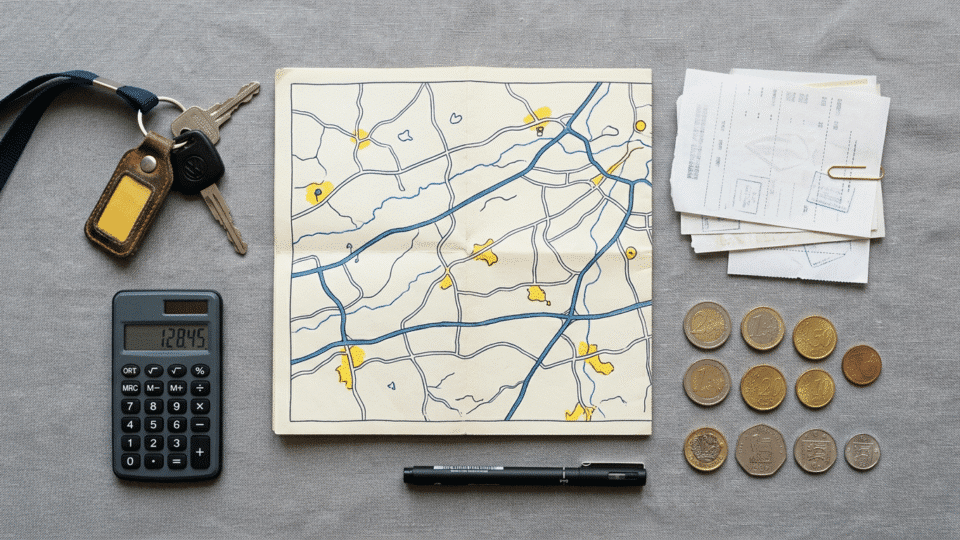
Driving in Europe in 2026 involves far more than fuel and accommodation. Depending on the country, travellers may need electronic vignettes, motorway tolls paid at a booth, separate charges for tunnels and bridges, emissions stickers, or registration for restricted-access zones.
For drivers from Romania, the differences matter. Hungary, Slovakia, Slovenia, the Czech Republic, Austria, Bulgaria and Switzerland use vignette systems. France, Italy, Croatia and Serbia mainly charge according to distance travelled. Germany has no general motorway charge for passenger cars, though some cities may require an emissions sticker. Other countries combine toll-free roads, individual charges and urban low-emission zones.
Driving in Europe: vignettes, tolls and rules in 2026
The most important point before setting off is not to confuse three distinct systems:
- vignette – payment for the right to use a road network for a specified period;
- motorway toll – payment based on the route or kilometres travelled;
- urban charge / emissions sticker – applicable only in certain cities or zones.
Some countries also charge separately for tunnels, bridges or Alpine sections even if you already have a vignette.
Romania: the rovinieta changed in 2026
From October 2026, Romania’s rovinieta road-use charge for passenger cars is also differentiated by emissions standard. Official rates for passenger cars are set in Romanian lei.
For 10 days, for example, the charge is approximately:
- 27 lei for an electric vehicle;
- 30 lei for Euro VI;
- 35 lei for Euro V–IV;
- 39 lei for Euro III–0.
For 12 months, the amounts range from approximately 228 to 330 lei, depending on the emissions class.
The rovinieta applies to the national road network under the legislation in force and must be bought before using toll roads.
Bulgaria: e-vignette for passenger cars
Bulgaria uses an electronic vignette for vehicles up to 3.5 tonnes. From August 2026, approximate passenger-car prices are:
- 1 day – €5.30;
- weekend – €6.60;
- 7 days – €10;
- 1 month – €19.90;
- 3 months – €35.90;
- 1 year – €64.50.
For Romanians travelling to Greece or Turkey through Bulgaria, the vignette should be checked before entering a motorway or other toll road.
Hungary: vignette required on motorways
Hungary uses an e-vignette for cars and motorcycles. Official prices for category D1, effective from 1 January 2026, are:
- 1 day – HUF 5,550;
- 10 days – HUF 6,900;
- 1 month – HUF 11,170;
- 1 year – HUF 61,760.
There are also annual regional vignettes, as well as special regional products introduced in 2026.
On the Romania–Budapest–Vienna route, a 10-day vignette is generally enough for a city break or a short transit journey. For a full calculation of the journey, see InfoBuz’s guide to the real cost of a road trip: fuel, rovinieta and tolls.
Austria: the vignette does not cover every charge
In Austria, passenger vehicles up to 3.5 tonnes need a vignette for motorways and expressways.
Digital vignettes are available and, in 2026, the traditional adhesive version is still available too. Austria will move exclusively to digital vignettes from 2027.
Importantly, certain Alpine sections, tunnels and mountain passes carry a separate charge even if the vehicle has a vignette.
One potentially troublesome detail is that some digital vignettes bought online by private individuals have an 18-day waiting period before activation because of the right of withdrawal. Short-term products may be subject to different rules.
Slovakia: a straightforward e-vignette
Slovakia uses an electronic vignette for passenger cars up to 3.5 tonnes. Current prices are:
- 1 day – €8.10;
- 10 days – €10.80;
- 30 days – €17.10;
- 365 days – €90.
The vignette is linked to the registration number, so the details must be entered accurately.
Czech Republic: vignette prices depend on powertrain
The Czech Republic uses an e-vignette for motorways. For conventionally powered vehicles, 2026 prices are:
- 1 day – CZK 230;
- 10 days – CZK 300;
- 30 days – CZK 480;
- 1 year – CZK 2,570.
Plug-in hybrids with CO₂ emissions of no more than 50 g/km qualify for reduced rates, while electric and hydrogen vehicles may be exempt. For vehicles registered outside the Czech Republic, the exemption must be notified through the official procedure.
Slovenia: a vignette is compulsory, and vehicle class matters
For standard passenger cars up to 3.5 tonnes in class 2A, the prices are:
- 7 days – €16;
- 1 month – €32;
- 1 year – €117.50.
Some taller vehicles fall within class 2B and pay more. Check the height above the first axle and the exact classification if travelling in a van, a particularly tall SUV or a light commercial vehicle.
Switzerland: one annual vignette only
Switzerland has one of the simplest systems. Motorways and expressways require an annual vignette costing CHF 40.
There are no one-day, weekly or monthly vignettes.
The 2026 vignette is valid from 1 December 2025 to 31 January 2027. It can be bought as a sticker or an e-vignette.
Even drivers entering for only a few hours must pay for the annual vignette.
Germany: no general Autobahn toll for passenger cars
In 2026, Germany has no general Autobahn charge for passenger cars. Cars can use most motorways free of charge.
There are, however, individual charges for certain tunnels and private roads.
In addition, some cities have low-emission zones and may require an Umweltplakette, the green emissions sticker. This is separate from motorway use.
France: payment depends on the route
France does not use a national vignette for passenger cars. Many motorways are operated under concession and charged through the péage system.
The amount depends on the route, distance and vehicle class. Some sections use conventional toll booths, while others are gradually moving to free-flow systems, with no physical barrier and payment made electronically.
For further information related to this subject, see Roaming in Europe in 2026: where you may pay extra on ferries, planes or near borders.
In 2026, tariffs on concession motorway networks rose by an average of approximately 0.86% compared with the previous year.
France also has ZFE low-emission zones in several cities, and some of them require a Crit’Air emissions vignette.
Italy: motorways charged by distance
Italy does not use a national vignette. On most motorways, drivers pay according to the distance travelled and vehicle class.
For 2026, Autostrade per l’Italia publishes indicative per-kilometre rates that differ between flatland and mountainous sections. For class A, the rate is around €0.079/km on flatland sections and €0.093/km on mountainous sections.
Payment can be made in cash, by card or through automated systems such as Telepass.
Also note the ZTL restricted-traffic zones in historic centres. Unauthorised entry can result in fines, even where there is no visible barrier.
Croatia: a distance-based toll system
Croatia does not have a standard vignette for passenger cars. On motorways, the charge depends on the distance travelled and vehicle category.
On many sections, drivers receive a ticket on entry and pay on exit. On shorter sections, bridges or tunnels, payment may be made directly.
For journeys to Zagreb, Zadar, Split or Dubrovnik, the travel budget should include motorway tolls separately from fuel.
Serbia: motorways with toll booths
Serbia charges for use of its main motorways, including the E70 and E75 corridors. For passenger cars, the price depends on distance and vehicle category.
On routes from Romania to Belgrade, Niš, North Macedonia or Greece, tolls are paid on the main motorway sections.
Official rates were updated from July 2026.
Greece: motorway tolls, no national vignette
Greece uses motorway tolls paid at toll stations. There is no national vignette for passenger cars.
For Romanians travelling to Thessaloniki, Halkidiki, Thassos or Athens, the total cost depends on the route and the number of tolled sections.
Spain: many motorways are free, but not all
Spain has removed charges from several major motorways in recent years, but some tolled sections and tunnels remain.
There is no national vignette for passenger cars.
Major cities are introducing an increasing number of low-emission zones, and access may depend on the vehicle’s classification.
Portugal: conventional and electronic tolls
Portugal has both motorways with conventional toll booths and sections with electronic-only charging.
There are dedicated registration and payment options for foreign-registered cars. It is important to check the system before entering electronic sections, as there is not always a payment desk.
Belgium, the Netherlands and Luxembourg
For passenger cars, Belgium, the Netherlands and Luxembourg do not have a general motorway vignette comparable to those in Austria or Hungary.
There may nevertheless be charges for tunnels, bridges, ferries or urban zones.
In Belgium and the Netherlands, low-emission zones may matter more than motorway tolls.
Denmark and Sweden: free roads, costly bridges
In Denmark and Sweden, most roads for passenger cars carry no general charge, but major bridges can have substantial tolls.
Classic examples are Storebælt in Denmark and Øresund between Copenhagen and Malmö.
Sweden also applies congestion charges in Stockholm and Gothenburg.
Norway: electronic system and numerous local charges
Norway uses an extensive automatic charging system: motorways, tunnels, bridges and entrances to cities may all generate charges.
Foreign vehicles can be registered with dedicated payment systems. Electric cars often receive discounts, but do not automatically travel free everywhere.
Poland: a mixed system
Poland has no national vignette for passenger cars. Some motorways are free, while others are concession-operated and charged on certain sections.
The route should be checked before departure, especially when travelling on the A1, A2 or A4.
Baltic states: Estonia, Latvia and Lithuania
For passenger cars, there is generally no national vignette comparable to those in Austria or Hungary. Charges are more relevant to commercial vehicles and particular infrastructure.
Drivers must nonetheless follow local rules on parking, ferries and urban access.
Ireland and the United Kingdom
Ireland has certain tolled motorways and bridges, including barrier-free systems.
The United Kingdom has no national vignette for passenger cars, but there are individual charges, bridges, tunnels and urban schemes such as London’s Congestion Charge and ULEZ.
Austria, Slovenia and Switzerland: a vignette does not mean everything is paid for
A common mistake is to assume that a vignette covers every road.
In Austria, some tunnels and Alpine sections carry additional charges. In Switzerland, certain tunnels, car trains or special crossings may have separate fees. In Slovenia, particular infrastructure may have its own charging arrangements.
Low-emission zones: another major pitfall for tourists
In 2026, the issue is no longer limited to motorways. A growing number of European cities restrict access for more polluting cars.
Examples include:
- Germany – Umweltzone and Umweltplakette;
- France – Crit’Air and ZFE;
- Italy – ZTL and local restrictions;
- Spain – Zonas de Bajas Emisiones;
- Belgium – LEZ in Brussels, Antwerp and other cities;
- United Kingdom – ULEZ and other clean-air zones.
These systems are not identical and cannot be addressed with a single European vignette. For travel outside the EU or at the Schengen area’s external borders, see InfoBuz’s analysis of the EES system at Romania’s borders.
What to check before entering each country
- the vignette or toll system;
- the car’s Euro emissions standard;
- emissions zones;
- tunnel and bridge charges;
- speed limits;
- mandatory equipment;
- winter tyre rules;
- parking in major cities;
- the official way to buy the vignette.
Buy vignettes only from official or authorised sources
One of the most common problems is buying from intermediary websites that add substantial commissions or, more seriously, are fraudulent.
In Hungary, the official operator explicitly warns drivers to buy only from authorised distributors.
Always check the official domain and the confirmation bearing the registration number before departure.
Example: Constanța – Vienna – Prague
A Romania–Hungary–Austria–Czech Republic road journey may require:
- a Romanian rovinieta;
- a Hungarian e-vignette;
- an Austrian vignette;
- a Czech e-vignette.
Entering certain cities may also bring emissions or parking rules into play.
On a European road trip, tolls can easily amount to hundreds of lei before fuel is even calculated.
Example: Romania – Greece
Via Bulgaria, the route involves:
- a Romanian rovinieta;
- a Bulgarian e-vignette;
- motorway tolls in Greece.
If travelling through Serbia and North Macedonia, the system changes: instead of a Bulgarian vignette, there will be several toll stations along the route.
Example: Romania – Italy
On the usual route through Hungary, Slovenia and northern Italy, drivers may need:
- a Romanian rovinieta;
- a Hungarian e-vignette;
- a Slovenian e-vignette;
- motorway tolls in Italy.
In Italy, it is necessary to check separately whether the destination lies within a ZTL.
Pre-departure checklist
- Check transit countries, not only the destination.
- Buy vignettes before entering tolled sections.
- Check the registration number twice.
- Save confirmations.
- Do not assume a vignette covers tunnels and bridges.
- Check the emissions zones in cities you plan to enter.
- Do not use unfamiliar websites promising “vignettes for all of Europe”.
Conclusion
Driving in Europe remains one of the most flexible ways to travel, but road charging is fragmented. There is no single European vignette and no common rule for all countries.
Vignettes predominate in Central Europe. France, Italy, Croatia and Serbia mainly use route-based charging. Germany has free motorways for passenger cars but urban emissions rules. Switzerland requires an annual vignette even for a very short visit.
The safest principle is simple: check the official system for every country a few days before departure. Prices and rules can change, while urban zones are becoming increasingly restrictive.
Frequently asked questions
Is there a vignette valid across all of Europe?
No. Each country has its own system, and some countries do not use vignettes at all.
Does Germany have a motorway toll for passenger cars?
There is no general Autobahn charge for passenger cars in 2026. Individual charges may apply to tunnels and private roads.
Does Switzerland have a 10-day vignette?
No. Passenger cars use the CHF 40 annual vignette, valid for the vignette year and the relevant grace periods.
Do you need to buy a vignette in Italy?
No. Most motorways are charged according to distance travelled and vehicle category.
Is there a motorway vignette in France?
No. Concession motorways use péage tolls. Separately, some cities use the Crit’Air emissions vignette.
What is the biggest mistake when buying vignettes?
Entering the registration number incorrectly or buying from an unofficial website. Always check the details before paying.
Sources: Hungary – e-vignette fees; Austria – official vignette information; Slovakia – e-vignette; Czech Republic – official rates; Switzerland – 2026 vignette; France – péage tolls and motorways; Italy – calculating motorway tolls; Croatia – road tolls. Rates were valid at the end of October 2026 and should be checked before departure.


Discuția cititorilor
Ai o opinie sau o întrebare despre acest articol? Spune-ne ce crezi.
Fii primul care deschide discuția.
Te rugăm să păstrezi un limbaj civilizat și să discuți la subiect. Comentariile spam sunt filtrate automat.