
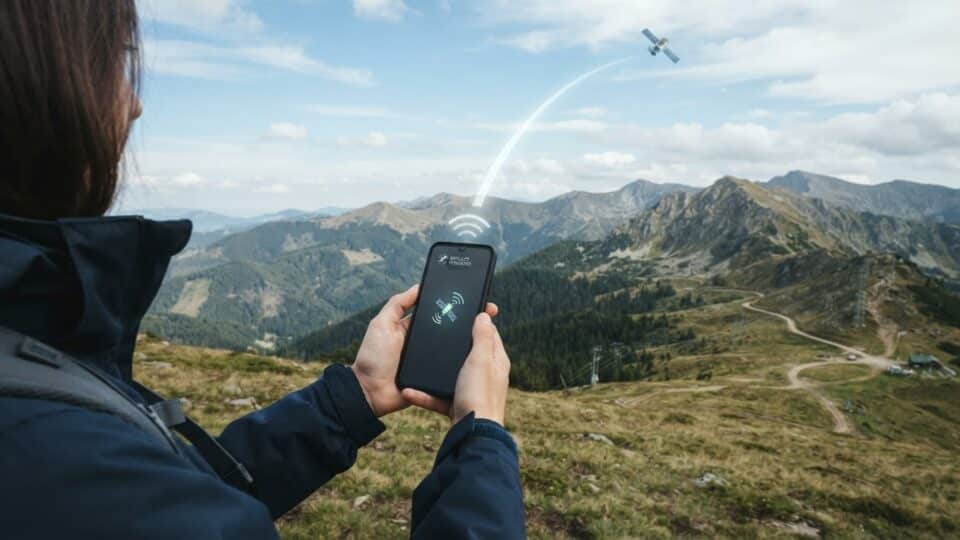
Satellite phone connectivity in Romania in 2026 is no longer an idea limited to specialist handsets with large antennas. Some conventional smartphones can already contact emergency services directly by satellite, while operators are testing Direct-to-Device connections that could eventually enable SMS, voice and even data where there is no mobile signal.
The situation is more complicated than it may appear. In Romania, Google officially lists Satellite SOS for compatible Pixel phones. Apple’s satellite features, by contrast, are not yet officially available in Romania. Meanwhile, Orange and Vodafone are working on integrating D2D connectivity with AST SpaceMobile, though full commercial trials have been pushed back to 2027.
For further background, see Satellite Internet in Romania: Starlink and Alternatives, Costs and Limitations in 2026, which examines a closely related aspect of this subject.
Satellite phone connectivity in Romania in 2026: what already works
At present, the clearest feature officially available to ordinary users in Romania is Satellite SOS on Google Pixel.
Google says the feature is available on Pixel phones from the Pixel 9 series onwards, except for the Pixel 9a. Romania is explicitly included on the list of supported countries.
The feature can be used when:
- there is no mobile signal;
- there is no Wi-Fi connection;
- the user is in a genuine emergency;
- the phone has a sufficiently clear view of the sky.
Which Pixel phones can use Satellite SOS
Google indicates support for the Pixel range from the Pixel 9 onwards, excluding the Pixel 9a. This includes compatible models in subsequent generations that have the necessary hardware and software.
The feature is integrated into Android and does not require a dedicated satellite phone.
There is an important detail for users, however: the service may be activated after software updates and after the device is registered on the satellite network. Google says users receive a notification when the feature becomes active.
How Satellite SOS works on Pixel
If there is no mobile network or Wi-Fi and you try to call emergency services, the phone may display an option to connect by satellite.
The process involves:
- calling the emergency number, such as 112 in Europe;
- selecting the Satellite SOS option if a terrestrial network is unavailable;
- completing a short questionnaire about the situation;
- positioning the phone according to the on-screen instructions;
- sending the information and location to emergency services;
- keeping the phone pointed towards the satellite to receive replies.
Google warns that connection and response times depend on location, terrain, buildings, trees and satellite availability.
It is not “satellite internet”
Satellite SOS does not turn a Pixel phone into a Starlink terminal and does not provide full satellite internet access.
It is a safety feature intended for exchanging essential messages with emergency services.
Bandwidth is limited, and the connection requires a good view of the sky. It is not intended for browsing, streaming or video calls.
What happens on iPhone in Romania
Apple has developed an extensive satellite ecosystem for the iPhone 14 and later models. In countries where it is available, an iPhone can offer:
- Emergency SOS via satellite;
- iMessage and SMS via satellite;
- location sharing through Find My;
- roadside assistance via satellite;
- satellite features provided by compatible carriers.
The issue for users in Romania is regional availability.
Apple’s satellite SOS is not yet available in Romania
Apple currently lists countries including the United States, Canada, the United Kingdom, France, Germany, Italy, Spain, Austria, Belgium, Portugal, Switzerland, Japan and several other markets for its Emergency SOS via satellite feature.
Romania does not appear on this list.
As a result, the fact that an iPhone 14, 15, 16 or a later model has compatible hardware does not guarantee that the feature can be used in Romania.
Apple’s Messages via satellite is not available in Romania either
Apple’s service for sending iMessage and SMS by satellite has even narrower availability in 2026.
Apple officially offers it in:
- the United States;
- Canada;
- Mexico;
- Japan.
Romania is not yet included.
Why the Satellite option appears on some iPhones even though the service does not work in Romania
iOS includes the interface and components required for satellite features on compatible models. Actual availability, however, is controlled by region and depends on approvals, providers and satellite infrastructure.
Apple says its satellite services depend on the country or region, and that expansion requires approvals and conditions specific to each market.
Apple uses Globalstar
The network Apple uses for its satellite features is provided chiefly by Globalstar and its partners.
The phone does not connect to a conventional geostationary satellite in the way a TV dish does. It uses satellites at far lower altitudes and must be pointed to maintain the link.
Apple explains that a message may take around 30 seconds to send in ideal conditions, and several minutes where trees or other obstacles are present.
What Direct-to-Device is, and why it is different
The next step is more significant: Direct-to-Device, or Direct-to-Cell.
Rather than the phone manufacturer incorporating a dedicated satellite service, the mobile operator extends its network through satellites that function like “mobile masts in space”.
The advantage is substantial: in some implementations, the phone does not need a specialised satellite antenna or dedicated hardware modifications.
Orange and Vodafone are testing Direct-to-Device in Romania
Romania was selected in 2026 to test Direct-to-Device technology based on AST SpaceMobile satellites and Satellite Connect Europe infrastructure.
Orange initially announced tests for the second half of 2026 covering:
- SMS;
- voice calls;
- mobile data.
Vodafone is also involved through Satellite Connect Europe, the company it created with AST SpaceMobile.
Full commercial trials have been delayed until 2027
In October 2026, Orange indicated that the extended demonstration planned for Romania would begin later, once the AST SpaceMobile constellation had enough satellites for a more stable connection.
The reason is straightforward: if too few satellites are in orbit, the connection may drop between successive passes.
Technical integration activity has already been reported in Romania and other European markets, but that does not mean the service is commercially available to Orange or Vodafone subscribers.
Why Direct-to-Device could change mobile telephony
Mobile networks are currently limited by the location of terrestrial masts.
In the mountains, the Danube Delta, at sea or in very remote areas, installing a 4G or 5G site can be difficult or uneconomical.
A Direct-to-Device satellite can cover vast areas and supplement the terrestrial network.
The aim is not to replace 5G. Satellite connectivity would serve as a safety net where terrestrial coverage disappears.
Could it work with your current phone?
This is one of the main advantages AST SpaceMobile is pursuing.
The company is designing the system so that the satellite can communicate with ordinary smartphones using standard cellular frequencies supplied by the operator.
In theory, many existing 4G and 5G phones could work without a dedicated satellite antenna.
Final compatibility will nevertheless depend on the operator, frequencies, software, regulation and phone model.
Is Starlink Direct to Cell the same thing?
The concept is similar, but the infrastructure is different.
Starlink Direct to Cell uses Starlink satellites equipped with cellular technology to deliver connectivity to compatible phones through partner operators.
Apple has also confirmed support for carrier-provided satellite features on some iPhones. When a phone is using such a network, it may display the SAT indicator in the status bar.
Availability depends on the operator and country, however. Romania currently has no general commercial Direct-to-Cell service available to all subscribers.
What happens if you lose signal in Romania today
If you have a compatible Pixel and Satellite SOS is active on the device, you may have an additional option for emergencies.
If you have an iPhone, Apple’s satellite features are not yet officially available in Romania, so they should not be relied upon in an area without signal.
Before travelling to an isolated area, it is advisable to:
- download offline maps;
- fully charge the battery;
- take a power bank;
- tell someone your route;
- check your operator’s coverage;
- not treat satellite connectivity as a substitute for safety planning.
At sea, in the Danube Delta and in the mountains, the difference could be substantial
Romania has many areas where mobile coverage can be intermittent or absent: mountain trails, the Danube Delta, isolated rural areas and maritime regions.
A D2D network could be especially important for fishers, sailors, tourists, mountain rescue services, transport and disaster response.
Until a commercial launch, however, it is important to distinguish between technical testing and a service available to customers.
Satellite phone connectivity will not replace the mobile network
Terrestrial networks have far greater capacity, lower latency and can serve extremely high densities of users.
Satellite services will supplement those networks in areas beyond the reach of mobile masts.
In a city such as Bucharest or Constanța, phones will continue to use 4G and 5G. Satellite connectivity will become relevant only when terrestrial coverage is unavailable or disrupted.
What to know about battery life and visibility of the sky
Connecting to a satellite is not as straightforward as connecting to a normal mobile mast.
The phone may ask the user to turn or point the device in a particular direction.
Buildings, walls, hills and dense trees can block the signal. In a cave, underground car park or between very tall buildings, the service may not work at all.
The link with roaming and travel
Satellite connectivity is especially relevant for people travelling in remote areas or abroad.
An iPhone bought in Romania may use Apple features while travelling in a country where the service is available, if Apple’s conditions are met.
Before travelling, it is also worth consulting InfoBuz’s guide to roaming in Europe in 2026 and unexpected costs on ferries, planes or near borders.
Satellite connectivity is not GPS
GPS is a positioning system: the phone receives signals from satellites to calculate its location.
Satellite connectivity is different: the phone must also transmit information to the network in space.
For readers interested in how GPS works, InfoBuz has separately explained how a phone calculates its position using satellites and why relativity matters to GPS.
What to watch in 2027
2027 could be the year when direct-to-smartphone satellite connectivity in Europe starts moving from demonstrations to more widely available services.
For Romania, the most important developments to follow are:
- Orange and Vodafone tests with AST SpaceMobile;
- the launch of a commercial D2D service;
- compatible phones and subscriptions;
- ANCOM approvals and European coordination;
- any expansion of Apple services to Romania;
- the extension of Satellite SOS to more Android phones.
Verdict: what you can use in Romania now
As of November 2026, the conclusion is clear.
Google Pixel: Satellite SOS is officially available in Romania on compatible models from the Pixel 9 onwards, excluding the Pixel 9a.
Apple iPhone: satellite hardware is present on the iPhone 14 and later models, but Apple’s satellite SOS and messaging features are not yet officially offered in Romania.
Orange/Vodafone D2D: the technology is in the testing and integration phase. It is not yet a general commercial service for subscribers in Romania.
This means satellite telephony has already reached conventional smartphones, but the market remains in a transition phase. In the coming years, the “no signal” indicator could become much rarer than it is today.
Frequently asked questions
Does Satellite SOS work on Pixel in Romania?
Yes. Google includes Romania on its official list of countries where Satellite SOS is available on compatible Pixel phones from the Pixel 9 series onwards, excluding the Pixel 9a.
Does Emergency SOS via satellite work on iPhone in Romania?
It is not officially available in Romania as of November 2026. Apple publishes a list of supported countries, and Romania is not currently included.
Can I send iMessage by satellite from Romania?
Not through Apple’s Messages via satellite service. It is currently officially available only in the United States, Canada, Mexico and Japan.
Does Orange already offer satellite internet directly to phones?
Not as a general commercial service in Romania. The operator is testing Direct-to-Device technology with AST SpaceMobile and Satellite Connect Europe, and extended trials are expected in 2027.
Do I need a special phone for Direct-to-Device?
The aim of D2D technologies is to allow many standard smartphones to use a satellite connection through ordinary cellular frequencies. Actual compatibility will depend on the operator, device and service.
Sources: Google Pixel Help – Satellite SOS; Apple Support – Messages via satellite; Apple Support – Emergency SOS via satellite; Orange Romania – Direct-to-Device testing; Light Reading – October 2026 update on the Orange D2D testing timetable.








Discuția cititorilor
Ai o opinie sau o întrebare despre acest articol? Spune-ne ce crezi.
Fii primul care deschide discuția.
Te rugăm să păstrezi un limbaj civilizat și să discuți la subiect. Comentariile spam sunt filtrate automat.