
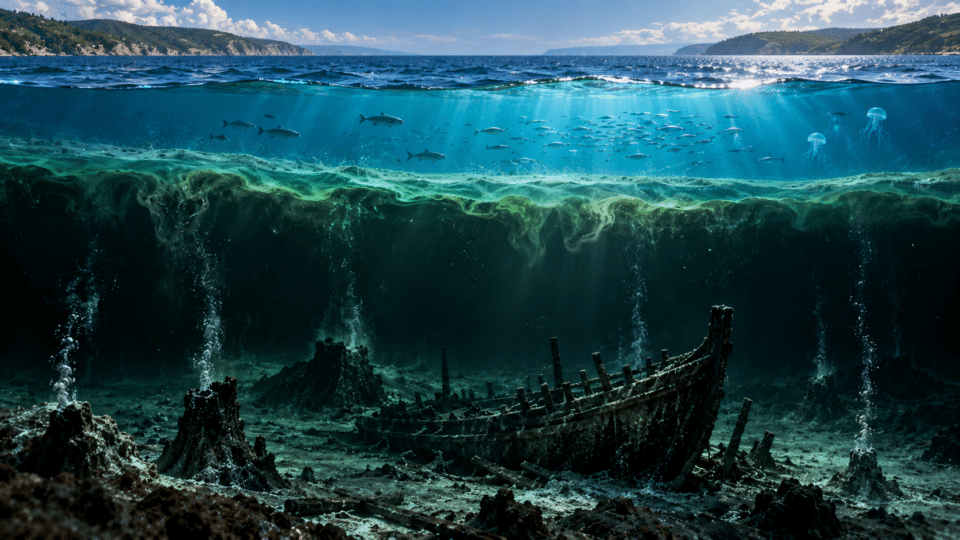
The Black Sea’s anoxic zone conceals one of the planet’s most unusual marine environments. At the surface, the Black Sea looks like any other: waves, fish, plankton, dolphins, ships and ports. But conditions change radically with depth. Oxygen declines, chemical transition layers emerge, and the deep waters are dominated by a mixture of saline water, hydrogen sulfide, methane and microorganisms that do not need oxygen to live.
For more on the Black Sea, see Drone attack in the Black Sea: two ships hit off Bulgaria, one sank, which provides additional context on the region.
The Black Sea is considered the world’s largest anoxic basin. Oceanographic research estimates that more than four-fifths of its volume exists under oxygen-free or permanently euxinic conditions — meaning there is no oxygen and hydrogen sulfide is present. The precise boundary is not fixed: in the centre of the basin, sulfide-bearing water may begin at roughly 90–100 metres, while nearer the margins it may lie at 150–180 metres, or even deeper.
That does not mean that “the Black Sea is dead”. On the contrary, its surface layer supports a complex marine ecosystem, while the oxygen-free depths contain an extremely active microbial world. The difference is that life there relies on chemical reactions other than those generally associated with familiar organisms.
Below the zone in which fish can survive lies a natural laboratory where bacteria and archaea use sulfur, nitrogen, iron and methane to obtain energy, while sediments preserve a chemical archive stretching back thousands of years.
The anoxic zone begins because two water masses do not readily mix
The Black Sea is almost enclosed. It is connected to the Mediterranean through the Bosporus, the Sea of Marmara and the Dardanelles. At the same time, the Danube, Dnieper, Dniester, Don and other rivers deliver large volumes of fresh water to its surface.
Surface water is less saline and lighter. Water entering from the Mediterranean through the Bosporus is saltier and denser, and sinks to depth. The result is a strongly stratified water column.
In an open ocean, storms, currents and global circulation can mix water and carry oxygen to great depths. In the Black Sea, the density difference acts as a barrier. Wind can stir the surface, but cannot efficiently ventilate the deep interior of the basin.
Organic matter produced at the surface — plankton, biological remains and material brought in by rivers — sinks. Microorganisms break it down and consume the available oxygen. Because oxygen is not replenished quickly enough, the deep waters have become permanently anoxic.
There is no single boundary: an intensely active chemical zone lies between fish and hydrogen sulfide
A popular picture suggests that oxygen abruptly ends at a particular depth and hydrogen sulfide begins. The reality is more complex.
Oceanographers generally describe three main zones: an oxygenated surface layer, with enough oxygen for most organisms; a suboxic zone, where oxygen falls close to zero but hydrogen sulfide does not yet dominate; and then an anoxic, sulfidic layer, where H₂S is present and increases with depth.
In the centre of the basin, some measurements place the disappearance of oxygen and the onset of sulfidic conditions at around 90–100 metres. Towards the margins, the structure of the water may push the interface down to 150–170 metres or deeper. The commonly cited 150-metre mark is therefore a useful guide, but does not describe every part of the Black Sea.
A 2025 study of sulfide oxidation, for example, found that the H₂S boundary lies at around 90–100 metres in the centre of the sea and may descend to 150–170 metres in peripheral areas.
What hydrogen sulfide is, and why there is so much of it at depth
Hydrogen sulfide, H₂S, is toxic at high concentrations and, when present in air, is associated with the smell of rotten eggs. In the Black Sea, however, the main reservoir is in deep water.
H₂S is produced largely by microorganisms that reduce sulfate while breaking down organic matter in the absence of oxygen. Sulfate is abundant in seawater, and sulfate-reducing bacteria use it as an electron acceptor in anaerobic metabolism.
A classic sulfur budget estimated the total sulfide inventory in the anoxic zone at about 4,600 Tg, most of it in the deep water column. More recent research on the Bottom Convective Layer has confirmed that microbial sulfate reduction is the dominant source of H₂S there.
This is why the more precise term is often euxinic: not merely oxygen-free, but oxygen-free and rich in sulfides.
Can hydrogen sulfide in the Black Sea “explode”?
It is one of the most persistent viral theories about the Black Sea: that the entire H₂S reservoir could suddenly rise to the surface and cause an explosion or an instant catastrophe for the countries along its shores.
This is not how the system normally behaves. Deep water is stably stratified and much denser than surface water. Hydrogen sulfide is dissolved in the water, and its transport towards the oxygenated zone is limited by the hydrographic structure and by the chemical and biological reactions that consume it at the interface.
The depth of the chemocline can change, and local intrusions and regional variations can occur. But modern oceanography does not support the scenario of a spontaneous “explosion” of the entire Black Sea as a likely event.
Research exists on extracting H₂S to produce hydrogen and on potential risks if stratification were to change radically. These are technological and scenario-based analyses, however, not evidence that a catastrophic event is imminent.
Below the fish lies a microscopic biosphere
The phrase “dead zone” can be misleading. Fish, molluscs and most marine animals cannot live without oxygen, but bacteria and archaea can use other metabolic pathways.
One of the most interesting marine microbial communities occupies the interface between oxygen and H₂S. Some bacteria oxidise sulfide, others use nitrogen compounds, while archaea can take part in the anaerobic oxidation of methane.
Genetic studies have identified organisms related to ANME groups in the Black Sea chemocline — archaea that consume methane without oxygen — as well as sulfate-reducing bacteria. Other studies have found bacteria including Sulfurimonas, Arcobacter and SUP05 groups, which can exploit the chemical energy available in the transition zone.
In other words, where the environment becomes impossible for a fish, it becomes an ideal niche for certain microorganisms.
Methane is another major feature of this hidden world
Black Sea sediments also produce and release significant amounts of methane. There are gas seeps on the shelf and slope, mud volcanoes, and gas-hydrate deposits in deep sediments.
In the Romanian sector, geological research has identified active methane-seep systems and areas where gas hydrates may act as a reservoir beneath the sediment.
Yet the fact that methane is produced in sediment does not mean it automatically reaches the atmosphere. An important share is consumed by microorganisms before it reaches surface waters.
In the anoxic zone, anaerobic methane oxidation is carried out by communities of archaea and bacteria. In the transition zone and oxygenated water, other microorganisms can consume the methane that remains. This biological filter is one of the most important barriers between the geological reservoir and the atmosphere.
There are genuine sulfurous springs and submarine seeps near Mangalia
The Black Sea’s chemical world is not confined to the abyssal basin. A study published in 2024 investigated submarine sulfurous seeps in the Mangalia area using geophysical and geochemical data.
Researchers identified several areas releasing fluids and gases, and measured methane concentrations above background levels at certain hotspots. Some of the highest dissolved CH₄ concentrations reached approximately 95.6 nmol/L at the sites examined.
These seeps are local phenomena and should not be confused with the deep anoxic layer spanning the basin. They nevertheless show how active the submarine geology of Romania’s sector is, and why the Black Sea matters to research on the carbon cycle.
The Black Sea preserves traces of a transformation around 7,000 years ago
During the last glaciation, global ocean levels were far lower and the Black Sea was largely a freshwater or brackish lake basin.
As global sea level rose, saline Mediterranean water began entering through the Bosporus. Sedimentological studies place the onset of anoxia at about 7,500 years ago, during a period when the basin shifted towards modern marine conditions.
The influx of salt water, combined with a major input of fresh water at the surface, created the stratified structure seen today. Black Sea sediments are therefore used to reconstruct sea-level changes, the Holocene climate and the evolution of the regional environment.
Why scientists use the Black Sea as a model for Earth’s ancient oceans
Over geological history, oceans have not always been oxygenated as they are today. There have been periods when vast basins became anoxic or euxinic, and the carbon- and sulfur-rich sediments deposited then contributed to the formation of source rocks for hydrocarbons.
The Black Sea offers an accessible modern analogue. Researchers can simultaneously measure oxygen, sulfide, methane, iron, organic compounds and microbial communities in a stable, stratified system.
A 2025 study of iron and sulfur isotopes in Romanian shelf sediments used precisely this setting to understand how pyrite forms and how redox conditions are recorded in sediment.
In sediments, chemistry continues after the water appears calm
The Black Sea floor is not inert. A sequence of chemical and microbial reactions takes place beneath the sediment surface.
Oxygen, where it is present, is consumed first. Further down, microorganisms can use nitrate, manganese, iron and sulfate. In areas where methane rises from deeper layers, it meets sulfate diffusing downward, creating what is known as a sulfate–methane transition zone.
In the Romanian sector, sediment analyses have shown that sulfate reduction coupled with the anaerobic oxidation of methane is one of the dominant processes. This mechanism converts methane and sulfate into bicarbonate and sulfide, and plays a major role in the carbon and sulfur cycles.
Why shipwrecks are so well preserved — and why this is only a by-product of the chemistry
The lack of oxygen removes many of the organisms that rapidly destroy wood in ordinary seas. This is why shipwrecks below the anoxic boundary have been found with masts, rudders and structural elements preserved to an extraordinary degree.
The Black Sea Maritime Archaeology Project documented 65 shipwreck sites dating from antiquity to the modern era. It used ROVs, sonar, lasers and photogrammetry to map the seabed to depths of about 2,200 metres.
Some vessels found in deep water have been preserved so well that they offer information about shipbuilding unavailable in written sources.
InfoBuz has previously covered why wooden shipwrecks in the Black Sea can survive for millennia. Here, shipwrecks are only a striking consequence of a much larger biogeochemical system.
2026: the Black Sea is warming, while oxygen is changing differently from one region to another
A study published in April 2026 examined the past three decades of physical and biogeochemical variability in the Black Sea. Researchers found clear trends of warming and salinisation in both pelagic and demersal habitats.
Deoxygenation and acidification are not developing uniformly, however. The study reports strong spatial contrasts, especially in coastal areas. This matters because the Black Sea has two separate oxygen-related issues: the basin’s natural, permanent deep anoxia, and episodes of hypoxia in shallower coastal waters, influenced by temperature, stratification and nutrient input.
On the north-western shelf, including near Romania, severe twentieth-century eutrophication previously produced extensive areas of hypoxia. Lower nutrient inputs improved conditions in many periods, but warming and human pressures could shift the balance again.
In 2026, Romania’s National Institute for Marine Research and Development “Grigore Antipa” commissioned a new integrated monitoring campaign for Romanian marine and coastal waters as part of its obligations under the Marine Strategy Framework Directive, a sign that oxygen, nutrients and ecosystem condition remain active monitoring concerns.
Deep anoxia and coastal hypoxia are not the same thing
This distinction is essential if the data are not to be turned into alarmism.
Deep anoxia has been a structural feature of the Black Sea basin for thousands of years. It is linked to salinity stratification and the isolation of deep water.
Coastal hypoxia is a temporary or seasonal fall in oxygen levels in shallower waters. It can be intensified by eutrophication, high temperatures, decomposing algae and seasonal stratification.
A summer episode of hypoxia along the coast does not mean that “hydrogen sulfide from the depths is rising towards the beach”. These are different processes, even though both involve a lack of oxygen.
Could the oxygen-free zone rise towards the coast?
The boundary between the layers can move. The chemocline varies over time and space according to currents, density and water intrusions. At the basin’s margins, oxygen-poor waters can come closer to the shelf than they do offshore.
But surface waters along Romania’s coast are not permanently in a sulfidic environment. Beach waters and most shipping and fishing areas are in the oxygenated layer.
The ecologically relevant coastal risk is instead the emergence of local hypoxia, particularly after major algal blooms and during periods of strong stratification — not a sudden upward movement of the entire deep H₂S reservoir.
The Danube directly influences the surface world and indirectly the one below
The Danube is among the Black Sea’s most important sources of fresh water, sediment and nutrients. Its inflow contributes to the low salinity of the surface layer and, in turn, to the stratification that isolates the depths.
At the same time, nitrogen and phosphorus carried by the river can fuel biological production. When biomass dies and decomposes, oxygen is consumed. Policies to reduce nutrients in the Danube basin therefore have measurable effects on the ecological condition of the north-western shelf.
InfoBuz has also explained why the Black Sea has tides, but their effect is small compared with the Atlantic. The basin’s stratification and circulation are shaped more strongly by density, wind and river inflow than by the tides visible along the coast.
A sea with two overlapping ecosystems
Perhaps the most useful way to picture the Black Sea is as two ecosystems layered one above the other.
Above is the sea we know: light, oxygen, algae, zooplankton, fish and dolphins. Below is a dark ocean without oxygen, dominated by microbial reactions and the chemistry of sulfur and methane.
Between them is a layer thin on the scale of the basin but biologically rich: the chemocline. Oxidised and reduced compounds meet there, and microorganisms exploit the difference in energy.
It is almost the equivalent of a boundary between two biochemical planets, one above the other in the same sea.
Why this world matters to Romania
For Romania, the Black Sea is not only a coastline and a tourism destination. It is an energy, climate and biological system at the country’s edge.
Romania’s sector includes the Danube-influenced shelf, submarine canyons, gas seeps, sediments rich in palaeoceanographic information, and areas of interest for hydrocarbons and gas hydrates.
At the same time, offshore resource development, fishing and climate warming make ecosystem monitoring increasingly important. InfoBuz has separately examined the economic implications of the Neptun Deep project and Romania’s offshore gas. Understanding the basin’s deep chemistry is also relevant to assessing geological processes in the same region.
What remains to be learned
- How far will the chemocline shift over coming decades? Warming, salinity and circulation may alter its position.
- How much methane is consumed before reaching the surface? The precise methane budget remains difficult to close.
- How will the microbiome respond to changes in temperature and nutrients? The transition zone is highly sensitive to chemical fluxes.
- How stable are gas-hydrate deposits? Their stability is controlled by temperature and pressure.
- Where are the greatest risks of coastal hypoxia? Regional monitoring is essential because basin-wide averages conceal local differences.
The Black Sea is not “dead”. It is divided between two worlds
The paradox of the Black Sea is that the same feature that makes animal life impossible at depth creates a unique microbial ecosystem and preserves an extraordinary geological and archaeological archive.
More than four-fifths of the basin’s volume bears little resemblance to the sea seen from the beach. There are no shoals of fish there, but there are intense biological reactions, hydrogen sulfide produced by microorganisms, methane consumed without oxygen, and sediments that preserve the story of the basin’s transformation from lake to sea.
Rather than a “dead zone”, the deep Black Sea is better described as a living world in another chemical language.
Frequently asked questions about the Black Sea’s anoxic zone
How much of the Black Sea has no oxygen? Classic studies estimate that about 85% of the basin’s volume is anoxic. The exact figure depends on the definition used and on the variable position of the interface.
At what depth does hydrogen sulfide begin? In the centre of the basin it may appear at around 90–100 metres, while at the periphery the boundary can descend to 150–180 metres or more.
Is there life in oxygen-free water? Yes. Not fish or most marine animals, but bacteria and archaea that use sulfur, nitrogen and methane in anaerobic processes.
Can H₂S suddenly reach the coast? There is no evidence that the entire deep reservoir is about to rise suddenly to the surface. Local variations and shifts of the interface can occur, but the basin’s stratification is very stable.
Why are shipwrecks preserved? The lack of oxygen prevents many organisms that degrade wood. Preservation is not perfect, but it can be exceptional.
Is there methane in Romania’s sector? Yes. Research has identified gas seeps, dissolved methane and gas-hydrate deposits in certain offshore areas.
Sources and transparency
- Deep-Sea Research – Modelling redox cycling across the suboxic–anoxic interface zone in the Black Sea
- Chemical Geology – Isotopic constraints on the sulfur cycle of the Bottom Convective Layer in the Black Sea, 2023
- Oceanology – Light Stimulation of Sulfide Oxidation in the Black Sea Anoxic Water Column, 2025
- Regional Studies in Marine Science – Trends across Black Sea habitat layers over three decades, 2026
- Frontiers in Marine Science – Underwater sulfurous seeps near Mangalia, Romania, 2024
- Marine and Petroleum Geology – Sediment geochemistry and methane oxidation in Romania’s Black Sea sector
- Communications Earth & Environment – Iron and sulfur pathways in Romanian shelf sediments, 2025
- USGS / Paleoceanography – Evolution of Holocene anoxia in the Black Sea
- University of Southampton – Black Sea Maritime Archaeology Project
- Deep-Sea Research – Robotic documentation of 2,500 years of Black Sea shipwrecks
- EU Publications Office – Integrated Romanian Black Sea monitoring campaign, 2026








Discuția cititorilor
Ai o opinie sau o întrebare despre acest articol? Spune-ne ce crezi.
Fii primul care deschide discuția.
Te rugăm să păstrezi un limbaj civilizat și să discuți la subiect. Comentariile spam sunt filtrate automat.