
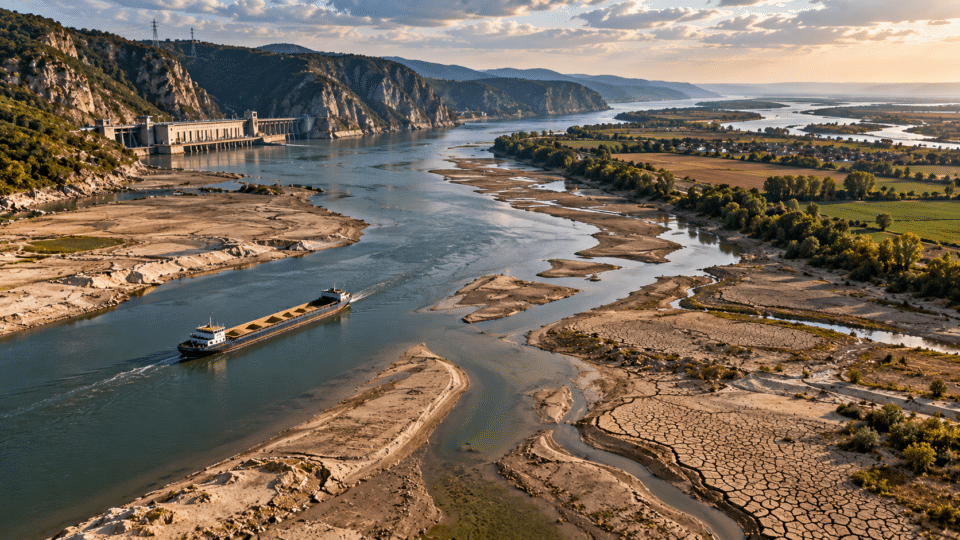
Low Danube flow is not an abstract problem for Romania. In the summer of 2026, the river fell to levels that brought irrigation restrictions and placed direct pressure on energy production. On 28 July, the National Administration “Romanian Waters” reported around 1,650 m³/s at the point where the river enters Romania, compared with a July long-term average of roughly 4,750 m³/s.
This article goes beyond the real situation during one dry summer. It sets out a hypothetical 12-month stress test: what would happen if the Danube remained, season after season, at roughly 1,500–2,000 m³/s at Baziaș, with only brief recoveries?
This is not a forecast for 2027, nor a claim that the Danube “will dry up”. It is an extreme scenario intended to show how many Romanian systems depend on the same river: the Iron Gates dams, Cernavodă, irrigation in the south-east, grain transport, water intakes, industry, fish farming and the Danube Delta.
The result is more complex than simply saying that there would be drought. The Danube is at once a transport corridor, power station, cooling-water source, water reserve and ecosystem. If flows remain low for a year, the problems do not all emerge on the same day. They accumulate and reinforce one another.
The summer of 2026 already offered a brief version of the scenario
On 28 July 2026, Romanian Waters announced a flow of around 1,650 m³/s at Baziaș and forecast a fall towards 1,500 m³/s in early August. The institution compared the situation with severe historical episodes and said the historical minimum used as a benchmark was about 1,400 m³/s.
At the same time, Stage III irrigation restrictions were already in force on the Călărași–Cernavodă section. This means a reduced supply flow or supply only during certain intervals.
InfoBuz followed the situation at the time in “The Danube nears a critical level: flow is almost three times lower than the August average”. That was a severe seasonal episode. This scenario asks what would happen if such conditions did not end with the summer.
Months 1–2: navigation and irrigation would take the first hit
River vessels need more than water in the river: they need a navigable depth in the shipping channel. When water levels fall, barges must reduce their draught, meaning less cargo on each voyage.
In 2026, the Danube Commission warned that prolonged low-water periods had become a structural problem for navigation. In September, Danube institutions explicitly discussed a future climate-change adaptation plan for navigation after record or near-record low levels during that summer.
For Romania, the impact would quickly be visible in grain, ores, petroleum products, construction materials and other bulk cargoes. A barge loaded to 50–60% does not necessarily become unprofitable, but the cost per tonne rises. Moving the same volume of goods requires more convoys, more fuel and more time.
Romania’s River Administration of the Lower Danube (AFDJ) continually publishes critical points on the Danube and measured minimum depths. In 2026, several sections of the Lower Danube required monitoring, surveys and very frequent updates to electronic charts precisely because of low water levels.
Why grain costs can rise even when the harvest exists
Romania exports large volumes of grain through the Port of Constanța, and the Danube is one of the natural routes connecting inland farming areas with seaports.
If barges carry less, logistics costs per tonne rise. Some cargo shifts to rail and road, but both have their own capacity constraints. Over a full year of low water, the pressure would not be merely seasonal: it would affect the wheat harvest, then maize and sunflower, as well as import-export flows during the winter months.
Food prices would not automatically rise because of the Danube alone. Harvests, energy, international markets and exchange rates matter enormously. But inexpensive river transport is one of the region’s logistical advantages; if it is temporarily lost, the costs must be absorbed somewhere along the supply chain.
Agriculture would quickly enter competition for water
Low flow does not mean irrigation pumps stop immediately. But water intakes operate within certain water-level and flow ranges, and authorities have restriction plans for periods of shortage.
In July 2026, Romanian Waters was already applying Stage III irrigation restrictions on the Călărași–Cernavodă section. It is a real example of the order of priorities: when the resource declines, agriculture can be limited before drinking water from centralised systems is cut.
If the situation lasts a year, a different problem emerges: farmers are no longer dealing with a single dry window, but with two consecutive agricultural cycles. Insufficient irrigation water can simultaneously affect summer-crop yields and soil-moisture reserves for the following season.
The International Commission for the Protection of the Danube River (ICPDR) warns that hot, dry regions of the Danube basin will face greater demand for irrigation water, while summer flows are vulnerable to decline. In the south-eastern basin, this is among the most important future conflicts between climate conditions and water use.
Drinking water would take priority, but not every locality is equally protected
It is important not to overstate the case: low Danube flow does not automatically mean Bucharest or all of Romania would run out of water. Supply systems use different sources, including inland rivers, reservoirs, groundwater and local intakes.
Romanian Waters has shown during recent episodes that, even under severe conditions on the Danube, reserves in the main reservoirs can maintain centralised water supply without nationwide restrictions. In this 12-month scenario, however, pressure would increase in localities directly dependent on the river, its branches or aquifers connected to Danube levels.
During dry periods in previous years, sections of Borcea, Măcin, Chilia, Tulcea and Sulina entered warning or restriction phases for uses including households, industry, irrigation, fish farming and transport.
In an extreme year, authorities would prioritise essential human consumption, with restrictions progressively shifting towards irrigation, industry and less critical uses. Localities with diversified sources would fare better than those dependent on a single intake.
The Iron Gates would generate less electricity just as the system needed it
Hydropower output depends on two fundamentals: flow and head, or the difference in water level. If less water passes through turbines, energy production falls.
Hidroelectrica states that the Romanian side of Iron Gates I has an average design output of around 5,241 GWh in an average hydrological year, equivalent in the company’s reporting to about 10% of national electricity production. The plant also has a disproportionate role in technological system services.
Iron Gates II adds further important capacity. In a persistently water-poor year, the plants would not automatically stop operating, but total generation would be substantially below that in a normal hydrological year.
This matters because hydropower is flexible. It can increase or reduce output quickly and helps Transelectrica balance the system. The loss would not be only in MWh, but also in flexibility.
Cernavodă would become the most sensitive energy point
The Cernavodă nuclear power plant uses Danube water for cooling systems. Nuclearelectrica stresses that the facility has several systems designed to operate at different water levels and that nuclear safety functions are provided redundantly.
The issue is commercial generation, not reactor safety. At very low levels, operation may be reduced or stopped in a controlled manner to protect pumps and maintain technical margins.
The summer and autumn of 2026 offered a real precedent. On 28 July, Romanian Waters announced the shutdown of Unit 1 in the context of very low flow. On 11 October, Nuclearelectrica said that both units were being maintained in a safe shutdown state, with no risk to nuclear safety.
InfoBuz separately explained the technical context in “Cernavodă, with both reactors shut down: why the Danube level matters and what the energy system risks”.
In a 12-month scenario, the issue would not be a shutdown lasting a few days, but the risk of repeated windows in which nuclear output could not be maintained at full capacity. That would simultaneously put pressure on imports, thermal plants, gas, renewables and storage.
The hardest energy scenario is one in which hydropower and nuclear power are affected at the same time
Severe hydrological drought hits two different sources through the same mechanism: too little water.
Hydropower plants produce less because flows are reduced. Cernavodă may face operational constraints because water levels and cooling conditions become unfavourable. At the same time, heatwaves that cause or worsen drought raise demand for air conditioning.
This is the difficult energy scenario: high demand precisely when two major domestic sources are constrained.
Romania would not automatically be left without electricity. Its system is interconnected with Europe; generation from gas, coal, solar and wind is available; and demand can be managed. But prices and imports would become much more sensitive to the regional situation.
Industry would begin to experience water as a raw material
Many industrial activities use water for cooling, processing, washing or transport. Under normal circumstances, water appears to be permanently available. During a year of hydrological drought, it becomes a production input that must be rationed.
Restriction plans establish different priorities depending on the river basin and user. Industry may receive lower flows before supply to the population is affected.
Companies with closed-loop systems, recycling and their own storage would be more resilient. Those dependent on direct intakes and high flows would have less flexibility.
The Danube Delta would lose more than water: it would lose the pressure that keeps the sea at bay
The Delta exists where the river’s freshwater meets the Black Sea’s saltwater. The greater the Danube flow, the farther the freshwater plume extends offshore and the more it pushes back seawater.
A model published in Ocean Science in 2025 shows that, under normal conditions, seawater can enter along the bed in the lower parts of the branches as a salt wedge. Reference simulations indicated intrusions of up to around 20 km upstream on the Chilia and Sulina branches and around 7 km on the Sfântu Gheorghe branch.
The study stresses that saltwater intrusion is not currently a widespread major problem in the Danube Delta, but that the risk is projected to increase as sea level rises and summer flow declines.
In this one-year scenario, saltwater would have more favourable periods in which to advance. Areas closest to the mouths could see salinity changes affecting vegetation, fish, local agriculture and freshwater intakes.
The Delta’s lakes and channels would not all dry up, but their connectivity would change
The Danube Delta is a network of branches, lakes, channels, sandbanks and floodplains. Many lakes depend on seasonal connections to the river.
With persistently low levels, some secondary channels would carry less water, exchanges between lakes and the main branches would fall, and shallow areas would warm more rapidly.
Warmer water holds less oxygen. If large amounts of organic matter and weak circulation occur at the same time, the risk of local hypoxia increases. For fish, the issue is not only less water, but the loss of breeding habitats and of connections between them.
Less sediment would reach some sections, changing the Delta’s dynamics
Flow also governs sediment transport. The relationship is not perfectly linear, as dams, hydraulic works and floods also play important roles, but prolonged low-water periods reduce the river’s ability to carry material.
The Delta needs sediment to offset subsidence and coastal erosion. In a single year, the geomorphological effect would be small at the scale of the Delta, but frequent repetition of low-flow years could worsen the sediment deficit over the long term.
Water quality would become more fragile
Less water means less capacity for dilution. The same quantity of nutrients or pollutants discharged into lower flows can produce higher concentrations.
The ICPDR warns that drought, warmer water and reduced availability can degrade water quality. In 2026, Romanian Waters explicitly referred to monitoring algal blooms in the context of low levels and high temperatures.
Over a full year of low water, warm periods would become the most vulnerable: high temperatures, slower flow, higher nutrient concentrations and less oxygen available.
Months 3–6: economic costs rise without a necessarily visible “crisis”
This is the stage at which indirect effects matter more than images of sandbanks.
- barges carry less and freight rates rise;
- irrigation is scheduled or restricted;
- hydropower becomes more expensive to replace;
- nuclear generation may be harder to maintain during critical periods;
- industry invests in water recycling or temporarily reduces consumption;
- in the Delta, dredging, monitoring and the maintenance of navigable channels become more costly.
None of these effects would “stop Romania”. Together, however, they could reduce competitiveness and increase costs at a time when drought is also affecting other Danube countries.
Months 6–9: the issue becomes reserves, not only flow
A two-month episode can be partly offset through reservoirs, restriction plans and stocks. After half a year, the question becomes: how much reserve remains?
Romania manages dozens of multipurpose reservoirs for drinking water, industry and energy. But they are fed by their own catchments. If the low-Danube scenario results from an extended regional drought, inland rivers are also likely to be below average.
This is where the synchronisation effect emerges: the Danube can no longer compensate for the energy system, while inland reservoirs must be managed more cautiously for the following winter and spring.
Winter would not automatically solve the problem
The Danube has a complex seasonal regime. Rain and snow in the upper basin can restore flows, but a dry winter with little snow would remove that “reset”.
A hydrological year with deficient precipitation in the Alps, Bavaria, Austria, Hungary and the Balkans can transmit the shortfall to Romania with a delay.
That is why the 12-month scenario is far more severe than an isolated dry Romanian summer: the Danube integrates what happens across a basin spanning much of Central and South-Eastern Europe.
For further information on Cernavodă, see also “Europe is drying out: drought hits the Danube, Rhine, agriculture and energy production”, which offers complementary details on this subject.
Months 9–12: agriculture enters a second season of shortage
If flows do not recover by the following spring, agriculture would face a problem different from simply losing the previous harvest.
Reservoir levels may be lower, groundwater may recover slowly, and farmers would enter the season uncertain about water availability for irrigation.
Sowing decisions could change: fewer water-intensive crops in vulnerable areas, accelerated investment in drip irrigation and soil management, and the abandonment of some irrigated land where water cannot be guaranteed.
In this way, a year of low Danube flow produces effects that continue after flows recover.
What the realistic order of priorities would be
In a water crisis, not all uses have the same priority. Water-management plans seek to protect human consumption and critical functions.
- 1. Water for the population and essential needs.
- 2. The safety of critical facilities, including cooling and essential services.
- 3. Minimum ecological flows and ecosystem protection where possible.
- 4. Industry and energy generation, adjusted to technical conditions.
- 5. Irrigation and other uses, where restrictions can become more severe.
The precise order depends on the basin plan and local circumstances, but the summer of 2026 already showed the principle: irrigation can enter successive restriction stages while centralised supply to the population is maintained.
How Romania could reduce the impact
There is no single “mega-solution”. Resilience comes from many large and small interventions.
- Modernising irrigation: reducing losses from canals and using more efficient technologies.
- Water recycling in industry: reducing dependence on continuous abstraction.
- Energy diversification: more capacity that does not depend on river flows.
- Flexible capacity and storage: batteries, flexible power plants and interconnections for periods of low hydropower output.
- Dredging and adaptive channel management: maintaining navigation with controlled environmental impact.
- Restoring wetlands and floodplains: increasing natural retention and ecosystem resilience.
- Redundant water sources for localities: where dependence on a single intake is critical.
A low Danube is not only a Romanian problem
The Danube crosses or forms the borders of 10 countries and gathers water from a much larger basin. Romania cannot control rainfall in the Alps or water levels in Hungary and Serbia.
This is why drought management on the Danube is inevitably international. The ICPDR, the Danube Commission and national authorities must coordinate hydrological information, navigation, ecological flows and infrastructure.
In 2026, the Danube Commission explicitly said that low water and hydrological volatility were “reshaping the operational reality” of navigation. In September, following a summer of extremely low levels, institutions began discussing a special climate-change adaptation plan.
What would not happen
A serious scenario must also state what is unlikely.
- The Danube would not disappear completely from the map within a year.
- Romania would not automatically lose drinking water nationwide.
- Cernavodă would not become nuclear-unsafe simply because the river level falls; its safety systems are redundant.
- River transport would not stop across the entire Danube, but it would become more expensive and constrained on critical sections.
- The Delta would not turn into a marine lagoon in a single year, but saltwater intrusion and ecological stress would increase in vulnerable areas.
The most dangerous scenario is one in which year one becomes the new normal
One extreme year produces losses, but systems can recover. The real problem emerges if such years become more frequent.
The ICPDR warns that drought periods, low flows and water shortages may become more intense, longer and more frequent in the Danube basin. Demand for irrigation may rise precisely in regions where summer resources are becoming scarcer.
At that point, designing infrastructure for the “average year” is no longer sufficient. Water intakes, navigable channels, irrigation and the energy system must work across a wider hydrological range.
The Danube is infrastructure Romania did not build
Motorways, power plants and canals can be expanded through investment. The Danube cannot be enlarged by decree.
Romania receives the river at Baziaș after its waters have travelled thousands of kilometres through several countries. Resilience therefore does not mean “producing more water”, but using it more efficiently, having alternative sources and designing systems for periods when the river provides far less than the historical average.
The summer of 2026 showed that flow around 1,500–1,650 m³/s is enough to cause irrigation restrictions, navigation difficulties and operational energy problems at the same time. If such levels persisted for an entire year, Romania would not stop—but almost every sector connected to the Danube would begin to pay the price.
InfoBuz also followed the uneven recovery of Danube water levels in September 2026, an example of the fact that the river does not respond identically along the entire Romanian section.
Frequently asked questions about low Danube flow
What counts as very low flow where the Danube enters Romania?
In July 2026, Romanian Waters reported 1,650 m³/s at Baziaș and cited a historical minimum of around 1,400 m³/s. Monthly averages are much higher and vary from season to season.
Would Romania run out of water?
Not automatically. Supply depends on many sources and reservoirs, and human consumption takes priority. Some localities and sectors dependent on the Danube would, however, be much more vulnerable.
Would the Iron Gates still operate?
Yes, but electricity output falls when available flow is low. A full year of reduced flows would significantly lower hydropower generation compared with an average hydrological year.
Is Cernavodă at risk if the Danube falls?
Nuclear safety has redundant systems. The issue may be maintaining commercial generation at extreme water levels; units can be shut down in a controlled manner if operating parameters require it.
What happens to navigation?
Vessels reduce their draught and cargo, critical sections emerge, and the cost per tonne rises. Some services may be temporarily suspended.
Can saltwater from the Black Sea enter the Delta?
Yes. Bottom saltwater intrusion exists near the river mouths. Models show that low flow favours further upstream penetration, but this is not currently a widespread problem throughout the Delta.
Sources and transparency
- National Administration “Romanian Waters” – Danube flow of 1,650 m³/s and restrictions in July 2026
- Nuclearelectrica – Cernavodă Units 1 and 2 maintained in a safe shutdown state, 11 October 2026
- AFDJ – Danube water levels and navigation forecasts
- AFDJ – critical points and minimum depths on the Lower Danube
- Danube Commission – low-water navigation challenges, 2026
- Danube Commission – low water and climate adaptation, September 2026
- ICPDR – climate change, drought, hydropower, navigation and water scarcity in the Danube Basin
- ICPDR – inland navigation on the Danube
- Ocean Science – modelling the river-sea continuum and saltwater intrusion in the Danube Delta, 2025
- Hidroelectrica – 2024 Annual Report, Iron Gates I and II
InfoBuz, 18 October 2026. The 12-month scenario is hypothetical and does not represent a hydrological forecast. Actual Danube flows vary seasonally, and effects on each sector depend on local water levels, rainfall, reservoir reserves, restriction measures and conditions across the entire European Danube basin.









Discuția cititorilor
Ai o opinie sau o întrebare despre acest articol? Spune-ne ce crezi.
Fii primul care deschide discuția.
Te rugăm să păstrezi un limbaj civilizat și să discuți la subiect. Comentariile spam sunt filtrate automat.