
Strategic resources such as copper, graphite, magnesium, gas and geothermal energy are not a hidden chest underground that can instantly be turned into cash. Between “it exists geologically”, “there is a measured resource”, “there is an economically mineable reserve”, “there is a licence”, “there is financing” and “there is commercial production” lie years of studies, permits and investment.
But in 2026, the picture is more interesting than it was only a few years ago. Romania has copper, graphite and magnesium projects that the European Commission has officially included on its list of strategic projects under the Critical Raw Materials Act. In October 2026, a second European round added a battery-recycling project and a magnesium-processing project in Romania.
For further context, see Dama Solar Romania: one of Europe’s largest solar parks, 1.3 GW and €728 million, an article examining an aspect directly related to this subject.
This means that Romania currently has five distinct entries on the EU’s strategic-project lists: Rovina for copper, SALROM Baia de Fier for graphite, Verde Magnesium for magnesium extraction, a battery-recycling facility in Răcari, and Verde Magnesium Industries for processing. These are not five mines, and not all are in production. Some are extraction projects, while others involve processing or recycling.
Beyond critical raw materials, Romania has two other underground resources with an obvious strategic role over the next 20 years: Black Sea gas and geothermal energy. Salt, while not “rare”, may also become important not only for industry but for infrastructure and potential storage caverns.
Strategic resources: a resource is not a reserve, and a reserve is not production
In mining, the terms matter. A mineral resource is a geological concentration estimated with a given degree of confidence. A mineral reserve is the part of a resource for which studies have demonstrated sufficiently clearly that extraction can be economic under the technical and price assumptions used.
Even a demonstrated reserve can remain unexploited for years if environmental approval, financing, infrastructure, sales contracts or social acceptance are lacking.
That is why this article does not compile speculative figures on the “value underground”. It looks at projects and volumes with a verifiable technical or institutional basis, specifying in each case where they stand on the path from geology to production.
1. Copper: the strategic resource Romania already produces
Copper is essential to electrification. Power grids, transformers, motors, electric vehicles, wind turbines and data centres all use large quantities of copper. For that reason, the EU treats it as a strategic raw material.
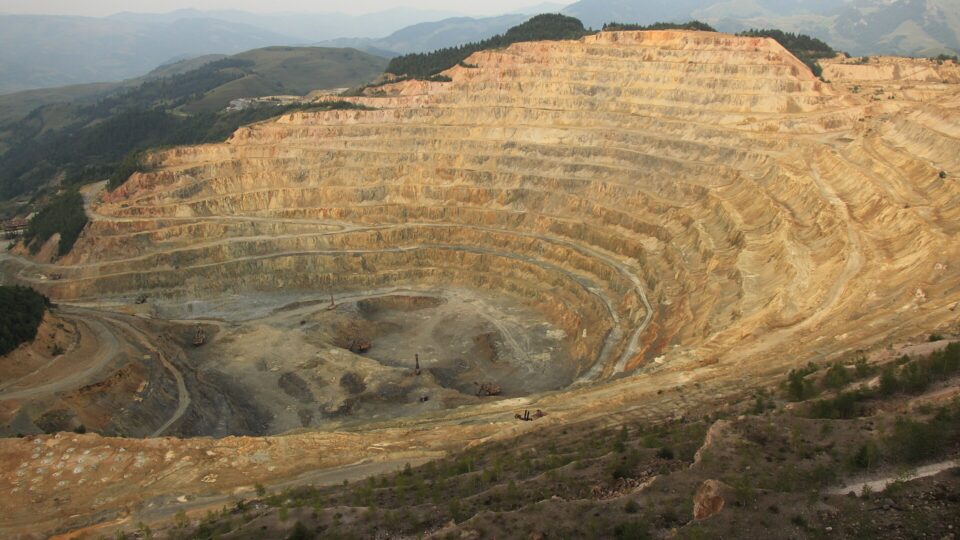
Romania already produces copper at Roșia Poieni through the state-owned company Cupru Min. Company documents indicate that its licence area accounts for around 60% of the country’s copper reserve. Cupru Min is Romania’s significant domestic producer of copper concentrate and operates the country’s largest open-pit copper mine.
This makes copper different from many other resources discussed publicly: it is not merely a potential project, but an existing industry that can be modernised, expanded and better integrated into the European value chain.
Rovina: a project that could add a new European source of copper
Rovina Valley, in the Apuseni Mountains, was included by the European Commission in the first CRMA list in March 2025 as a strategic copper-extraction project. The project is promoted by Euro Sun Mining and includes the Colnic and Rovina deposits and, at a later stage, Cireșata.
The technical document filed in February 2026 identifies, for Colnic and Rovina, 123.3 million tonnes of ore in Proven + Probable reserves, containing approximately 197,522 tonnes of copper and 1.84 million ounces of gold. Cireșata is not included in those reserves and remains a resource for future studies.
The development plan presented by the company envisages a mine life of nearly 17 years, with around 9,000 tonnes of copper a year in the first stage and roughly 106,000 ounces of gold annually.
Rovina is not yet a producing mine, however. It remains in the permitting, planning, environmental and financing process. CRMA status can speed up procedures and improve access to financing, but it does not replace those stages.
Why copper could matter more than gold in 2040
Gold has a high value per kilogram, but copper has a systemic function. An electrified economy uses the metal in vast volumes. Expanding grids for renewables, data centres, heat pumps, charging stations and electric transport means more conductors, cables and transformers.
For Romania, the strategic benefit would not lie only in exporting concentrate. Greater value would arise if part of the chain—refining, processing, cables, electrical components and recycling—remained in the country.
2. Baia de Fier graphite: an ordinary-looking material that is critical for batteries
Natural graphite is the dominant raw material for lithium-ion battery anodes. The industry understandably talks much about lithium, nickel and cobalt, but batteries also use substantial quantities of graphite.
The European Commission estimates that the EU currently extracts less than 0.1% of its natural graphite needs, and that European demand could reach around 480,000 tonnes in 2030. From this perspective, Baia de Fier becomes far more significant than the project’s global scale might suggest.
The SALROM Baia de Fier project was designated an EU strategic project in 2025. SALROM’s published technical plan aims to resume extraction in the historic Ungurelașu and Cătălinu areas and produce at least 15,000 tonnes a year of battery-grade graphite.
The project has an estimated life of about 20 years, and SALROM has indicated commercial-capacity production from 2027 as its target. In August 2026, the government approved the removal of certain assets from the closure programme to allow activity to resume in the area.
Importantly, the 15,000-tonne annual target is planned capacity, not current production.
Baia de Fier could matter more if Romania processes the graphite locally
Extracting concentrate is only the first step. For use in a battery, graphite must be micronised, spheronised, purified and often carbon-coated to become anode material.
In November 2025, SALROM announced a separate project worth around €250 million for an integrated processing facility at Baia de Fier, capable of converting concentrate into CSPG-type products for the lithium-ion industry.
That is the difference between “having graphite” and holding a position in Europe’s battery value chain. The economic and strategic value rises substantially if the material does not leave the country at the concentrate stage.
3. Magnesium: Romania’s project in a market where the EU depends on imports
Magnesium is the lightest structural metal used on an industrial scale. It is used in cars, aviation, defence and alloys where low weight matters.
The European Commission says the EU is completely dependent on imports at the processing stage for metallic magnesium. It is precisely this vulnerability that turned the Verde Magnesium project in Bihor County into a European strategic project.
The first 2025 CRMA list includes Verde Magnesium’s Romanian extraction project. The company says commercial operations are targeted for the end of 2028, scaling up to 30,000 tonnes a year in 2030 and, under its development scenario, up to 90,000 tonnes a year in 2036.
These figures are the developer’s targets, not guaranteed production. They nevertheless illustrate the ambition: bringing primary magnesium production back to Europe after roughly 25 years.
Romania also received a strategic magnesium-processing project in 2026
The second CRMA list, approved by the European Commission on 9 October 2026, includes Verde Magnesium Industries as a processing project in Romania. Separately, the company launched procurement procedures in September for equipment for a calcination facility in Beiuș, including CO₂ capture and purification.
The distinction matters: one project is focused on extraction and the other on processing. Together, they seek to build a domestic chain rather than simply a mine.
4. Battery recycling becomes strategic “urban mining”
The EU list of October 2026 adds another Romanian project: a battery-recycling facility in Răcari, Dâmbovița County, promoted by ECO LIFE STYLE.
The project is intended to recover cobalt, lithium, manganese, graphite and nickel from spent batteries. The fact that a recycling project has received the same strategic status as a mine says something about the next 20 years: a “resource” is no longer only what is extracted from the ground, but also what can be recovered from products already made.
For Romania, this direction could be as important as discovering a new deposit. Batteries will become an increasingly large industrial waste stream, while the materials within them already have mining, chemical and energy infrastructure “embedded” in them.
5. Salt: abundant, but strategic through volume and infrastructure
Salt is not a critical raw material in the CRMA sense. Romania has large resources, and import dependency is not the issue. That can make it seem less spectacular.
Yet SALROM produced approximately 1.123 million tonnes of salt in 2024, including rock salt, solution-mined salt and other grades. The company holds 14 extraction licences for salt and other non-metallic products.
Salt is used in food, chemicals, road treatment and many industrial processes. But the strategic value of salt formations may also increase for another reason: underground caverns.
Strategy and governance documents for Romania’s salt sector mention the possibility of using caverns created through solution mining to store gas. In future, the same geology may become relevant to hydrogen, compressed air or other forms of storage, if projects demonstrate technical and economic feasibility.
That does not mean Romania already has ready-to-use “hydrogen storage sites in salt”. It means a very old geological resource could acquire a new role in an energy system requiring long-duration storage.
6. Black Sea gas: the strategic resource closest to new production
Natural gas is not a critical raw material under the CRMA and is a fossil fuel. Yet for the next 10 to 20 years, it may play a different strategic role: energy security, flexibility for the electricity system and the replacement of some regional imports.
Neptun Deep is Romania’s largest gas project and the country’s first deep-offshore project. OMV Petrom and Romgaz estimate around 100 billion m³ of recoverable volumes, investment of approximately €4 billion and plateau production of around 8 billion m³ a year.
On 28 September 2026, the operators said first gas was expected in the first half of 2027, with the production plateau to be reached by the end of the third quarter of 2027. Seven of the ten development wells had already been completed.
InfoBuz examined the project separately in “Neptun Deep in 2027: who benefits from Black Sea gas and what the €4 billion investment means”.
Strategic does not necessarily mean indefinitely strategic
Gas may have high strategic value in 2027–2040 and a different value thereafter. If electrification, storage and renewable generation grow, gas’s role in final consumption may decline.
Romania’s advantage, therefore, is not only in extracting the gas, but in using the revenue and infrastructure for the next transition: power grids, storage, petrochemicals, biomethane and, where realistic, hydrogen.
7. Geothermal energy: the resource that never leaves Romania by ship
Geothermal energy differs from ores. It does not involve extracting a metal that can be sold anywhere; it uses underground heat locally.
Romania’s best-known geothermal resources are in the west of the country, especially in Bihor County. Oradea already offers a concrete example: the Nufărul I project has installed capacity of around 18 MW, and the municipality said in 2025 that geothermal energy had reached around 15% of the heating system’s annual thermal energy, with a target of exceeding 30% in the following years.
In 2026, Termoficare Oradea reported a share of more than 12% in the previous year and plans for further geothermal development, including in Ioșia Nord.
Geothermal energy’s strategic quality comes from its predictability. Unlike gas, local underground heat does not depend on shipping or geopolitics. For district heating, industry and greenhouses, a well-developed geothermal resource can permanently reduce fuel consumption.
InfoBuz has also examined the new generation of geothermal technologies and why Big Tech is beginning to buy 24/7 geothermal power. Romania does not yet have commercial Fervo-style enhanced geothermal system (EGS) projects, but western Romania’s experience provides a starting point for thermal uses.
What the EU list shows: Romania went from three to five strategic projects
The European Commission’s first CRMA list, approved in March 2025, included three projects in Romania:
- Rovina — copper extraction;
- SALROM Baia de Fier — battery-grade graphite extraction;
- Verde Magnesium — metallic magnesium extraction.
On 9 October 2026, the Commission approved a further 46 projects in the EU. Romania received two additional entries:
- the Răcari battery-recycling facility — cobalt, lithium, manganese, graphite and nickel;
- Verde Magnesium Industries — magnesium processing.
This development matters more than the simple count. Romania’s 2025 profile was dominated by extraction. In 2026, processing and recycling appear explicitly as well. This is exactly the direction the EU is trying to encourage: value chains, rather than only exports of raw material.
The CRMA sets concrete targets for 2030
The Critical Raw Materials Act sets three EU-wide benchmarks for 2030: at least 10% of annual consumption of strategic raw materials is to be covered by extraction in the EU, 40% by processing and 25% by recycling.
The EU is also seeking to avoid excessive dependence on a single external supplier. In graphite and magnesium, this problem is already evident.
For Romania, strategic-project status can bring clearer permitting procedures, visibility among financiers and better access to European instruments. EU status does not, however, automatically turn a project into a completed investment.
What is not included simply because it appears on a geological map
Romania has historical and geological references to lithium, rare earths, tungsten, molybdenum, uranium and other elements. Some appear in strategies and academic studies.
But geological occurrence alone is not enough to say Romania has a strategic commercial reserve. Without sufficient drilling, a classified resource, metallurgical recovery, cost estimates, environmental approvals and an economic study, a figure may be more interesting to geologists than to industry.
This is why this article does not present “billions of euros underground” for lithium or rare earths where there is no modern project with verifiable figures comparable with Rovina, Baia de Fier or Verde Magnesium.
The most valuable resources may be old mining waste
Romania has decades of mining history and, with it, waste heaps and tailings ponds. Some contain metals that were not worth recovering at old prices and with older technologies.
As critical metals become more expensive and separation processes improve, old waste may become a “secondary resource”. The advantage is that the material has already been taken out of the mountain. The disadvantage is that tailings ponds may pose environmental problems and have highly heterogeneous compositions.
This is where mining policy and the circular economy meet: remediation of a site can be linked to recovering residual metals, if studies show that the process is safe and economic.
Romania does not gain strategically by exporting concentrate alone
Real value is created across several stages. Extracted ore can become concentrate; concentrate can be refined; metal can become a component; and that component can be incorporated into a motor, cable, battery or defence system.
The more stages Romania retains, the greater its value added and the lower the risk that a domestic raw material is exported cheaply and reimported expensively as an industrial product.
From this perspective, graphite processing, magnesium processing and battery-recycling projects may be as strategically important as mines themselves.
Which resource has the greatest potential to 2045?
There is no single winner. They address different problems.
- Copper probably has the broadest structural demand because electrification uses it in almost every type of infrastructure.
- Graphite could give Romania a rare position in a European chain that is highly dependent on imports.
- Magnesium has high strategic value for automotive, aerospace and defence industries in an EU without significant primary production.
- Gas has the clearest route to substantial short-term volumes and revenue, but its role will evolve with the energy transition.
- Geothermal energy does not produce raw-material exports, but can displace fuel imports year after year.
- Salt remains a high-volume industrial resource and may acquire new functions through underground storage.
- Recycling could become the fastest-growing source of lithium, cobalt, nickel and graphite without opening a new mine.
What could block all these projects
Geology is only the first condition. At least six further filters follow:
- permitting and the duration of procedures;
- investment financing;
- the cost of energy and processing;
- effects on water and biodiversity;
- acceptance by local communities;
- the existence of a buyer for the final product.
A mine with excellent resources but no permit or financing has a very different economic value from an operation already in production.
Romania has a window of opportunity, not a guarantee
In 2026, Europe is actively trying to bring part of its critical-raw-materials supply chains inside the Union. Demand for copper, graphite, magnesium and battery materials creates an opening that Romania did not have in the same form ten years ago.
The inclusion of five Romanian projects on CRMA lists is a strong institutional signal. But real success will be measured differently: tonnes produced, jobs, taxes, local processing, rehabilitated mining sites and industrial contracts.
Romania does not become the “Saudi Arabia of critical minerals” through a press release. It could, however, become a useful European node if it can combine what it already has underground with what it has often lacked above it: predictable permitting, capital, infrastructure and a processing industry.
Frequently asked questions about Romania’s strategic resources
How many Romanian projects are on the EU strategic list for critical raw materials? After the second round on 9 October 2026, Romania has five distinct entries: three selected in 2025 and two added in 2026.
Does Romania already produce copper? Yes. Cupru Min mines the Roșia Poieni deposit and says it holds the mining right for around 60% of the country’s copper reserve.
Is battery-grade graphite already produced at Baia de Fier? Not at the planned capacity. SALROM is preparing to resume mining and targets a minimum of 15,000 tonnes a year, but that figure is planned capacity.
Why is magnesium important? The EU is completely dependent on imports for processed metallic magnesium, which is used in automotive, aerospace and defence applications.
How much gas is estimated at Neptun Deep? Around 100 billion m³ of recoverable volumes, with plateau production estimated at around 8 billion m³ a year.
Is salt a critical raw material? Not in the CRMA sense. It is nevertheless an important industrial resource, and salt formations may have additional value for underground storage.
Sources and transparency
- European Commission — CRMA strategic-project list, updated in October 2026
- European Commission — Decision 2025/840: Rovina, SALROM Baia de Fier and Verde Magnesium
- Cupru Min — corporate documents on Roșia Poieni and its share of Romania’s copper reserves
- Euro Sun Mining — 2026 technical report/MD&A for Rovina Valley
- SALROM Graphite — Baia de Fier technical summary
- SALROM — €250 million project for graphite processing at Baia de Fier
- Verde Magnesium — strategic project and production targets
- SALROM — annual report on salt production and mining activity
- OMV Petrom — Neptun Deep volumes, production and timetable, 28 September 2026
- Municipality of Oradea — the Nufărul I geothermal project and its district-heating share
- Municipality of Oradea — 2025 results and geothermal expansion in 2026









Discuția cititorilor
Ai o opinie sau o întrebare despre acest articol? Spune-ne ce crezi.
Fii primul care deschide discuția.
Te rugăm să păstrezi un limbaj civilizat și să discuți la subiect. Comentariile spam sunt filtrate automat.