
Drones at Romania’s border have become one of the most persistent security threats on NATO’s eastern flank in 2026. Data updated by Romania’s Ministry of National Defence on 12 November show that, since the start of the war in Ukraine, there have been 179 attacks near Romania’s border, 58 unauthorised incursions into national air or maritime space, and six drones shot down.
The figures matter particularly for Dobruja. Tulcea County, the Danube Delta, the Sulina area and the northern coast are close to Ukrainian Danube ports that have repeatedly been attacked in recent years. Romanian or allied military aircraft have been scrambled on numerous occasions, while residents have received RO-Alert messages.
Drones at Romania’s border: official tally updated on 12 November 2026
According to data published by the Ministry of National Defence, the cumulative situation since the start of the war in Ukraine is as follows:
- 179 attacks near Romania’s border;
- 126 instances in which military aircraft were scrambled for monitoring;
- 58 unauthorised incursions into national air or maritime space;
- 6 drones shot down after unauthorised entry;
- 81 drones or drone fragments identified, recovered or neutralised;
- 9 naval mines neutralised by the Romanian Naval Forces in their area of responsibility.
In 2026 alone, the ministry reports 112 attacks near the border, 91 instances in which aircraft were scrambled, 39 unauthorised incursions, six drones shot down, and 44 cases in which drones or fragments were identified, recovered or neutralised.
The Sulina incident of 10 November
The most recent major episode before the tally was updated took place on 10 November. The ministry’s radar surveillance system detected an aerial target approximately 25 kilometres east of Sulina.
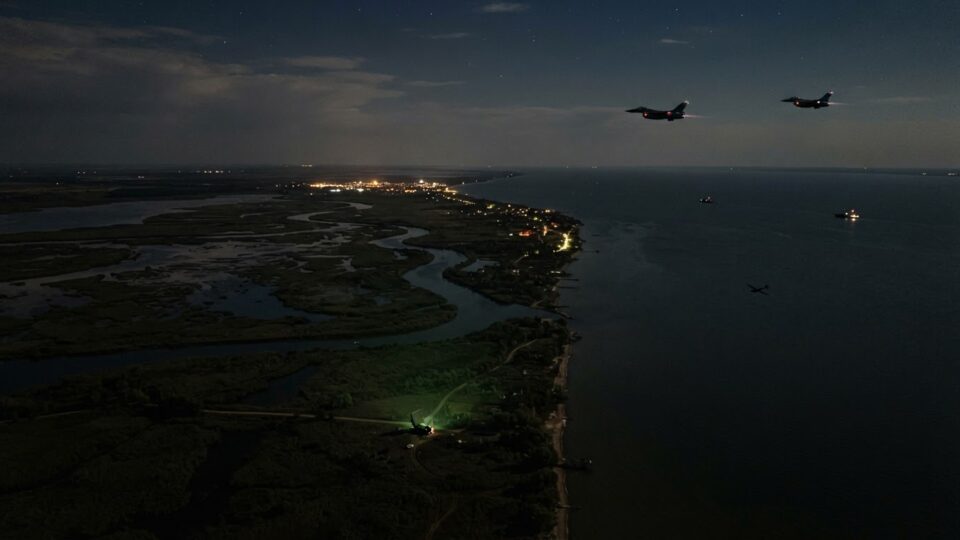
Two Romanian Air Force F-16s on Air Policing combat duty took off from the 86th Air Base at Fetești to monitor the situation. The National Military Command Centre notified the General Inspectorate for Emergency Situations, and an RO-Alert message was issued at 5:31pm to residents in eastern Tulcea County.
The air alert ended at 6:38pm. Such episodes illustrate how quickly a military situation near Ukrainian ports can become a direct security concern for Romania.
Why Tulcea is so exposed
Geography accounts for much of the risk. The Ukrainian ports of Reni and Izmail, as well as the Chilia branch of the Danube, are very close to Romanian territory. Attacks on port and logistics infrastructure along the Danube can bring drones or their fragments close to Romanian airspace.
Some aircraft may stray because of navigation issues, electronic jamming, malfunctions or evasive manoeuvres. Others may cross the border accidentally for short periods. In every case, the authorities must quickly establish the object’s trajectory, the nature of the threat and whether it could strike an inhabited area.
InfoBuz has previously documented the case of drone fragments at Capu Midia and the risk to the coast, as well as incidents involving drones shot down and Black Sea security.
What an “unauthorised incursion” means
An unauthorised incursion does not automatically mean a deliberate attack on Romania. The term indicates that an airborne object entered national air or maritime space without authorisation.
In such a situation, radar systems track the target and command centres determine the level of risk. Fighter aircraft may be scrambled to identify and monitor it, while residents may be warned through RO-Alert if objects or fragments could fall.
The decision to engage a drone depends on several factors: its trajectory, altitude, type, the area it is flying over and the risk to the population.
Why F-16s and allied aircraft are scrambled
NATO Air Policing is a permanent service. Aircraft kept on alert can take off within a very short time when radar detects an unknown or potentially dangerous target.
Romania deploys its own F-16s, while aircraft from allied countries are also periodically deployed under enhanced Air Policing missions. On the night of 2 to 3 November, for example, two Spanish Air Force F-18s took off from the 57th Air Base at Mihail Kogălniceanu after aerial targets were detected near the border, in the Izmail and Chilia areas.
In that case, no incursion into Romanian airspace was confirmed, but residents of northern Tulcea County received an RO-Alert message.
What residents should do when they receive an RO-Alert message
RO-Alert messages issued in Tulcea do not mean that a strike on a locality is inevitable. They are precautionary measures in a situation where a risk cannot be ruled out.
During an alert, the basic advice is to avoid open areas and windows. People should follow the instructions in the message, shelter in a protected area and not travel towards places where objects or fragments have been spotted.
A crashed object should not be touched. Even if it appears destroyed, it may contain explosives, fuel, batteries or hazardous components.
Why not all drones are shot down
Shooting down an object over national territory can create risks of its own. A drone destroyed in the air produces fragments that may fall uncontrollably, including near populated areas.
For that reason, the military response is not automatic. The armed forces continually assess whether intercepting and engaging a target reduces the risk or, conversely, could increase it for people on the ground.
The six drones shot down reported by the Ministry of National Defence in 2026 nevertheless show that Romania has moved from monitoring alone to actually engaging targets when operational conditions have required it.
58 unauthorised incursions: how to interpret the figure
The figure of 58 incursions since the start of the war is significant, but needs to be put in context. It does not mean 58 attacks on Romania. The ministry explicitly distinguishes between attacks conducted near the border and actual incursions into national space.
Still, the increase in incidents in 2026 indicates far greater pressure on the air-surveillance and air-defence system. This year alone, 39 unauthorised incursions have been reported, compared with nine in 2025 and seven in 2024.
This trend helps explain investment in radars, air defence and counter-drone systems, as well as the permanent presence of allied aircraft on Romanian territory.
The role of Mihail Kogălniceanu Air Base
For Dobruja and the coast, the 57th Air Base at Mihail Kogălniceanu is of major strategic importance. Romanian forces, as well as allied contingents and aircraft deployed to reinforce NATO’s eastern flank, operate from the base.
Its location enables a rapid response towards the Danube Delta, the Black Sea and the eastern border. At the same time, the 86th Air Base at Fetești provides an essential part of the F-16 combat-duty service.
Romania has scrambled military aircraft 126 times
One of the most relevant figures in the tally is the number of take-offs to monitor the air situation: 126 cases since the start of the war.
The number reflects how often the air-defence system must move from radar surveillance to an operational response. There have already been 91 such instances in 2026, most triggered by intense military activity near the border.
The risk to Constanța and the coast
Most alerts have been concentrated in Tulcea County, but the security risk does not stop at administrative boundaries. Constanța hosts strategically important military, port, energy and logistics infrastructure, while the Black Sea remains an active military area.
For more on the Black Sea, see Maritime risks in the Black Sea: ships damaged near Sulina and the security of the Port of Constanța, which provides additional details on the subject.
For people in Constanța, the direct risk remains much lower than in communities near the Danube border. However, the incidents at Capu Midia and air activity at Mihail Kogălniceanu show that the coast forms part of the same regional security architecture.
What the 2026 figures tell us
The ministry’s tally shows a clear difference from previous years. In 2024, 26 attacks near the border and seven unauthorised incursions were reported. In 2025, there were 28 attacks and nine incursions. By 12 November 2026, the number had reached 112 attacks and 39 incursions.
The increase does not mean Romania has directly entered the war. It does mean that the effects of the war in Ukraine are appearing ever more often close to national territory, and that defence systems are under much greater strain.
Frequently asked questions
How many drones have entered Romanian space without authorisation?
The Ministry of National Defence reports 58 unauthorised incursions since the start of the war in Ukraine, 39 of them in 2026.
How many drones has Romania shot down?
According to data updated on 12 November 2026, six drones that entered without authorisation were engaged and shot down.
How often have military aircraft been scrambled?
The ministry cites 126 instances since the start of the war, 91 of them in 2026.
Why does Tulcea receive so many RO-Alert messages?
The county is very close to Ukrainian ports on the Danube, which are frequently attacked with drones. Alerts are issued as a precaution when objects or fragments could reach Romanian territory.
Does a drone incursion automatically mean an attack on Romania?
No. An unauthorised incursion can have several causes and does not automatically amount to a deliberate attack. The authorities analyse the trajectory and context of every incident.
Sources: Ministry of National Defence — drone and naval-mine incident situation, updated on 12 November 2026; Ministry of National Defence — the 2/3 November incident; Digi24 — the Sulina incident of 10 November.









Discuția cititorilor
Ai o opinie sau o întrebare despre acest articol? Spune-ne ce crezi.
Fii primul care deschide discuția.
Te rugăm să păstrezi un limbaj civilizat și să discuți la subiect. Comentariile spam sunt filtrate automat.