
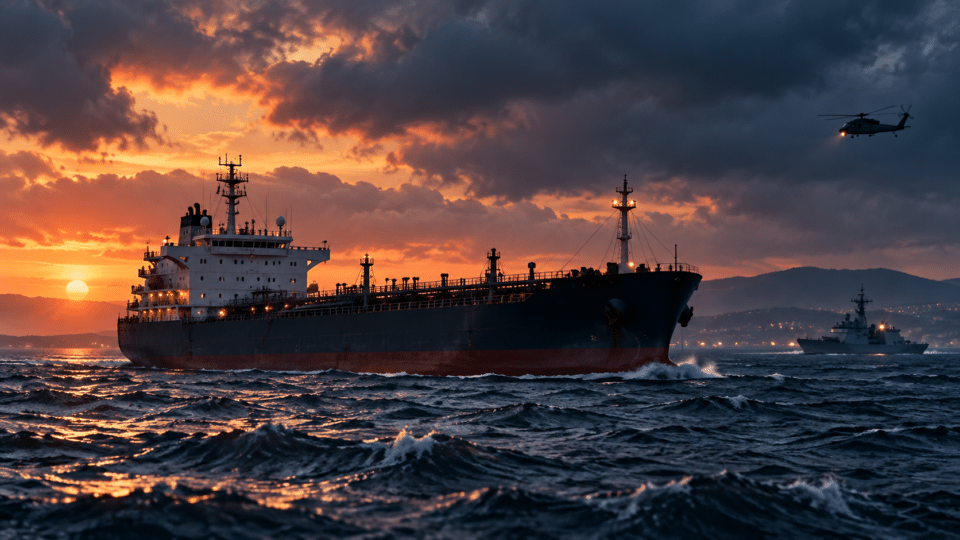
Maritime risks in the Black Sea returned to the forefront after October 2026 incidents involving commercial ships in the western basin, with implications for navigational safety in Romania and Bulgaria. Near Sulina, the Wine Trader sent a distress signal after a fire, and Romanian authorities deployed naval assets and helicopters to rescue the crew. Against the backdrop of several reported incidents in the region, responsibility for each attack and the assessment of risk must be considered separately.
Maritime risks in the Black Sea: what is confirmed about the Wine Trader
According to information released by the Romanian Naval Authority and reported by AGERPRES on 15 October, the San Marino-flagged vessel was approximately 13 nautical miles southeast of Sulina, had 12 people on board and reported a fire in its superstructure. The authority said at the time that five crew members had been rescued and seven were missing. It also stated that the vessel was not carrying cargo. This last point matters: its description as a “chemical-products vessel” should not be confused with the actual transport of a hazardous cargo at the time of the incident.
In its 15 October statement, the Ministry of Internal Affairs described the deployment of Border Police, the General Inspectorate for Emergency Situations (IGSU), the General Aviation Inspectorate, two Black Hawk helicopters and intervention boats. Difficult weather and sea conditions hampered the mission. On 16 October, IGSU announced that operations had resumed with air crews and the intervention vessel Fifi MAI 0101. The status of those being sought may change; the figures above are explicitly attributed to official updates of 15–16 October and are not presented as a final toll.
Were drones the cause? What can and cannot be said
Media reports, including by the Associated Press, place the incident within a series of reported drone attacks on commercial vessels in the Romanian and Bulgarian areas of the Black Sea. However, a suspicion or an intelligence assessment is not the same as a definitive public conclusion from a technical and judicial investigation. The identification of munitions, the flight path, the launch operator and intent are separate questions. It is not rigorous to automatically attribute the same cause or perpetrator to every case of damage.
The regional context is serious even without a final conclusion on each incident. In a July 2026 statement, the International Maritime Organization (IMO) had already condemned attacks on commercial ships in the Black Sea and the Sea of Azov, warning of the danger to seafarers, logistics chains and the marine environment. See also InfoBuz’s analysis of the reported naval incidents in the Bulgarian area.
Why the difference between the territorial sea and the exclusive economic zone matters
Under the UN Convention on the Law of the Sea (UNCLOS), the territorial sea may extend up to 12 nautical miles from the baselines, with the coastal state exercising sovereignty there in accordance with international law. The exclusive economic zone (EEZ), which may extend up to 200 nautical miles, grants functional sovereign rights over resources and certain jurisdiction, but is not legally equivalent to the territory of the state. Exact coordinates and baselines matter; a simple distance from the town of Sulina does not by itself determine the legal regime governing a location.
This distinction becomes crucial in discussions of NATO. Articles 4, 5 and 6 of the North Atlantic Treaty have different roles. Article 4 allows consultations when an ally considers its security to be threatened. Article 5 concerns armed attack and collective defence, while Article 6 defines the area to which the treaty applies. Neither the mere presence of a drone in an EEZ nor an incident involving a foreign-flagged commercial vessel automatically triggers Article 5. Any political and legal assessment belongs to the allies, based on confirmed circumstances.
What crews face: from fire to abandoning ship
For seafarers, the immediate risk is not abstract. An explosion, fire or loss of manoeuvrability can affect communications and firefighting systems, access to lifesaving equipment and the ability to receive assistance in strong winds. In the case of oil or chemical tankers, the risk assessment also depends on the type of cargo actually on board, the atmosphere in the tanks and the integrity of compartments. A major pollution event cannot be inferred from the type of vessel alone.
Seafarers need updated alerts, route assessments, risk-control measures and tailored emergency procedures. These do not eliminate the threat, but they can reduce response times and the consequences of an incident.
What it means for Port of Constanța and trade
Heightened risk in the western Black Sea may increase insurance costs, alter port-call planning and lead operators to reassess routes, without automatically meaning that Port of Constanța is closed or that shipping has been disrupted. In the absence of a statement from the port administration on specific restrictions, no suspension of operations should be announced.
For more information about Port of Constanța, see Port of Constanța changes authentication from 19 October: what companies using the APMC Portal need to know, which provides complementary details on this subject.
The economic impact may emerge indirectly through risk premiums, delays, additional security checks, supply and chartering. Each effect requires concrete data from authorities, shipowners or insurers, rather than extrapolations from a single incident.
Five questions that still need answers
- What is the investigation’s conclusion on the cause of the fire aboard the Wine Trader?
- What is the final status of the crew, as confirmed by the rescue authority?
- What verifiable technical information exists on the type and origin of any drones involved?
- Have new navigational warnings or traffic restrictions been issued for the areas concerned?
- What measures to protect commercial routes have been officially communicated by authorities and NATO?
Named sources and update
Ministry of Internal Affairs — rescue mission, 15 October 2026; AGERPRES / IGSU — 16 October 2026 update; AGERPRES / Romanian Naval Authority — vessel and crew information; IMO — warning on attacks on commercial ships; UN — UNCLOS, Part V, exclusive economic zone; NATO — text of the North Atlantic Treaty.








Discuția cititorilor
Ai o opinie sau o întrebare despre acest articol? Spune-ne ce crezi.
Fii primul care deschide discuția.
Te rugăm să păstrezi un limbaj civilizat și să discuți la subiect. Comentariile spam sunt filtrate automat.