
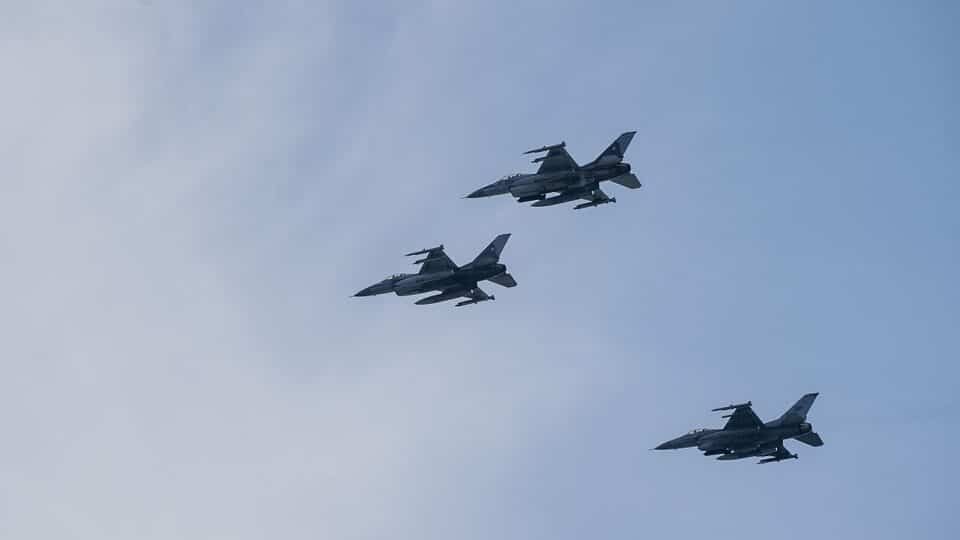
Two drones downed by Romanian F-16s, commercial ships hit near Sulina, and a meeting of Romania’s Supreme Council of National Defence (CSAT) called for 22 October 2026. These are three parts of the same security crisis, one that has brought the risks of the war in Ukraine ever closer to civilian shipping and Romania’s waters. Within just a few days, air and maritime incidents raised urgent questions: who protects ships, what does an incursion into national airspace mean, and how quickly can NATO respond?
The answer is not an alarmist scenario of imminent war. Black Sea security depends on verifiable facts, essential legal distinctions and concrete protective measures. This article brings together statements from Romania’s Ministry of National Defence, publicly available institutional data, maritime rules and reporting by international news agencies, separating what has been confirmed from hypotheses still under investigation.
What happened on 17 October: two Geran drones downed in Romanian airspace
On Saturday, 17 October 2026, the Ministry of National Defence’s radar systems detected several aerial targets moving from east of Snake Island towards the south-west. Two Romanian Air Force F-16s from the 86th Air Base at Borcea were on air-policing duty and took off at 17:43. The first drone entered Romanian airspace at 17:59 and was downed at 18:01; the second entered at 18:01 and was neutralised at 18:05.
Both targets were destroyed over Romanian territorial waters, in the maritime area near Sulina. The ministry identified the devices as jet-powered attack drones from the Geran family. This distinction matters: these were not simply drone fragments found after an attack in Ukraine, but an active interception of aircraft that had entered national airspace. The precise data and timings appear in the Ministry of National Defence’s official statement of 17 October.
A timeline of incidents that changed the security climate
- 5 October: a commercial vessel carrying corn was hit in Romania’s exclusive economic zone; two deaths and 11 people rescued were reported, according to the Associated Press.
- 14–15 October: further aerial incidents prompted the scramble of Romanian F-16s and Spanish F/A-18s deployed on an Allied mission. Public alerts were issued in Tulcea County.
- 15 October: two tanker/chemical carriers caught fire offshore near Romania’s coast. Search-and-rescue operations followed, along with an investigation into the causes.
- 17 October: two Geran drones were downed by F-16s over Romanian territorial waters.
- 21 October: the Presidential Administration announced that CSAT would meet on Thursday, 22 October, at 18:00.
This timeline shows a series of different incidents. Some occurred near the border, others in national airspace or offshore, at locations governed by distinct legal regimes. They should not automatically be combined into a single “attack on Romania”, nor attributed to the same party without an investigation. Their repetition nevertheless creates a practical security problem that the authorities cannot ignore.
Commercial ships hit: why the danger to seafarers is greater than it appears from shore
At sea, only seconds can separate a military incident from a humanitarian disaster. An explosion aboard a commercial vessel can cause fire, loss of propulsion, flooding of compartments or make it impossible to recover the crew, especially in difficult weather. In the case of the Wine Trader, near Sulina, initial reports on 15 October said that seven seafarers were missing while rescuers operated in harsh conditions. The status of those missing must be tracked through updated official statements, rather than treated as a final toll.
Reuters reported on 15 October that two chemical cargo ships caught fire in waters near Romania following drone incidents in the region. At that point, Romanian authorities had not publicly established a definite causal link between each fire and the drones observed in the airspace. The qualification is crucial: the fact that ships were damaged is different from an official identification of the perpetrator and the mechanism behind each attack.
The series of strikes near Bulgaria and Romania had already been documented. For the sequence of maritime incidents and their impact on the Port of Constanța, InfoBuz published the analysis “Maritime Risks in the Black Sea: Ships Damaged Near Sulina”, as well as its report on ships hit in the Bulgarian area in early October. The new element is the combination of attacks on commercial shipping and the direct response by Romanian military aircraft.
How frequent have drone incidents become? Ministry of National Defence data
The picture is not limited to a handful of dramatic news reports. In the Ministry of National Defence’s public tally, updated on 21 October 2026, the institution counted, since the beginning of the war, 165 attacks near the border, 112 aircraft scrambles, 54 unauthorised incursions and six drones downed. The same record includes 81 cases involving the identification of drones or drone fragments, and nine sea mines either neutralised or washed ashore.
For 2026, the ministry’s data recorded 98 attacks near the border, 77 air-force interventions, 35 unauthorised incursions and six drones downed, as of the update cited. These categories should not be added together to calculate a “total number of attacks against Romania”: they measure different types of operational situation, sometimes connected to the same episode. The figures describe the intensity of surveillance and incidents; they do not constitute an official statement that all were deliberate attacks on Romanian territory.
What jet-powered Geran drones mean
The Geran family is associated with attack drones used by Russia in its war against Ukraine. The Ministry of National Defence statement, however, specified a technical detail: the aircraft intercepted on 17 October were jet-powered. It is therefore inaccurate to describe them simply as slow propeller-driven models without taking the official identification into account.
For air defence, speed, altitude, direction of flight and propulsion type alter the time available to identify a target and choose an interception method. Not every detected target has to be shot down immediately: it must be classified, the danger to civilians and traffic assessed, and rules of engagement applied. The operation of 17 October illustrates a confirmed military response; sensitive procedural details and the full radar data are not public.
Territorial waters or an exclusive economic zone? The distinction that matters for NATO
One of the terms most often confused is “Romania’s waters”. Under the law of the sea, the territorial sea may extend up to 12 nautical miles from the baselines. The coastal state exercises sovereignty over it, including the airspace above it, under Articles 2 and 3 of the UN Convention on the Law of the Sea (UNCLOS). A drone entering the airspace above the territorial sea without authorisation therefore presents a direct issue of violation of national airspace.
The exclusive economic zone, or EEZ, is different. Within it, the coastal state has sovereign rights and specific jurisdiction over resources and certain economic activities, but it does not exercise the same territorial sovereignty over the entire maritime or air space as it does in the territorial sea. In the Black Sea, maritime delimitations between states matter in practice. A ship hit in an EEZ and a drone downed above territorial waters are therefore serious events, but not legally identical ones.
For more on the Black Sea, see also “The Black Sea’s Anoxic Zone: A World Without Oxygen Where Methane, Sulphur and Microbes Replace Fish”, which provides additional background on the sea.
This distinction does not diminish the gravity of attacks on civilian vessels. It explains why claims such as “NATO was automatically attacked” or “Article 5 applies automatically to any explosion in the EEZ” are too categorical. Establishing the facts, the exact location and the legal classification are necessary steps before collective responses can be discussed.
What NATO can do, and why Article 4 is not Article 5
Two Alliance mechanisms are often cited in crises of this kind. Article 4 of the North Atlantic Treaty allows a member state to request consultations when it considers its territorial integrity, political independence or security to be threatened. Such consultations can lead to assistance, surveillance, coordination or stronger defensive measures. They are not, however, a declaration of war.
Article 5 concerns collective defence in the event of an armed attack. NATO explains that the assessment of such an attack depends on the circumstances, and that Article 4 consultations are neither a mandatory requirement nor an automatic trigger for Article 5. The distinction is fundamental for the public: every serious incident merits a response and investigation, but not every incident automatically requires all Allies to use military force.
According to a report published by The Guardian on 20 October, Allies also discussed stepping up maritime and air surveillance in the context of attacks on commercial vessels. Patrols, information-sharing, drone detection and the defence of infrastructure can be reinforced without such a development necessarily meaning direct military confrontation between NATO and Russia.
Why CSAT is meeting on 22 October, and what is known about its official agenda
On 21 October, the Presidential Administration announced that President Nicușor Dan had convened a meeting of the Supreme Council of National Defence for Thursday, 22 October 2026, at 18:00, at the Cotroceni Palace. According to the official statement carried by AGERPRES, the meeting will examine the security implications of the Black Sea incidents and measures to improve Romania’s response capacity in protecting territorial waters and critical maritime infrastructure.
The published agenda does not list decisions already taken, announce a general mobilisation or state that Article 5 has been activated. Actual decisions can only be presented after the meeting, if the authorities make them public. Until then, discussion of what CSAT “will decide” must remain about possible options and priorities, not invented outcomes.
What could be strengthened: air defence, ports and ship safety
The first logical priority is a shared operational picture: radar systems, aircraft, port authorities and search-and-rescue bodies must be able to quickly correlate an object in the air with a vessel’s movement and the risk to people. In the context of drones, both early detection and coordinated intervention matter, to reduce danger to crews, coastal populations and lawful traffic.
A second possible direction, though not a confirmed CSAT decision, is stronger protection of critical points: ports, Danube access routes, energy facilities and offshore platforms. Protection does not mean air-defence weapons alone; it also involves navigation procedures, monitoring, emergency measures, communications and plans for incidents involving hazardous materials carried by sea.
A third area is international cooperation. Romania can request Allied consultations and support, intensify joint exercises and update protocols between civilian and military authorities. These are security-policy options, not an announcement that a particular system will be installed tomorrow or that escorts for all commercial ships have already been approved.
The Port of Constanța, Sulina and offshore infrastructure: why the stakes are economic
The Black Sea is not only a military frontier. It is also a commercial gateway for grain, fuels, raw materials and containerised goods, while the Port of Constanța and Danube access channels play a strategic role. Even if port activity continues, repeated incidents can affect insurance costs, companies’ appetite for particular routes and the organisation of transport operations. These effects depend on commercial assessments and developments on the ground; they do not automatically follow from every air alert.
Romania is also developing offshore energy projects. Neptun Deep, where production is estimated to begin in 2027, illustrates the growing importance of protecting offshore installations. Mentioning strategic infrastructure does not mean it was targeted in the October incidents: without evidence or an official statement, it would be unjustified to claim that the project was attacked.
What this means for people in Tulcea and along the coast
For residents near the border, such incidents often mean sirens, RO-Alert messages and the sound of aircraft scrambled on missions. An alert is a preventive measure in response to an assessed risk, not evidence that a locality has been attacked. On 14 and 15 October, the Ministry of National Defence reported several air missions and alerts in Tulcea County in connection with targets detected near the border.
When a RO-Alert is issued, the public should follow the specific instructions of the authorities, rather than rumours spread on social media. People should not travel to places where drone debris or suspicious objects may be present. Reporting such items through official channels and avoiding handling any fragments are common-sense precautions, particularly when their origin and payload have not been established.
Three scenarios to watch after the CSAT meeting
- Stronger prevention: authorities announce surveillance measures and coordination with Allies, without dramatic changes to public life. This is a possible scenario, not an announced decision.
- Greater diplomatic and military pressure: Romania requests additional support and NATO increases certain missions. The details would need institutional confirmation.
- Further incidents: if airspace incursions or maritime attacks continue, risk assessments and defence decisions could change rapidly. Neither the future severity nor responsibility for new attacks can be assumed.
What is visible now is a security crisis with real consequences, but still-open outcomes. A serious assessment requires monitoring statements from the Ministry of National Defence, the Presidential Administration and NATO, rather than treating every rumour as an official announcement. Accurate reporting matters all the more when tensions are rising.
Frequently asked questions about Black Sea security
Did Romania down two Russian drones on 17 October 2026?
The Ministry of National Defence confirms that Romanian F-16s downed two jet-powered Geran-family attack drones over Romania’s territorial waters. The model is associated with Russia’s arsenal, while the technical identification and timeline appear in the ministry’s official statement.
Were the commercial ships hit in territorial waters or in the exclusive economic zone?
The incidents took place in different areas, both near territorial waters and in the exclusive economic zones of coastal states. The location of each case must be checked separately, since the two spaces are governed by different legal regimes.
Has NATO’s Article 5 been activated?
There was no announcement in official information verified on 21 October that Article 5 had been activated in response to these incidents. Consultations and requests to strengthen security do not amount to the automatic activation of collective defence.
When will the CSAT meeting on the Black Sea take place?
The meeting is scheduled for Thursday, 22 October 2026, at 18:00, at the Cotroceni Palace. The official agenda concerns Black Sea security and protection of critical maritime infrastructure. Its conclusions must be checked after the meeting has taken place.
Sources and verified documents
- Ministry of National Defence — 17 October 2026 statement on the interception of Geran drones.
- Ministry of National Defence — official tally of drone and sea-mine incidents, updated on 21 October 2026.
- Presidential Administration, via AGERPRES — announcement of the CSAT meeting of 22 October 2026.
- Reuters, 15 October 2026 — fires aboard commercial ships and rescue operations.
- Associated Press, 5 October 2026 — attack on a commercial ship carrying corn.
- NATO — Article 4 and NATO — Article 5, institutional explanations.
- United Nations — UNCLOS on the territorial sea and the airspace above it.
Reporting date: 21 October 2026. This article examines the facts known before the CSAT meeting scheduled for 22 October. Information on the following day’s decisions and maritime investigations can be updated only after new official statements are issued.








Discuția cititorilor
Ai o opinie sau o întrebare despre acest articol? Spune-ne ce crezi.
Fii primul care deschide discuția.
Te rugăm să păstrezi un limbaj civilizat și să discuți la subiect. Comentariile spam sunt filtrate automat.