
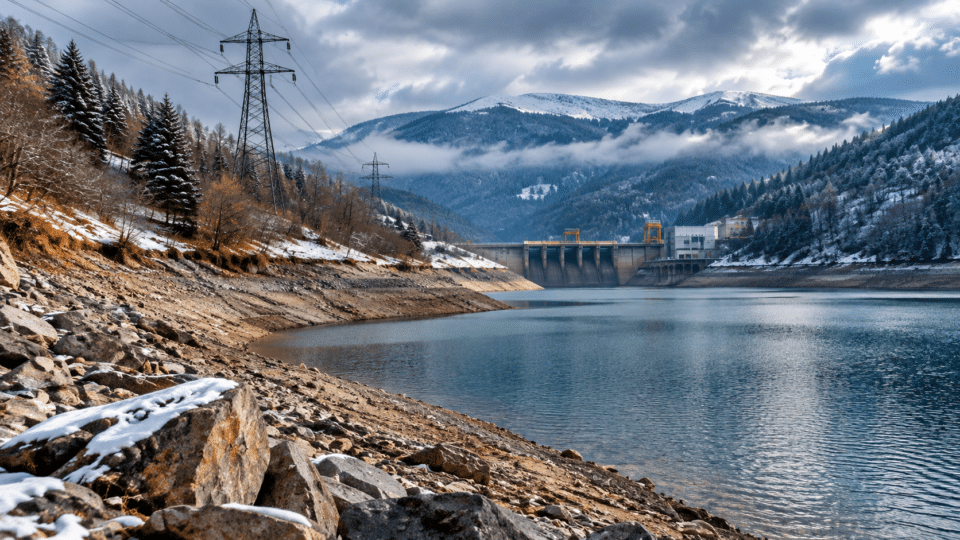
Winter 2026–2027 presents a challenge for Romania’s energy security: ENTSO-E forecasts low hydropower reserves, but does not automatically predict power cuts.
Europe is entering winter 2026–2027 with substantially more renewable generation capacity and battery storage capacity that has doubled. Romania, however, faces a different issue: the flexibility provided by hydropower plants has been reduced after drought, and the European operators’ report expects energy reserves in the main reservoirs to be below 50% at the start of the season. This is the difference between a reassuring European average and a country’s specific vulnerabilities.
This InfoBuz analysis draws on ENTSO-E’s Winter Outlook 2026–2027, published on 13 November, and, crucially, on the separate technical commentary for Romania. It does not portray a blackout as inevitable; it explains the conditions that could place the system under strain.
Europe in three figures: +134 GW, 38 GW and almost -6 GW
- About +134 GW (+16%) of new installed renewable capacity compared with the previous winter, mainly solar photovoltaic capacity.
- 38 GW of battery energy-storage power capacity across the continent, more than twice the previously reported level.
- Almost 6 GW less hard-coal and lignite capacity; the transition is reducing some conventional generation while increasing the flexibility provided by batteries.
ENTSO-E’s overall conclusion is favourable for electricity supply adequacy in Europe. It nevertheless identifies specific risks for Cyprus, Malta and Ireland, partly mitigated in the latter two countries by dedicated resources, as well as residual risks in some northern European systems. Ukraine and the Republic of Moldova are assessed in a separate context. A Europe-wide conclusion should not be treated as a uniform guarantee for every region.
Romania: hydropower reserves estimated below 50%, but the figure needs context
The country document says that prolonged drought during the summer and early autumn of 2026 reduced water inflows and hydropower availability. From August onwards, stored water was used intensively during demand peaks to offset a significant fall in nuclear generation. The result is that energy reserves in the main reservoirs are estimated to be below 50% at the start of winter.
Importantly: this figure refers to the energy reserves associated with hydropower reservoirs. It does not mean that every reservoir in Romania is less than half full by volume. Nor is it a report of the current water level at each dam. It is a seasonal assessment and should be read accordingly.
Two demand scenarios: a normal winter and a colder one
Reference scenario
For the period from November 2026 to March 2027, consumption is projected at around 24.9 TWh, approximately 1.3% higher than in the previous winter. Peak demand could reach 9.1 GW.
Colder-winter scenario
The estimate rises to around 25.7 TWh, roughly 4.9% above the previous season, with a potential peak of 9.5 GW. These are planning scenarios, not actual consumption figures or precise weather forecasts. An increase in maximum power demand can put pressure on available flexibility at certain hours, even if total energy demand for the season rises less dramatically.
Five variables that matter more than an alarmist headline
1. Water available to hydropower plants
Hydropower plants can respond quickly to changes in demand, but cannot repeatedly provide the same flexibility when stored resources are limited. The management of reserves in the first months of winter may affect the safety margin towards the end of the season.
2. Availability of nuclear and gas-fired units
The report explicitly notes that an unplanned outage at major units, including the Brazi power plant or one or more units at Cernavodă, would increase pressure if it coincided with low hydropower and renewable output. This is a risk scenario, not a statement that those plants will be taken offline.
3. Gas needed for both heating and electricity generation
A prolonged cold spell can simultaneously increase gas demand for heating and for power plants. If other technologies are constrained, the availability of gas-fired generation becomes even more important.
4. Imports from the region
The national commentary anticipates that Romania will be a net importer of electricity during the winter. Imports do not automatically indicate a system failure: interconnected markets are designed to exchange electricity. The risk arises if several countries require electricity at the same time while interconnection capacity or available regional energy is limited. The report also notes potentially high demand from the Republic of Moldova and Ukraine.
5. Deferred maintenance work
Some planned work on transmission infrastructure was postponed during the summer to preserve import capacity. If it has to be rescheduled in winter, some network configurations could temporarily have lower cross-border capacity or additional congestion.
Three scenarios in plain language
- Manageable scenario: demand remains close to the forecast, hydropower is managed prudently, conventional generation is available and import flows function. The system has several balancing options.
- Strained scenario: persistent cold, weak wind and modest solar output during evening peaks coincide with limited hydropower. The need for flexible generation and imports may increase.
- Combined stress scenario: a major unplanned outage coincides with high demand, low hydropower reserves and restricted imports. This is a vulnerability-analysis exercise, not a prediction that power cuts will occur.
Does this automatically mean higher bills or power cuts? No
An adequacy report examines the system’s likely ability to balance supply and demand under certain conditions. It does not set the final tariff charged by each supplier and cannot predict the price on an individual consumer’s bill. Prices also depend on contracts, tariff structures, energy markets and applicable legislative interventions.
Likewise, a narrower adequacy margin is not an announcement of a blackout. Dispatching, cross-border exchanges and safety measures exist precisely to manage difficult situations.
The dashboard worth watching throughout the winter
- Hydropower reserves: the indicator of energy available in reservoirs and its weekly trend, rather than a single percentage taken out of context.
- Peak demand: the power required in the most demanding hours, compared with the 9.1–9.5 GW scenarios.
- Availability of dispatchable generation: especially nuclear, gas-fired and other capacity that can respond to demand.
- Net imports and interconnection capacity: how much supply is entering the country and whether there are constraints or scheduled works.
- Regional weather: temperatures, wind, solar irradiation and precipitation, interpreted together rather than in isolation.
InfoBuz conclusion
The accurate picture of winter 2026–2027 is paradoxical: Europe is adding renewable generation and storage, while Romania must manage its water resources and reliance on regional flexibility more carefully. Neither absolute optimism nor panic is supported by the documents reviewed. The most useful approach is to monitor the indicators and update the explanation as new data emerge.
Winter 2026–2027: what the ENTSO-E report indicates for Romania
Winter 2026–2027 will test the flexibility of Romania’s electricity system, but the ENTSO-E outlook does not say that the country will run out of electricity. The energy reserve in the main reservoirs is estimated at below 50% at the beginning of the season. This indicator concerns the energy available in reservoirs; it neither means that all reservoirs are at the same level nor that half of the country’s generation is missing.
In the average scenario, consumption from November 2026 to March 2027 is estimated at 24.9 TWh, with a peak of 9.1 GW; in a colder scenario, consumption could reach 25.7 TWh, with a peak of 9.5 GW. These figures are projections, not measured actual consumption. Source: ENTSO-E, Romania country commentary, pp. 37–38.
At European level, the addition of around 134 GW in renewable capacity and battery power capacity reaching 38 GW improve operating options. However, GW measures power, not the number of hours for which storage can provide energy. For context, read InfoBuz’s analysis of connecting renewable projects in Romania to the grid.
The lead image is an AI-generated editorial illustration, not a documentary photograph of a dam in Romania.
Sources, review date and limitations
Analysis conducted on 17 November 2026. The consumption figures are scenarios, while ENTSO-E’s national commentaries provide operational context that is not always fully modelled in the European assessment. The editorial examples of stress factors should not be interpreted as certain future events.






Discuția cititorilor
Ai o opinie sau o întrebare despre acest articol? Spune-ne ce crezi.
Fii primul care deschide discuția.
Te rugăm să păstrezi un limbaj civilizat și să discuți la subiect. Comentariile spam sunt filtrate automat.