
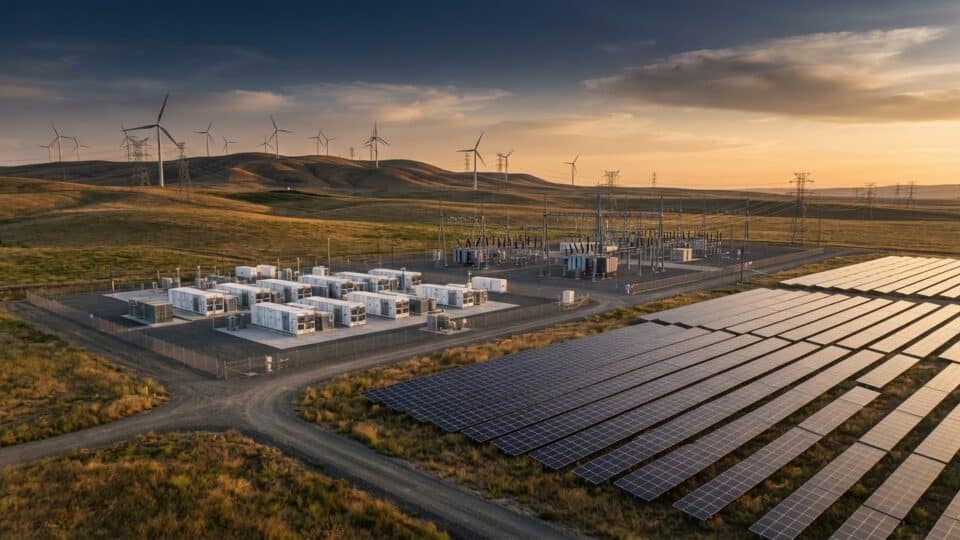
Green energy in 2026: the IEA report explains why the expansion of solar and wind generation cannot be separated from investment in grids, storage and flexible consumption.
Renewable energy could become the dominant source of new power-generation capacity worldwide, but one of the decade’s central questions is not how many panels are installed, but how many megawatt-hours can be used when the sun and wind are generating. The International Energy Agency’s (IEA) Renewables 2026 report, published on 6 November 2026, forecasts an increase of nearly 4,800 GW in global renewable capacity over 2026–2031. It also warns that forced reductions in generation during periods of surplus could exceed 800 TWh a year by 2031 in the key markets assessed.
This is the paradox of abundant energy: installations may be capable of producing cheap electricity while grids cannot absorb all of it, wholesale prices may turn negative, and household bills may not automatically fall. InfoBuz has separated the IEA’s global forecasts from their possible implications for Romania, without presenting scenarios as certainties.
What the IEA report published in November 2026 actually says
- Nearly 4,800 GW of additional renewable capacity is forecast worldwide for 2026–2031, around 57% more than the increase recorded over the previous six years.
- More than three-quarters of the forecast growth in renewable capacity is expected to come from solar photovoltaic technology.
- From 33% in 2025 to nearly 45% in 2031: the estimated rise, according to the executive summary, in renewables’ share of global electricity generation.
- About 200 TWh in 2025 and potentially more than 800 TWh in 2031: the volume of technically curtailed solar and wind generation in the key markets tracked, according to the IEA forecast.
- More than 670 GWh in 2031: the projected global capacity of behind-the-meter battery storage at consumer sites in the main scenario.
All these figures are IEA data and forecasts, not measurements for Romania. Source: IEA, Renewables 2026 — Executive summary, published on 6 November 2026.
The first point many reports miss: GW are not TWh
A gigawatt (GW) measures electrical power or capacity. A terawatt-hour (TWh) measures energy produced or consumed over a period. Installing new solar capacity alone does not establish how much energy it will supply each year: the result depends on irradiation, orientation, availability, grid constraints and operating hours.
Directly comparing “4,800 GW of new capacity” with “800 TWh of curtailed energy” would be like comparing an engine’s power with the number of kilometres travelled. Both figures matter, but they measure different things.
What curtailment means: when energy is available but cannot be delivered
Forced generation reductions occur when operators of variable sources, such as solar and wind plants, generate less than natural conditions would allow for technical reasons, system-security requirements, or constraints on demand and the grid. It does not necessarily mean that a particular panel has failed or that power has been lost in cables. It means that some of the potential generation does not become electricity delivered to consumers.
The IEA says this technical curtailment nearly doubled in 2024 and again in 2025 in the key markets assessed. Its estimate for 2031 could exceed 800 TWh, equivalent to nearly 8% of relevant variable renewable generation in the scenario. This is an infrastructure- and policy-implementation-dependent forecast, not an outcome that has already occurred.
Why a negative wholesale price does not mean free electricity at home
During some hours, available generation can exceed demand and system flexibility; wholesale markets can signal this through very low or negative prices. But the wholesale price for a short interval is not the same as the final amount paid by a customer. Supply contracts, grid charges, taxes and tariff structures are governed by separate rules.
A fixed-price offer or a bill made up of several components does not automatically become negative merely because an electricity market traded below zero for several hours. It is essential not to confuse the spot price, the contractual price and the final bill.
Why batteries may become infrastructure, not merely an accessory to solar panels
A battery can shift part of electricity consumption from hours of high solar generation to the evening or night. But the usable energy stored, charging and discharging power, conversion losses, degradation, operating regime and applicable prices must all be considered.
The IEA estimates that consumer-side storage will grow almost sixfold, exceeding 670 GWh by 2031, and that more than one-third of residential photovoltaic systems could include batteries. This is a global forecast; it does not demonstrate that every household installation in Romania would achieve the same savings or payback period.
The invisible bottleneck: 3,000 GW in advanced grid-connection queues
Another major finding in the report is the rise to around 3,000 GW of renewable projects at advanced stages in global grid-connection queues. The IEA says the increase in applications comes from batteries and hybrid projects. A connection application is not the same as a power plant that has been built and is operating, while reforming connection rules can remove speculative or less viable projects.
This is why Romania should be assessed separately in terms of announced capacity, capacity with approvals, financed capacity, capacity under construction and capacity actually commissioned. InfoBuz previously documented the gap between permits and real-world generation in “Romania’s paper green-energy boom”.
Three scenarios for the coming years
Scenario 1: New capacity while grids fall behind
Panels and turbines are installed quickly, but investment in transformers, transmission lines and interconnectors progresses more slowly. The likely result is greater pressure to curtail generation and sharper price volatility at certain times. This is a possibility examined in the report, not a specific forecast for a Romanian county.
Scenario 2: Batteries and flexible consumption
Storage and shifting certain types of consumption to favourable hours reduce part of the imbalance. Conceptual examples include controlled charging of electric vehicles, flexible industrial processes and storage systems operated in coordination with the grid. The benefit depends on tariff rules and actual investment.
Scenario 3: Modernised grids and better regional exchanges
Expanded interconnections, automation, dispatching and market mechanisms can allow energy available in one region to reach places where there is demand. Large renewable capacity has full economic value only if it can deliver energy when it is useful.
What this means for Romania and prosumers
The IEA report is global. It cannot determine Romania’s future kWh price, the exact level of ANRE tariffs, the bill settlement for a particular prosumer or the profitability of a local project. It does, however, provide a framework for interpretation: the number of panels is not enough; grid connection, storage and the ability to use the electricity must also be considered.
For individual decisions, a homeowner should compare hourly consumption with hourly generation, the battery’s power and usable energy, and the terms of their specific contract. An investor needs to examine connection conditions and exposure to hourly prices. For relevant Romanian rules, see InfoBuz’s analysis of prosumer compensation.
Frequently asked questions
Does this mean that 800 TWh will definitely be “thrown away” in 2031?
No. It is an IEA estimate for the technical curtailment of potential generation in key markets, under a scenario. Infrastructure and rules can change the outcome.
Why build renewables if they are sometimes switched off?
Because they supply energy in many other hours and diversify supply. The integration challenge does not cancel their benefits, but it does show the need for grids, storage and flexibility.
Is a battery worthwhile for every home with solar panels?
No. It depends on the consumption profile, prices, equipment cost, regulation and conversion losses.
Do negative wholesale prices immediately appear on my bill?
Not necessarily. The contract and the regulated or commercial components of the bill matter.
When will solar become the world’s leading renewable source?
The IEA estimates that solar generation will overtake hydropower in 2029; this is a forecast, not an outcome already confirmed.
Green energy: why 4,800 GW are not 800 TWh
Green energy can grow strongly in installed capacity, but grids cannot always absorb all potential generation. The IEA’s Renewables 2026 report forecasts nearly 4,800 GW of additional renewable capacity over 2026–2031. GW measure power, while TWh measure energy accumulated over a period; the figures are not directly comparable.
According to the IEA, the technical curtailment of wind and solar generation in key markets reached nearly 200 TWh in 2025 and could exceed 800 TWh a year in 2031, equivalent to around 8% of variable renewable generation in the markets assessed. This is a scenario, not a loss that has already occurred, and the figure does not apply exclusively to Romania. Source: IEA Renewables 2026 — Executive summary.
For prosumers, batteries can help shift consumption from daytime to the evening, but their viability depends on installation cost, tariffs, storage efficiency, self-consumption, warranty and compensation rules. Read InfoBuz’s article on prosumer compensation and its analysis of connections to Romania’s grid.
Sources and methodology
- IEA, Renewables 2026 — report published on 6 November 2026.
- IEA — Executive summary: capacity, generation, technical curtailment, batteries and grid connections.
- IEA — Renewable electricity chapter.
InfoBuz editorial note: all global forecasts are attributed to the IEA. The examples and implications for Romania are interpretations, not official local estimates. This article distinguishes between installed capacity, energy generated, technically curtailed energy and final consumer prices.








Discuția cititorilor
Ai o opinie sau o întrebare despre acest articol? Spune-ne ce crezi.
Fii primul care deschide discuția.
Te rugăm să păstrezi un limbaj civilizat și să discuți la subiect. Comentariile spam sunt filtrate automat.