
Updated: 10 October 2026 la 21:50. Articolul a fost revizuit pentru a reflecta informațiile disponibile la această dată.
Luca Niculescu, Romania’s prime minister-designate since 5 October 2026, faces both a parliamentary arithmetic problem and an economic-policy challenge. For his proposed government to take office, it needs the votes of a majority of all deputies and senators — under the current parliamentary configuration, the threshold cited for recent attempts has been 233 votes in favour. Securing those votes, however, would not guarantee a stable coalition for the budget, taxation and reforms.
On 8 October, Niculescu met representatives of PSD, PNL and UDMR to discuss the shape of the future cabinet. Their responses highlighted different conditions: PSD does not support a technocratic government and is calling for a change in economic direction and a committed majority; PNL said it does not want to govern alongside PSD in the same arrangement, but did not rule out supporting the government in the confidence vote; UDMR said it was willing to support an executive even without participating directly in it. These positions set out intentions and negotiating conditions, not votes that have already been secured.
Why Luca Niculescu is a designate, not a serving prime minister
President Nicușor Dan designated Luca Niculescu on 5 October 2026, following a new round of consultations with the parties. At the time of reporting, Niculescu had not received Parliament’s confidence vote and had not taken the oath required to exercise the mandate. A designated candidate negotiates a list of ministers and a programme, but does not automatically lead the executive before the government is invested.
Article 103 of the Constitution provides that, within 10 days of designation, the candidate must seek a vote of confidence for both the programme and the full list of government members. The Chamber of Deputies and the Senate debate the proposal in a joint sitting. The government formally takes office after taking the oath under Article 104.
This timeline matters in order to avoid confusion: a meeting with party leaders, the presentation of a programme or acceptance of a nomination does not amount to approval of a new cabinet. Until the constitutional process is complete, the work of the caretaker executive must be distinguished from negotiations on the next government.

Why 233 votes are needed
The threshold follows the constitutional rule requiring a majority of all deputies and senators, rather than merely a majority of those present in the chamber. According to AGERPRES reporting on the 30 September vote, the cabinet proposed by Siegfried Mureșan needed at least 233 votes in favour and received only 182 votes for, with 15 against, amid absences and non-participation in the vote.
The number of MPs present, abstentions and party strategy all matter, but they do not arbitrarily alter the majority threshold required for a confidence vote. One party may attend the sitting yet decline to vote, while another may support a cabinet without nominating ministers. This is why the analysis must focus on votes that can be guaranteed, rather than simply adding up the declared seats of every group invited to negotiations.
A majority to install a government may differ from a working majority for each piece of legislation. A party may, for example, provide votes only to overcome an institutional deadlock while retaining the freedom to oppose tax changes or austerity measures. This is one of the real risks facing a minority government.
For additional context, see Dama Solar Romania: one of Europe’s largest solar parks, 1.3 GW and €728 million, an article that examines an aspect directly related to this subject.
What PSD, PNL and UDMR said after the 8 October consultations
PSD, in positions communicated after the talks, called for abandoning the technocratic-cabinet formula, changing the economic direction and establishing a committed parliamentary majority. This position should not be presented as a commitment to vote in favour; it is a condition that would still need to be discussed within the party.
PNL said it did not intend to join a government proposed by Luca Niculescu alongside PSD, but was open to the possibility of supporting a cabinet’s installation. Here, too, there are two distinct issues: participation in the executive through ministers, and a parliamentary confidence vote. Conflating them would mean predicting an alliance that has not been confirmed.
UDMR indicated it was prepared to vote for a government even if it did not join it. That position could give the negotiations greater flexibility, but the size and durability of any majority depend on the decisions of all parliamentary groups and on the text of the programme presented.
USR said it would assess its support according to the programme, the ministers and the proposed majority, while reiterating its opposition to a cabinet containing PSD ministers or controlled by PSD. The responses indicate that, as of the time of reporting, there was no single political arrangement publicly confirmed and accepted by all parties.
Why the president chose a diplomat
Luca Niculescu is a diplomat and former journalist with experience in foreign affairs and in coordinating Romania’s efforts to join the Organisation for Economic Co-operation and Development (OECD). In explaining the designation, the president stressed a diplomat’s ability to reconcile divergent positions and the importance of economic and administrative objectives connected to OECD membership.
Diplomatic experience may be useful in difficult negotiations, but it is no substitute for parliamentary support. A technocratic proposal may have a list of capable specialists and still fail if parties do not support its programme. Conversely, a political cabinet may win votes quickly and later encounter conflict when implementing the budget.
The president said Niculescu was free to choose either a political or technocratic formula, depending on his discussions with the parties. That statement does not mean that either option had already been definitively chosen.
How Romania reached its fourth nomination of 2026
The political crisis began after the fall of Ilie Bolojan’s government in a no-confidence motion in May 2026. The first prime ministerial nominee thereafter was Eugen Tomac, in June, but he relinquished the mandate before it reached a vote. The second proposal, Adrian Veștea, was rejected by Parliament on 22 June. The cabinet proposed by Siegfried Mureșan failed to win confidence on 30 September.
The fourth designation does not prove that every constitutional solution has been exhausted, but it suggests how difficult it has been to secure a stable majority. Scenarios involving early elections require an assessment of the constitutional conditions and procedural stages; they cannot be presented as the automatic result of a single rejection.
InfoBuz previously reported on the development of the political crisis after the Bolojan government. This article focuses specifically on what the fourth designation means, the voting arithmetic and the conditions shaping the October negotiations.
How the crisis relates to the national budget
A government without a clear majority may struggle to advance the budget and economic policies. Parties need to reach agreement on public spending, taxes, investment and measures to control the deficit. Not all of these decisions can be postponed until political disputes subside.
Political uncertainty can affect investor expectations and perceptions of fiscal predictability, but a particular rise in interest rates or in the euro exchange rate cannot automatically be inferred merely from a change in the name of the prime minister-designate. Markets respond to a combination of domestic and international factors, including inflation, monetary policy and financing conditions.
That is why a credible governing programme needs to explain its funding sources and the order of its priorities. A pledge to increase spending cannot be assessed without knowing the tax revenues available and possible offsets. Similarly, a deficit-reduction programme has social consequences that need to be explained.
What parties can negotiate without joining the government
Parliamentary support can take different forms: participation through ministers; a political agreement to support a minority cabinet; a confidence vote followed by separate decisions on legislative proposals; or support limited to a set of measures. Each option carries political costs and offers different degrees of stability.
A temporary majority for installing a government may allow institutions to function, but it does not automatically provide votes for every reform. If a cabinet is made up of technocrats, political responsibility for its measures does not disappear; it must be assumed through the votes of the parties supporting it.
Negotiations may also include policy guarantees and consultation mechanisms. For the public, it would be useful if any agreements were communicated in enough detail to allow an assessment of whether their provisions are being met.
What this means for OECD accession and external partners
Joining the OECD involves institutional assessments, standards and reforms across multiple areas. Luca Niculescu’s previous work coordinating this process is relevant, but his nomination alone does not guarantee a final accession timetable or the approval of reforms without parliamentary votes.
External partners generally watch for continuity in commitments and the administration’s capacity to implement measures. In these circumstances, a coherent programme and a functioning administrative apparatus may matter more than the duration of widely publicised negotiations. Claims about specific reactions from investors or international institutions, however, require verifiable documents and statements.
What to watch before the vote
The first step is the presentation of a full list of ministers and a governing programme. The second is explicit confirmation from the parties and parliamentary groups that will vote in favour. The third is the committee hearing process for ministerial nominees, followed by Parliament’s joint vote.
It is also important to watch whether parliamentary groups maintain their positions on voting day. Statements made before a negotiation are not necessarily firm voting commitments. A narrowly calculated majority can be affected by absences, changed positions or internal decisions.
At the time of reporting, it cannot be stated whether Niculescu will or will not secure the 233 votes. What can be said is that the threshold is known and that the negotiations have produced divergent public conditions. The outcome depends on the parties’ decisions and the final programme.
Frequently asked questions
Is Luca Niculescu already Romania’s prime minister?
At the time of reporting, he is prime minister-designate. He has not been invested through a parliamentary vote and the taking of the oath.
Why does he need 233 votes?
Because investment requires a majority of all deputies and senators, rather than only the MPs present at the sitting.
Have PSD and PNL announced a joint coalition?
No. The positions reported after the 8 October consultations show conditions and reservations, not a final joint agreement.
Are early elections inevitable?
No. They are a possible constitutional scenario under certain conditions, not an automatic consequence of a difficult nomination.
How to check whether a majority is merely declared or has already been negotiated
In the days before a confidence vote, statements can serve to obtain concessions and influence negotiations. To establish whether a majority exists, it is necessary to follow official decisions by party leaderships, the ministerial list, the committed programme and statements by parliamentary groups. A leader may express a willingness to engage in dialogue without the party’s MPs having actually decided to vote in favour.
Another essential distinction is between a majority to install a government and a majority to pass future legislation. Support offered solely to overcome a crisis does not guarantee passage of the budget, tax changes or administrative reforms. A public agreement setting out priorities, timelines and a mechanism for resolving disputes would allow a more responsible assessment of a coalition’s stability.
Questions to ask the new cabinet before the vote
Beyond the names of ministers, voters should learn which fiscal measures are proposed, what their estimated costs are, how priority investments will be financed and which policies would be changed immediately. There also needs to be an explanation of the relationship between budget targets, the protection of public services and external commitments. A programme may contain appealing objectives, but without figures, deadlines and clearly assigned responsibilities, it cannot be assessed after a few months.
Until the vote, any calculation of the number of supporters should be presented as an estimate, not a definitive outcome. This precaution does not diminish the importance of the story; it avoids turning the fluid dynamics of negotiations into certainties that do not exist.
Sources and limits of verification
- AGERPRES — timeline and party positions, 5–9 October 2026.
- AGERPRES — vote on the Mureșan cabinet and the 233-vote threshold.
- Constitution of Romania — Article 103, government investiture.
- HotNews — statements on Luca Niculescu’s designation, 5 October.
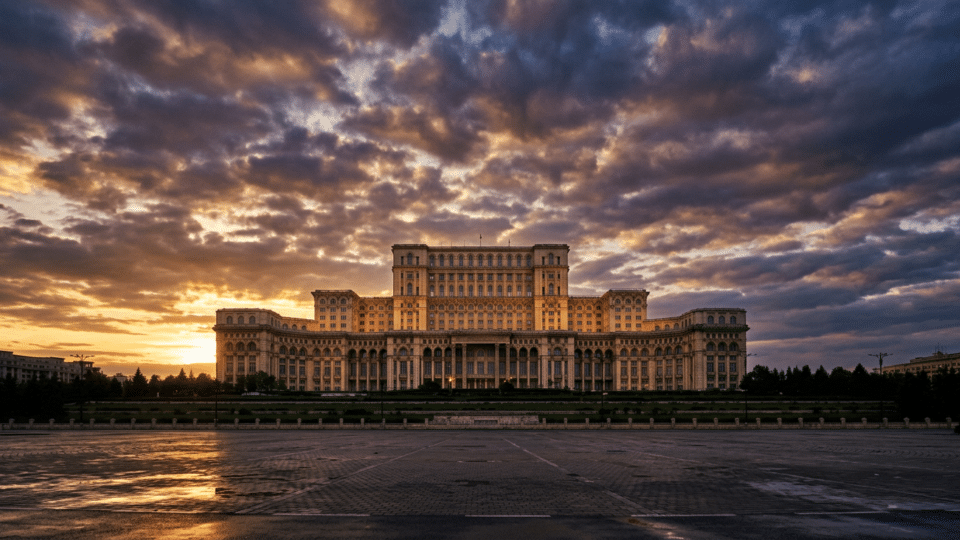
InfoBuz reporting, 10 October 2026. Information on the negotiations reflects statements made publicly up to the verification date. We do not attribute any vote in favour before the parliamentary sitting. The photograph of the Palace of Parliament is archival.








Discuția cititorilor
Ai o opinie sau o întrebare despre acest articol? Spune-ne ce crezi.
Fii primul care deschide discuția.
Te rugăm să păstrezi un limbaj civilizat și să discuți la subiect. Comentariile spam sunt filtrate automat.