
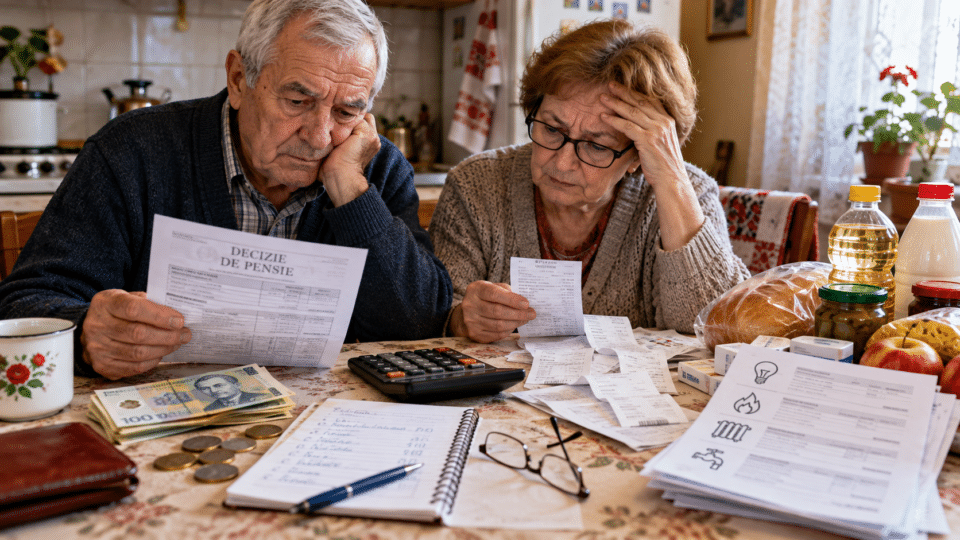
The average pension is not the income of the “typical retiree”, nor can it on its own show whether a person can cover their expenses. On 31 December 2025, Romania’s National Public Pension House (CNPP) reported an average pension of 2,818 lei for state social-insurance pensioners, compared with 3,165 lei for old-age pensioners. Meanwhile, CNPP continues to list the social allowance for pensioners at 1,281 lei, a level in force since January 2024.
For more information about CNPP, see also The Romania–US pension agreement has entered into force: how years worked are combined and where to apply, which provides complementary details on the subject.
The distinction between these figures matters more than it may initially seem. The first is an average across a broad administrative category, the second concerns a subcategory, and the third is a social threshold topped up in certain cases. None is, by itself, a “minimum basket”, and none can describe how much a person has left after food, housing charges, energy, transport and medical treatment.
In 2026, the issue has an immediate practical relevance: Law No. 141/2025 keeps the reference-point value at 81 lei throughout the year, while the application of provisions on the increase mechanism in Law No. 360/2023 has been postponed until 2027. This sets the nominal framework, but it does not show what happens to real purchasing power.
The average pension is not the most common pension
Romania’s National Institute of Statistics (INS) TEMPO series on the average monthly pension has a precise definition: the indicator is calculated by dividing amounts due by the average monthly number of pensioners. It is therefore an aggregate average. An increase in the average may result from recalculations, changes in the structure of beneficiaries or differences between pension categories. It does not prove that every beneficiary received the same increase, and it cannot be treated as a median.
The end-of-2025 snapshot in the CNPP activity report illustrates the limits of a single average. The institution records 4,583,151 state social-insurance pensioners, with an average pension of 2,818 lei. Of them, 3,679,218 were old-age pensioners, with an average pension of 3,165 lei.
These values are not contradictory. They answer different questions and show why the phrase “Romanians’ average pension” can conceal a relevant part of the picture. They are also a snapshot taken on 31 December 2025 and should not be confused with the monthly average calculated by INS for a given period.
The 1,281 lei threshold is not a standard contributory pension
CNPP lists the social allowance for pensioners at 1,281 lei, in force since January 2024. This is a differential top-up to the statutory threshold for eligible beneficiaries, not the amount of a contributory pension calculated in the same way for everyone. That is why using the term “minimum pension” without explanation can be misleading.
The threshold remains important in a purchasing-power comparison. A person starting at 1,281 lei has far less room to absorb price changes than someone starting with the average pension reported by CNPP. But this does not justify the conclusion that everyone at the threshold faces the same circumstances: rent, home ownership, family support, local assistance and health can radically alter the disposable budget.
Average pension and cost of living: the comparison must be made by category
Headline inflation is a necessary benchmark, but an insufficient one. An older household may devote a larger share of its income to food, utilities and healthcare than the average across all households. Transport, by contrast, may matter less for someone with travel concessions or who travels rarely. There is therefore no single basket that can honestly be presented as the “basket of all pensioners”.
A reproducible analysis should close the comparison at the latest common month for which both the selected income data and INS price indices are available. The basic formula can be expressed simply:
real adjusted income = nominal income / (basket price index / 100)
The basket index should not be taken automatically from the headline consumer price index. It must be calculated from stated weights for categories such as food, housing and energy, healthcare, and transport. For a scenario with weights w, the index is the sum of each category’s weight multiplied by that category’s price index:
basket index = Σ (category w × category index)
The basic condition is that the weights total 100% and that all indices use the same reference period. The result is a transparent simulation, not a direct observation of a real person’s budget.
Three scenarios that should be kept separate
| Scenario | Starting income | What may weigh disproportionately | What cannot be assumed |
|---|---|---|---|
| Single person at the social threshold | Social allowance, if eligible | Fixed housing and energy costs | That all beneficiaries pay the same bills or have the same health status |
| Pensioner close to the system average | Average pension, with the category specified | Food, utilities and recurring medical costs | That the average is the most common income |
| Retired couple | Two individual pensions | Medical and food costs | That every cost is twice that of one person; some fixed bills are shared |
The table does not assign monthly amounts to these expenses. Such an estimate would require both extracted and verified TEMPO price series and weights supported by household-consumption data. Without them, a final figure for “how much a pensioner has left” would imply false precision.
Medicines cannot be treated like any other price category
In healthcare, the amount paid by the patient may differ from the medicine’s full price. Lists and rules issued by Romania’s National Health Insurance House (CNAS) set reimbursement levels, reference prices and maximum co-payments, while the specific situation depends on the diagnosis, prescription, medicine selected and eligibility.
According to documents published by CNAS, certain pensioner categories with income from pensions and social allowance of up to and including 2,020 lei are eligible for 90% reimbursement for medicines in sub-list B, within a prescription limit of up to 330 lei per month. The rule does not mean that every treatment becomes free, nor does it make it possible to calculate each pensioner’s monthly healthcare spending automatically.
In a useful model, healthcare should be tested under at least two variants: one with a standard share of medical spending and another with a higher share for ongoing treatment. The difference between the results would show the budget’s sensitivity without claiming that any one treatment plan is universal.
Utilities depend on the home, consumption and period
The same principle applies to energy. Someone living in an apartment connected to district heating, someone who heats with gas and someone using electricity do not have the same cost structure. Distribution tariffs and protection measures have applied over different periods and under different conditions. For example, Romania’s National Energy Regulatory Authority (ANRE) announced differentiated adjustments to gas-distribution tariffs from 1 July 2025.
The practical implication is straightforward: a standard national bill may be a useful illustrative example, but it is not evidence of the actual cost facing pensioners in Romania. For any simulation, consumption, heating type, season and tariff period should be published alongside the result.
What can be said now — and what still needs an audited calculation
The available data support two firm conclusions. First, the average pension is an aggregate indicator and cannot be used as a faithful portrait of every pensioner. Second, the differences between the social-allowance threshold, the average for all state social-insurance pensions and the average for old-age pensions are large enough that a single comparison with inflation would be incomplete.
On these data alone, it would not be responsible to publish one figure for the real gain or loss of purchasing power between 2024 and 2026. That would require extracting INS series at the same reference date for pensions and price indices, setting the weights for each scenario and verifying the calculation method. A sensitivity analysis is also important: how does the result change if food, energy or medicines account for 5–10 percentage points more of the budget?
Until then, the most accurate reading of the average pension is a limited one: it shows a system-wide average, not whether a particular pensioner can cope with the cost of living. For the broader context of material vulnerability, the figures should also be read alongside indicators of poverty risk in Romania, which measure a different phenomenon from the amount of a pension.
Frequently asked questions
Is the average pension the same as the pension received by most pensioners?
No. The average pension is an aggregate indicator and does not show the distribution of pensions. It is not automatically either the most common pension or the median pension.
Is the 1,281 lei social allowance the minimum contributory pension?
No. It is a social threshold topped up for eligible beneficiaries under the legal rules, and it must be distinguished from a pension resulting from contributions.
Why is headline inflation not enough to compare pensions?
Because spending patterns differ. Food, energy, housing, medicines and transport can have very different weights for single people, couples and pensioners undergoing recurring treatment.
Can one minimum basket be calculated for all pensioners?
Not credibly. Explicit scenarios can be constructed with published weights and assumptions, but these are simulations and do not replace the real budgets of all households.









Discuția cititorilor
Ai o opinie sau o întrebare despre acest articol? Spune-ne ce crezi.
Fii primul care deschide discuția.
Te rugăm să păstrezi un limbaj civilizat și să discuți la subiect. Comentariile spam sunt filtrate automat.