
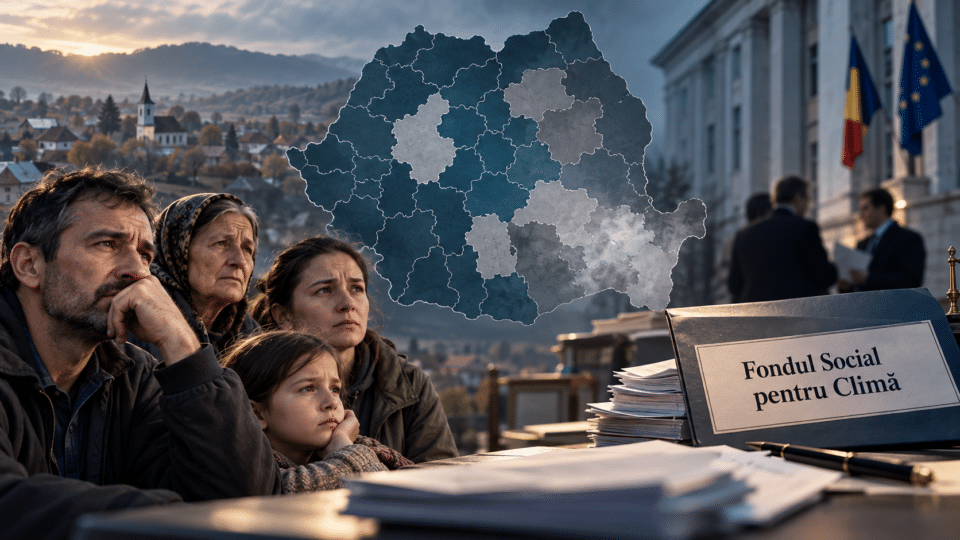
Romania could receive an estimated EU contribution of between €5.05 billion and €6.01 billion for 2026–2032 through the Social Climate Fund. But that amount does not yet make it possible to say which villages, small towns or neighbourhoods will receive help with renovation, heating or transport. At the time the public documents were reviewed, there was no accessible official list of eligible or excluded localities, nor an approved Romanian plan published with annexes allowing the criteria and budgets to be checked.
It would therefore be inaccurate to say that certain localities have already been left out. The documented risk is different: low-income households, inefficient homes and people with poor access to mobility may be difficult to identify or support unless Romania promptly publishes clear rules and a procedure that works beyond well-resourced local administrations.
This article is a documentary draft by the InfoBuz editorial team. The analysis draws on the EU regulation, Romania’s legislative framework and public European Commission pages; it does not assign eligibility to individuals or localities, and it does not replace future official guidance.
Social Climate Fund: what Romania’s plan must provide
Regulation (EU) 2023/955 establishes the Social Climate Fund for 2026–2032. The instrument is linked to the effects of extending the European emissions trading system to buildings and road transport, known as ETS2.
The Fund does not operate as an automatic payment to every resident of a poor area. It is intended for vulnerable households, vulnerable micro-enterprises and vulnerable transport users. Eligible measures include building renovation, energy efficiency, replacement of fossil-fuel heating systems, renewable energy sources, low-emission mobility and, under certain conditions, temporary direct income support.
The regulation requires every member state to substantiate its Social Climate Plan. The plan must show how it identifies vulnerable beneficiaries; how it applies definitions of energy and transport poverty; which measures it funds; what its targets and milestones are; and on what timetable they will be implemented. These elements matter precisely because vulnerability cannot be reduced to income.
A family on a modest income may live in a well-insulated home and have functional public transport. Another family on a similar income may pay a disproportionate share for firewood, gas or electricity and rely on an old car to reach work, a doctor or school. The regulation allows this national and territorial context to be assessed, but it does not itself produce an automatic map of beneficiaries in Romania.
What is publicly known about Romania’s plan
The European Commission page for national Social Climate Fund plans did not, at the time of the review used for this draft, provide an adopted Romanian plan published with the annexes needed to check territorial distribution. This does not mean Romania has lost money, nor that the plan was not submitted in a non-public form. It means only that a resident cannot use the public page to verify whether their locality is eligible.
In Romania, Emergency Ordinance No. 119 of 9 October 2024 designates the Ministry of Investments and European Projects (MIPE) as national coordinator and cites a possible EU contribution of between €5.05 billion and €6.01 billion. This is a range of potential allocation within the mechanism, not an amount already approved, contracted or transferred to beneficiaries.
The European Commission has also granted Romania technical assistance to prepare the plan. The existence of this support shows that institutional preparation was recognised as necessary; it does not confirm that a beneficiary register, criteria or payment procedures are already operational.
Where the risk arises for villages, small towns and outlying areas
The risk cannot honestly be reduced to the idea that “weak town halls lose money”. The regulation allows national, regional and local measures. Some support could be delivered through a national scheme, without each commune having to submit projects; for more complex investments, local capacity may matter more. The specific mechanism must, however, be set out in the plan and implementing acts.
In practical terms, vulnerability appears differently across the country. In rural areas, the absence of regular transport to essential services can be as burdensome as a heating bill. In cities, tenants, owners in deteriorating apartment blocks and people living in properties with unclear legal status may face difficulties even where local authorities have well-prepared projects.
The Commission’s country report on Romania points to high levels of risk of poverty or social exclusion, unequal access to services in rural and marginalised communities, and administrative-capacity problems in complex projects. These findings do not identify eligible localities, but they explain why a scheme based solely on well-written applications could miss vulnerable households.
In this context, county-level aggregate data would be insufficient. They can conceal major differences between a city connected to transport networks and communes in the same county, between efficient homes and fuel-intensive dwellings, or between owners and tenants. An editorial ranking of localities, without comparable data series and the legal criteria set out in the plan, would create false precision.
The matrix needed to check support
InfoBuz has not constructed a vulnerability “index”, because the necessary data have different reference periods and geographical levels, and a proprietary score would not represent official eligibility. Instead, the plan and subsequent guidance should allow the public to check at least the following seven points:
| What must be verifiable | Why it matters | What is clearly public now |
|---|---|---|
| Criteria for vulnerable households | Shows whether income, energy expenditure and housing conditions are taken into account. | The EU framework requires identification; Romanian thresholds for the Fund are not public in the documents reviewed. |
| Criteria for transport vulnerability | Distinguishes administrative distance from real access to work and services. | The EU definition exists; national application cannot be publicly verified. |
| Budget by measure | Shows how much goes to renovation, heating, mobility and temporary support. | No verified public breakdown of the Romanian plan is available. |
| Role of institutions | Clarifies who receives applications, verifies data and makes payments. | MIPE is the national coordinator; the beneficiary’s specific route is not clearly public. |
| Territorial priorities | Shows whether mechanisms are envisaged for rural areas, outskirts or mountain areas. | No official list or territorial quota has been identified. |
| Data correction and appeals | Protects people omitted from registers or classified incorrectly. | No public procedure specific to the Fund has been identified. |
| Published results | Allows verification of the number of households supported and the effect of measures. | Will depend on the approved plan and monitoring rules. |
A national register could reduce a local filter, but it must be open to appeal
The government programme presented in June 2026 included updating the criteria for vulnerable consumers, an interoperable national register and energy advice offices. These are public-policy commitments reported by AGERPRES, not evidence that the systems are already functioning.
If it became operational, a register linked to relevant data could reduce a household’s dependence on a town hall’s capacity to prepare case files. But automation does not solve everything. People with incomplete data, homes without clarified documentation, recent changes in income or atypical living arrangements may be omitted. Any credible mechanism therefore needs local information, assistance with applications and a clear route to correct or challenge a decision.
Energy advice offices could play precisely this practical role: translating a technical rule into accessible support. Until an official procedure is published, they cannot be presented as active access points for the Social Climate Fund.
ETS2 and the Fund are not the same thing
The Fund is designed to mitigate the social costs of the transition, not to automatically guarantee that bills will not rise. ETS2 applies to fuel suppliers for buildings and road transport; the cost may be partly passed along the chain to consumers. It would be inaccurate to say that a household directly pays an “ETS2 tax”.
A HotNews report, based on institutional responses, documented a difference in positions over the timetable: the Ministry of Energy supported delaying full access to the ETS2-associated mechanism until 2030, while MIPE stressed the need to clarify the timetable in order to secure funding. This is a public-policy dispute, not a final European Union decision, nor evidence that Romania has lost the funds.
For more information on European funding, see also Romania’s Recovery Plan enters its final phase: what the country may still save by year-end, which offers complementary details on this subject.
For households, the key issue is the period between possible costs and the arrival of investments that reduce consumption or dependence on fuels. The longer the plan, access rules and administrative systems are delayed, the more the effective implementation period to 2032 is compressed.
What to watch before promises of support
The first necessary document is the public version of Romania’s Social Climate Plan, including its submission date, its status in the Commission’s assessment and its budget annexes. The eligibility criteria, the institution receiving applications or the automatic-identification mechanism, the timetable, the appeals route, and open data on beneficiaries and investments must then be published.
Until then, the ceiling of roughly €6 billion should be read as a conditional opportunity, not support that is already available. For a resident of a village with infrequent transport or an apartment block with high bills, the useful question is not yet “how much money will I receive?”, but “under what rule can I be identified, where can I seek support, and how can I correct a wrong decision?” Without public answers to these questions, it cannot be demonstrated either that a locality is included or that it has been excluded.
Frequently asked questions
Is there already an official list of Romanian localities eligible for the Social Climate Fund?
No official list of eligible or excluded localities was identified in the public documents reviewed. The EU regulation requires the identification of vulnerable beneficiaries, but the practical application must be explained in the national plan and implementation rules.
Does an amount of up to roughly €6 billion mean the money is already available to the public?
No. The €5.05 billion–€6.01 billion range in Romania’s framework represents a possible EU contribution for 2026–2032. It is not equivalent to money approved for a household, contracted or paid out.
Who may be covered by the Social Climate Fund?
The EU regulation covers vulnerable households, vulnerable micro-enterprises and vulnerable transport users. The precise criteria for Romania must be established and made public through the national plan and implementation schemes.
Can town halls decide on their own who receives support?
This cannot be stated without official procedures. The regulation allows national, local and regional measures. The specific roles of town halls, ministries and other institutions must be set out in the plan and funding guidance.
Sources consulted
- European Commission – Social Climate Fund national plans
- EUR-Lex – Regulation (EU) 2023/955 establishing a Social Climate Fund
- Legislative Portal – Emergency Ordinance No. 119 of 9 October 2024
- European Commission – Country Report Romania 2026
- AGERPRES – Government programme: energy advice offices and affordable prices








Discuția cititorilor
Ai o opinie sau o întrebare despre acest articol? Spune-ne ce crezi.
Fii primul care deschide discuția.
Te rugăm să păstrezi un limbaj civilizat și să discuți la subiect. Comentariile spam sunt filtrate automat.