
Updated: 27 April 2026 la 23:41. Articolul a fost revizuit pentru a reflecta informațiile disponibile la această dată.
Romania is going through a new period of political tension after the Social Democratic Party (PSD) and the Alliance for the Union of Romanians (AUR) announced joint steps to table a no-confidence motion against the government led by Prime Minister Ilie Bolojan. Romania’s 2026 political crisis follows PSD’s withdrawal from the governing coalition, a decision that left the executive without a stable parliamentary majority and opened the prospect of a major government crisis.
According to Reuters, PSD, the largest parliamentary party, has aligned with AUR in an attempt to oust Ilie Bolojan’s pro-European government. The stakes are not only political but also economic, as instability could affect Romania’s access to European funds, the timetable for reforms and investor confidence.
How Romania reached its political crisis
The political crisis deepened after PSD decided to withdraw its support for Prime Minister Ilie Bolojan and the government of which it had been part. The Social Democratic ministers left the executive, and the coalition built to maintain a pro-European majority was left without the necessary support in Parliament.
In an earlier analysis, Reuters reported that PSD’s withdrawal caused the governing coalition to lose its parliamentary majority. The conflict was fuelled by dissatisfaction with budget-deficit reduction measures and reforms undertaken by the Bolojan government to meet commitments to the European Union.
In short, the crisis has three main components: the struggle for political control, dissatisfaction with austerity measures, and pressure from deadlines for accessing European funds.
What is the no-confidence motion against the Bolojan government?
A no-confidence motion is the mechanism through which Parliament can dismiss the government. If a motion is tabled and receives the required number of votes, the cabinet falls and Romania enters a new phase of political negotiations to form another government.
In the current case, PSD and AUR have announced that they will support a no-confidence motion against the Bolojan government. Euronews Romania reported that Petrișor Peiu and Marian Neacșu announced that AUR and PSD would vote for a no-confidence motion to dismiss the government.
According to Reuters, PSD and AUR together control around 220 of Parliament’s 464 seats, but 233 votes are needed for the motion to pass. This means that the two parties need additional support from other lawmakers or parties.
When could the no-confidence motion be voted on?
The political timetable still depends on negotiations in Parliament, but Euronews Romania wrote that George Simion indicated 5 May as the date for the vote on the motion. However, in such situations, deadlines can change depending on parliamentary procedures and negotiations between parties.
Another analysis published by Euronews Romania indicates that PSD and AUR would need additional votes to dismiss the government. This makes the coming days decisive for the future of the cabinet led by Ilie Bolojan.
Why this crisis matters for Romanians
For many Romanians, a political crisis may appear to be a conflict between parties, with no direct effect on daily life. In reality, government instability can have concrete consequences: delayed reforms, stalled investment, higher borrowing costs for the state, pressure on the budget, and a risk that some European funding could be lost or delayed.
Reuters wrote that PSD’s departure from the governing coalition endangers Romania’s access to European funds and could also affect the country’s credit rating. The country rating matters because it influences the interest rates at which Romania can borrow on international markets.
If investors perceive Romania as politically and fiscally unstable, the state may have to borrow at higher cost. Over time, this puts pressure on the budget, which may be reflected in higher taxes, spending cuts or postponed public investment.
Romania: Between the illusion of independence and the risk of a real energy crisis
What happens to European funds and the PNRR?
One of the most sensitive stakes in the crisis concerns European funds and the PNRR, Romania’s National Recovery and Resilience Plan. The Bolojan government argues that reforms must continue so Romania can access European money before deadlines set at EU level.
According to Reuters, Prime Minister Ilie Bolojan has refused to resign, citing reforms needed to access more than €10 billion in recovery and resilience funds before the August deadline.
This is where one of the biggest problems lies. If Romania changes its government at a critical moment, important decisions may be delayed. A caretaker government, or one under pressure from parliamentary negotiations, has less political strength to enact difficult reforms.
Can the Bolojan government fall?
Yes, the Bolojan government can fall if the no-confidence motion receives the necessary votes. However, at this point PSD and AUR do not appear to have enough votes on their own. Dismissing the government requires a parliamentary majority, and the two parties must secure additional support.
HotNews reported that the announcement of the joint PSD-AUR initiative was made by Marian Neacșu for PSD and Petrișor Peiu for AUR. The announcement came at a tense moment, while the political landscape was already marked by consultations and discussions about the future of the government.
The coming days are therefore decisive. If PSD and AUR succeed in securing additional votes, the government can be dismissed. If not, the Bolojan government can continue, but in a fragile arrangement without a clear majority.
What Prime Minister Ilie Bolojan says
Prime Minister Ilie Bolojan has said that he does not intend to resign and strongly criticised the PSD-AUR initiative. According to HotNews, Bolojan accused PSD of having “blown up the government” and argued that Romania is witnessing “de facto a new coalition”.
This statement illustrates the prime minister’s strategy: shifting the discussion from simply dismissing the government to the more difficult question of who can form a stable majority afterwards.
In politics, it is not enough to bring down a government. There must also be a workable alternative. If there is no clear majority, Romania may enter a period of deadlock, with lengthy negotiations, interim ministers and postponed decisions.
What PSD says about the motion alongside AUR
PSD says that the no-confidence motion does not necessarily amount to a post-motion political alliance with AUR. HotNews reported that PSD leader Sorin Grindeanu said there is no post-motion political agreement with AUR.
On the other hand, Euronews Romania cited statements according to which, although PSD and AUR have differences, the two parties currently share one objective: dismissing the Bolojan government.
What role does President Nicușor Dan have?
The president has an important role in mediating the crisis and appointing a new prime minister if the current government falls. At this stage, the head of state must manage consultations among the parties and avoid a complete paralysis of important decisions.
If the motion passes, the president will have to consult parliamentary parties and nominate a candidate for prime minister. If a majority cannot be formed, the crisis may continue and Romania could enter a period of heightened political instability.
Could early elections be held?
In theory, yes. In practice, early elections are difficult to trigger in Romania. Constitutionally, they require clear procedural steps and the failure to form a new government under certain conditions. This is why, although early elections are often discussed, the most likely scenario is an attempt to form a new parliamentary majority.
Reuters notes that Romania has not held early parliamentary elections to date and that the next general election is scheduled for 2028. Therefore, even if the current government falls, parties will most likely try to form a new governing arrangement.
How Romanians could be affected by the political crisis
The effects of a political crisis do not always emerge immediately, but they can become visible in several important areas.
The first is the economy. If instability persists, Romania may be seen as a higher-risk country. This could lead to higher interest rates on government borrowing and additional pressure on the budget.
The second concerns investment. Investors prefer stability. When a government is at risk of falling and reforms are uncertain, some investment may be postponed.
The third concerns European funds. If reforms undertaken through the PNRR are delayed, Romania risks losing valuable time in accessing European money.
The fourth concerns social measures. In a context of a high budget deficit, any political deadlock can delay decisions on pensions, wages, taxes, local investment or support programmes.
What scenarios are possible in the period ahead?
The first scenario is that the motion does not pass. In that case, the Bolojan government continues but remains vulnerable, forced to negotiate every major proposal in Parliament.
The second scenario is that the motion passes. The government falls, and the president begins consultations to nominate a new prime minister.
The third scenario is the formation of a new pro-European majority, but without Ilie Bolojan. Reuters reported that PSD could return to a pro-European alliance if Bolojan were replaced, but the National Liberal Party (PNL) rejected this option.
The fourth scenario is prolonged political deadlock, with a caretaker government, tough negotiations and increased pressure from financial markets and European institutions.
Why the crisis comes at a sensitive moment
Romania is not facing only an internal political dispute. The country must manage a high budget deficit, reforms undertaken through the PNRR, economic pressures, regional tensions caused by the war in Ukraine, and the need for stability in its relationship with the European Union and NATO.
In such a context, a government crisis is not merely a party-political problem. It can influence the country’s economic direction, the confidence of external partners and the state’s capacity to make swift decisions.
Conclusion
Romania’s 2026 political crisis could become one of the most important political confrontations of recent years. The PSD-AUR initiative for a no-confidence motion against the Bolojan government puts pressure on the entire political landscape and opens several scenarios: the continuation of a minority government, the fall of the executive, the formation of a new majority or prolonged deadlock.
For more information about AUR, see also Who could become the new prime minister after the Bolojan government is dismissed?, which provides additional details on this subject.
For Romanians, the stakes are not only about who remains at Victoria Palace, the seat of government. The real issue is economic stability, access to European funds, the pace of reforms and the state’s ability to avoid a long period of uncertainty.
The coming days will show whether the no-confidence motion has enough votes to pass or whether the Bolojan government will survive politically, albeit in a far more fragile arrangement than before.
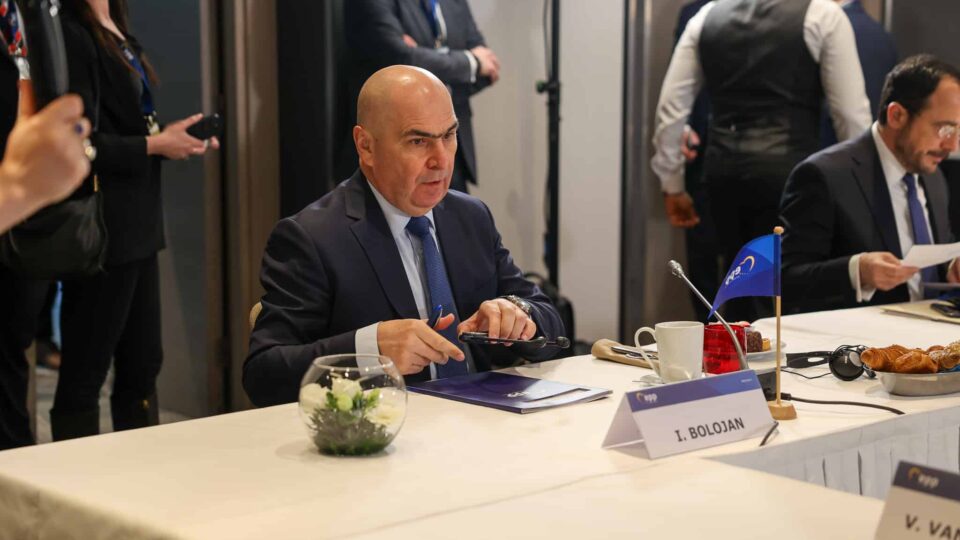
Photo source: European Council / Wikimedia Commons, Creative Commons Attribution 4.0 licence.
{
“@context”: “https://schema.org”,
“@type”: “FAQPage”,
“mainEntity”: [
{
“@type”: “Question”,
“name”: “What is the no-confidence motion against the Bolojan government?”,
“acceptedAnswer”: {
“@type”: “Answer”,
“text”: “A no-confidence motion is the parliamentary procedure through which the government can be dismissed. In the context of Romania’s 2026 political crisis, PSD and AUR have announced steps to table a no-confidence motion against the government led by Ilie Bolojan.”
}
},
{
“@type”: “Question”,
“name”: “How many votes are needed to dismiss the Bolojan government?”,
“acceptedAnswer”: {
“@type”: “Answer”,
“text”: “For a no-confidence motion to pass, it needs the votes of a majority of lawmakers. In the current case, the stated threshold is 233 votes. If the motion receives this number of votes, the Bolojan government is dismissed.”
}
},
{
“@type”: “Question”,
“name”: “Could Romania lose European funds because of the political crisis?”,
“acceptedAnswer”: {
“@type”: “Answer”,
“text”: “A prolonged political crisis could delay the reforms and decisions needed to access European funds, including funding linked to the PNRR. The main risk is that measures undertaken by Romania in its relationship with the European Union could be blocked or postponed.”
}
},
{
“@type”: “Question”,
“name”: “Will Romania hold early elections?”,
“acceptedAnswer”: {
“@type”: “Answer”,
“text”: “Early elections are theoretically possible, but difficult to trigger. If the Bolojan government falls, the most likely scenario is that parliamentary parties will try to form a new majority and nominate a new prime minister.”
}
},
{
“@type”: “Question”,
“name”: “How could Romanians be affected by the 2026 political crisis?”,
“acceptedAnswer”: {
“@type”: “Answer”,
“text”: “Romanians could be affected indirectly through economic instability, delayed investment, pressure on the budget, increased government borrowing costs and possible delays in implementing reforms or accessing European funds.”
}
}
]
}








Discuția cititorilor
Ai o opinie sau o întrebare despre acest articol? Spune-ne ce crezi.
Fii primul care deschide discuția.
Te rugăm să păstrezi un limbaj civilizat și să discuți la subiect. Comentariile spam sunt filtrate automat.