
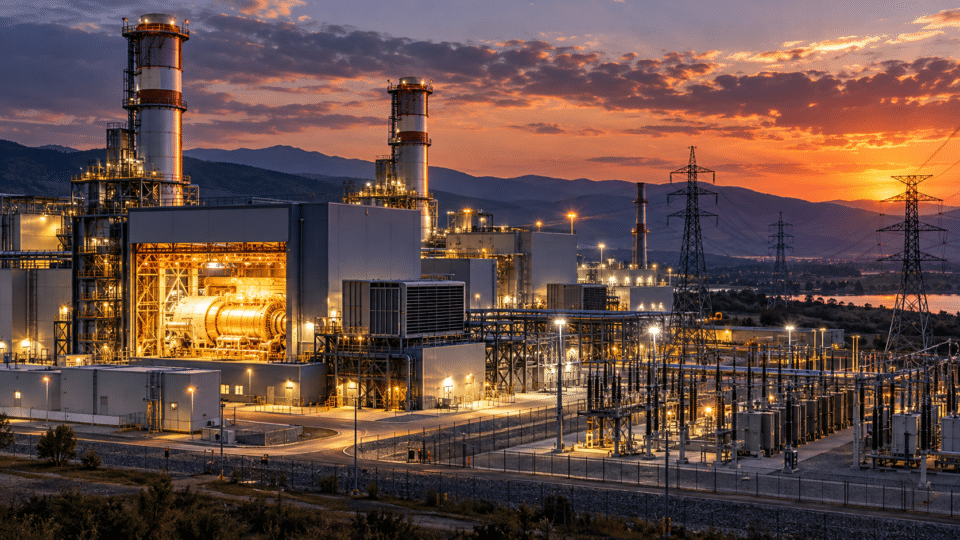
The first gas turbine at the new Mintia power plant ran on natural gas for the first time on Thursday, October 8, 2026. This is an important technical milestone, but it does not yet mean that the plant is supplying power commercially or has reached its planned capacity of about 1,700 MW.
According to a statement issued by Prime Minister Ilie Bolojan and reported by AGERPRES, the firing of turbine No. 1 will be followed by the completion of testing, synchronisation with the National Energy System (SEN), and delivery of the first megawatts. In other words, as of the announcement, firing on gas had been confirmed, but not stable commercial generation publicly measured on the grid.
The distinction matters: a turbine can be started and tested before its electricity is synchronised, scheduled and supplied consistently into the system. For Romania, Mintia could become a significant source of flexible capacity, but its concrete impact will only become clear in operational data.
For more information about ANRE, see also It is not a bill discount: who can actually be paid to reduce energy use under ANRE’s new mechanism, which provides complementary details on this subject.
Mintia turbine: what is confirmed and what comes next
Public documents and statements point to a sequence of steps that should not be conflated:
| Technical milestone | What it means | Publicly verifiable status |
|---|---|---|
| Energised connection | The equipment linking the plant to the grid is energised and tested. | Confirmed for gas turbine No. 1 on June 15, 2026. |
| Turbine fired on gas | The turbine runs on natural gas for the first time. | Confirmed on October 8, 2026. |
| Synchronisation with the SEN | The generator is brought to grid parameters for connection and power transfer. | Announced as the next stage; no subsequent public confirmation was identified in the sources reviewed. |
| First MW supplied | Electricity is actually injected into the grid, potentially including during testing. | Announced as the next step on October 8. |
| Stable commercial operation | Generation is available and sustained under operating conditions, rather than only during testing. | Not publicly confirmed by the sources reviewed. |
In June, Transelectrica announced that the 400 kV connection for turbine No. 1, the connection transformers and the systems supplying the plant’s internal services had been tested under voltage. However, the statement specified that checks and tests were continuing. This test confirms the readiness of an essential part of the electrical infrastructure; it does not mean that electricity was already being sold or supplied commercially.
Why June reports of the “first megawatt” do not settle the timeline
Reports emerged around June 15, based on sector sources, that the first megawatt could be injected into the SEN in the following days. However, Transelectrica’s technical statement of June 15 does not confirm such an injection; it confirms only the voltage test and that testing was to continue.
The October 8 announcement again places synchronisation and the first megawatts among the steps still to come. Without a statement from the transmission system operator, the investor, or public operating data showing the time, output and delivery regime, it would not be responsible to present it as certain that Mintia had already injected electricity into the SEN before this point.
The apparent break in the timeline may have different technical explanations: a planned test may be postponed, a one-off transfer of power during testing is not the same as commercial operation, and acceptance and permitting stages may be separate. However, these are possible explanations, not facts publicly confirmed for this project.
1,677.12 MW is authorised capacity, not today’s output
The establishment authorisation issued by ANRE in April 2025 indicates a 1,677.12 MW combined-cycle power plant. The authorised configuration includes two Siemens Energy SGT5-9000HL gas turbines, one SST5-5000 steam turbine and three generators.
In the October 8 statement, the capacity of the two gas turbines is put at approximately 1,100 MW, while capacity of around 1,700 MW is associated with completion of the combined cycle. This means that neither the start-up of the first turbine nor even that of both gas turbines should automatically be equated with reaching the project’s total output.
There is also an important difference between installed capacity and energy generated. Capacity, expressed in MW, indicates what the plant can supply at a given moment under its design conditions. Energy, expressed in MWh, indicates how much it has generated over a period. A high-capacity plant may generate little in a month if it is still being tested, has outages or is run only during certain hours.
Transelectrica documentation published in August for the connection of CECC Mass Mintia indicates a maximum simultaneous exportable capacity of 1,677.12 MW. This shows that the project has also been assessed in terms of transmitting electricity into the transmission grid. By itself, it does not demonstrate that the entire capacity is already available in operation.
What Mintia could change for Romania
New gas-fired capacity can help the SEN particularly when consumption rises, wind and solar generation is low, or other units are unavailable. Gas-fired plants are generally more flexible than traditional coal-fired units and can play an important role in balancing a system with more renewable sources.
This is why Mintia’s impact should be assessed beyond the number displayed on the project plaque. If it is available and competitive, the plant could reduce the need for imports at certain times and add a safety margin to the system’s operation. But there is no rule under which every new MW installed automatically eliminates one MW of imports: it depends on demand, competing domestic generation, regional prices, grid congestion and fuel costs.
Likewise, firing up the turbine does not justify a conclusion that household bills will fall. The final electricity price depends on the wholesale market, generation costs, emissions certificates, grid tariffs, taxes and the contracting scheme that applies to the supplier. A new power plant can contribute to security of supply without, by itself, causing an immediate reduction in individual bills.
The power project also depends on gas
Mintia is not only an electricity-generation project but also a very large consumer of gas. In Transgaz’s 2026–2035 development plan, the plant’s capacity is listed as 1,700 MW and its estimated annual natural-gas consumption as 2.5 billion cubic metres. This is a planning estimate, not consumption already measured after start-up.
The project’s outcome will therefore depend on the simultaneous operation of three components: the turbines and equipment at the plant, electricity transmission infrastructure, and gas supply at a cost that allows economically viable operation. This link explains why a plant can be technically capable of generating electricity but not operate continuously at maximum output.
As renewable projects expand, including the wind investments discussed in InfoBuz’s analysis of the 650 MW Ukraine–Romania WIND project, the flexibility of a gas-fired plant may become valuable. Its real value, however, will be measured in availability, energy delivered and cost, rather than announcements about maximum capacity.
What data to watch after the first firing
To determine when Mintia has actually moved from testing to generation, the most useful public confirmations would be:
- an announcement on the synchronisation of turbine No. 1 with the SEN;
- the maximum output supplied, expressed in MW, and the date on which it was reached;
- the amount generated over a period, expressed in MWh;
- the operating regime: testing, commissioning or commercial operation;
- the entry into service of the second gas turbine and, separately, the steam turbine in the combined cycle;
- any limitations on grid export or gas supply.
The verifiable conclusion at this point is narrow but relevant: Mintia’s first turbine was fired on natural gas on October 8, 2026. Electricity actually reaching the grid has been announced as the next stage, not yet confirmed as stable commercial generation. When data on synchronisation and MW delivered emerge, they will say more about the impact on Romania than the theoretical capacity of almost 1,700 MW.
Frequently asked questions
Is the Mintia plant already generating commercial electricity?
There is no public confirmation of stable commercial operation in the sources reviewed. On October 8, 2026, the first firing of turbine No. 1 on gas had been confirmed, while synchronisation and delivery of the first megawatts were announced as the next stages.
How much can the Mintia plant generate after completion?
ANRE’s authorisation indicates a capacity of 1,677.12 MW for the combined-cycle plant. Public statements distinguish approximately 1,100 MW for the two gas turbines from around 1,700 MW after the combined cycle, including the steam turbine, enters operation.
Will Mintia automatically lower energy bills?
No. New capacity can help balance the system and, during certain hours, reduce the need for imports, but bills also depend on the cost of gas, CO2 certificates, the wholesale market, grid tariffs, taxes and supply contracts.
Sources consulted
- AGERPRES — Bolojan: First firing of gas turbine No. 1 takes place at Mintia’s new power plant
- ANRE — Press release: establishment authorisation for the Mintia power plant
- Transelectrica — Statement on the 400 kV connection for Mintia Gas Turbine 1
- Transelectrica — Notice on the connection of CECC MASS MINTIA
- Transgaz — 2026–2035 development plan for the National Natural Gas Transmission System


Discuția cititorilor
Ai o opinie sau o întrebare despre acest articol? Spune-ne ce crezi.
Fii primul care deschide discuția.
Te rugăm să păstrezi un limbaj civilizat și să discuți la subiect. Comentariile spam sunt filtrate automat.