
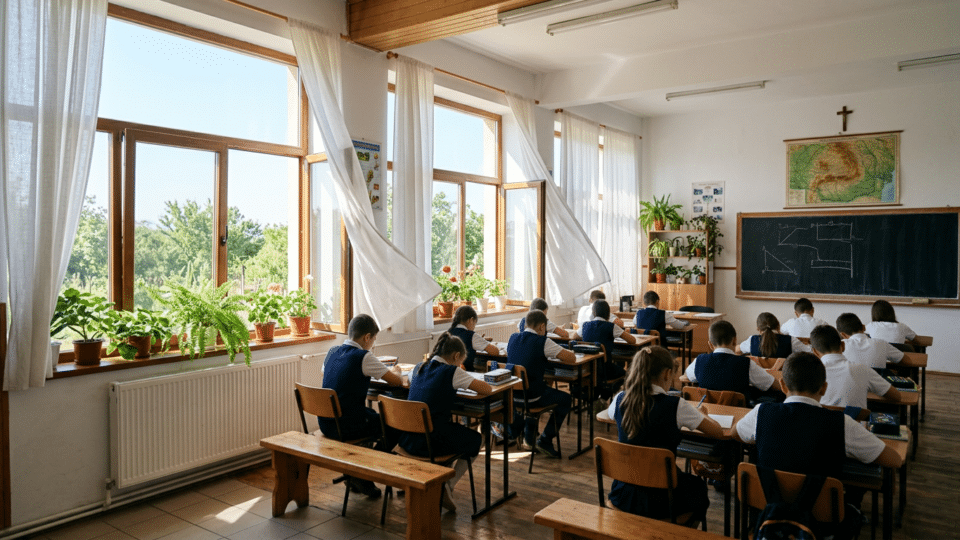
A classroom may have windows that open and still be difficult to ventilate during a full lesson. In practice, fresh air depends on more than the presence of windows: how many people are in the room, how much air volume the classroom has, how far the windows can open, whether air has a route out, the outdoor temperature, and whether traffic noise makes it impossible to leave windows open for longer periods.
In brief: rising CO₂ levels in a classroom can indicate that the supply of outdoor air is insufficient for the number of occupants and the time in question. On its own, it does not prove the presence of mould, fine particles, radon or a specific health risk. A useful assessment therefore combines repeated measurements with information on windows, temperature, humidity, noise, the number of occupants and maintenance of the systems installed.
What Romania requires for classroom ventilation
Romania’s hygiene standard for facilities used by children and young people requires natural ventilation in rooms and sets a minimum of three air changes per hour for classrooms. This means that, over one hour, an amount of air equivalent to the room’s volume should be replaced at least three times. The standard also specifies air-flow speeds that should not cause discomfort and states that ventilation efficiency is assessed through laboratory methods. The requirements can be consulted in the version published on the Legislative Portal.
The same framework links ventilation to the indoor microclimate and occupancy: classrooms are specified to provide 5–8 cubic metres of air per person, a temperature of at least 20°C, and relative humidity of 30–60%. A classroom with the same number of windows may perform differently if it is smaller, more crowded, or if its windows are arranged in a way that allows air in but does not circulate it through the room.
The standard cannot be meaningfully checked by counting windows. Three air changes per hour is an airflow rate relative to the classroom’s actual volume. For example, in a room of 180 cubic metres, this benchmark corresponds to 540 cubic metres of air replaced per hour. This is a simple editorial calculation: 3 air changes/hour × 180 m³ = 540 m³/hour. It does not demonstrate that this airflow is achieved; that requires an appropriate technical method and documented measurement conditions.
CO₂ in classrooms: an indicator of ventilation, not a complete verdict
Pupils and teachers exhale carbon dioxide. In an occupied room, the concentration rises when too little outdoor air enters in relation to the number of people and the length of the activity. For this reason, a CO₂ sensor using NDIR technology can be useful for tracking the pattern during a lesson: how quickly the reading rises, whether it falls during breaks, and whether it drops after ventilation.
Guidance from the US Environmental Protection Agency (EPA) treats CO₂ as a useful signal that ventilation with outdoor air may be insufficient. But it recommends assessing it alongside temperature, humidity, air movement, airflow rates and possible pollutant sources. In other words, CO₂ is a measure of occupancy and ventilation, not an instrument that independently certifies overall air quality.
The 1,000 ppm reference point appears frequently in guidance and documents on indoor environments. It should be read as a benchmark that warrants investigation, not as a universal medical limit beyond which a classroom automatically becomes dangerous. Duration, the outdoor background level, the device’s position, the number of pupils, open windows and the pattern of readings all matter. An isolated reading taken next to a pupil or immediately after the class has entered can be misleading.
A functional analysis published by Romania’s Ministry of Education used CO₂ as an indirect method of assessing indoor air and reported an average of 3,021 ppm in the classrooms observed. The document is relevant as a precedent, including for its observation that functional windows did not always guarantee effective ventilation. However, it is not a current, representative picture of all schools in Romania: the year, sample and measurement conditions must be kept in mind when interpreting it.
Why an open window may not solve the problem
Natural ventilation needs a force to move air: wind, the temperature difference between indoors and outdoors, or both. When there is little wind and the temperature difference is small, two open windows may produce weak or uneven air exchange. A top-hung window, a window obstructed by furniture, or a door kept shut can limit the air path more than the mere sight of an open window suggests.
For more information on children’s health, see also WHO recommends a new approach to obesity in children and adolescents, which offers complementary details on this subject.
There is also the question of actual use. Missing handles, restrictors, grilles, faulty mechanisms, a key kept elsewhere, or rules established for safety can reduce the effective opening area. These circumstances do not automatically prove defective design; they may point to a delayed repair, an operational rule or a technical solution unsuited to the classroom.
Energy renovation should be assessed separately. A more airtight building may reduce heat loss, but it needs ventilation designed and operated so that indoor air is replaced. The label “renovated” does not, by itself, support a conclusion that ventilation is good or poor.
The overlooked trade-off: fresh air versus noise
A window facing a heavily trafficked road, a noisy yard or a construction area may be difficult to keep open precisely when the classroom needs ventilation. In this case, a teacher may be caught between noise that interrupts the lesson and air that is being renewed too slowly. The situation should not be reduced to the idea that someone “doesn’t want to open the window”.
Technical regulations for school buildings treat ventilation and noise protection as requirements that must be reconciled. Standard NP 010-2022 provides, among other things, for the acoustic impact to be justified when ventilation units are placed directly in the classroom. Standard I5-2022 also includes indoor noise requirements for such spaces. A noisy mechanical system may end up being switched off; an open window exposed to noise may end up being closed. In both cases, performance on paper is not the same as performance during a lesson.
A phone app may be used only as a rough guide, for example to document that noise appears to rise sharply when windows are opened. It does not replace an official acoustic measurement, which requires the appropriate instrument, calibration and method.
A practical map of the problem: what to observe and check
| Observable sign | What it may mean | What data would clarify the situation | What document or intervention may matter |
|---|---|---|---|
| CO₂ rises quickly in every lesson | High occupancy for the room volume, or insufficient outdoor-air supply | CO₂ readings over time, time of day, number of people, windows/doors, temperature | Classroom volume, approved capacity, ventilation design |
| Readings fall only slightly although windows are open | Weak natural airflow, limited opening, or uneven circulation | Type and openable area of windows, wind, outdoor temperature | Window repairs, adjustments, technical analysis of the air path |
| Windows are kept closed because of noise | A conflict between ventilation and acoustic comfort | Simultaneous CO₂ and noise measurements, with windows open and closed | Acoustic assessment, ventilation and noise-mitigation solutions |
| A mechanical system exists but appears unused | Fault, noise, costs, lack of adjustment or maintenance | Operating schedule, airflow rates, filters, complaints, technical checks | Maintenance contract, service records, commissioning |
| Persistent odour or visible dampness | There may be a moisture source or an issue separate from CO₂ | Inspection for leaks, humidity, ventilation and affected materials | Inspection and repair report; potentially a specialist assessment |
A minimum protocol that does not turn the sensor into an arbiter
For a responsible local investigation, measurements should be taken only with the necessary permissions and without identifying pupils. The device should be checked in accordance with the manufacturer’s instructions; where the analysis could have technical or administrative consequences, involving a specialist is prudent. Measurement on a single day or in a single corner of a room cannot represent the school.
- Record the classroom, date, time period, sensor position and height, without placing it near a pupil’s face, a window or an air vent.
- Record CO₂ in ppm, temperature in degrees Celsius and relative humidity as a percentage at regular intervals, for example every one to five minutes.
- Record the number of people, when pupils enter and leave, whether windows and the door are open, and for how long.
- Repeat the observation across several lessons and, ideally, on days with different outdoor conditions.
- If noise is part of the problem, record window conditions at the same time. Professional noise measurement should be conducted separately, using appropriate instrumentation.
More informative than the highest value is the curve: what happens after the class enters, how quickly CO₂ falls during the break, and whether the same room behaves differently with a different number of people. This pattern can guide further checks, but it does not replace airflow measurement or an assessment of the systems installed.
Who can answer, and what requests are realistic
Specific responsibility varies depending on the building owner, the local public authority, the school management, refurbishment projects and existing contracts. It cannot be assigned correctly without documents. That is why the first useful request is not a broad accusation, but a request for verifiable information.
A parent, teacher or pupil representative may ask the school and, where relevant, the authority managing the building to clarify:
- the classroom’s capacity and volume, and how occupancy is determined;
- the planned type of ventilation: natural, mechanical or mixed;
- the condition of the windows and whether there are restrictions on opening them;
- the most recent repairs, ventilation maintenance, filter changes and any faults;
- project, handover or renovation documents concerning ventilation and acoustic protection;
- how repeated reports concerning air, temperature, noise or dampness are assessed.
In some cases, the remedy may be simple: repairing a window, introducing a ventilation schedule between lessons, or clearing an obstructed opening. In others, the issue requires adjusting a system, cleaning and replacing filters, measuring airflow rates, acoustic interventions or upgrading ventilation. An air purifier may reduce certain particles if it is properly selected and sized, but it does not automatically supply outdoor air and cannot by itself solve CO₂ build-up; the distinction is also explained in InfoBuz’s article on HEPA filters, CADR and the limits of air purifiers.
What we still do not know at national level
The documents consulted do not provide a recent, representative public basis for mapping classrooms that are difficult to ventilate across Romania. It cannot honestly be said that a particular region, generation of buildings or category of schools automatically has a bigger problem without comparable measurements.
This is also why a local investigation should stop short of broad verdicts. High CO₂ in one classroom on a busy afternoon is a signal worth checking. It becomes a well-documented technical problem only when that signal is repeated, conditions are described, and documents on design, use and maintenance are considered alongside the measurements.
The useful question for a school is not simply, “Why don’t you open the windows?”, but: what airflow can this classroom achieve under normal occupancy conditions without unjustifiably sacrificing temperature and the ability to teach because of noise? The answer requires more than a sensor, but it can begin with simple, repeated and verifiable data.
Frequently asked questions
Is high CO₂ in a classroom proof that the air is dangerous?
Not automatically. CO₂ is a useful indicator of the relationship between occupancy and the supply of outdoor air, but it does not directly measure fine particles, mould, radon, formaldehyde or noise. A reading must be interpreted according to duration, the number of people, the sensor’s position and changes over time.
What is an acceptable CO₂ threshold in a classroom?
The 1,000 ppm reference point is used in some guidance to signal that ventilation should be checked, but it is not a universal medical limit. A one-off exceedance does not independently establish a diagnosis concerning either the building or pupils’ health.
Can parents measure classroom air with a sensor bought online?
They can obtain indicative observations if the device is checked and measurement is repeated under recorded conditions. Technical, administrative or official conclusions require an appropriate method, complete data and, where applicable, a qualified specialist.
Who is responsible for repairing windows or maintaining ventilation?
It depends on the building’s legal and administrative arrangements, the owner, the local authority’s responsibilities, school management and maintenance contracts. The answer must be established from documents, not assumed solely because the problem occurs in a classroom.
Sources consulted
- Hygiene standard for facilities used by children and young people – Legislative Portal
- Functional analysis of Romanian primary schools: light and air quality
- EPA – Reference Guide for Indoor Air Quality in Schools
- SINPHONIE: Schools Indoor Pollution and Health, final report
- NP 010-2022 – Standard on the design, construction and operation of education buildings




Discuția cititorilor
Ai o opinie sau o întrebare despre acest articol? Spune-ne ce crezi.
Fii primul care deschide discuția.
Te rugăm să păstrezi un limbaj civilizat și să discuți la subiect. Comentariile spam sunt filtrate automat.