
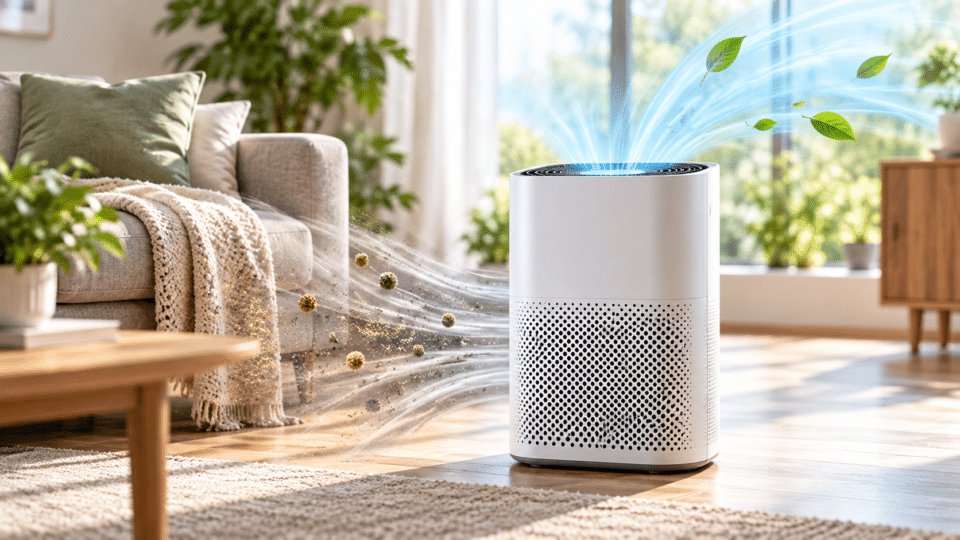
An air purifier can reduce the concentration of certain particles in a room, but it cannot turn a poorly ventilated home into a pollution-free space. According to the US Environmental Protection Agency (EPA), filtration is a useful complement to source control and ventilation, not a universal substitute. Its effectiveness depends on the type of pollutant, the filter installed, the clean-air flow rate and the operating time.
Air purifiers: which particles and gases they can capture
Fine dust, pollen, particles from cooking smoke and some airborne biological particles can be captured by efficient mechanical filters. Gases and odours are different: a particle filter does not automatically capture volatile organic compounds or carbon monoxide. If the aim is to reduce certain gases, it requires adsorbent materials, such as activated carbon, designed for the pollutants in question.
For more information on activated carbon, see Water filters: what activated carbon, reverse osmosis and NSF standards remove, which provides complementary details on the subject.
The EPA notes that no household device removes every pollutant. Air pollution from a continuous source — cigarette smoke, improper combustion or dampness that encourages mould, for example — must primarily be addressed by removing the source. An air purifier will not fix a water leak, nor will it make a room with gas leaks safe.
What a HEPA filter is — and what 99.97% means
HEPA filters are designed to capture a very high proportion of particles as air passes through the filter medium. Under some technical definitions, a figure of 99.97% is used for particles of around 0.3 micrometres under test conditions. This percentage describes the filter’s performance in a test; it does not promise that the air throughout a room will instantly become “99.97% pure”.
There can be major differences between particle sources, room geometry, leakage around the cartridge, fan speed and open doors. A high-performing filter in a unit that moves little air may reduce particles more slowly than a properly sized one. Look for information on CADR, not just a HEPA label.
CADR: the most useful sizing indicator
CADR (Clean Air Delivery Rate) expresses the clean-air flow delivered by a device for certain types of particles. It may be shown in m³/h or cfm. The figure should be matched to the room’s actual volume and the speed at which you intend to use the purifier. It is not a measure of how effectively gases are removed.
As a rough example, a 20 m² room with a 2.5-metre ceiling has a volume of about 50 m³. For filtration equivalent to five room volumes per hour, the theoretical calculation is 50 × 5 = 250 m³/h CADR. This is not a legal requirement or a promise of exactly five outdoor-air changes: the “changes” here are filtration equivalents. Actual results depend on how the air mixes and where the unit is placed.
The EPA also provides a sizing table based on room area: for a 200-square-foot room (about 18.6 m²), it indicates a minimum CADR of 130 cfm (about 221 m³/h), assuming a conventional ceiling height. This is a benchmark comparable with the example above.
Activated carbon: when it helps, and when it is just a label
An activated-carbon filter can adsorb certain gases and odours. But the actual quantity of material and the air-contact time are essential. A thin sheet of carbon marketed as a solution for “all toxins” does not deliver the same performance as a module designed for a specific pollutant. The EPA warns that there is no gas-performance rating system as widely used as CADR is for particles.
In particular, do not rely on a room air purifier to make a space safe where carbon monoxide or natural gas is accumulating. These require ventilation or extraction measures, alarms and repair of the source.
Ionisation, plasma, UV and “fresh ozone”: are they worth it?
Some devices include ionisation, plasma or UV features. Their effectiveness and risks cannot be inferred simply from the presence of the function. Some technologies can generate ozone, a respiratory irritant. The EPA advises caution with generators that intentionally produce ozone to “clean” the air: at concentrations compatible with protecting health, it does not effectively remove most household pollutants.
A purifier with good mechanical filtration, a published flow rate and available replacement filters may be a more verifiable choice than one with many eye-catching modes but no accessible independent testing.
Where to place an air purifier — and how long to run it
- Choose the room where you spend the most time or where there is an identified particle risk.
- Do not block intake and outlet grilles with furniture or curtains.
- Follow the manufacturer’s recommended clearances and avoid corners that restrict air circulation.
- Compare CADR at the setting you will actually use, not only at a very noisy maximum setting.
- Replace filters according to the manual; a dirty or saturated filter loses performance.
Can it stop allergies, viral infections or mould?
Filtration can reduce certain particles and exposures, but health outcomes vary between people and situations. It does not replace medical treatment for asthma or allergies, nor does it replace ventilation and reducing exposure at the source. With mould, the source of moisture must be found and repaired; capturing some spores in the air does not stop a colony growing on walls.
If cooking smoke is the problem, an effective cooker hood that exhausts contaminants outdoors can address part of it at the source. See InfoBuz’s analysis of how cooker hoods capture kitchen pollutants.
Checklist before buying
- Which pollutant do you want to reduce: particles, pollen, smoke or a specific gas?
- What is the measured CADR, expressed in comparable units?
- What are the room’s floor area and ceiling height?
- How much do replacement filters cost, and will they still be available after a year?
- What are the noise level and power consumption at a setting suitable for daily use?
- Are there independent results and information on ozone emissions?
Frequently asked questions
Does an air purifier replace opening a window?
No. Particle filtration does not automatically provide fresh air or control all gases and excess carbon dioxide.
Is a higher CADR always better?
It may filter particles faster, but it should be weighed against noise, cost, room size and the operating setting.
Do I need activated carbon?
Not if the main issue is particle filtration alone; for specific gases, check the testing and the actual mass of the adsorbent medium.
Official sources
US EPA — Guide to Air Cleaners in the Home, second edition; US EPA — Air Cleaners and Air Filters in the Home. The sizing recommendations are indicative and concern particles, not all gases.




Discuția cititorilor
Ai o opinie sau o întrebare despre acest articol? Spune-ne ce crezi.
Fii primul care deschide discuția.
Te rugăm să păstrezi un limbaj civilizat și să discuți la subiect. Comentariile spam sunt filtrate automat.