
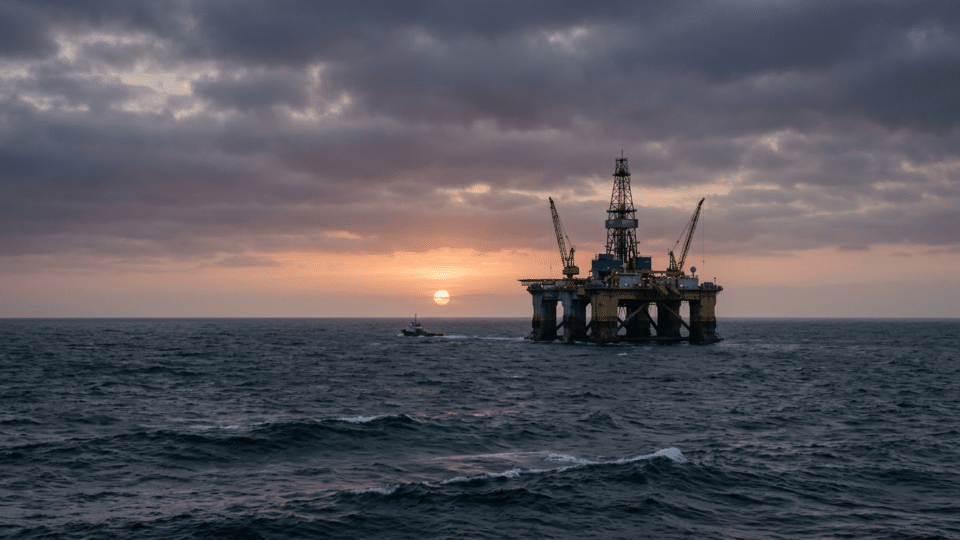
On 1 October 2026, the European Commission sent Romania a reasoned opinion over its incomplete compliance with European obligations on preventing and managing accidents in offshore oil and gas operations. For Romania, where Neptun Deep’s licence holders expect first production in the first half of 2027, this is not an abstract issue: the state must be able to show that Black Sea safety rules are being applied, monitored and corrected when problems arise.
For more on the European Commission, see Europe enters the winter of 2026–2027 with gas storage below usual levels. Why the Commission says the system can withstand it, which provides related context.
In brief: a reasoned opinion is not a fine, not a ruling by the Court of Justice of the European Union, and does not automatically suspend Neptun Deep. The Commission’s public statement does not say that the project is unsafe. It does say, however, that Romania is not fully meeting certain obligations on preventing and responding to offshore accidents, and calls on it to remedy the situation.
The relevant question for the public goes beyond the general assurance that “there are rules”. Romania already has a dedicated law, a competent authority and oversight procedures. The real test is whether authorities can show a verifiable chain from rule to implementation: documentation submitted, independent assessment, administrative decision, inspection, non-compliance identified—if any—and corrective action closed.
What the European Commission is asking for—and what the reasoned opinion does not say
In its 1 October 2026 package of decisions, the European Commission says Romania has not fully complied with EU rules on the safety of offshore oil and gas operations. The country has two months to respond and address the shortcomings identified. If its response is not considered satisfactory, the Commission may decide to refer the case to the Court of Justice of the European Union.
This is the second major public stage in a case that began in September 2021 with a letter of formal notice. At that point, the Commission cited the incorrect transposition into Romanian law of aspects of Directive 2013/30/EU, according to the European Commission Representation in Romania.
The Commission page consulted does not publish the precise articles of the directive or the Romanian documents deemed non-compliant in case INFR(2021)2150. That limitation matters. Without the detailed text of the reasoned opinion or an official explanation from Romanian authorities, it would not be rigorous to say that a particular installation, well or company is directly concerned.
The 1 October package also includes a separate case concerning missing information in Romania’s reporting on climate and energy progress. The two procedures should not be conflated: incomplete energy reporting is not, in itself, evidence of an offshore safety deficiency.
Offshore rules in Romania: the framework exists, but evidence of enforcement must be visible
Directive 2013/30/EU is intended to prevent major offshore accidents and limit their consequences for people, the marine environment and coastal economies. It requires operators to identify major risks, prepare emergency response plans and submit certain systems to independent verification. States must have a competent authority, oversee operators and intervene, including by stopping activities when legal conditions are not met.
In Romania, Law No. 165/2016, in the consolidated version available on the Legislative Portal, regulates the safety of offshore petroleum operations. The law provides for a major hazard report, independent verification and intervention by the competent authority. For relevant operations, the major hazard report must be accepted before activity begins or continues, under the conditions set out by law.
Government Decision No. 408/2025 sets out the responsibilities of the Competent Authority for the Regulation of Offshore Operations in the Black Sea, known by its Romanian acronym ACROO. The institution assesses and accepts documents required by law, carries out inspections, checks and investigations, applies compliance measures, and cooperates with other authorities. Under the legislation, ANRM/ANRMPSG retains its role concerning petroleum agreements.
This institutional chain contradicts the notion that Romania is starting from scratch. But the existence of a regulatory architecture does not automatically amount to its full application. This is precisely where the Commission’s reasoned opinion is relevant: Brussels has flagged a compliance problem, while public details on its exact nature remain insufficient.
An audit trail for Neptun Deep before first production
Neptun Deep is the project that makes this discussion urgent. OMV Petrom and Romgaz said through the Bucharest Stock Exchange that first production is expected in the first half of 2027, while plateau production is estimated at about 8 billion cubic metres a year for the project as a whole. These are estimates and project-status updates from the project’s co-licence holders, not independent certification of Romanian authorities’ compliance.
The project’s environmental documentation refers to the major hazard report and the role of the offshore competent authority. This points to a straightforward set of evidence that the public should be able to request from institutions, within the limits of information protected for industrial or commercial security reasons.
| Oversight stage | Responsible party | Relevant public evidence |
|---|---|---|
| Identification of major hazards | Operator | Confirmation that the report was submitted, and a public summary of non-confidential conclusions |
| Acceptance of documentation | ACROO | Date and subject of the acceptance decision, without publishing sensitive details |
| Independent verification | Operator and verification body | Type of verification, scope covered and confirmation of completion |
| Pre-operational inspection | ACROO and other competent authorities | Number of checks, objectives inspected and status of the measures ordered |
| Emergency preparedness | Operators and emergency-response authorities | Exercises, lessons learned, available resources and institutional coordination |
The table does not claim that these documents are missing. It shows the difference between two very different statements: “the procedure is provided for by law” and “the procedure has been applied and can be demonstrated”. The public research used for this article did not identify sufficient official confirmation that major hazard reports had been accepted for every relevant offshore component of Neptun Deep, nor a public account of inspections and corrective measures related to the project.
Emergency exercises are useful, but do not replace technical oversight
Romania has tested institutional cooperation. In October 2024, the Romanian Naval Authority announced a complex exercise involving a simulated explosion, fire, missing people and marine pollution. Participants included naval authorities, emergency-response forces and industry representatives. Such an exercise is relevant because an offshore accident can combine the rescue of lives, pollution control and protection of navigation.
But an exercise cannot substitute for the documentation of a specific installation. Emergency preparedness must be linked to the characteristics of the platform, wells, pipelines, response equipment and evacuation routes. For public assessment, the non-confidential conclusions from the 2024 exercise would be useful, including its recommendations and how they were followed up.
The regional security context makes the call for transparency more reasonable still. Maritime and military risks in the Black Sea are not the same as the risk of an industrial accident, but they may complicate access, communications and coordination during an emergency. This context was also examined in InfoBuz’s report on Black Sea security and recent incidents.
What authorities should explain in the coming months
A credible response to the Commission’s reasoned opinion does not require the publication of technical plans that could create vulnerabilities. It does, however, require verifiable reference points. Romanian authorities could publicly clarify:
- which obligations under Directive 2013/30/EU are considered unmet, and what legislative or administrative measures are being prepared;
- which institution coordinates Romania’s response in case INFR(2021)2150;
- how responsibilities are divided among ACROO, the authority responsible for petroleum agreements, and bodies responsible for the environment, navigation and emergency response;
- how many offshore inspections have been carried out, how many instances of non-compliance have been identified, and how many measures have been closed, with data aggregated in a way that does not expose sensitive information;
- what documentary and verification steps remain before Neptun Deep actually enters production.
This information would separate the energy promise from the administrative evidence. Neptun Deep may matter for gas supply, but its strategic importance does not lessen the duty of oversight. On the contrary, the greater the project’s significance, the stronger the public case for offshore rules in Romania to be applied transparently.
Not a choice between gas and safety
The debate risks being reduced to a false choice: either rapid gas production or strict rules. The European directive and Romanian law start from a different principle: operations may continue only with prevention, verification and response capacity that work in practice.
At this point, the confirmed facts support a limited but important conclusion. Romania has a legal and institutional framework for offshore oversight; the European Commission says compliance with it is not yet complete; and the operators expect Neptun Deep production to begin in the first half of 2027. Between these three realities lies a public obligation: the state must document how it closes the shortcomings and how it verifies safety before offshore operations expand.
Editorial method: This analysis compares official communications from the European Commission, publicly available Romanian legislation and official reporting by the Neptun Deep licence holders. It does not treat company statements as independent verification and does not link the reasoned opinion to a particular installation, because the technical details of case INFR(2021)2150 have not been published in the sources consulted.
Frequently asked questions
Does the European Commission’s reasoned opinion stop Neptun Deep?
No. A reasoned opinion is a stage in an infringement procedure and is not, by itself, a decision to suspend the project. The Commission may refer the case to the Court of Justice of the European Union if it considers Romania’s response unsatisfactory.
Does the reasoned opinion mean Neptun Deep is unsafe?
No. The Commission’s public communication concerns Romania’s compliance with European offshore-safety obligations and does not state that Neptun Deep is unsafe or directly affected by the shortcomings identified.
What is a major hazard report?
It is the documentation through which an operator identifies and assesses the risks of major accidents, safety barriers and response measures. Romanian law requires the competent authority to accept this report before certain operations take place.
Who oversees offshore safety in Romania?
ACROO is responsible for assessing documentation, inspections, oversight and compliance measures in offshore operations. Responsibilities are also distributed among other institutions, including those involved in petroleum agreements, environmental matters, navigation and emergency response.
Sources consulted
- European Commission — October infringements package: key decisions on energy, 1 October 2026
- European Commission — Safety of offshore oil and gas operations
- Legislative Portal — Law No. 165/2016 on the safety of offshore petroleum operations
- Legislative Portal — Government Decision No. 408/2025 on the organisation and operation of ACROO
- Bucharest Stock Exchange — Neptun Deep advances towards first gas production expected in H1 2027







Discuția cititorilor
Ai o opinie sau o întrebare despre acest articol? Spune-ne ce crezi.
Fii primul care deschide discuția.
Te rugăm să păstrezi un limbaj civilizat și să discuți la subiect. Comentariile spam sunt filtrate automat.