
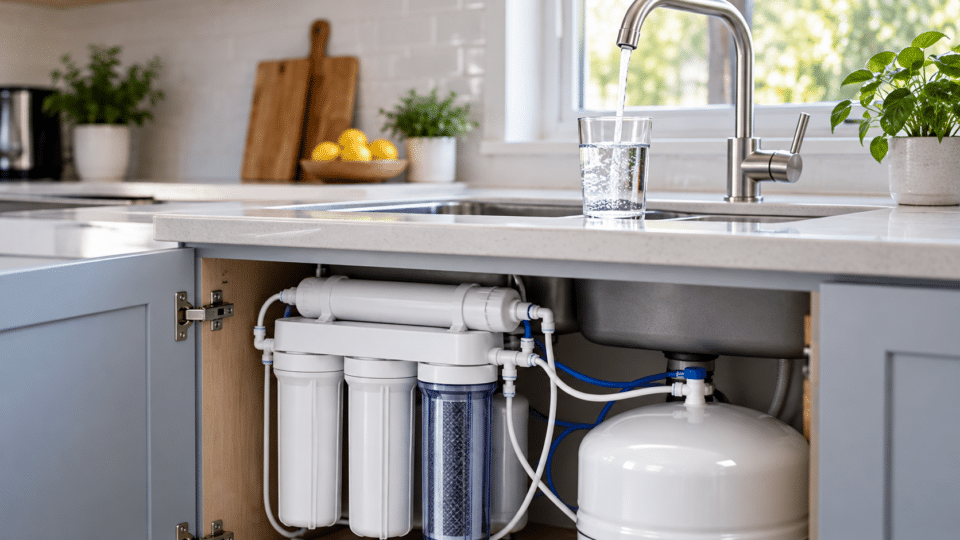
Water filters are designed for different problems: chlorine taste, certain metals, or contaminants that require specific treatment. The claim that a product “removes 99% of impurities” does not, by itself, say what was measured or under what conditions. When choosing a water filter for the kitchen, the right question is not which device has the most filtration stages, but which contaminant you want to reduce and whether there is verifiable certification for that contaminant and that model.
The CDC, EPA and NSF stress that household filters are not interchangeable: some improve taste, others reduce particular chemical compounds, and some technologies are also designed to address microorganisms. The wrong filter can create a false sense of safety.
Water filters: first, find out what is in your water
If your water comes from the public supply, check recent water-quality reports and any notices issued by the local operator. If you use a well or spring, obtain laboratory testing for the relevant parameters. Smell, taste and clarity do not prove that water is safe: contaminants such as metals, nitrates or microorganisms may be present without any obvious sign.
Do not buy a reverse-osmosis system simply because a seller shows you a high electrical-conductivity or TDS reading. TDS gives an approximate indication of the concentration of dissolved substances; it is not a universal test for toxicity or bacteria. Minerals that contribute to TDS can be normal components of drinking water.
What activated carbon does
Activated carbon captures certain molecules through adsorption and is commonly used to reduce chlorine taste and odour. Its performance against other pollutants depends on the type and amount of material, flow rate and duration of use. The label “activated carbon” alone does not establish that a device removes arsenic, nitrates, viruses or all pesticides.
Many filter pitchers and refrigerator cartridges are primarily intended to improve organoleptic properties. The CDC warns that most are not designed to remove microorganisms. For substances that affect health, a product needs a contaminant-specific reduction claim supported by its certification.
Reverse osmosis: more filtration, but also trade-offs
Reverse osmosis (RO) forces water through a semi-permeable membrane and can reduce several categories of dissolved substances and microorganisms. Not all systems remove the same contaminants to the same extent, and performance depends on pressure, membrane integrity and maintenance. The CDC notes reductions in certain metals and salts and, under some conditions, other compounds, but says claims must be checked for the specific model.
RO systems can also produce a wastewater stream and require replacement consumables. The full cost includes cartridges, the membrane, installation and maintenance. A balanced decision addresses an identified real-world risk, rather than an abstract desire for “zero-mineral” water.
NSF/ANSI 42, 53, 58 and 401 are not quality ratings from low to high
| Standard | Type of claim it verifies | Example use |
|---|---|---|
| NSF/ANSI 42 | Aesthetic effects | Chlorine, taste, odour |
| NSF/ANSI 53 | Reduction of certain contaminants with health effects | Lead or particular compounds, if the precise claim is certified |
| NSF/ANSI 58 | Performance of reverse-osmosis systems | Specific reductions demonstrated for an RO system |
| NSF/ANSI 401 | Certain emerging contaminants | Selected compounds such as pharmaceutical residues, depending on the certificate |
NSF says the standards’ numbering reflects the order in which they were developed, not a commercial ranking. The presence of a 53 certification does not mean that a product automatically removes every contaminant covered by that standard. Check the certification listing for the specific claim—for example, “Lead Reduction” or “PFOA/PFOS Reduction”—and for the exact cartridge or model identification.
What about PFAS, lead and pesticides?
For PFAS, the EPA and NSF recommend choosing a filter whose certification and performance statement cover the relevant substances, particularly systems certified with appropriate claims under NSF/ANSI 53 or 58. Not every product bearing the same logo has the same effectiveness against PFAS. A system designed to improve taste should not be marketed as a universal solution for all persistent substances.
For lead, look specifically for lead reduction in the certified claim. For nitrates, pesticides and different metals, check the system’s suitability separately. Do not extrapolate from one contaminant to another, and do not assume that a technology that performs well in a laboratory will work identically at every household flow rate and concentration.
What filters can do against bacteria and viruses
The CDC explains that effectiveness against microorganisms depends on pore size and the technology actually used. Microfiltration can reduce certain larger organisms, but does not guarantee virus removal. Ultrafiltration, nanofiltration and reverse osmosis have different capabilities. If a water source is suspected of microbiological contamination, follow public-authority warnings and choose a method validated for the particular risk.
Boiling can control some microbiological risks, but it does not remove PFAS or resolve chemical contamination. NSF explicitly warns that boiling PFAS-contaminated water does not reduce exposure. Delayed cartridge replacement is not without consequences either; service intervals are calculated for particular volumes or conditions.
How to check a genuine certification in five steps
- Identify the problem: taste, lead, nitrates, PFAS, microorganisms or another parameter.
- Record the exact model and cartridge code, not just the brand name.
- Check the certification organisation and its public product listings.
- Look for the reduction claim for the specific contaminant, not merely the standard number.
- Check the flow rate, capacity, test conditions, costs and replacement schedule.
NSF provides a guide to contaminant-reduction claims and public product listings. A promotional document produced by a retailer is not the same as a current certification issued for the model being purchased.
What this means for a home in Romania
If mains water complies with the applicable standards and chlorine taste is the only problem, a filter certified for aesthetic effects may be sufficient. If testing identifies a problematic contaminant, choose a system designed and certified for it. If water comes from an untested well, testing is the priority, followed by deciding on treatment—not buying the most expensive device.
InfoBuz has separately explained how to follow local water-operator notices during service interruptions; in such situations, a household filter does not replace safety instructions issued for the water network.
Frequently asked questions
Does a filter pitcher remove bacteria?
This should not be assumed. Most pitchers are designed primarily for taste and odour; check for a specific microbiological certification if that is the risk.
Is NSF 53 always better than NSF 42?
No. This is not a ranking. The standards certify different claims; what matters is the contaminant in question and the specific claim.
Is reverse osmosis needed in every home?
No. The choice should be justified by the water’s composition, the household’s needs and the cost of use.
Primary sources
CDC — About Choosing Home Water Filters; NSF — Standards for Water Treatment Systems; NSF — Explanation of Standards 42, 53 and 401; US EPA — Reducing PFAS With Home Filters; NSF — PFAS in Drinking Water.



Discuția cititorilor
Ai o opinie sau o întrebare despre acest articol? Spune-ne ce crezi.
Fii primul care deschide discuția.
Te rugăm să păstrezi un limbaj civilizat și să discuți la subiect. Comentariile spam sunt filtrate automat.