
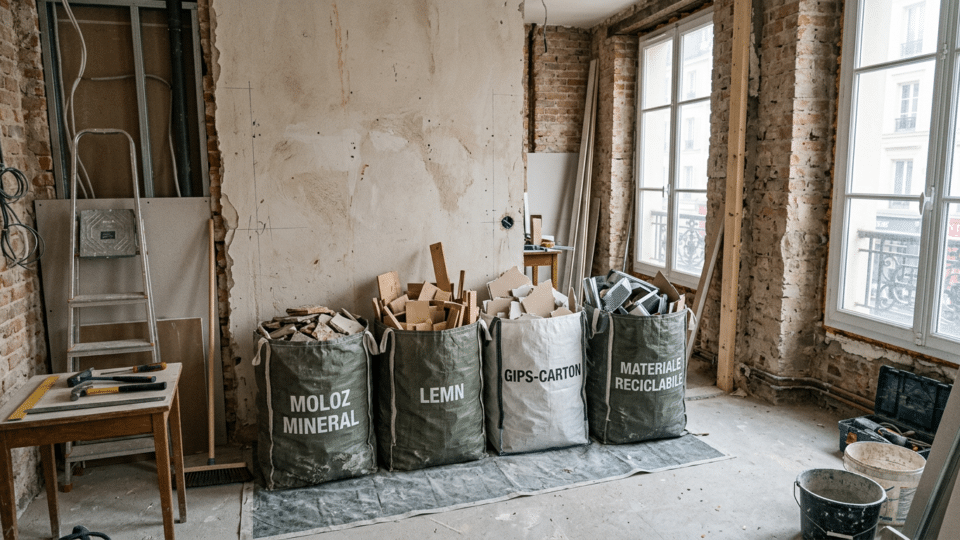
A stripped-out bathroom, removed flooring and a replaced kitchen can produce, within a few days, materials that are subject to different arrangements and should not automatically follow the same route. Bags of ceramic tiles and mortar, plasterboard, a door, old furniture, adhesive containers and paint tins are, in practice, separate waste streams hidden behind the convenient catch-all term “rubble”.
The short answer: renovation waste should not be left beside a waste collection point and is generally not covered by ordinary household-waste collection. The homeowner must check which channel is available locally — a scheduled service, charged bags, a skip, direct drop-off or a voluntary drop-off centre — and retain proof of handover. The national rule is shared; actual access, prices and paperwork vary from one locality to another.
The framework law, Emergency Ordinance No. 92/2021 on the waste regime, prohibits abandoning, dumping or concealing waste, as well as keeping or disposing of it outside authorised sites. At the same time, the mere fact that someone has loaded the debris into a van does not, in itself, establish where it ended up or how it was treated.
The renovation-waste map begins before demolition
The removal plan should be made before the contractor breaks the first wall tile. Once materials are mixed into a single pile, they become harder to reuse or sort and, in some cases, more costly to collect. The European Commission notes that construction and demolition waste includes, among other materials, concrete, bricks, wood, glass, metals and plastics; mixing can compromise material recovery and introduce contaminants into fractions that could otherwise be recovered.
For further context, see Romania’s renovation plan: is the path from funding to construction site still visible?, an article that examines an aspect directly related to this subject.
In an apartment, separation need not become an impossible logistical operation. It is useful, however, not to mix mineral materials from the outset with wood, metal, furniture or containers that still contain chemical products.
| What the work produces | Examples | Route to check locally | What not to assume |
|---|---|---|---|
| Mineral fraction | concrete, brick, mortar, floor tiles, wall tiles | bags or a skip for construction waste; sometimes direct drop-off | That every operator will recycle all of it |
| Finishes and composite materials | plasterboard, laminate flooring, insulation, skirting boards | an operator that explicitly confirms it accepts them | That they automatically count as “clean rubble” |
| Bulky items | furniture, doors, mattresses, sanitary ware | a separate bulky-waste campaign or service, or collection for a fee | That a furniture collection service also takes ceramics, rubble or sanitary ware |
| Clean packaging | cardboard, film, metal, empty and clean plastic | separate collection, only where local rules and the material’s condition allow it | That packaging full of adhesive or paint can enter ordinary recycling |
| Higher-risk products | paints, varnishes, solvents, containers with residues, suspect materials | a site or operator that explicitly accepts this category | That they can go in a rubble bag or household-waste bin |
The exact category and whether it is actually accepted are determined by the local operator or facility. The table does not replace municipal sanitation rules or manufacturers’ instructions for leftover chemical products.
Renovation waste: five routes that should not be confused
Mineral rubble has its own route
Brickwork, mortar, concrete, floor-tile and wall-tile debris are the materials most commonly associated with “rubble”. For small volumes, some services sell bags or charge per bag collected; for larger projects, a skip may be the solution. The price, maximum permitted weight, collection window and accepted materials are local decisions, not uniform rules across Romania.
For example, the sanitation service page for Bucharest’s Sector 2 publishes separate rates per 25 kg bag, cubic metre and tonne, as well as a skip option for large quantities. These figures are useful in illustrating how the service can be priced, but they are not a national price benchmark and should be reconfirmed when ordering.
Plasterboard, flooring and insulation require an extra question
These materials are often loaded together with the mineral fraction to clear the home quickly. The problem is that they do not have the same composition. Plasterboard contains gypsum and cardboard; laminate flooring is generally a composite material; insulation may have different handling requirements. Before placing an order, ask directly whether the operator accepts these materials and whether they need to be kept separate.
It would not be accurate to promise the homeowner that they will be recycled. Lawful collection, sorting, material recovery, reuse, backfilling and disposal are distinct operations. The European Commission specifically warns of the difference between reported “recovery” rates and actual recycling.
An old door and furniture are not automatically rubble
A solid-wood door, a functional piece of furniture, a radiator or a light fitting may have a chance of reuse before becoming waste. This is a practical option only if the item is safe, complete and can be collected before demolition. Once broken, wet, contaminated with adhesive or mixed with site debris, reuse becomes unlikely.
For items that cannot be reused, check the bulky-waste service separately. Do not assume that a campaign for old furniture accepts ceramic sinks, bathtubs, bags of mortar or tile offcuts.
Paint and solvents are not dealt with by “emptying” the container
Containers holding leftover paint, varnish, thinner, adhesive or solvent should be kept separate and labelled as clearly as possible until handover. Do not pour the contents into a drain or mix them into bags of mineral materials. For old products or those without labels, ask the local operator or environmental authority for instructions for the specific category.
If the building contains suspect materials — for example, old elements whose composition cannot be identified — the work should not be treated as routine rubble removal. An assessment and an operator competent to handle that risk are needed. Materials that may contain asbestos are one example where improvisation can create exposure and contamination.
Where the chain breaks: collection is not the final destination
Emergency Ordinance No. 92/2021 provides that economic operators authorised to collect waste must hand it over to facilities authorised for recovery or disposal. The ordinance also states that handing waste to an operator does not automatically release the producer or holder from responsibility for the full recovery or disposal operation.
For an apartment owner, this rule does not mean having to follow the truck personally to the treatment facility. It does mean that it is worth choosing an identifiable channel and being able, if necessary, to reconstruct the basic route: who collected the waste, when, what type of waste they accepted and what destination they declare.
A reasonable chain of custody for a small renovation:
- Photograph the materials before loading, particularly where there are several categories or a large quantity.
- Order the service in your own name, or retain the quote and order confirmation made by the contractor.
- Request proof of collection: a receipt, invoice, payment receipt, handover record or written confirmation identifying the provider and service.
- Ask for the collected material to be specified: construction waste, bulky waste, mixed materials or a special fraction.
- For large volumes or renovation contracts, ask which facility or operator is named as the destination and what documents the company can provide.
The form of the documents depends on the waste stream, quantity and contractual relationship. Not all domestic projects generate the same set of transport documents. But a phone conversation without a quote, receipt or invoice is weak evidence if a dispute arises later.
The rule is national; the service is local
This is where homeowners are often caught out: the right to use the waste collection point near an apartment block does not automatically extend to waste generated by renovation. Sanitation contracts, local decisions, available infrastructure and the operator’s conditions determine the practical route.
Examples from Bucharest show why there is no single price for Romania. Sector 2 publishes different prices by bag, volume and tonne. In Sector 3, the city hall said that, from 1 June 2025, construction and renovation-waste collection is no longer free for private individuals. In Sector 1, a city hall statement carried by AGERPRES in May 2025 referred to contracting through the local operator and a per-bag charge.
These three cases do not support a national average. They do show something important: before starting work, the homeowner should check the city hall website, local regulations, the sanitation operator and, where one exists, the voluntary drop-off centre. Information from a neighbouring town or an older post may already be useless.
For a larger renovation, the cost of removal should be included in the project budget from the outset, alongside transport and protection for common areas. The same cost discipline matters at other stages of a housing project; for example, realistic estimates of construction work are considered separately in InfoBuz’s analysis of the cost of a house from foundation to key handover.
What to ask before accepting a “rubble removal” offer
The lowest price alone is not evidence that a service is inadequate; a high price is not a guarantee of recycling. A useful comparison begins with the precise scope of the service.
- Which materials are accepted and which are refused?
- Is the price per bag, cubic metre, tonne, transport trip or skip? Does it include collection from the floor of the building, handling and treatment fees?
- Is there a weight limit per bag or a time limit for the skip?
- Who issues the invoice or collection document?
- Is the company contracted directly by the homeowner, or is it only an intermediary for the renovation team?
- What is the declared destination for the waste category collected?
- If the company cites an “authorisation”, for what specific activity: collection, transport, treatment, recovery or disposal?
The final question prevents a common confusion. A company’s legal existence is not, by itself, proof that it can manage every kind of waste. If the answer is unclear, request the company’s details and relevant documents, then check with the competent environmental authority or choose the public channel indicated by the city hall.
An example: organising a renovation without turning the hallway into storage
Hypothetical example: in an apartment, floor tiles are replaced in the bathroom and kitchen, several pieces of furniture are dismantled, a door is replaced and a wall is repaired with plasterboard. No weight estimate is given here, because the quantity depends on surface areas, thicknesses and materials.
A prudent arrangement would first separate ceramics and mortar into bags compatible with the ordered service; keep plasterboard and flooring aside until their acceptance is confirmed; photograph the furniture and door before deciding on reuse or the bulky-waste service; and keep paint and adhesive containers separate. At the end, the homeowner would archive the order, invoice and proof of collection with the renovation contract.
Not every project needs five skips. The point is simpler: materials with clearly different routes should not be mixed without knowing whether the selected service accepts them.
What the homeowner can and cannot prove
With a contract, an invoice and confirmation of collection, a homeowner can more credibly show that they used an identifiable service. With information about the accepted fraction and the declared destination, they can better assess whether the service is coherent. For large quantities, weighing or handover documents can add a further level of traceability, if available.
These documents do not automatically prove that every kilogram was recycled. That would require information about subsequent treatment, which is not always public or uniformly accessible to homeowners. The accurate wording is therefore: “I handed over the waste through a documented channel”, not “I recycled everything”, in the absence of a specific confirmation.
In Romania, renovation projects are often discussed in terms of energy efficiency, finishes and cost. The route taken by the debris is a less visible part of the same work. Planned before demolition, it can prevent common areas from being blocked, rushed orders and the risk that an apparent saving becomes an administrative or environmental problem.
Frequently asked questions
Can I leave a few bags of rubble next to the apartment-block bin?
No. Waste generated by renovation must not be abandoned on public land or outside authorised sites. Check the local service for construction waste, charged bags, a skip or drop-off at a locally accepted site.
Is it enough if the tradesperson says they will handle removal?
It is safer for this obligation to be set out in the quote or contract and for you to receive proof of collection. Ask which materials they collect, who issues the document and through which operator or facility the waste stream will be managed.
Is sanitary ware bulky waste?
Do not assume so. Sinks, toilets and bathtubs may be accepted differently from old furniture. Confirm this explicitly with the local operator or the collection company.
Can I put leftover paint in the rubble skip?
Not without the operator’s explicit confirmation. Paints, varnishes, solvents and containers with residues must be handled separately, through a channel that accepts the relevant category.
Sources consulted
- Emergency Ordinance No. 92/2021 on the waste regime — Legislative Portal
- Construction and demolition waste — European Commission
- Construction waste — Sector 2 Sanitation Service
- Uncontrolled dumping of construction waste penalised — Sector 3 City Hall
- Press release — Sector 1 City Hall, carried by AGERPRES





Discuția cititorilor
Ai o opinie sau o întrebare despre acest articol? Spune-ne ce crezi.
Fii primul care deschide discuția.
Te rugăm să păstrezi un limbaj civilizat și să discuți la subiect. Comentariile spam sunt filtrate automat.