
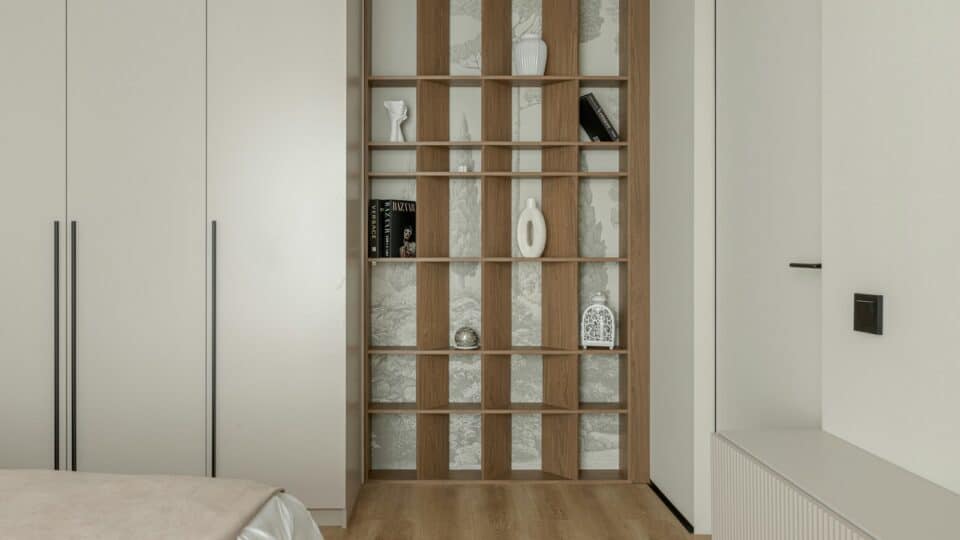
The question of “custom or modular furniture?” becomes expensive when it is reduced to the price of the furniture unit itself. In a real apartment, there are measurements, a floor that is not perfectly level, carrying it upstairs, installation, a scratched component, a move, or a door front that can no longer be replaced a few years later.
The short answer: custom-made furniture is worth assessing for how precisely it solves a difficult space and how effectively it uses the available volume. Modular furniture is worth assessing for standardisation, faster availability and the option to reconfigure or replace certain components. Second-hand furniture can greatly reduce the upfront payment, but it shifts responsibility to the buyer for checking its condition, collection, component compatibility and the risk of repairs. Without written quotes for the same configuration, it is not possible to honestly say which option is cheaper in Romania.
A useful comparison starts with the same storage requirement, not labels such as “premium” or “economy”, or a price per linear metre.
Custom or modular furniture: compare the same function, not two pictures
An open bookcase, a wardrobe with drawers and a kitchen are different projects. That is why two quotes for the same length may conceal units with different depths, more door fronts, different fittings, costly drawers or far less interior space.
For a like-for-like test, the editorial team should fix a technical specification. For example: a storage unit for a 240 cm wall, with a defined height and depth, a set number of shelves, two enclosed sections, two drawers and a requirement for secure wall fixing. The same specification should be sent to a modular furniture retailer, custom-furniture workshops, and applied to a second-hand item that can perform the function without makeshift solutions.
Before comparing costs, the following should be recorded separately:
- usable capacity: shelf length, number of drawers, hanging space or internal volume, depending on the furniture’s purpose;
- the room’s actual dimensions, including skirting boards, sockets, pipes, edges and irregularities in the walls or floor;
- the materials, edging, fittings and fixing systems stated in the quote;
- what the price includes: design, measurement, delivery, carrying upstairs, installation, cut-outs, filler panels and packaging removal;
- the calendar time from the first measurement to normal use of the item.
A price per linear centimetre may be only a preliminary reference point. By itself, it cannot show whether two pieces offer the same capacity, the same quality of mechanisms or the same amount of installation work.

The total cost has more columns than the purchase invoice
A simple formula, applicable to all three options, is:
Total cost of use = product price + design/measurement + delivery/carrying upstairs + installation + adaptations + repairs paid for by the buyer + moving cost − realistic recoverable value.
The formula will not produce a useful result if the figures are guessed. It does, however, require the buyer to see what is missing. “Recoverable value” is not the desired asking price in a listing, but the amount that can realistically be obtained after accounting for the time, transport and conditions required to sell it.
| Cost or risk item | New modular furniture | Custom-made furniture | Second-hand furniture |
|---|---|---|---|
| Design and measurement | Usually limited to planning and checking the space; depends on the chosen service | May be a separate stage; the party responsible for measurements should be stated in writing | Checking dimensions is usually the buyer’s responsibility |
| Adapting to niches and uneven walls | May require filler panels, cut-outs or compromises | May be included in the project if explicitly stated in the quote | Often limited; alterations can eliminate the price advantage |
| Installation and rectification | Check whether these are included and the conditions for complaints | Check the product, installation and response time separately | May require DIY work or a separately contracted service |
| Moving and reconfiguration | Possible only if the system, instructions and joints allow it | May be difficult if the piece was made for an exact niche | Depends on construction, condition and whether all components have been retained |
| Recoverable value | Possible but not guaranteed; the product line, completeness and condition matter | May be low for pieces highly specific to a space | A low initial price may limit the loss, but does not remove logistical costs |
This is also why installation should not be treated as a minor detail. With furniture that is fixed in place or installed, a conformity issue may mean dismantling and reinstalling it, rather than simply replacing a box.
Repair and lack of conformity: legal rights are not the same as a commercial return
In Romania, Emergency Ordinance No. 140/2021 also applies to goods that are to be manufactured or produced. The fact that an item is custom-made therefore does not take it outside the rules on the conformity of goods.
The legislation provides that the seller is liable for lack of conformity existing at delivery and discovered within two years. For issues discovered in the first year, the law establishes, under the conditions set out in the act, a presumption that the lack of conformity existed at delivery, unless proven otherwise. The consumer may request repair or replacement, and the remedy must be provided at no cost and within a reasonable period of no more than 15 calendar days, a period agreed in writing by the seller and consumer.
If the goods were installed before the lack of conformity appeared, the obligation to provide a remedy may include dismantling and reinstallation, or covering the associated costs. During the first 30 calendar days after delivery, the law provides for a corrective measure option under its specific conditions. For a significant order, it is worth reflecting all these details in the contract as well: who takes the measurements, who installs the furniture, how the work is accepted and within what period a problem will be repaired.
These rights should not be confused with a right to withdraw after changing one’s mind, or with a retailer’s commercial returns policy. Products made to the consumer’s specifications or clearly personalised products may be excluded from withdrawal. For example, Dedeman’s policy mentions this exclusion. It does not, however, cancel legal rights concerning lack of conformity.
Check repairability before ordering, not after a hinge breaks
A long warranty is not the same thing as repairability. For a unit with doors, drawers and fixing systems, the useful questions are specific: can an identical hinge be ordered? Is there a part number? Can a door front, rail or leg be replaced? Are the colour and dimensions still available in the range? Who pays for the call-out and labour after the warranty expires?
As a reference point, the voluntary EU Ecolabel criteria for furniture include the availability of spare parts for at least five years and design for disassembly. These are not general obligations for every piece of furniture sold in Romania, but they provide a practical set of questions for any supplier.
In the modular segment, parts availability can be a real advantage, but it should not be assumed. IKEA, for example, documents a service for small parts and certain larger components; availability depends on stock and whether the product is still in the range. This is one retailer’s policy, not a rule for all modular systems.

Moving changes the ranking of the three options
For an owner who expects to live for a long time in an apartment with a difficult niche, the space gained through a custom-made piece may justify a higher initial cost and more difficult resale. In that case, the comparison is not only with the price of a standard system, but also with the function lost: unused gaps, storage moved into other units and any necessary adaptations.
For a tenant or someone expecting to move within one or two years, reversibility matters more. Modular or second-hand furniture may be better suited if it can be dismantled without damage, all components remain identifiable and the new space can accommodate it. A modular arrangement that has been heavily altered, with cut panels, adjusted units and special fixings, may nevertheless lose some of its mobility advantage.
Second-hand is a distinct category. Goods bought from a private individual do not ordinarily fall under the same consumer-protection regime as goods bought from a trader. For second-hand goods bought from professionals, the European framework allows a shorter liability period than the standard one to be agreed, but not less than one year. The Council of the EU explains the difference between purchases from traders and from private individuals.

Three scenarios where the decision changes
1. Uneven wall, narrow niche, space up to the ceiling
Here, custom-made furniture may come out ahead through its use of space, but only if the quote specifies tolerances, cover panels, skirting boards, cut-outs and responsibility for measurements. Modular furniture is not ruled out: it may work with additions, but these need to be budgeted for rather than treated as minor accessories.
2. Renting or a likely move
The first criterion is disassembly, not catalogue appearance. Ask for reassembly instructions, check whether missing elements can be bought, and calculate the services needed for dismantling, packing, transport, carrying upstairs and installation in the new home. A sturdy second-hand unit may make sense if it is complete and fits along the access route; otherwise, logistics can absorb the low price.
3. Owner-occupied home, long-term use
Verifiable durability and the possibility of repair matter more here. Request the materials, the brand or model of fittings where relevant, service terms and parts that can be ordered later, all in writing. A verbal promise of a “long warranty” is no substitute for the contract, invoice and installation acceptance report.
The quote request specification that makes comparison possible
Until the editorial team collects comparable quotes for the same configuration, any figure presented as the “right price” would be unreliable. For their own decision, readers can send every supplier the same list:
- The space dimensions, photographs and notes on walls, floor, skirting board, sockets and access to the apartment.
- The required function: minimum capacity, number of shelves, drawers and doors, and the type of items to be stored.
- The requested materials and fittings or, if these have not been selected, clearly stated options in the quote.
- An itemised price for design, measurement, product, delivery, carrying upstairs, installation, fixings and any adjustments.
- The calendar timeframe from measurement to installation, and the procedure for delays or remedying lack of conformity.
- Warranty terms, parts that can be bought separately and the cost of interventions after the warranty.
- The possibility and conditions for dismantling, reassembly and adaptation in a future move.
Keep the quote, approved drawing, invoice and installation acceptance report. For second-hand furniture, add detailed photographs, measured dimensions, a list of missing components, proof that the piece fits along the transport route and the estimated collection cost. If an old item is being replaced, separate planning for its removal is still necessary; InfoBuz’s guide to the legal route for renovation waste explains why bulky furniture should not be confused with rubble.
The right verdict is therefore conditional. Custom-made furniture buys precision, but it can also buy irreversibility. Modular furniture buys standardisation, but it may require costly adaptations. Second-hand furniture buys a lower upfront price, but requires more checking and logistics. The best choice is the one whose total cost, rights to a remedy and route through the next move can be seen before payment.
Frequently asked questions
Does custom-made furniture have a legal warranty?
Yes. Emergency Ordinance No. 140/2021 also applies to goods that are to be manufactured or produced. Personalisation may affect the right to withdraw after changing one’s mind, but it does not remove rights relating to lack of conformity of the goods.
Is modular furniture always easier to move?
No. The advantage depends on the specific construction, disassembly instructions, condition of the joints, availability of components and the extent to which the system has been modified for the original space.
How do I compare second-hand furniture with new furniture?
Compare the same function and add the costs of inspection, collection, transport, missing parts, repairs, cleaning and installation, as well as the risk of more limited rights when buying from a private individual.
Sources consulted
- Emergency Ordinance No. 140/2021 on certain aspects concerning contracts for the sale of goods — consolidated version
- Consumer protection: shopping rights — Council of the European Union
- EU Ecolabel — Furniture product group criteria
- Online returns policy for private individuals — Dedeman
- Furniture spare parts — IKEA Romania




Discuția cititorilor
Ai o opinie sau o întrebare despre acest articol? Spune-ne ce crezi.
Fii primul care deschide discuția.
Te rugăm să păstrezi un limbaj civilizat și să discuți la subiect. Comentariile spam sunt filtrate automat.