
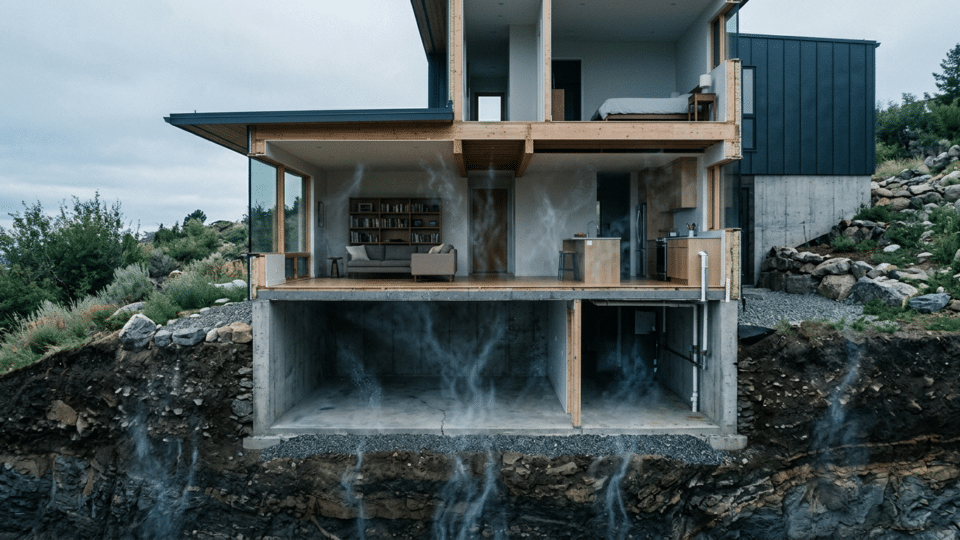
Radon can enter buildings from the soil and accumulate in indoor air, without any smell, colour or taste. For a house or flat, the useful question is not whether it can be “felt” in a room, but whether average long-term exposure is high. That cannot be determined from an area map, occasional airing-out, or the number shown by a detector on a single day.
In Romania, the reference level is 300 Bq/m³ as the annual average of the indoor radon concentration. Bq/m³ means becquerels per cubic metre, the unit expressing radioactive activity in a volume of air. The level is not a biological boundary below which risk becomes zero, but the benchmark at which Romania’s framework requires the causes to be assessed and reduction measures to be taken.
In brief: to establish a home’s actual risk, request screening carried out under the methodology by a laboratory designated by the National Commission for Nuclear Activities Control (CNCAN). This normally uses integrated detectors left in the home for at least three months; a rapid measurement may serve a different purpose, but it does not replace an estimate of the annual average.
Radon at home: four tools, four different answers
Confusion arises because all of these tools produce, in one way or another, a figure for radon. But that figure does not carry the same meaning in every case.
| Tool or stage | What it helps with | What it cannot establish on its own |
|---|---|---|
| Radon map | Shows areas where measurements and interventions should be prioritised. | The concentration in a particular room or home. |
| Integrated screening | Estimates CARIA, the annual average indoor concentration. | Where radon enters and which technical solution is appropriate. |
| Diagnostic measurement | Identifies sources and entry routes to inform a remediation plan. | Replacing longer-term screening. |
| Follow-up measurement | Checks whether reduction work has been effective. | Guaranteeing that the result will remain unchanged after alterations to the building. |
The map published by CNCAN is useful as a guide. It aggregates measurements and may indicate where authorities, designers and owners should pay closer attention. It cannot, however, diagnose a house: two nearby buildings may have different concentrations because of their foundations, cracks, basement, ground conditions, ventilation and the way rooms are used.
The same principle applies to a commercial detector. A value displayed in real time may be useful for observing variations or deciding that an investigation is warranted. But without information on duration, placement, method, calibration and the necessary corrections, it is not automatically equivalent to the screening set out in the Romanian methodology.
Why today’s reading is not an annual average
Radon concentration can vary from hour to hour, day to day and between seasons. Air exchange, the temperature difference between indoors and outdoors, atmospheric pressure, and how a room is used can all temporarily alter the measured value.
This is why the methodology approved by CNCAN Order No. 153/2023 defines CARIA as the annual average radon activity concentration in indoor air. For screening, it provides for an integrated method lasting at least three months, preferably during the cold season. If the measurement lasts less than 12 months, the results are corrected using the factors provided for in the methodology to estimate the annual average.
Homes require at least two detectors, placed in rooms relevant to occupancy in line with the technical requirements. In other words, a single value recorded near a window, in a rarely used room or over a weekend does not answer the question that CARIA answers.
The World Health Organization says that radon-related risk rises with long-term exposure and recommends measurements of at least three months to estimate the annual average. In its fact sheet on radon and health, the WHO recommends a reference level of 100 Bq/m³ where national conditions allow, and states that the national level should not exceed 300 Bq/m³.
This does not mean Romania has two competing legal thresholds. For homes in Romania, the applicable benchmark is the 300 Bq/m³ reference level for the annual average. The 100 Bq/m³ value is the WHO’s international public-health recommendation.
How to request an interpretable radon measurement
The first step is to check the laboratory. CNCAN publishes a register of designated laboratories; its status should be checked when making the request, as lists and the validity of designations may be updated. The fact that a company sells detectors or offers a rapid reading does not by itself establish that it conducts screening under the CNCAN methodology.
Before placing an order, it is worth requesting written answers to a few straightforward questions:
- Is the measurement integrated-method screening lasting at least three months?
- How many detectors are included, and in which rooms will they be placed?
- Will the final result state the actual exposure period and the values obtained?
- Will the report calculate CARIA and state any correction factors?
- Is the laboratory designated by CNCAN for radon at the time of contracting?
The public documents consulted do not set out a standard national price for testing a home. The price should be requested directly from the laboratory and compared with the service included: the number of detectors, duration, analysis, report and any subsequent recommendations.
Minimum checklist for reading a measurement report
An interpretable result is more than “radon: X Bq/m³”. The report should be read alongside the following information:
- the address and rooms where the detectors were placed;
- the number of detectors and their placement;
- the start and end dates of the measurement;
- the method used and the laboratory that issued the result;
- the values for each detector, where reported;
- the estimated CARIA and the correction factors used if the period was shorter than a year.
These details explain why two numerical results cannot automatically be compared. A reading of 250 Bq/m³ on one day and a CARIA of 250 Bq/m³ obtained after screening do not have the same interpretive weight.
What to do if the result is below, close to or above 300 Bq/m³
A result below the reference level does not mean there is no risk at all. It is, however, the relevant information for deciding whether, under the conditions measured, the home is below Romania’s benchmark for the annual average.
If the value is close to 300 Bq/m³, keep the report, ask the laboratory what the measurement uncertainty means, and avoid drawing conclusions based on ventilation carried out specifically during the test period. It is also reasonable to discuss repeating the measurement, particularly if there have been major changes to ventilation or to how rooms are used.
If at least one result exceeds 300 Bq/m³, the methodology provides for identifying the causes, establishing a remediation plan and carrying out a follow-up measurement after the measures have been applied. The next step is not necessarily to buy a fan or undertake work at random.
The diagnostic measurement has a distinct purpose: it may use continuous and instantaneous methods for at least five days so specialists can identify the sources and routes through which radon enters the building. It helps design the intervention, but does not replace the minimum three-month screening used to estimate annual exposure.
Ventilation helps, but is neither a verdict nor a universal fix
Ventilation can reduce radon concentration in some situations, but the effect may be temporary. If radon continues entering from the soil, a basement or air routes within the building, the concentration may rise again after windows are closed.
CNCAN’s guidance on radon-concentration remediation treats solutions as building-specific interventions: the source, entry routes, foundation, existing ventilation, the use of rooms, costs and energy efficiency must be assessed together. Measures may include sealing some entry routes, controlled changes to ventilation or foundation-level solutions, but selecting them requires a technical diagnosis.
This is also why energy renovation should be part of the discussion. Replacing windows, insulating a building or changing its ventilation can alter airflow within it. This does not mean every renovation increases radon, but the methodology recommends repeating measurements after refurbishment, structural alterations or other interventions that may change ventilation.
When to repeat testing and the tenant’s role
The methodology recommends repeating measurements at least once every 10 years, as well as after works that alter the structure, thermal insulation, airtightness or ventilation. For a family spending substantial time in ground-floor, semi-basement or basement rooms, these are generally the spaces that warrant particular attention, without automatically excluding upper floors.
A tenant can ask the owner for a measurement and request access to the full report. In practice, the owner is the person able to decide on work to the building, but the result matters to everyone occupying the space. A constructive discussion starts with the laboratory report, rather than assuming that the mapped area or a momentary reading has already settled the question for the flat.
The WHO associates radon with lung cancer, and smoking substantially increases the risk. Measuring and reducing exposure are building-level prevention measures; they are not a medical test and cannot diagnose an individual.
Local data may signal a problem, but does not automatically describe all of Romania
CNCAN has said that 20% of the educational buildings investigated exceeded the 300 Bq/m³ reference level. The important wording is “of the buildings investigated”: the statement does not provide, in a complete and readily auditable public dataset, all the detail required to turn that percentage into a national rate for schools or homes.
A study published in 2025, conducted in Cluj-Napoca, analysed 198 educational institutions and 266 houses, with measurements in 1,440 rooms. Its authors reported exceedances of 300 Bq/m³ in 24% of educational institutions and 13% of the houses included. The study is useful in showing variation between buildings and the influence of local characteristics, but it is not a representative sample of all homes in Romania.
The practical conclusion is less dramatic, but more useful: the map and local data may show that it is worth paying attention; only a properly conducted measurement in the space where you live can estimate that home’s exposure.
Frequently asked questions
What is the reference level for radon in Romania?
The reference level is 300 Bq/m³ for the annual average indoor radon concentration. It is not an instantaneous value, nor a level below which risk becomes zero.
Is an online-bought radon detector enough?
It can be useful for orientation and observing variations, but it is not automatically equivalent to screening carried out under the Romanian methodology. For a result comparable with the reference level, check the duration, method, placement and whether the laboratory is designated by CNCAN.
How long should a home radon measurement last?
The screening methodology provides for the integrated method to be used for at least three months, preferably in the cold season. For periods shorter than 12 months, correction factors are used to estimate the annual average.
Does daily ventilation eliminate the radon problem?
Ventilation can temporarily reduce the concentration, but it does not necessarily eliminate the source or the route through which radon enters the building. After a high result, the causes must be assessed and a building-specific plan developed.
What happens after a result above 300 Bq/m³?
The causes must be identified and a remediation plan developed. A diagnostic measurement helps identify sources and entry routes, while a follow-up measurement is carried out after interventions to check their effectiveness.
Sources consulted
- CNCAN – Basic radiological safety requirements for natural radiation sources
- CNCAN Order No. 153/2023 – Methodology for determining radon concentration in indoor air and workplaces
- CNCAN – Designated laboratories
- World Health Organization – Radon and health
- Cucoș et al. – A comparative analysis of indoor radon activity concentrations in Romanian houses and educational institutions





Discuția cititorilor
Ai o opinie sau o întrebare despre acest articol? Spune-ne ce crezi.
Fii primul care deschide discuția.
Te rugăm să păstrezi un limbaj civilizat și să discuți la subiect. Comentariile spam sunt filtrate automat.