
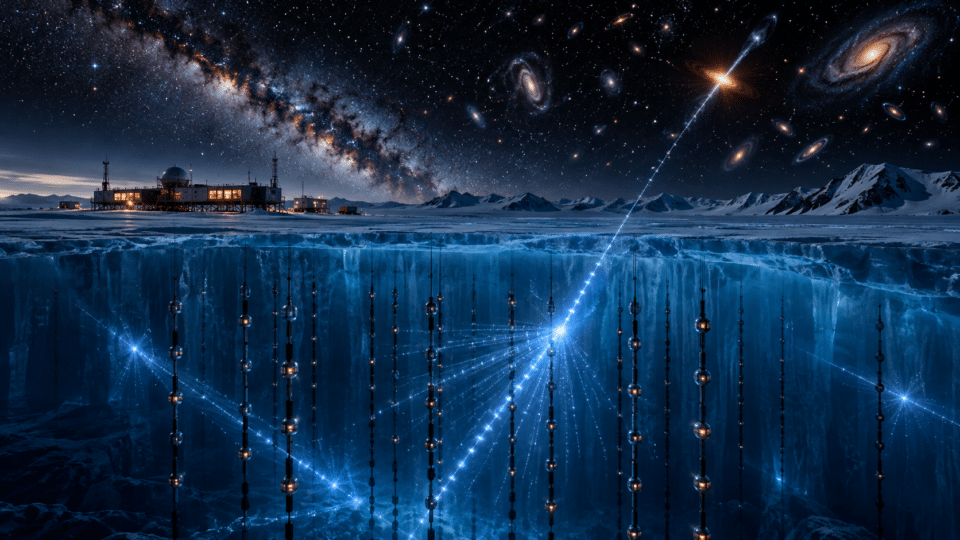
Beneath the South Pole, at depths of roughly 1,450 to 2,450 metres, Antarctic ice is more than the setting for an experiment. It is the medium through which an extremely faint light travels, captured by thousands of sensors and used to reconstruct the passage of particles arriving from space. The IceCube Observatory does not “see” neutrinos directly. It records the traces left by their rare interactions with matter.
In brief: cosmic neutrinos interact with atoms so rarely that they can escape very dense regions of the Universe and reach Earth almost undisturbed. That very elusiveness also makes them difficult to detect. IceCube’s solution was to turn a vast volume of transparent ice into a particle detector.
The claim in the brief that the 2026 Nobel Prize in Physics recognised contributions to IceCube is not presented in this article as a confirmed fact: the official individual Nobel Prize page could not be verified from the documentation available. IceCube’s scientific importance, however, is supported by the collaboration’s documentation and published research on the detection of an astrophysical neutrino flux.
What actually reaches IceCube’s sensors
A neutrino is an elementary particle with no electric charge. They exist in enormous numbers throughout the Universe and constantly pass through Earth and our bodies. Most come from ordinary processes, including the Sun and Earth’s atmosphere. IceCube, however, targets a far rarer subset: very-high-energy neutrinos produced in violent astrophysical phenomena.
Because they are electrically neutral, neutrinos are not deflected by galactic magnetic fields in the way that protons and other charged cosmic rays are. And because they interact only weakly with matter, they can emerge from regions that light struggles to cross. This does not mean they provide a complete, unaltered image of their source: direction, energy and event type must be reconstructed from an indirect signal, and detections remain few.
When a neutrino does interact with an atomic nucleus near the detector, it can produce a charged particle. If that particle travels through the ice faster than light in ice—not faster than the speed of light in a vacuum—it produces Cherenkov radiation. This is the optical equivalent of a shock wave: an extremely faint bluish light emitted in a cone.
According to the technical explanation from the IceCube educational programme, digital optical modules measure the timing and intensity of the Cherenkov photons that reach them. From the distribution of those times and intensities, researchers estimate the event’s path and energy. There is no photograph of the neutrino, nor a photograph of the cosmic object thought to have produced it.
Why nearly a cubic kilometre of ice was needed
In its final configuration, IceCube has 5,160 digital optical modules installed on 86 vertical cables, known as strings. Its instrumented volume is on the order of one cubic kilometre. This scale is not engineering spectacle for its own sake; it is a direct response to the extremely low probability that neutrinos will interact.
A small detector would allow nearly all neutrinos to pass through without leaving a measurable signal. A huge volume increases the chance that, from a very sparse flux, some particles will interact close enough to the sensors. The clear deep ice therefore has two roles: it is the mass in which an interaction can take place, and the medium through which Cherenkov light travels to the modules.
The location beneath the ice also reduces the background from particles produced in the atmosphere. In particular, muons created when cosmic rays strike the atmosphere can mimic some signals of interest. One important method is to select events that appear to come through Earth, from below the detector: the planet filters out a substantial share of atmospheric muons. But this is not an absolute rule. At very high energies, even neutrinos are more likely to interact while crossing Earth, and the planet becomes partly absorbent to them.
The discovery in the data was not a single “signal”
In 2013, the IceCube collaboration published evidence for high-energy neutrinos that could not be satisfactorily explained by atmospheric background alone. The analysis, extended to three years of data, reported 37 candidate events, with deposited energies between about 30 and 2,000 TeV, and rejected the hypothesis of an exclusively atmospheric origin at 5.7 sigma.
This is the key point for readers: the result was not inferred from a single particle with a “cosmic” label. It was a statistical conclusion, reached by comparing the distribution of observed events with models for neutrinos and muons produced in Earth’s atmosphere. The three-year analysis published in Science thus strengthened the case for an astrophysical flux of high-energy neutrinos.
The shift mattered for astronomy. Optical, radio and gamma-ray telescopes track photons; cosmic-ray detectors largely track charged particles, whose paths are bent by magnetic fields. Neutrinos add a different messenger. They do not replace other instruments, but become especially useful when observations are combined.
From an event to a likely source: TXS 0506+056
In September 2017, the IceCube-170922A alert flagged a high-energy event with a direction reconstructed well enough to allow rapid follow-up observations by other instruments. In that region of the sky, astronomers found the blazar TXS 0506+056 during a period of intense gamma-ray activity. A blazar is an active galaxy whose relativistic jet is pointed roughly towards us.
The multimessenger paper in Science, based on data from IceCube and several astronomical observatories, described the coincidence as a significant association between the neutrino and the active source. This is strong evidence that some active galactic nuclei can accelerate particles capable of generating very-high-energy neutrinos.
The proper wording remains cautious. The TXS 0506+056 case does not prove that all blazars are important neutrino sources, nor that they account for most of the astrophysical flux observed by IceCube. In addition, the retrospective analysis of an excess of events from the direction of the same source in 2014–2015 has a statistical significance that must be read carefully, not as absolute confirmation.
What a neutrino map of the Milky Way can reveal
A later stage of the research was the reporting of a high-energy neutrino signal from the plane of the Milky Way. The result matters because it shows that part of the signal may be linked to processes within our own galaxy, where cosmic rays interact with gas and radiation.
But this observation, too, is not a checklist of individual objects identified on a map. It may represent diffuse emission, the combined contribution of sources too faint to separate one by one, or a combination of these explanations. The distinction may sound technical, but it is crucial: detecting a region of emission is not the same as identifying the specific accelerator within that region.
That is why neutrino astronomy works best as a coordinated effort. An alert can trigger observations in gamma rays, radio, optical light, X-rays and other bands. A useful comparison is the study of fast radio bursts: there, too, localisation and multiwavelength observations are needed to link a pulse to its cosmic environment, as explained in InfoBuz’s analysis of the host galaxy of a fast radio burst.
What remains unknown
IceCube has shown that the Universe produces high-energy astrophysical neutrinos and has provided important associations with candidate sources. It has not, however, resolved the origin of the entire observed flux, nor the full problem of the highest-energy cosmic rays.
- Most events cannot be securely attributed to an individual source.
- Atmospheric background and reconstruction errors must be modelled for every analysis.
- Direction is reconstructed with different levels of precision depending on the type of observed interaction.
- At extreme energies, Earth is no longer only a useful filter; it can absorb some of the neutrinos that would otherwise cross it.
IceCube-Gen2 has been proposed as an expansion of the observatory, with a larger optical component and other systems intended to cover a broader energy range. It is a planned project, not a result already achieved; its performance and timetable should be understood as project goals.
IceCube’s lasting contribution is its method: a faint light signal recorded in ice becomes, through reconstruction and statistics, information about otherwise inaccessible cosmic phenomena. Antarctica has not become a telescope in the usual sense. It has become an active part of a detector able to listen to the Universe through particles that are almost unwilling to be observed.
Frequently asked questions
Does IceCube detect neutrinos directly?
No. The detector records Cherenkov light emitted by charged particles produced when a neutrino rarely interacts with matter near the sensors.
Why is IceCube built beneath Antarctic ice?
Deep ice is transparent enough for Cherenkov light to travel through it, while the very large volume increases the chance of observing rare neutrino interactions. The depth also helps reduce background from atmospheric particles.
Has IceCube found the origin of all cosmic neutrinos?
No. IceCube has demonstrated an astrophysical neutrino flux and obtained important associations, including with the blazar TXS 0506+056, but most of the flux still has no securely identified individual source.
What does multimessenger astronomy mean?
It combines information from different messengers—such as radio and optical light, gamma rays, gravitational waves, cosmic rays and neutrinos—to study the same source or event.
Sources consulted
- IceCube FAQ – detector design and location
- Detecting Neutrinos – IceCube Masterclass
- Observation of High-Energy Astrophysical Neutrinos in Three Years of IceCube Data
- Multimessenger observations of a flaring blazar coincident with high-energy neutrino IceCube-170922A
- The IceCube-Gen2 Project
For more on Antarctica, see Beneath Antarctic ice is not a “frozen” world: what is millions of years old and what is still moving, which offers complementary details on the subject.


Discuția cititorilor
Ai o opinie sau o întrebare despre acest articol? Spune-ne ce crezi.
Fii primul care deschide discuția.
Te rugăm să păstrezi un limbaj civilizat și să discuți la subiect. Comentariile spam sunt filtrate automat.