
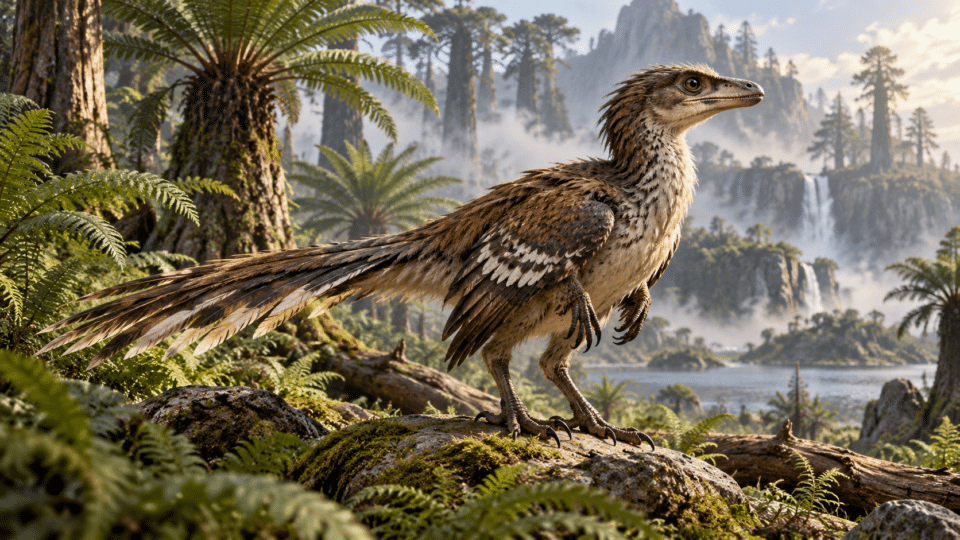
A Late Jurassic fossil discovered in southeastern China complicates the convenient picture of early birds as animals all moving along the same path towards ever-improving flight. The newly described species, Yuezhuornis yangyuanensis, is placed within Avialae—the branch that includes modern birds and their extinct relatives—but had unusually short forelimbs and anatomical indications of a largely ground-based life.
In brief: The fossil supports the idea of an avialan with greatly reduced flight ability, possibly lost within this evolutionary branch. It is not, however, a direct record of behaviour: researchers infer limb function from body proportions, statistical comparisons and the species’ position on the evolutionary tree.
The study, published in Nature on 14 October 2026, describes holotype IVPP V34427, an incomplete skeleton from the Zhenghe fauna, associated with rocks around 150–148 million years old. The important conclusion is not that all very early birds were terrestrial, but that distinct body plans and strategies already existed in a period close to that of Archaeopteryx.
What the flightless Jurassic bird fossil directly shows
Some details are anatomical observations, rather than assumptions about how the animal lived. The skeleton preserves elements of the skull, vertebral column, pelvis, tail and limbs. The authors identified a mixture of traits seen in avialans and in bird-related predatory theropods.
- Its forelimbs were very short relative to the rest of its body.
- Its teeth had serrated edges.
- The second toe was hyperextensible and bore a curved, sickle-shaped claw.
- The skull retained features the authors compared with those of some troodontids, a group of non-avialan theropods.
This combination may seem contradictory only if “bird” is used as a synonym for a pigeon, swallow or any modern animal with a beak and long wings. In palaeontology, membership of a group is determined by evolutionary relatedness—its position on a phylogenetic tree—not by a single function such as flight.
The authors’ analysis places Yuezhuornis within Avialae, slightly more derived than Archaeopteryx and as the sister taxon to Zhengheornis. This is the result of the character matrix and method used in the paper, not an unchangeable verdict. A future independent analysis may test that placement with new data.
Why short wings suggest a ground-based life
The authors did not find a label on the fossil saying that it could not fly. They compared limb proportions and other body features with ecomorphometric data, then interpreted the result alongside the species’ phylogenetic placement. Their conclusion is that the animal was terrestrial and probably flightless.
In Reuters reporting, researcher Min Wang nevertheless noted an important limitation: small wings do not automatically rule out a few short flights. A comparison of its proportions with 377 living bird species placed the animal close to terrestrial forms, but a fossil cannot directly measure take-off, manoeuvrability or the distance of any possible flight.
For that reason, the wording in the headline should be read as editorial shorthand for the strongest functional interpretation currently available, not as absolute certainty about the animal’s every movement. More cautiously, Yuezhuornis can be described as a predominantly terrestrial avialan with much reduced flight ability.
A bird lineage can give up flight
Flight is not a requirement for remaining within a bird lineage. Modern flightless birds, from ostriches to kiwis, demonstrate this, although they are not perfect analogues for a Jurassic animal. They emerged much later, in different ecosystems, and their bodies are products of separate evolutionary histories.
The significance of Yuezhuornis lies in its timing: according to the study and an institutional release by the Chinese Academy of Sciences, it may be the oldest known evidence for the loss of flight in avialan evolution. The phrase “oldest known evidence” is essential. It does not mean that this animal was the first flightless creature to exist, but that no older fossil evidence for the phenomenon is currently available.
There are two main scenarios. In the first, the ancestors of this lineage had greater aerial ability, which Yuezhuornis or its close relatives lost in favour of a terrestrial niche. In the second, the lineage retained limited aerial ability from an early stage. Current evidence does not allow a definitive choice between them.
A “raptor” claw does not make Yuezhuornis a Velociraptor
The hyperextensible second toe and curved claw are striking because they recall deinonychosaurs, the group popularly associated with “raptors”. But the dramatic label can mislead. Yuezhuornis was not classified within Dromaeosauridae, and a similar claw does not make it a “feathered Velociraptor”.
The serrated teeth and claw are consistent with a carnivorous diet and with the use of the foot to catch or restrain prey. They do not demonstrate, however, that the animal was a fast runner, an active hunter or a direct competitor of other small dinosaurs. There is a gap between anatomy and a precise hunting scene that the fossil alone cannot bridge.
For more on palaeontology, see Dinodontosaurus isiyavamanda: the fossil kept for 60 years that could shift the timeline of the earliest dinosaurs, which provides complementary details on the subject.
Archaeopteryx is not the simple opposite of the new fossil
Archaeopteryx is often presented as the classic benchmark for an early bird. The comparison with Yuezhuornis is useful, but it should not be turned into a simplistic contest between a “flier” and a “non-flier”. Specialist literature still debates the precise aerial performance of Archaeopteryx, even though its anatomy includes feathered surfaces and wing proportions more favourable to flight than those seen in the new fossil.
A recent overview of Archaeopteryx ecology underscores precisely this difficulty: the aerial function of early avialans cannot be reduced to two perfectly separate categories. For Yuezhuornis, the relevant contrast concerns proportions and possible ecological specialisation, not a claim that one was the “first true bird” and the other an exception to the rule.
Why the Zhenghe fauna matters, not just one skeleton
The fossil did not emerge from a complete geological void. The Zhenghe fauna in Fujian province had already become important after the description of Fujianvenator prodigiosus, another Late Jurassic avialan. The 2023 paper on Fujianvenator showed that this fossil assemblage may preserve terrestrial diversity underrepresented at other sites.
That is where Yuezhuornis makes its broader contribution. A single specimen cannot establish how widespread terrestrial avialans were during the Jurassic, nor can it single-handedly rewrite the origin of flight. But set alongside other fossils from the same geological window, it suggests that the early bird tree had more ecological branches than the linear story of “ground dinosaur, then a bird increasingly better at flight” implies.
In evolution, the loss of a function does not mean going backwards in time. It may mean specialisation in an environment where flight matters less than running, balance, feeding or defence on the ground. Further fossils and phylogenetic tests will determine how extensive this early evolutionary experiment was.
Frequently asked questions
Was Yuezhuornis a bird or a dinosaur?
In the authors’ published analysis, Yuezhuornis belongs to Avialae, the group that includes modern birds and their extinct relatives. Avialans are theropods, so the simple opposition between “bird” and “dinosaur” does not accurately describe their relationship.
Is it certain that Yuezhuornis could not fly at all?
Not entirely. The study strongly supports a terrestrial lifestyle and reduced flight ability, based on limb proportions and comparative analyses. The possibility of very short flights is not ruled out.
What makes the fossil important for bird evolution?
It shows that some Late Jurassic avialans may have had very different bodies and ecological niches. This supports a branching evolutionary history, with several specialisations coexisting, rather than a single obligatory direction towards flight.
Sources consulted
- Jurassic flightless bird reveals early ecological diversity of avialans — Nature
- Not All Early Birds Evolved Toward Better Flight, Jurassic Fossil Suggests — Chinese Academy of Sciences
- Chinese fossil of bird with undersized wings scrambles avian evolution — Reuters
- A new avialan theropod from an emerging Jurassic terrestrial fauna — Nature


Discuția cititorilor
Ai o opinie sau o întrebare despre acest articol? Spune-ne ce crezi.
Fii primul care deschide discuția.
Te rugăm să păstrezi un limbaj civilizat și să discuți la subiect. Comentariile spam sunt filtrate automat.