
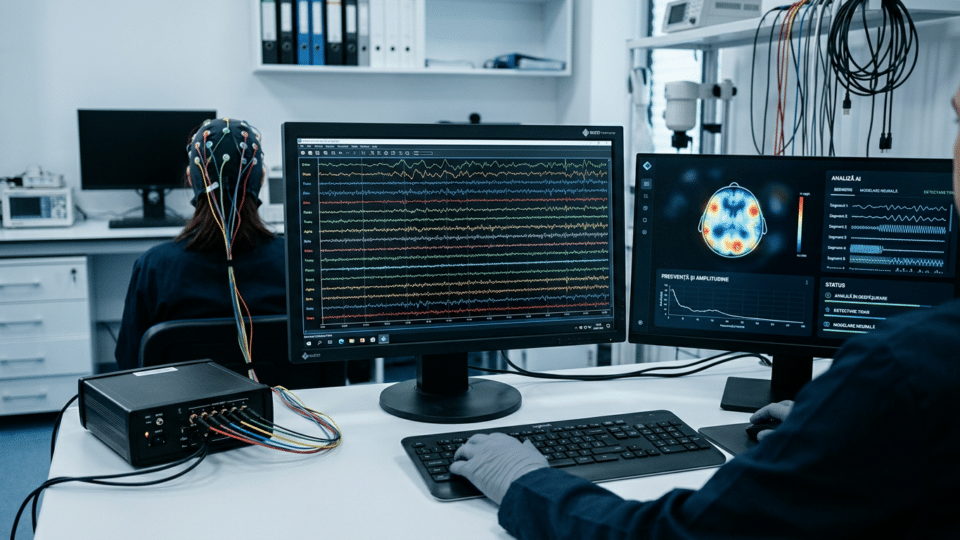
An experimental AI system for epilepsy used patient responses to adjust how it interprets alerts generated by brain monitoring. In a simulation based on data collected in hospital, this feedback loop reduced false alarms by a median 77.2%, without an increase in detector sensitivity.
The result, published on 13 October 2026 in Nature Medicine, does not mean that a chatbot can diagnose epilepsy or that a device can reliably predict the next seizure. It is a proof of feasibility: an EEG-based detector can become less noisy when it receives context from the person being monitored.
In brief: the novelty is not simply the use of AI in a medical application. The patient becomes part of the process through which the system checks and adjusts its alerts. The idea may be useful, but the study has not yet demonstrated clinical benefits in everyday life, nor does it describe a product available in Romania.
For more on neurology, see Graphene and stroke: experimental sensors identified vulnerable brain tissue in real time in a mouse study, which offers complementary details on this subject.
What this AI system for epilepsy actually does
The platform tested by researchers linked several components: EEG signals, other physiological data, information on sleep and medication, a detector for suspicious events, and a smartphone app with a conversational interface.
EEG, or electroencephalography, records the brain’s electrical activity. The detection algorithm analysed these signals and could issue an alert when it identified a pattern consistent with a seizure. The patient could then respond in the app: did the alert correspond to a seizure, was it a false alarm, or was the event uncertain?
That response does not automatically become an absolute medical truth. In the paper, it functions as an imperfect label that is useful for adjusting the detector. A patient may not remember the episode, may respond late or may not notice certain seizures. The authors explicitly acknowledge these limitations.
The language model in the platform was used for conversation, routing questions and accessing structured data. It was not shown to make diagnoses, independently confirm a seizure or recommend changes to treatment. The distinction matters: the conversational app is the interface through which context is collected, while the EEG detector is the component that analyses the brain signal.
The loop that reduces false alerts
The study’s technical contribution can be summarised in five steps:
- The EEG and other data produce a continuous stream of information.
- The detector flags a possible event.
- The patient can confirm, reject or mark the alert as uncertain.
- The response is used to make subsequent adjustments to the detector.
- The recalibrated detector is assessed using data that follow that point in time.
In the main analysis, which the authors call a pseudoprospective simulation, adjustments based on patient-initiated alerts reduced the median false-alarm rate from 0.469 to 0.097 per hour. That is a relative reduction of 77.2%.
The percentage is large, but the remaining figure needs to be read with equal care. A rate of 0.097 false alarms per hour is roughly equivalent to around 2.3 false alerts a day. For someone expected to act on notifications, that may still be a real burden.
A second analysis, based on feedback collected through the app, indicated an 80.9% reduction in false alarms and an improvement in the F1 score, a measure that balances correct detections and errors. This stage had feedback data for a smaller subgroup of six people, so it should not be treated as broad clinical confirmation.
Fewer false alerts do not automatically mean better detection
This is the main limitation that headlines about “AI learning from the patient” can obscure. In the experiment, baseline sensitivity was maintained, but it did not increase. In other words, the system became more selective within the reported analysis, but the study does not show that it identified more seizures than before.
Nor does it show that the platform prevents injuries, reduces emergency calls, lowers hospital admissions or improves quality of life. Those outcomes would require different types of studies, conducted over longer periods and outside the hospital setting.
Clinical guidance from the International League Against Epilepsy and the International Federation of Clinical Neurophysiology on automated seizure detection using wearable devices underscores the importance of clinical validation and real utility for patients. Performance depends on seizure type, the sensor used and the setting in which the device is tested.
A joint position statement by the American Epilepsy Society, Epilepsy Foundation and Danny Did Foundation warns that false alarms can lead to anxiety, disruption and notification fatigue. A detector should therefore not be judged on sensitivity alone: the false-alert rate and time to alert also matter.
The study was small and conducted in a controlled setting
The research involved 13 adults admitted to an epilepsy monitoring unit: 11 were monitored with scalp EEG and two with intracranial EEG. Median participation was about 4.87 days. In total, patients and the platform exchanged 1,307 messages.
Of the 58 seizure-detection alerts sent through the platform, patients responded to 67.2%. This is useful evidence that interaction is possible, but it also highlights a practical issue: one-third of alerts received no response.
In daily life, the situation may be more difficult than in a specialist unit. Electrodes may shift, everyday activities may affect the signal, the phone may not be within reach, and a patient may be too tired, confused or affected by the episode to complete a confirmation accurately. The study does not yet provide answers to these issues over months of home use.
This caution matters in a field where continuous data can seem highly persuasive. Intelligent health monitoring can be useful only if the signal, algorithm, human response and medical intervention form a safe system. In that sense, the subject is linked to broader questions about continuous health monitoring and control over body data.
What would need to be shown before home use
The next step is not simply installing the app on more phones. Real clinical use would require, among other things, larger outpatient studies over longer periods and involving diverse populations.
- Performance needs to be checked across different seizure types and under ordinary living conditions.
- Researchers need to measure what happens when the patient does not respond, responds incorrectly or provides contradictory feedback.
- Outcomes that directly matter to people should be assessed: alert-related stress, caregiver interventions, quality of life and safety.
- Algorithm recalibration needs clear rules: who oversees it, how it is checked and when a clinician must be involved.
- EEG data and medical conversations require protection, access rules and clear responsibilities.
What such a device would mean in Romania
The published study does not indicate that the platform has CE marking, authorisation for clinical use in the European Union or availability in Romania. It should therefore not be presented as an option that a patient can request at an appointment today.
Romania’s National Agency for Medicines and Medical Devices states that medical devices placed on the market or put into service in Romania must generally bear CE marking and comply with the applicable European framework. For AI-based medical software, technical demonstration is only one part of the route: evidence of performance, safety and benefit is needed in the proposed population and context of use.
There is professional interest in AI in neurology in Romania, but thematic interest is not equivalent to adopting an international platform. For patients, the useful message for now is simpler: monitoring apps and devices should not replace a plan established with a neurologist, and a digital alert is not an emergency service.
The Nature Medicine study points to a credible research direction: the patient can provide information that EEG alone does not have. But precisely because that information is sometimes incomplete or ambiguous, the technology needs to be validated as a collaborative system involving the patient, the algorithm and the medical team—not as a replacement for them.
Frequently asked questions
Can this AI device predict an epileptic seizure?
No. The study assessed the adjustment of an alert detector based on patient feedback. It did not demonstrate reliable prediction of future seizures.
Did the AI reduce the number of seizures?
No. The research reported a reduction in false alerts in a pseudoprospective simulation. It did not measure a reduction in seizures, hospital admissions or injuries.
Is the device available in Romania?
The sources consulted do not indicate that the experimental platform has CE marking, clinical authorisation in the European Union or availability to patients in Romania.
Why are false alerts important?
False alerts can interrupt activities, cause anxiety and lead to notification fatigue. However, a reduction in false alerts needs to be assessed together with the detector’s sensitivity, so that relevant events are not missed.
Sources consulted
- Nature Medicine — Human–artificial intelligence collaboration for comanaging epilepsy in real time
- ILAE and IFCN — Automated seizure detection using wearable devices: A clinical practice guideline
- American Epilepsy Society, Epilepsy Foundation and Danny Did Foundation — Position Statement on Noninvasive Seizure Detection/Alerting Devices
- ANMDMR — CE marking for medical devices
- European Commission / MDCG — Guidance on the interplay between the MDR/IVDR and the AI Act









Discuția cititorilor
Ai o opinie sau o întrebare despre acest articol? Spune-ne ce crezi.
Fii primul care deschide discuția.
Te rugăm să păstrezi un limbaj civilizat și să discuți la subiect. Comentariile spam sunt filtrate automat.