
Updated: 19 October 2026 la 13:22. Articolul a fost revizuit pentru a reflecta informațiile disponibile la această dată.
Several European countries are experiencing intense social tensions. Europe protests 2026: events in October brought to the surface a crisis that cannot be reduced to images of burning cars or smashed shopfronts. In France, demonstrations against rising prices and problems in education were accompanied by looting, arson and thousands of arrests. In Italy and Belgium, clashes with police heightened tensions. In Spain and Portugal, the struggle for affordable housing has become a symbol for a generation that works but cannot build a stable life. In Albania, a separate movement is challenging the government and a controversial property-development project.
What do these events have in common, who stands to gain politically, and where does the right to protest end and violence begin? InfoBuz reviewed reporting by AFP and Associated Press, information published by Le Monde, Euronews, The Guardian, El País and RTP, as well as Eurostat statistics. The main conclusion is that there are similar economic grievances, but no evidence that the protests in these countries form a single coordinated Europe-wide uprising.
InfoBuz documentary analysis | Updated 19 October 2026. This article compares public sources and official data; it does not claim that the newsroom conducted interviews or on-the-ground checks at the sites of the incidents. Operational tallies may change.
Europe protests 2026: timeline from 15 to 19 October
One important starting point is the chronology. In France, the protest wave of 17 October followed weeks of mobilisation by secondary-school and university students. Demonstrations became nationwide on Saturday, while further episodes of tension were reported in Paris on Sunday. In Italy and Belgium, demonstrations over the same weekend had local demands and organisers. In Portugal, trade unions mobilised crowds over pay, public services and housing, and some participants set up protest camps.
In Spain, the symbol of the protests emerged earlier: the eviction of an 87-year-old woman from the home in which she had lived for decades. The case triggered mobilisation and fuelled a national debate over rents and tenant protections. In Albania, clashes in Tirana are linked to corruption allegations, student demands and opposition to a luxury tourism project. A coincidence in timing is therefore not evidence of common leadership.
This is also supported by summaries published by Al Jazeera, drawing on AFP, AP and Reuters, and by The Guardian’s analysis of the protests’ causes.
France: 550,000 protesters, according to authorities, and nearly 2,400 arrests

France is the most serious case in this sequence of events. For Saturday, 17 October, French authorities estimated turnout at about 550,000 people; organisers put it at around 800,000. The gap between the estimates should not be concealed: they reflect different counting methods and interests, and no single definitive figure can be claimed without a shared methodology.
The arrest tally rose quickly. Early reports spoke of several hundred detentions. In reports published on Sunday by Associated Press and AFP, the number arrested had reached nearly 2,400. The number of people arrested must not be confused with the number convicted, nor with the number of violent protesters: each case must be determined individually, and an arrest is not a conviction.
According to the French Interior Ministry, nearly 1,000 police officers and gendarmes were injured in Saturday’s violence, a tally reported by AFP. These are extraordinary figures that explain the pressure on the authorities, but they do not automatically justify every intervention by law-enforcement agencies. Assessing the legality and proportionality of the use of force remains a separate matter.
Limoges town hall and damage in Paris: why these images became emblematic
The most shocking confirmed episode was the fire that devastated Limoges’s historic town hall. The 19th-century building was engulfed in flames after a group entered it, and its roof collapsed. Le Monde reported the prefect’s statements and the firefighters’ response, while AP documented the destruction.
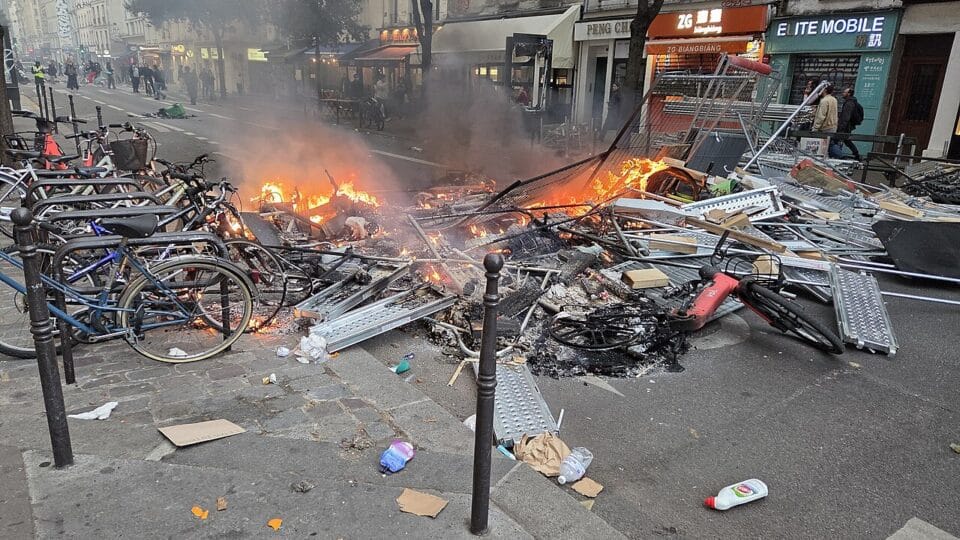
In Paris, shops were looted, windows smashed, vehicles set on fire and commercial areas affected. Other incidents were reported in Marseille, Lyon and Bordeaux. According to AP, a group briefly entered the lobby of Marseille town hall, while a fire broke out at a tourist office in Lyon. These acts are serious regardless of the motives cited by those involved.
Yet an image of a building on fire can distort perceptions of a huge demonstration. Most people who took to the streets cannot be treated as participants in arson simply because they were in the same city or there on the same day. Explaining unrest means showing both the destruction and the thousands of people who called for change without committing offences.
From schools to the streets: how the French protest movement expanded
The French movement did not begin as an operation to destroy shops. Before the national demonstrations, school and university students raised concerns about study conditions, teacher shortages, school schedules and difficulties accessing university. They were joined by trade unions, workers and people dissatisfied with the cost of living, public services and wage levels.
Support from trade unions and calls by groups close to the former Yellow Vest movement broadened the participant base. The demands became multiple: schools, transport, fuel, pensions, social protection and purchasing power. Such a heterogeneous movement is difficult to represent through a single leader or message.
This is one explanation for its vulnerability. The larger the crowds and the more diverse the demands, the harder it is for organisers to control groups moving separately. This mechanism does not show that peaceful protesters are responsible for violence; it does, however, point to the practical difficulty of separating, in real time, legitimate protest from offences committed nearby.
Was the violence organised? What authorities say and what remains unproven
President Emmanuel Macron and Interior Minister Laurent Nuñez attributed some of the attacks to radical far-left groups and to people who took advantage of the chaos to loot. This is the authorities’ official assessment, not an independent conclusion that all incidents had a single command structure or the same motivation.
A serious investigation must distinguish at least three categories: protesters participating peacefully; people engaged in direct confrontations with police; and individuals exploiting crowds for theft or destruction. Their geographical overlap does not mean they share an intention. Demonstrating coordination requires specific evidence: communications, preparation, funding or operational links. Such a finding does not follow from superficial similarities between viral images.
In addition, Euronews reported on 19 October that Macron acknowledged failures of anticipation and intelligence, while refusing to dismiss the interior minister. This shifts part of the debate from identifying those responsible in the streets to the state’s ability to protect protesters, traders and institutions at the same time.
What happened to injured protesters, and why the use of force matters
The controversy is not limited to assaults on police. AP reported that investigations were opened after young people were seriously injured: a protester lost a hand in Saint-Étienne, while a 17-year-old girl lost an eye in Mulhouse. The precise circumstances and any responsibility of law-enforcement officers must be established through investigations, not verdicts delivered on social media.
The state has a duty to prevent attacks and protect uninvolved people, but also to use means proportionate to the actual danger. Protesters, for their part, have the right to demonstrate without automatically being identified with those who commit arson. If one part of the public sees only devastated shops and another only police interventions, public debate fractures into two incomplete accounts.
A further detail concerns a death reported by Paris police, initially described as occurring after cardiac arrest. The prosecutor’s office was investigating the case, AP reported. Until the results are available, there is no basis for claiming that the death was caused by police or street violence.
Spain: one eviction becomes a symbol of the housing crisis
In Spain, the central driver of mobilisation differs from that behind the violence in France. The case of Maricarmen Abascal, an 87-year-old woman evicted from her Madrid home on 23 September, became a symbol of tenants’ difficulties. Footage documented by Reuters shows that she was removed from the building amid protests by neighbours and activists. She later died after being admitted to hospital.
Her death prompted public emotion and gave a face to a problem that can appear abstract in market statistics. El País reported on 17 October that activists were continuing to camp in Puerta del Sol, while the disappearance of an improvised memorial outside her former home intensified tensions. It would not be correct to portray her death as a medically proven result of the eviction, but the symbolic link between the events fuelled mobilisation.
Activists’ demands include more affordable rents, limits on evictions and stricter rules on speculative investment in housing. The debate is complex: property owners invoke protection of property and predictable contracts, while tenants seek housing security. No isolated measure automatically resolves supply shortages, construction costs and pressure on major cities.
Importantly, the Spanish protests should not be portrayed wholesale as violent unrest comparable to the fires in France. The sources reviewed point above all to civic mobilisation and a social dispute over housing.
Portugal: tents in central Lisbon, not the same spiral of violence
In Portugal, protesters took to the streets of Lisbon, Porto and Coimbra on 17 October, answering union calls for better wages, pensions, public services and access to housing. Public broadcaster RTP reported that participants stayed overnight in camps set up in Rossio, Lisbon, and Praça D. João I, Porto.
These tents convey a very different message from a burning shop: for some young people, finding an affordable rental is so difficult that the housing issue is represented through the temporary occupation of public space itself. The mobilisation indicates a high level of frustration, but the scale of discontent does not automatically justify the conclusion that Portugal has entered a period of widespread violence.
Rising property prices provide context. Eurostat data show that, between 2015 and the third quarter of 2025, housing prices in Portugal rose by about 169%. This statistical series measures house prices, not directly the level of new rents in Lisbon; the two phenomena are related, but not identical.
Italy: demonstrations in Milan descended into clashes
In Milan, Italy, protests over rising prices and the war began peacefully, but violent incidents emerged after masked individuals threw stones and other objects at police and set fire to makeshift barricades. Officers responded with tear gas and water cannon. Incidents were also reported in Bologna. The Al Jazeera/AFP/AP/Reuters report mentions injuries and detentions, including of minors.
Prime Minister Giorgia Meloni strongly condemned the damage, while Milan mayor Giuseppe Sala distinguished between the demonstration’s social causes and violence against law-enforcement officers. The difference between these political positions does not change the central question: what economic response could reduce discontent without making public security the debate’s only subject?
Italy has its own structural problems, including regional income disparities and difficulties for young people beginning their careers. It would be simplistic to present every protest as a direct consequence of the same economic shock. But rising basic expenses and a perception of stagnation can amplify demands that might otherwise remain separate.
Belgium: tensions in Brussels and Liège against a backdrop of reforms
In Belgium, demonstrations in Brussels and Liège were marked by clashes with police, according to Euronews. Officers used tear gas and water cannon to disperse groups accused of attacks and arson. The mobilisation took place amid dissatisfaction with the cost of living and proposed changes to education and public budgets.
Brussels also has a symbolic dimension: it hosts European Union institutions, but those institutions are not automatically responsible for every decision of the Belgian government. The protests have domestic causes, and their presence in the European capital does not demonstrate an uprising against the EU as an institution.
An honest assessment requires a comparison of the duration, scale and intensity of incidents, rather than selecting only the most dramatic images. A water cannon used in one city does not mean an entire country is in a state of insurrection.
Albania: a separate case that should not be confused with the EU protests
Albania is not a member state of the European Union, and its protests have their own political dynamics. In Tirana, students and opponents of Edi Rama’s government continued demonstrations against perceived corruption, conditions in education and a controversial tourism-development project. According to Euronews, police reported 167 arrests and 132 officers injured over five days of clashes.
Part of the demonstrations concerned a property project associated with a company founded by Jared Kushner, according to international media reports. Authorities alleged violence against institutions, while seven police officers were suspended as accusations of excessive use of force were investigated. Together, these elements point to a distinct crisis involving education, governmental integrity, economic development and public trust.
Including Albania in a continent-wide overview is useful for comparison, but it would be wrong to present it as part of the same union protest or common campaign as France, Spain or Portugal.
What Eurostat data show: a real problem that predates the protests
Beyond political statements, official data provide a test of the hypothesis that housing has become less affordable. Eurostat calculated that EU house prices in the third quarter of 2025 were 63.6% above their 2015 level, while rents were 21.1% above the same benchmark. In the year-on-year comparison for the third quarter of 2025, house prices rose by 5.5% and rents by 3.1%.
This is a cumulative market trend, not a measure of the cost borne by every household. An owner without a mortgage and a young person signing their first rental contract today face different financial realities. National averages can also conceal contrasts between major cities and smaller places, tourist areas and regions with declining populations.
In its Housing in Europe 2025 publication, Eurostat says EU households spent an average of 19% of disposable income on housing in 2024. The European housing-cost overburden indicator identifies situations in which costs exceed 40% of disposable income. In cities, almost 10% of the population was in this situation in the year examined.
There is also a psychological pressure that is difficult to express as a percentage: people compare not only today’s rent with last year’s, but their realistic chances of starting an independent life, having children or remaining in the city where they work. This is a plausible social interpretation of the data, not an InfoBuz survey.
Why the housing crisis cannot be solved by a single law
Two solutions commonly arise in public debate: rent controls and building new homes. Both have implications and limits. Caps can offer swift protection to some tenants, but the design of the rules matters for the supply of rental contracts and investment in maintenance. Building homes expands supply in the long term, but takes time and requires infrastructure, funding and available land.
A 2025 study published by the European Commission finds that house prices have risen faster than incomes over the past decade and that higher interest rates have reduced the affordability of buying. It also highlights the difficulties faced by people entering the rental market compared with those protected by older contracts.
An effective response may require several measures in parallel: affordable construction, transparent contracts, protection against abusive evictions, efficient use of existing homes and transport infrastructure linking cheaper areas to jobs. None offers dramatic overnight results, and the debate over the balance between property owners’ and tenants’ rights must remain open.
Cost of living: why lower inflation does not erase past price rises
A frequent source of misunderstanding is the difference between inflation and the price level. If inflation slows, that generally means prices are rising more slowly, not that they return to where they were five years ago. For an employee, the energy bill or grocery basket matters as an amount actually paid, not only as a percentage change.
Energy shocks, trade disruptions and international economic uncertainty can put pressure on household budgets, but their effects must be checked separately in every country. It would not be correct to argue that the same political decision produced the violence in Paris, Milan and Brussels in identical ways. Businesss, welfare systems and protest histories differ.
For Romania, the mechanism is familiar: in the InfoBuz analysis “Inflation in the household”, we explained why a tenant, a pensioner and a family with children experience the same macroeconomic statistic differently. A national indicator can improve while the pressure on certain groups remains severe.
Young people, school, work and housing: the protests’ common thread
One visible feature is the presence of young people in several of the movements. In France, demands from schools preceded the protests’ expansion. In Belgium, education and costs borne by students form part of the debate. In Albania, young people are challenging employment prospects and the quality of education. In Spain and Portugal, the inability to pay a reasonable rent is central to the discontent.
The problems are not identical, but all touch on the implicit promise a society makes to younger generations: if you study and work, you will have a chance at an autonomous life. When access to housing and public services seems to move further out of reach of incomes, discontent can become political. This is an interpretation of the similarities, not proof of a European organisation coordinating the protests.
The authorities’ response matters. Announcing partial measures without deadlines, funding or assessment mechanisms can deepen mistrust. At the same time, radical promises that cannot be funded risk turning a social movement into another cycle of disappointment. Credible change requires measurable indicators and the participation of those affected in decision-making.
Who gains politically from street chaos?
In France, the violence immediately entered the political dispute ahead of the presidential election. Macron condemned attacks on institutions and shops, insisting that perpetrators be held accountable. Marine Le Pen criticised the government’s ability to maintain order, while Jean-Luc Mélenchon blamed the executive for the deteriorating social climate while also rejecting looting. These positions were reported by Associated Press.
From the perspective of political communication, violent images can benefit arguments promising immediate order, while economic grievances can bolster parties and movements proposing broad social change. The electoral outcome is not predetermined, however. Voters may condemn vandalism while also condemning policies they see as responsible for declining living standards.
An additional risk is the deliberate conflation of the right to protest with criminal responsibility. If all demonstrators are presented as extremists, social demands disappear from the discussion. If all destruction is excused as an expression of desperation, the real victims of violence—traders, residents, workers and passers-by—are ignored.
What is known and what remains unclear: five decisive questions
1. Were the protests coordinated between countries?
Available reporting points to separate movements with partly similar demands. There is insufficient public evidence to claim the existence of a single European command centre. Similar economic demands are not equivalent to a conspiracy.
2. How many people took part, and how many were violent?
In France, there are two significant turnout estimates—550,000 and 800,000—depending on the source. Arrest tallies are separate and evolving. There is no shared, verified indicator for the proportion of violent protesters across all the states examined.
3. Who is responsible for attacks and disproportionate interventions?
Criminal responsibility for arson and looting must be established individually. Separately, investigations into injuries sustained during public-order operations must examine the circumstances, applicable rules and use of dispersal methods.
4. Will economic measures resolve the tensions?
Some measures may relieve pressure in the short term, but housing supply, real wages and the quality of public services do not change instantly. Clear deadlines, comparable data and verifiable reporting are needed.
5. Could there be a further escalation?
It is a risk, not a certainty. What matters is the schedule of demonstrations, law enforcement’s response, governments’ willingness to engage in dialogue and organisers’ ability to separate peaceful protest from violence.
Disinformation: how a photograph can invent a “European uprising”
In times of crisis, striking images circulate faster than explanations. A photograph of fire and smoke may be real, yet be shared with the wrong location, a false date or a description that turns a local incident into an allegedly generalised situation. Every image should therefore be checked against its source, the date it was taken and its location.
This article does not automatically assign images from one city to another or suggest that all European demonstrations are violent. In Spain and Portugal, the sources consulted primarily document protests over housing and the cost of living. In France, Italy, Belgium and Albania, there are separate reports of clashes, with different tallies and causes.
The same filter should apply to political statements. An allegation made by a minister or opposition leader is an attributed claim, not evidence in itself. Responsible reporting checks whether subsequent investigations support it.
What does this mean for Romania?
Romania is not part of the protests described, but pressures related to housing and living standards are relevant. In Eurostat’s 2024 data, Romania had one of the European Union’s highest housing-overcrowding rates, at about 41%. This indicator measures available space against household composition and must not be confused with the share of the population that pays rent.
A closer analysis of local conditions shows that pressure can be high even where statistical averages appear moderate. In the InfoBuz analysis of rents and incomes, we detailed why monthly income, utility bills and family needs are more relevant than a European percentage viewed in isolation.
For Romanian authorities, the lesson is not that violence must inevitably be expected, but that unresolved problems can damage trust in institutions. Transparent data, predictable measures and genuine consultation with society can prevent the accumulation of grievances more effectively than crisis-only responses.
Three scenarios for the coming weeks
The de-escalation scenario. Governments engage with trade unions, students and housing organisations, offer a timetable and verifiable measures, and organisers isolate violent behaviour. Demonstrations may continue without the same intensity of incidents.
The prolonged-conflict scenario. If negotiations fail, protests may recur. Law-enforcement agencies remain under pressure, local economies experience disruption and political disputes become more radicalised. This scenario does not automatically entail violence in every city.
The polarisation scenario. Images of destruction are used to delegitimise all demands, while possible abuses during interventions are minimised or instrumentalised. The result may be declining mutual trust without resolving the original problems.
None of these scenarios is a firm forecast. Developments depend on concrete decisions, new information and the conduct of many actors. Monitoring events should therefore include not only arrest tallies, but political outcomes, economic measures, investigations and mechanisms for dialogue.
InfoBuz conclusion: not one uprising, but a warning in several languages
The events of October 2026 show a continent facing real social tensions, but ones distributed unevenly. France saw exceptional destruction; Italy and Belgium recorded clashes; Spain and Portugal put housing at the heart of protest; and Albania is experiencing a distinct political crisis. Putting all these situations under the label “Europe in flames” would make for a striking headline, but conceal precisely the information readers need.
For further information about Belgium, see also Europe in flames: major fires in Greece, Croatia, Spain and France, while Belgium faces the largest fire in its history, which provides complementary details on this subject.
The essential question is not whether discontent exists—the evidence clearly shows that it does—but whether institutions can respond before desperation is exploited politically and before violent groups monopolise public attention. The right to protest, citizens’ safety and individual accountability must be defended at the same time. Only then can analysis of the crisis remain stronger than the spectacle of destruction.
Sources and methodology: information underpinning this analysis
Main photo credit: Burning barricade on Rue Beaubourg in Paris, 17 October 2026. Photograph: Lechat / Wikimedia Commons, licensed CC BY-SA 3.0. A real image from the day of the demonstration, resized for publication.
News sources, consulted on 19 October 2026: AFP – toll of violence in France; Associated Press – protests, arrests and investigations; Le Monde – timeline and Limoges; Euronews – French authorities’ response; The Guardian – causes of the European protests; El País – housing mobilisation in Madrid; RTP – protests in Portugal; Euronews – Belgium; Euronews – Albania.
Institutional data and analysis: Eurostat – house-price and rent trends; Eurostat – Housing in Europe 2025; European Commission – housing market and affordability.










Discuția cititorilor
Ai o opinie sau o întrebare despre acest articol? Spune-ne ce crezi.
Fii primul care deschide discuția.
Te rugăm să păstrezi un limbaj civilizat și să discuți la subiect. Comentariile spam sunt filtrate automat.