
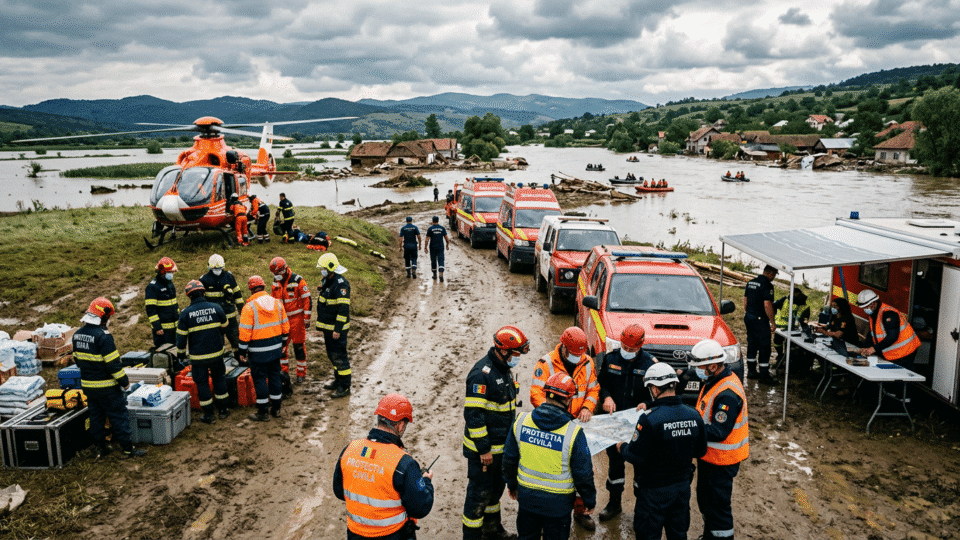
How prepared is Romania for the next major crisis? The answer cannot be reduced to a simple yes or no. Romania has functioning emergency institutions, state reserves, a diverse energy mix, and access to EU and NATO mechanisms. At the same time, serious vulnerabilities remain: water infrastructure is uneven, drought affects agriculture, critical networks need investment, and many systems still depend on imports, interconnections or limited backup capacity.
A modern crisis may involve a major earthquake, prolonged drought, a regional blackout, a cyberattack, an epidemic, disrupted supply chains, or a combination of several events. Real resilience is measured by a state’s ability to keep essential services running and return quickly to normal operations.
How prepared is Romania for the next major crisis? The broader picture
Romania is not starting from scratch. Its National Emergency Management System has clearly defined structures coordinated through the National Committee for Emergency Situations (CNSSU), the Department for Emergency Situations (DSU) and the General Inspectorate for Emergency Situations (IGSU). The European Commission notes that Romania has planning for prevention, preparedness, response and recovery, while the main identified risks include floods, drought, wildfires, earthquakes, nuclear and chemical accidents, epidemics and zoonoses.
For additional context, see Road safety in Romania: real progress and a wide gap from the EU average, which examines an aspect directly related to this subject.
In addition, in 2026 Romania continued consultations with NATO on civil preparedness and resilience, while critical infrastructure falls under a strengthened framework through Law No. 294/2024 on the resilience of critical entities.
1. Energy: Romania has diversity, but is not invulnerable
One of Romania’s greatest advantages is its diverse energy mix. The country generates electricity from nuclear power, hydropower, gas, coal, wind, solar and biomass. Its grid is also interconnected with neighbouring systems.
That diversity reduces the risk of a crisis caused by a single source. If hydropower output falls because of drought, gas, nuclear power, imports or renewables can compensate, depending on availability.
Yet that same flexibility also points to a vulnerability: a period of drought, low wind, high consumption and nuclear unavailability could place severe pressure on the system.
InfoBuz has separately examined the risk of an energy crisis in Romania and the limits of the idea of energy independence.
Gas: a strategic advantage, but not a universal solution
Romania has domestic gas production and significant transmission infrastructure. Over the medium term, development of Black Sea projects could strengthen energy security.
At European level, the European Commission said in July 2026 that there were no immediate concerns over security of gas supply for the following winter, while stressing the need to maintain stocks and coordination.
The problem is that gas does not automatically protect the electricity system if the grid fails, generation capacity is insufficient, or infrastructure is damaged.
2. Water: one of the largest structural vulnerabilities
Water is probably among the areas where the gap between regions is greatest.
The European Commission says that only around 57% of Romania’s population is connected to public water-supply networks, the lowest share in the EU. Around 23% of treated water is lost before reaching consumers, while more than 60% of wastewater is not adequately treated.
These figures do not mean that 43% of the population has no access to water at all. Rather, a large share depends on local systems, wells or networks that are not part of centralised public systems.
Drought can turn a water problem into a food problem
Romania is vulnerable to long periods of drought. Agriculture depends heavily on rainfall, and irrigation infrastructure does not cover farmland evenly.
In a severe-drought scenario, the same water shortage affects several areas at once:
- agriculture;
- hydropower generation;
- water supplies for settlements;
- ecosystems;
- industry.
This turns drought from a meteorological event into an economic and social risk.
3. Food: Romania produces a great deal, but depends on logistics
Romania is an important producer of cereals and agricultural goods, which offers a genuine advantage in the event of an external food crisis.
But agricultural production is not the same as full food security.
Getting food to the population requires:
- fuel;
- road and rail transport;
- electricity for storage and refrigeration;
- processing;
- warehouses;
- functioning retail.
A logistics shock can create local shortages even when national production is sufficient.
State reserves exist and are used
The National Administration of State Reserves and Special Issues (ANRSPS) is tasked with intervening in exceptional situations and manages stockpiles intended to protect the population, the economy and national defence.
The institution can build emergency stocks, provide humanitarian aid and release products from the state reserve through decisions approved at government level.
In 2026, ANRSPS published documents concerning aid for settlements affected by water-supply interruptions, indicating that the mechanism is not merely theoretical.
Oil reserves: a critical component
Romania also maintains minimum stocks of crude oil and petroleum products under European and national rules. From 2025–2026, ANRSPS has had a strengthened role as the central stockholding entity.
These reserves matter for the continuity of transport, emergency intervention and the economy in the event of a major supply disruption.
4. Infrastructure: where the speed of recovery is decided
A severe crisis tests not only institutions but infrastructure.
Resilience depends on:
- the electricity grid;
- water treatment plants and pipelines;
- bridges and roads;
- railways;
- telecommunications;
- data centres;
- hospitals;
- warehouses and logistics;
- fuel networks.
In recent years Romania has adopted a framework for the resilience of critical entities, and the National Coordination Centre for Critical Infrastructure Protection serves as the coordinating authority.
Critical infrastructure needs redundancy
A system is resilient when a single failure cannot stop it completely.
Examples of redundancy include:
- multiple electricity-supply sources;
- generators and uninterruptible power supplies in hospitals;
- alternative transport routes;
- energy interconnections;
- alternative water sources;
- duplicated data centres and communications systems.
Romania’s problem is not necessarily the complete absence of such solutions, but their uneven distribution and the age of some infrastructure.
5. Emergency response: one of Romania’s strengths
Romania has a relatively well-established disaster-response structure. The DSU and IGSU coordinate interventions, and the country participates in the European Union Civil Protection Mechanism.
In 2026, Romania is also developing rescEU medical and CBRN stockpiles for responding to chemical, biological, radiological and nuclear incidents.
This offers an important advantage: in a major crisis, Romania does not depend exclusively on its own resources, but can access shared European capabilities.
6. A major earthquake remains the extreme-impact scenario
A powerful earthquake in the Vrancea seismic zone would test almost every system at once:
- hospitals;
- telecommunications;
- electricity and gas supplies;
- transport;
- earthquake-vulnerable buildings;
- temporary accommodation capacity;
- emergency logistics.
Romania has institutional experience and preparedness exercises, but the vulnerability of its building stock—especially in Bucharest and other cities—remains one of its most difficult problems.
7. Cybersecurity: a crisis can begin without an explosion
An increasing share of critical infrastructure is digital. Electricity grids, water systems, communications, banks and logistics all depend on IT systems.
A major cyberattack can have effects comparable to a physical incident if it disrupts essential services.
Modern resilience therefore means not only generators and stockpiles, but also:
- offline backups;
- network segmentation;
- alternative operations centres;
- response teams;
- manual emergency procedures.
8. The public: the most overlooked part of preparedness
Even a well-organised state needs the public to be able to function independently for a short period.
In many European countries, modern civil-protection guidance encourages households to be able to cope for at least 72 hours using their own resources.
That means having:
- water;
- non-perishable food;
- medicines;
- torches and batteries;
- a radio;
- a power bank;
- essential documents;
- cash;
- alternative charging sources.
Public preparedness reduces pressure on emergency services in the first hours after a disaster.
Where Romania is well placed
- functioning response and coordination institutions;
- a diverse energy mix;
- substantial agricultural production;
- state and petroleum reserves;
- EU and NATO membership;
- access to European civil-protection mechanisms;
- regional energy and logistics interconnections.
Where serious vulnerabilities remain
- water infrastructure and network losses;
- drought and agriculture’s dependence on rainfall;
- earthquake-vulnerable building stock;
- ageing critical networks;
- wide regional disparities;
- dependence on logistics and transport;
- the need for more energy storage and flexibility;
- limited preparedness among part of the population.
A realistic resilience score
If preparedness were divided into five areas, the assessment might look as follows:
| Area | Indicative assessment | Main risk |
|---|---|---|
| Energy | medium to good | simultaneous imbalances and infrastructure |
| Water | medium to low | losses, drought, limited network connection |
| Food | good in production, medium in logistics | drought and distribution |
| Emergency response | good | multiple simultaneous events |
| Critical infrastructure | medium | age and uneven redundancy |
This is not an official index, but an editorial synthesis based on the available data and vulnerabilities.
What should be accelerated by 2030
For greater resilience, Romania needs several clear priorities:
- modernising water networks;
- energy storage and flexible capacity;
- seismic retrofitting of buildings;
- irrigation and better water management;
- protection of digital infrastructure;
- regional logistics warehouses;
- regular exercises for institutions and the public;
- redundancy in telecommunications and energy.
Conclusion
How prepared is Romania for the next major crisis? Better than public debate sometimes suggests, but less prepared than would be necessary for a prolonged systemic event.
Romania has institutions, reserves, energy and agricultural production, and European support. The problem is that many vulnerabilities are interconnected. A drought can affect water, agriculture and hydropower at the same time. An earthquake can hit transport, energy, hospitals and telecommunications simultaneously.
Real resilience does not mean eliminating every risk. It means having enough alternatives in place for society to keep functioning when one or more components fail.
Frequently asked questions
Does Romania have state reserves for crises?
Yes. ANRSPS manages state reserves and emergency stocks for exceptional situations, including products intended to protect the population and the economy.
Is Romania energy independent?
Not entirely. Romania has a diverse energy mix and important domestic resources, but it participates in the European market and can import electricity or gas when conditions require it.
What is the biggest vulnerability?
There is no single one. Water, drought, ageing infrastructure and seismic risk are among the most significant structural vulnerabilities.
Can Romania request European help during a crisis?
Yes. Romania participates in the EU Civil Protection Mechanism and can request support in the event of major disasters.
How long should a household be able to manage without outside help?
A practical benchmark frequently used in European civil protection is a minimum of 72 hours with water, food, medicines and basic energy sources.
Sources: European Commission – Romania’s national disaster management system; European Commission – Water Wise Romania; ANRSPS – state reserves; Ministry of Internal Affairs – critical infrastructure protection; European Commission – security of gas supply.




Discuția cititorilor
Ai o opinie sau o întrebare despre acest articol? Spune-ne ce crezi.
Fii primul care deschide discuția.
Te rugăm să păstrezi un limbaj civilizat și să discuți la subiect. Comentariile spam sunt filtrate automat.