
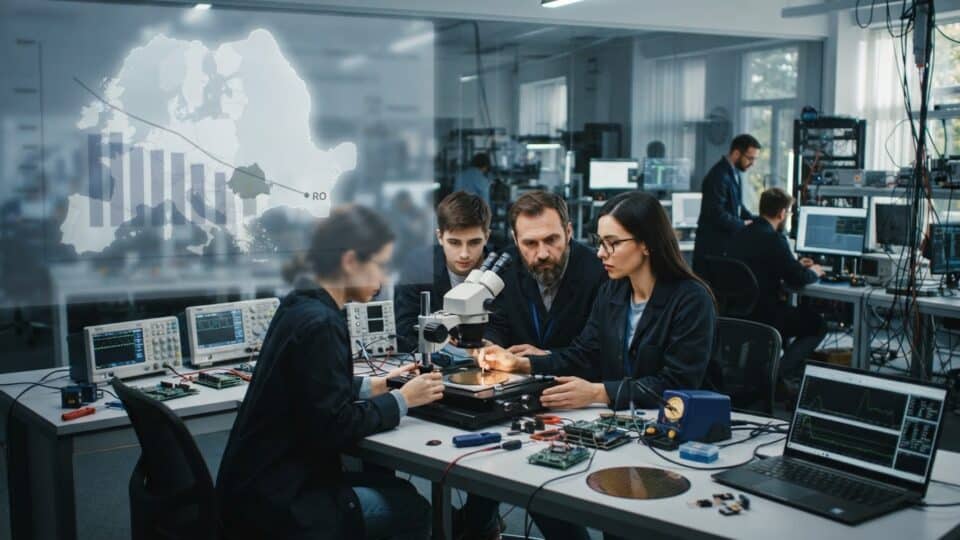
Romania ranks last in the EU for innovation in the European Innovation Scoreboard 2026, and its gap with the European average remains very wide. Romania’s score is about 47 points, compared with roughly 111 for the EU average. Although performance improved from 2025, the gap remains large enough to affect productivity, wages, companies’ ability to export higher-value products and long-term competitiveness.
For further context, see Inflation in Romania: the EU’s highest in September 2026, at 6.5%, which examines an issue directly linked to this subject.
The issue returned to the foreground on 13 November 2026, after an analysis warned that Romania’s position at the bottom of the European ranking is not merely a reputational problem but one that could translate into an economic cost over the next decade.
Romania ranks last in the EU for innovation in 2026
The European Innovation Scoreboard 2026, published by the European Commission on 9 July, compares research and innovation systems across all member states.
The ranking uses 32 indicators grouped into several dimensions, including:
- human resources;
- research systems;
- digitalisation;
- finance and support;
- firm investment;
- use of information technologies;
- intellectual property;
- collaboration;
- innovation outputs.
In 2026, Romania ranks last among the 27 member states, with a score of around 47, against approximately 111 for the EU average.
Romania remains in the “Emerging Innovators” category, alongside Bulgaria, Latvia, Slovakia, Poland and Croatia.
The European ranking: who leads and where Romania stands
At the top of the ranking are:
- Sweden — approximately 155;
- Denmark — approximately 150;
- the Netherlands — approximately 142.
Romania’s score is around 47, compared with around 55 for Bulgaria.
That puts the gap between Romania and Europe’s leaders at more than threefold in terms of the composite index.
The full report is available in the European Innovation Scoreboard 2026.
Romania nevertheless improved on 2025
One important detail is that the score has not been entirely stagnant.
In the European Commission’s chart, Romania has a score of about 45 in 2025 and 47 in 2026.
The direction is positive. The problem is the pace.
If other countries advance at the same rate or faster, the relative gap may persist for years.
R&D spending is among the lowest in the EU
One of the clearest explanations emerges from Eurostat data and the European Commission’s analysis.
In 2024, Romania spent around 0.46% of GDP on research and development.
The EU average was around 2.24% of GDP.
That means Romania’s R&D intensity is almost five times lower than the European average.
Why the R&D share of GDP matters
Research and development do not always produce quick results. Over the long term, however, they are the source of many competitive advantages:
- new products;
- more efficient industrial processes;
- automation;
- patents;
- proprietary software;
- higher-value technologies;
- export capacity.
Countries that invest consistently in R&D tend to have more companies able to sell complex products and services, rather than only labour or low-margin production.
Romania does not only have a public-funding problem
The OECD states in Economic Survey Romania 2026 that private-sector participation in research and development is also low.
Corporate R&D expenditure is modest, while some multinationals operating in Romania conduct their research in other countries.
That means Romania may have:
- factories;
- operational centres;
- services;
without necessarily retaining the activities with the greatest intellectual value.
OECD: Romania has low innovation capacity
The OECD describes the situation directly: R&D intensity is about 0.5% of GDP, among the lowest of the countries assessed.
The report also highlights weak performance in:
- patents;
- scientific publications;
- intellectual-property income;
- research-business links.
See OECD Economic Surveys: Romania 2026.
A central problem: weak links between universities and companies
An innovative ecosystem requires more than laboratories and start-ups.
Ideas need to move between:
- universities;
- research institutes;
- companies;
- investors;
- the public sector.
Where these links are weak, research remains isolated and companies buy technology from abroad rather than develop it locally.
Venture-capital funding remains limited
European country profiles from recent years point to another vulnerability: little venture capital is available to innovative companies.
For a technology start-up, the challenge is not only the idea. It is the ability to finance:
- product development;
- hiring specialists;
- testing;
- international expansion;
- intellectual-property protection.
Without funding, companies may remain small or relocate to ecosystems where capital is more readily available.
Romanian start-ups also face unpredictability
The European Startup & Scaleup Scoreboard 2026 presents a mixed picture.
Romania has some favourable regulatory features, but the report notes that fiscal and legislative unpredictability is a major problem for firms.
About 90% of the companies assessed identify policy uncertainty as an obstacle to long-term investment.
Why unpredictability hits innovation harder
A factory can calculate the payback period of an existing production line relatively simply.
A research project may require three years, five years or sometimes 10 years before it delivers a commercial result.
If taxes, rules or funding schemes change frequently, long-term projects become harder to justify.
Romania nevertheless has a real advantage: digitalisation
The European Innovation Scoreboard shows that Romania is not weak in every area.
Digitalisation and the use of certain cloud technologies have advanced strongly in recent years.
The number of ICT specialists has grown, and the economy already has an IT sector of regional importance.
This is one of the foundations on which Romania could build.
But digital infrastructure is not enough
A country can have fast internet and software specialists without having a complete innovation ecosystem.
It also needs:
- funding;
- R&D;
- patents;
- technology transfer;
- companies that can scale;
- stable policies.
Otherwise, Romania may become very good at adopting technology developed elsewhere while remaining weak at creating it.
The difference between adoption and innovation
A company can buy a German robot, an American AI system or French software and become more productive.
That is technology adoption.
Innovation occurs when a company:
- develops its own technology;
- creates a new product;
- generates intellectual property;
- sells the solution in other markets.
Why innovation matters for wages
Wages can rise sustainably when productivity rises.
If an employee produces more economic value per hour, the company has more room to pay higher wages.
Innovation can increase that value through:
- automation;
- premium products;
- efficient processes;
- intellectual property;
- access to new markets.
Why innovation matters for exports
Innovative economies export more than raw materials and standardised production. They export:
- software;
- equipment;
- medicines;
- industrial technology;
- specialised services;
- patents and licences.
These products tend to have higher margins and are harder to replace in global supply chains.
Last place for innovation does not mean Romania has no innovative companies
The ranking measures the national system, not the value of every company.
Romania has:
- high-performing start-ups;
- IT companies;
- engineering centres;
- highly skilled specialists;
- universities with research projects.
The problem is that these examples are not yet numerous or interconnected enough to lift the national average.
Why a country can have “islands of excellence” and still score poorly
A successful IT cluster in one city, or a few successful companies, cannot automatically offset:
- very low public investment;
- limited venture capital;
- weak technology transfer;
- too few innovative small and medium-sized enterprises;
- underfunded research.
Innovation must be connected to industry
Economic data published today also show a 3.7% fall in industrial production in the first nine months of 2026.
InfoBuz has separately examined how Romania’s GDP recovered in the third quarter, even as industry remained weak.
The problems are connected.
An industry that invests little in technology and proprietary products has fewer chances of competing over the long term with economies that innovate consistently.
The 2027 recovery plan has high stakes here
The government is preparing a stronger economic focus on investment and competitiveness.
InfoBuz has already examined the 2027 economic recovery plan and its emphasis on production, investment and cutting red tape.
But if innovation is not part of the same equation, Romania risks continuing to attract investments that use technology developed in other countries.
What could change the situation
There is no single solution. A credible package would include:
- higher public funding for research;
- multi-year stability for R&D budgets;
- incentives for private research;
- larger venture-capital funds;
- technology-transfer programmes;
- university-industry collaboration;
- attracting multinational R&D centres;
- protecting and commercialising intellectual property;
- greater fiscal predictability.
The 2% of GDP target remains distant
European Commission documents note that Romania has a target of around 2% of GDP for R&D by 2027.
At the current intensity of roughly 0.46%, the gap is enormous.
Even doubling spending would leave Romania below the current European average.
The issue is not only how much is spent, but how
Additional funding must be accompanied by:
- performance assessment;
- genuine competition between projects;
- multi-year funding;
- outcome indicators;
- transfer into the economy.
Otherwise, bigger budgets may produce few commercial results.
What it means for companies
For a Romanian company, innovation does not necessarily mean a billion-euro laboratory. It can mean:
- automating a process;
- proprietary software;
- a new product;
- a patent;
- a more efficient production method;
- entering a new market.
What it means for employees
Innovative economies tend to create more roles requiring:
- engineering;
- analysis;
- research;
- design;
- software;
- technical management.
Over time, this can change both the wage structure and the types of jobs available.
Romania last in the EU for innovation: the conclusion
The European Innovation Scoreboard 2026 data are difficult to ignore.
Romania made modest progress from the previous year but remains last in the EU, with a score of about 47 compared with roughly 111 for the European average.
The biggest problem is structural: very low investment in research, limited funding for innovative companies and insufficient links between research and the economy.
Romania also has solid starting points: digital infrastructure, IT specialists, industry and access to European funds.
The question is not whether the potential exists. It is whether it can be turned quickly enough into products, patents, scaling companies and higher wages.
Frequently asked questions
Where does Romania rank in the EU for innovation in 2026?
Romania ranks last among the 27 member states in the European Innovation Scoreboard 2026.
What is Romania’s score?
In the European Commission’s chart, Romania has an index of about 47, compared with approximately 111 for the EU average.
How much does Romania invest in research and development?
European data for 2024 indicate about 0.46% of GDP, compared with an EU average of approximately 2.24%.
Did Romania fall back from 2025?
No. Its score rose slightly, from around 45 to around 47, but its relative position remains last in the EU.
What are the main problems?
Underfunded research, low private R&D investment, modest venture capital, weak technology transfer and policy unpredictability are among the factors identified in European and OECD reports.
Sources: European Commission — European Innovation Scoreboard 2026; Eurostat — Key figures on Europe 2026; OECD — Economic Surveys Romania 2026; European Startup & Scaleup Scoreboard — Romania 2026.









Discuția cititorilor
Ai o opinie sau o întrebare despre acest articol? Spune-ne ce crezi.
Fii primul care deschide discuția.
Te rugăm să păstrezi un limbaj civilizat și să discuți la subiect. Comentariile spam sunt filtrate automat.