
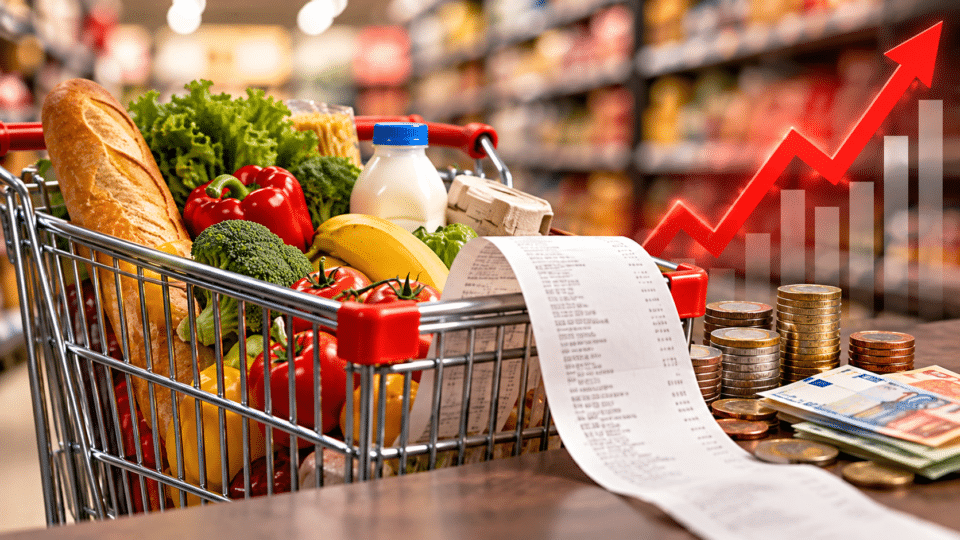
Inflation in Romania reached 6.5% in September 2026, the highest annual harmonised rate in the European Union, compared with an EU average of 3.8%. Eurostat published the final figures on 16 October. The 2.7-percentage-point gap does not mean that all products became more expensive by the same proportion, nor that prices in Romania are the highest in Europe in absolute terms. It shows the average pace of price increases over one year, calculated using a method that is comparable across countries.
For further context, see Inflation fell to 6.2% in August, but services became more than 11% more expensive. Why lower inflation does not feel the same for everyone, which offers complementary details on the subject.
Inflation in Romania: what the September figures show
| HICP indicator | August 2026 | September 2026 |
|---|---|---|
| Romania – annual inflation | 6.3% | 6.5% |
| EU – annual inflation | 3.2% | 3.8% |
| Euro area – annual inflation | 3.2% | 3.8% |
| Romania – monthly change | — | +0.8% |
Romania was followed in the annual-rate ranking by Lithuania, at 6.1%, and Bulgaria, at 5.6%. At the other end of the scale were Sweden, at 1%, and Hungary and Denmark, both at 2.1%. Romania had already recorded the EU’s highest annual rate in August, at 6.3%; the rise to 6.5% in September signals another modest acceleration in the indicator, not a 6.5% increase in a single month.
Why annual and monthly inflation must be distinguished
The annual rate compares the price level in September 2026 with that in September 2025. The monthly rate compares September with August 2026. In Romania, the harmonised monthly rate was +0.8%, according to Eurostat’s table. For this reason, a headline saying that prices rose by 6.5% “in September” would be misleading: the 6.5% figure refers to the past 12 months.
The Harmonised Index of Consumer Prices, abbreviated as HICP, is used for international comparisons. It should not automatically be confused with the national consumer price index published by Romania’s National Institute of Statistics (INS): the basket, methodological rules and coverage of certain types of spending can produce different figures. A proper comparison between countries uses the same data series, rather than values taken from different indicators.
Energy pushes up inflation in Europe, but euro-area figures alone do not explain Romania
Eurostat attributes 1.71 percentage points of the annual inflation rate in the euro area to rising energy prices. Services contribute 1.52 points, non-energy industrial goods 0.29 points, and food, alcohol and tobacco 0.25 points. These contributions are calculated for the euro area and cannot be presented as the contributions of the same categories to inflation in Romania.
In the euro area, energy was 18.9% more expensive than a year earlier, according to the indicator published on 16 October. For Romanian households, the analysis must be supplemented with INS data on products and services, as well as changes in the tariffs actually paid, before the national figure can be attributed to a single cause. Energy prices, indirect taxes, exchange rates, distribution costs and competition affect individual products differently.
What 6.5% inflation means for a family
A simplified example: if a basket of expenditure had cost exactly 3,000 lei in September 2025 and had followed the structure of the national harmonised index perfectly, the same basket would cost about 3,195 lei in September 2026. The difference of 195 lei is an illustrative calculation, not an estimate of a real family’s bill. People use different baskets: those who rent, commute by car or have children experience different prices.
That is why personal inflation cannot be reduced to the Eurostat figure. For a specific budget, readers can list their fixed costs, food purchases, energy, transport and services, then compare them with the same months of the previous year. InfoBuz also explained the differences between households in its analysis, Household inflation: renter, pensioner and family with children.
Why lower inflation does not automatically mean lower prices
If annual inflation falls from 6.5% to 4%, it generally means prices are still rising, but at a slower pace. Prices would fall at the level of the overall index only if its change became negative. In addition, even average inflation of 4% can conceal price declines for some products and steep increases for others.
Income also matters. If a person’s salary rises more slowly than their basket of expenses, purchasing power falls. If income keeps pace with, or rises faster than, the prices actually paid, the situation may be different. These comparisons should be made over the same period and, ideally, in real terms.
What comes next: figures to watch in November
Eurostat scheduled its flash estimate for October inflation in the euro area for 4 November 2026, with the next full release of indicators due on 18 November. Until then, the September results are the official harmonised benchmark available. A rigorous article should update the figures only when new series validated by INS or Eurostat are published.
Frequently asked questions
Does Romania have the highest prices in the EU?
That is not the conclusion. In September 2026, Romania had the highest annual rate of price growth measured by the HICP. Actual price levels and purchasing power are assessed using other indicators.
Is the 6.5% inflation rate monthly?
No. It is the annual rate, comparing September 2026 with September 2025. Romania’s harmonised monthly change was +0.8%.
Is inflation in Romania the same for every household?
No. The index is a statistical average. Individual spending patterns and prices can create significant differences between households.
Sources and methodology
Eurostat — Annual inflation up to 3.8% in the euro area, 16 October 2026; Eurostat — Harmonised Indices of Consumer Prices, definitions and methodology. The comparison uses the HICP indicator exclusively; the budget examples are illustrative.







Discuția cititorilor
Ai o opinie sau o întrebare despre acest articol? Spune-ne ce crezi.
Fii primul care deschide discuția.
Te rugăm să păstrezi un limbaj civilizat și să discuți la subiect. Comentariile spam sunt filtrate automat.