
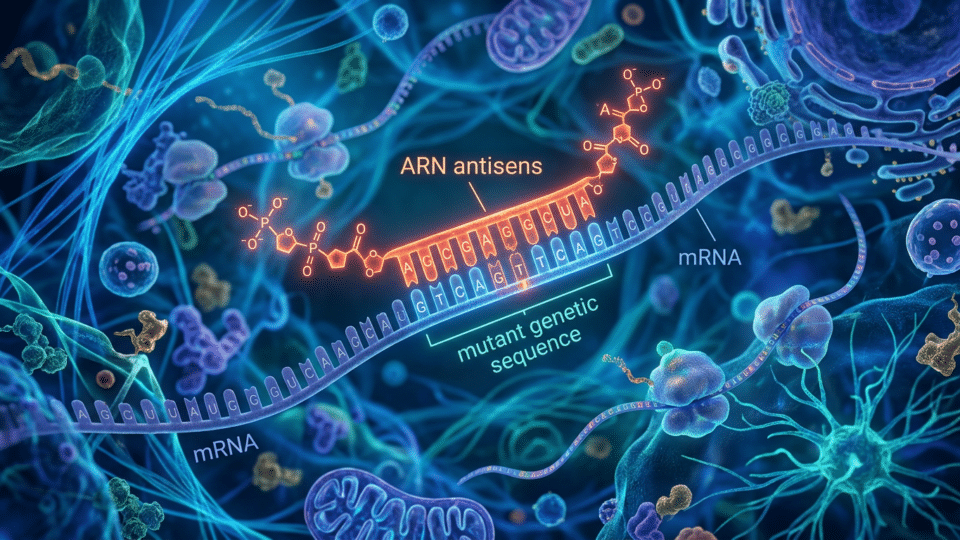
An experimental RNA-based treatment was associated with improved clinical and biological measures in one man with a very rare form of amyotrophic lateral sclerosis (ALS). The result, published online in Med on September 14, 2026, and reported by Nature on September 18, is primarily relevant as a demonstration that a drug can be designed for a specific genetic variant. It is not, however, evidence that the disease has been cured or that the treatment works for most people with ALS.
The study included just one participant, had no comparison group and followed the patient for one year. In this situation, researchers may observe a promising signal, but they cannot reliably separate the drug’s effect from the sometimes variable natural course of the disease. The authors refer to feasibility, tolerability and early signs of benefit, rather than demonstrated efficacy.
What happened in this case
The patient had ALS associated with the pathogenic p.Arg15Leu variant in the CHCHD10 gene. This gene is involved in the functioning of mitochondria, the cellular structures that produce energy. Pathogenic variants in CHCHD10 are an extremely rare cause of an inherited form of motor neuron disease and have been associated, in some families, with a slower course than is often seen in ALS.
The investigational drug, called nL-CHCHD-001, is an antisense oligonucleotide. In brief, it is a synthetic nucleic-acid sequence designed to bind to the RNA produced by a gene. In this case, the aim was not to permanently alter DNA, but to reduce production of the CHCHD10 protein, which is thought to have a toxic effect in the patient’s genetic variant.
The treatment was administered intrathecally, meaning through a lumbar puncture into the cerebrospinal fluid. The participant received six doses over 12 months: three of 50 mg, followed by three of 75 mg. The study reported no serious adverse reactions; headache and fatigue after administration were described as mild or moderate.
| Measure monitored | What the study reported after 12 months | What it can and cannot show |
|---|---|---|
| Plasma neurofilament light (NfL) | Decreased by approximately 50% and entered the laboratory reference range | It is a biomarker of neuronal damage; this is encouraging, but on its own it does not amount to a certain clinical benefit. |
| ALSFRS-R | Increased from 33 to 36 points | The score tracks daily functions; an increase in one patient does not demonstrate efficacy for other patients. |
| Slow vital capacity | Increased from 48% to 55% of the predicted value | It is a relevant measure of breathing, but the result must be confirmed in a larger group over a longer period. |
| Safety | No serious adverse events were reported | One year and one participant are not enough to establish a long-term safety profile. |
The data come from the scientific article published in Med. Nature‘s report of September 18, 2026 stresses the same caution: it is too early to say whether the intervention stops ALS progression or can be considered a curative treatment.
Why this cannot be called a “cure”
An N-of-1, or “single-patient”, study is sometimes the only realistic way to test an intervention for a mutation so rare that it does not allow the rapid recruitment of dozens or hundreds of people. It can answer important initial questions: can the drug be made, does it reach where it needs to go, is it tolerated, and do changes consistent with the expected biological effect occur?
But on its own, it cannot answer the key question for medical practice: what would have happened without treatment? ALS does not progress in the same way in every person. In addition, this case concerns a genetic form with a slow course. Stability or a temporary improvement must be interpreted in that context, rather than automatically compared with the course of all forms of ALS.
Longer-term follow-up, replication of the observation in other carriers of the same variant, and careful safety assessment are still needed. Even then, the findings may remain applicable only to a very small number of people with comparable CHCHD10 mutations, not to all patients diagnosed with ALS.
Why antisense RNA may still be an important direction
The case’s greatest value is not the promise of a universal medicine, but the speed with which a very precise genetic hypothesis was turned into a testable intervention. According to the authors, 320 candidate molecules were evaluated before the compound used in the patient was selected. This was followed by non-clinical testing and regulatory steps for an individualised investigational product.
This model follows a simple logic: if a mutation causes disease through a specific molecular mechanism, a treatment can attempt to correct or mitigate that exact mechanism. Antisense oligonucleotides are not an experimental technology in an absolute sense; medicines in this class already exist for other conditions. But every new sequence, every target gene and, especially, every use in the central nervous system must be assessed separately.
The US Food and Drug Administration also has specific recommendations for developing individualised antisense oligonucleotides for very severe or life-threatening diseases. The document shows why such a pathway is exceptional: the genetic target is usually unique or present in only one or two patients, and conventional drug development for a large group is not realistic. The FDA guidance does not constitute approval of the treatment in this case.
What this means for people with ALS in Romania
The result does not mean that nL-CHCHD-001 is available in Romania, the European Union or as a standard treatment. It is an investigational product administered as part of an individualised clinical evaluation in the United States. It should not be interpreted as a reason to seek out the drug independently, or supplements or unvalidated therapies that claim to “repair RNA”.
For additional context, see CEI does not yet replace the health card: what the CNAS update of September 3 means, an article that explores an aspect directly related to this topic.
The practical message is different: genetics is becoming increasingly important in ALS. The 2024 European Academy of Neurology guideline notes that an underlying genetic mutation can be identified in approximately 20% of patients and that the emergence of molecular therapies for specific subtypes supports rapid genetic testing. Testing does not automatically establish access to treatment, but it may clarify the diagnosis, implications for the family, and possible eligibility for research or clinical trials.
The decision should be discussed with the neurologist managing the patient’s care and, when indicated, with a specialist in medical genetics or genetic counselling. A genetic result may have consequences for relatives, and interpreting a variant is not always straightforward: a change found in an analysis is not automatically the cause of the disease.
Current care should not be delayed while waiting for a personalised therapy. The European guideline recommends coordination by a multidisciplinary team, including assessment of respiratory, nutritional, communication, rehabilitation and psychological-support needs, alongside treatments available and appropriate for each patient. The EAN recommendations for ALS management stress that this care remains essential, even in a field where genetically targeted medicines are advancing rapidly.
What comes after this initial signal
The CHCHD10 case is proof of principle: for certain ultra-rare forms of ALS, developing a treatment that targets the RNA of a gene may be possible within a timeframe compatible with the progression of the disease. This is an important change from a model in which a drug needed, from the outset, a large population of patients with the same form of disease.
However, proof of principle is not equivalent to definitive clinical evidence. At present, the accurate wording is that one patient had better biological markers and stable or modestly improved clinical function after treatment. It remains to be seen whether the benefit persists, whether it occurs in other people with the same mutation, and whether the balance of benefits and risks is favourable in the long term.
For patients and families, the justified hope is not that of a prematurely announced cure, but that precise genetic diagnosis could gradually become a more useful part of medical decision-making and access to research.
Frequently asked questions
Is this RNA treatment a cure for ALS?
No. The study followed one patient for 12 months and had no control group. Encouraging signs emerged, but long-term effectiveness and applicability to other patients have not been demonstrated.
What type of ALS was the treatment designed for?
It was designed for ALS associated with the pathogenic p.Arg15Leu variant in the CHCHD10 gene, a very rare form of motor neuron disease.
What is an antisense oligonucleotide?
It is a synthetic nucleic-acid molecule that binds to a gene’s RNA to modify production of the corresponding protein. It does not permanently change the patient’s DNA.
Is the drug available in Romania?
There is no indication that this investigational product is available as a standard treatment in Romania or the European Union. It was administered in the context of an individualised clinical evaluation in the United States.
Should all people with ALS have genetic testing?
Genetic testing is worth discussing with a neurologist and a medical genetics specialist. Consensus recommendations and European guidelines point to the growing importance of genetic assessment, but the choice of test and interpretation of the result should be personalised.









Discuția cititorilor
Ai o opinie sau o întrebare despre acest articol? Spune-ne ce crezi.
Fii primul care deschide discuția.
Te rugăm să păstrezi un limbaj civilizat și să discuți la subiect. Comentariile spam sunt filtrate automat.