
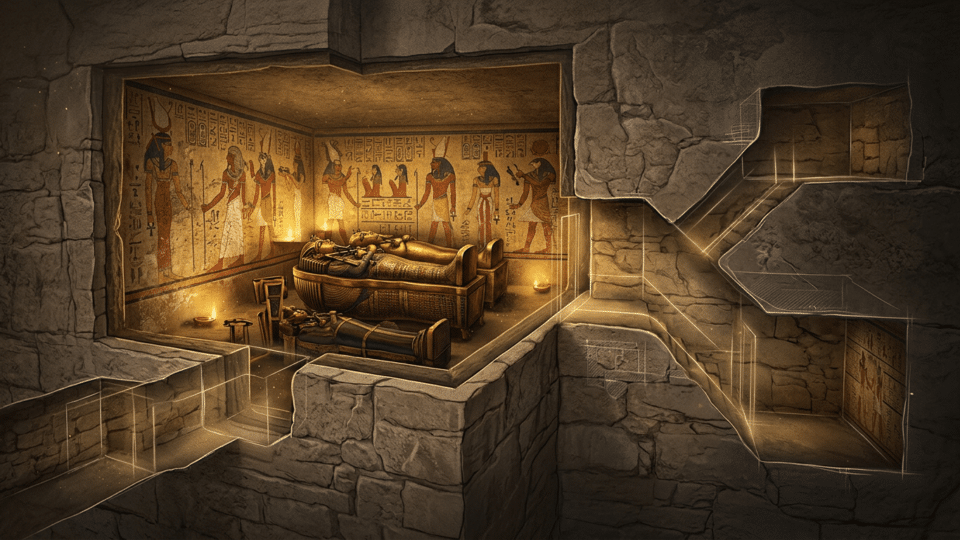
New measurements taken around Tutankhamun’s tomb in the Valley of the Kings do not confirm a secret chamber, nor do they prove that Nefertiti is buried there. They do, however, indicate anomalies that could correspond to a debris-filled corridor and spaces with apparently artificial geometry beyond the known areas of tomb KV62.
The development is not simply a revival of the idea put forward in 2015 that the pharaoh’s tomb conceals unexplored rooms. The team led by Egyptian archaeologist Mamdouh Eldamaty combined ground-penetrating radar used from inside the tomb with a surface microgravity survey and older electrical-resistivity data. This overlap of methods is precisely what has brought the issue back into focus.
Still, the accurate wording remains: there are geophysical indications that justify further verification. For now, there are no images from a new chamber, no opened entrance, no identified objects and no human remains found near Tutankhamun’s burial chamber.
What the new investigations detected
The report discussed by Nature on September 17, 2026, brings together three types of information:
- Ground-penetrating radar from inside KV62, used to trace differences behind the walls and in the surrounding rock;
- Microgravity, a method that measures extremely small variations in the gravitational field and can suggest changes in underground density;
- Electrical-resistivity data obtained in 2017, which had already indicated anomalies in nearby areas.
More than 1,200 measurements were taken across an area of approximately 35 square metres in the microgravity survey. The authors interpret some lower-density zones as having outlines that appear to form right angles and roughly align with the north wall of the burial chamber. Such shapes may be compatible with human-made spaces, but are not proof in themselves: natural fractures, uneven rock, fills and site-specific ground conditions can affect the signal.
George Ballard, a structural engineer and co-author of the geophysical analysis, said the radar data could indicate a corridor about two metres wide, densely filled with rubble. This qualification matters. A corridor filled with material would not behave like an empty chamber in radar data, and its signal could be harder to distinguish from the surrounding rock.
The most discussed area, called “anomaly 7” by the analysis’s authors, is said to have a predominantly low-density area and, within it, an approximately square shape with higher density. The proposed hypothesis is that it could be a chamber containing objects. This remains an interpretation, not the identification of artefacts: without direct inspection, higher density cannot establish what exactly is there.
To complement the information above, see also RNA treatment for a rare form of ALS improved a single case. Why the result does not yet mean a therapy for patients, an article that explores an aspect directly related to this subject.
Why the new data do not automatically overturn the 2018 conclusion
The issue has an important history, because earlier scans produced contradictory results. In 2015, British Egyptologist Nicholas Reeves observed lines, cracks and possible traces of covered openings on the north wall of the burial chamber. He proposed that KV62 may be an adapted part of a larger royal tomb, and that the hidden areas could be connected to Nefertiti.
The first ground-penetrating radar investigations appeared to support the idea of spaces beyond the walls. A subsequent scan, however, did not reproduce the results. In February 2018, three independent teams carried out a new ground-penetrating radar campaign using different frequencies. The conclusion reported at the time was that there was no evidence of doors or voids immediately behind the burial chamber, out to approximately four metres. The result was publicly presented as a rejection of the hypothesis of adjacent hidden chambers. National Geographic’s report on the 2018 scan also explains the possibility that some earlier signals may have been spurious reflections produced by painted plaster, rock or the sarcophagus.
The new authors do not simply argue that the 2018 result was wrong. Their explanation is that the earlier research primarily looked for a large void immediately beyond the wall, whereas the current interpretation considers a possible debris-filled route and anomalies farther away in the rock surrounding the tomb.
This is the crucial distinction: the 2018 verdict was negative for empty chambers or detectable doors near the burial-chamber walls, not proof that the underground area around KV62 cannot contain any structure whatsoever. At the same time, this distinction does not automatically turn the new hypothesis into an established fact.
| Question | What can be said now |
|---|---|
| Is there a confirmed secret chamber? | No. Geophysical anomalies have been reported, not a directly inspected room. |
| Has Nefertiti been identified there? | No. The connection with Nefertiti is a historical hypothesis, not a result of the measurements. |
| Do the data contradict the 2018 conclusion? | Not necessarily. They propose a different target: possibly filled structures located beyond the area where immediate voids were sought. |
| What would be decisive evidence? | An authorised, minimally invasive exploration, using a camera or another instrument inserted into a verified area. |
Why Nefertiti’s name is being raised again
Nefertiti, Akhenaten’s wife and one of the central figures of the Amarna period, has been associated with this debate because of Nicholas Reeves’s theory. The hypothesis is based on KV62’s unusually small size for a pharaoh, the tomb’s layout and certain features of the burial-chamber paintings. Under this reading, Tutankhamun was hastily buried in an altered section of an older royal construction.
But even if corridors or chambers were confirmed, concluding that they belonged to Nefertiti would require separate evidence: inscriptions, objects bearing a royal name, a sarcophagus or other datable archaeological elements. The space could be a funerary storeroom, an annex to a royal construction or a structure with no direct connection to the queen. The current research cannot choose among these scenarios.
There is another important limitation: the full analysis of the data has not yet been made available to the scientific community. Geophysicist Christopher Gaffney, a ground-penetrating radar specialist at the University of Bradford, described the report as interesting but said the public information was insufficient for a definitive conclusion. Peter Styles, a geophysicist at Keele University, considered the chamber hypothesis plausible on the basis of the microgravity data, but called for further details.
What could happen next—and why Egyptian authorisation is essential
The decision rests with Egypt’s Supreme Council of Antiquities. According to information published on September 17, 2026, the team has considered controlled, very small boreholes through which miniature equipment with cameras could be inserted. If authorisation is obtained, this phase could begin no earlier than November 2026.
This does not mean breaking through the painted walls of the burial chamber. A responsible check would first need to establish the target and access route precisely, then limit the intervention in order to protect both the tomb’s decoration and the fragile rock of the Valley of the Kings. That is why approval from Egyptian institutions and assessment by conservators are as important as the geophysical signal.
The interim conclusion is less spectacular than headlines about “Nefertiti’s tomb”, but more accurate: KV62 once again has anomalies worth testing, and the new methods have defined a more precise target than in earlier campaigns. A discovery begins only if a chamber or corridor is seen and documented directly.
Frequently asked questions
Have hidden chambers been discovered in Tutankhamun’s tomb?
No. Researchers have reported geophysical anomalies compatible with possible structures, but no room has been inspected directly.
Is it confirmed that Nefertiti is near Tutankhamun’s tomb?
No. The Nefertiti hypothesis is based on interpretations of the architecture, paintings and historical context; the new measurements do not identify a particular person or tomb.
Why are microgravity measurements important?
They can indicate differences in underground density without excavation. A less-dense area may suggest a void or a different fill, but it needs confirmation through other methods or direct inspection.









Discuția cititorilor
Ai o opinie sau o întrebare despre acest articol? Spune-ne ce crezi.
Fii primul care deschide discuția.
Te rugăm să păstrezi un limbaj civilizat și să discuți la subiect. Comentariile spam sunt filtrate automat.