
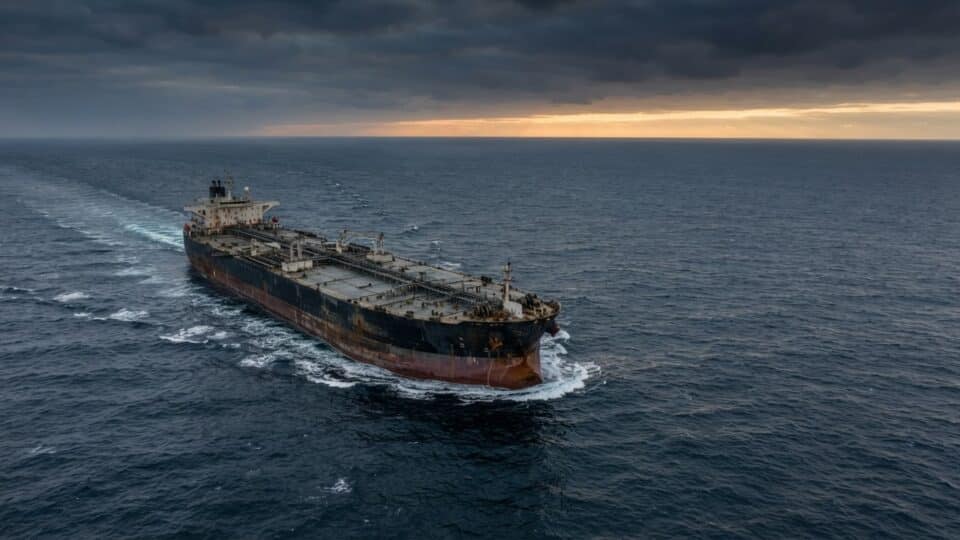
The oil shadow fleet has become one of the most difficult issues in maritime trade: tankers with hard-to-trace owners, frequent flag changes, insufficiently transparent routes, and questions over liability insurance. On 16 November 2026, the Council of the European Union added new companies and individuals involved in this ecosystem to its sanctions lists. The issue is not only who receives the money from oil, but who is liable if a vessel causes an environmental disaster.
This InfoBuz guide explains the phenomenon using documents from the Council of the EU, the International Maritime Organization (IMO), AIS rules, the European sanctions framework and international compensation conventions. It distinguishes confirmed facts from estimates and from indicators which, on their own, do not prove a violation.
What happened on 16 November 2026: the new sanctions and what the numbers mean
The Council of the EU announced sanctions against 12 individuals and 101 entities—113 designations in total—in sectors regarded as important to financing Russia’s war against Ukraine. The official statement also refers to nearly 50 Russian banks or financial institutions, oil and energy companies, and actors in the shadow-fleet network.
In maritime transport, the document names companies from the United Arab Emirates, China, Seychelles and Oman that purchase petroleum products of Russian origin, as well as individuals involved in owning or managing vessels targeted by sanctions. The legal measures applicable to individuals and entities designated under this regime include asset freezes and a prohibition on making funds available, subject to the terms of the legal instruments.
An essential clarification: the 113 designations of 16 November do not mean 113 newly sanctioned tankers. The statement describes individuals and entities, while the list of sanctioned vessels is a separate instrument. An article that confused those categories would produce a false figure. Source: Council of the EU statement of 16 November 2026.
What is the oil shadow fleet?
The terms shadow fleet, dark fleet and “fleet in the shadows” describe vessels used in commercial operations with limited transparency and, in some cases, to evade sanctions or safety rules. The IMO has warned about shipping associated with unclear ownership, problematic maintenance, questionable insurance and ship-to-ship transfers conducted under risky conditions.
There is, however, no single technical category recorded in a vessel’s certificate as a “shadow tanker”. A ship may be suspected by authorities, formally placed on a sanctions list, or assessed by commercial organisations according to their own criteria. Those situations should not be conflated.
| Situation | What is known with certainty | What cannot automatically be inferred |
|---|---|---|
| Vessel officially listed by the EU | There is an identification and specific legal measures in EU instruments. | It does not follow that every vessel of the same company is listed in the same way. |
| Vessel that has changed flag | Its registry history can be checked. | A flag change alone does not prove evasion. |
| Vessel with no publicly visible AIS signal | A tracking service does not show its position at the time of checking. | It does not automatically prove that equipment was deliberately switched off. |
| Oil transfer between vessels | There is an STS operation that must be assessed in context. | STS is not, by definition, illegal. |
How many tankers are there? Why there is no single universally valid figure
In 2023, the IMO reported that discussions in its Legal Committee had referred to an estimated fleet of 300–600 tankers. That was an estimate at the time, not a certified count of vessels in November 2026. Definitions, periods and access to data vary between analyses.
For a figure that can be checked over time, the Council of the EU reported on 23 July 2026 that 41 vessels had been newly added, in addition to 632 already listed under the relevant regime. That package brought the total to 673 vessels, which the European explanatory page summarises as “more than 670”. This is the size of the EU list at that date, not a measurement of the entire opaque fleet worldwide. Sources: the 21st sanctions package and the IMO.
How the economic chain works: an oil cargo involves more actors than the vessel
At first glance, the story seems simple: a ship loads oil in one port and discharges it in another. In practice, the same voyage involves different entities and contracts. That fragmentation is precisely what makes it difficult to see who has economic control and who bears the risk.
| Link in the chain | Commercial or legal role | Question of control |
|---|---|---|
| Producer and seller | Supplies or markets the cargo. | What is the origin of the cargo, and who receives payment? |
| Trader and charterer | Negotiates the transaction and the vessel’s use. | Who contracts the transport, and what documents support it? |
| Registered owner and beneficial owner | Legally owns the vessel, or may indirectly control the company. | Can the ownership chain be identified? |
| Technical manager and crewing company | Provide maintenance, compliance and seafarers. | Are there verifiable responsibilities and certificates? |
| Flag, classification and insurance | Contribute to safety oversight and risk coverage. | Are the documents valid and recognised? |
| Port and service providers | Handle the cargo and provide services to the vessel. | Do restrictions apply to the ship, cargo or counterparty? |
Without separating these functions, a sanction against a trader may be misrepresented as a blanket ban on every associated vessel. Nor is the legal owner shown in a registry necessarily the beneficial owner.
Six technical indicators worth checking—and the limits of each
1. IMO number and vessel history
A vessel’s trading name and flag can change. The IMO identifier is designed to be a permanent element of vessel identification, useful for matching registries, technical history and sanctions. In a serious check, the name painted on a vessel’s hull is not enough: it must be matched with the IMO number, the history of changes and registry records.
2. Rapid changes of flag
Moving from one flag registry to another is legal in many circumstances. It becomes a risk indicator when it occurs repeatedly alongside documentary inconsistencies, a history of problematic inspections, or an inability to identify the operator. It is not evidence of a breach without verification of the context.
3. Ownership through intermediary companies
A company based in a jurisdiction does not prove, by its address alone, that it is evading sanctions. The problem arises where the control structure is opaque and individuals or companies already designated may benefit indirectly from a vessel’s activity. Corporate registries, commercial records and official lists are relevant here.
4. Classification and technical inspections
The state of a vessel’s hull, critical equipment, history of deficiencies and port-state-control inspections all matter for safety. The European Maritime Safety Agency notes that some vessels in the opaque fleet do not call at EU ports and do not sail under member-state flags, limiting the visibility provided by the ordinary European inspection regime. Not knowing a vessel’s technical condition is itself a risk-assessment problem.
5. Liability insurance
Having a document resembling an insurance certificate is not the same as verifying that real coverage exists, who issued it and whether the policy applies. The CLC 1992 framework may apply to damage caused by persistent oil pollution, under the terms of the convention. The lack of adequate cover increases the risk that affected people will face difficulties recovering compensation.
6. Routes, AIS signals and cargo documents
Unusual maritime behaviour must be interpreted alongside other evidence: navigation data, cargo documents, ownership changes and applicable restrictions. Maritime compliance bodies and sanctions authorities warn about manipulation of position information or shipping documents, but no isolated indicator enables an outside observer definitively to establish a crime.
AIS, the “disappearing vessel” and the false sense that a public map sees everything
AIS—the Automatic Identification System—automatically transmits such data as a vessel’s identity, position, course and speed to other ships and shore stations. SOLAS Regulation V/19 requires AIS equipment for certain categories of vessel, including vessels of 300 gross tonnage or more on international voyages, subject to the exceptions in the applicable rules.
A vessel may be absent from a commercial tracking application for different reasons: incomplete radio or satellite coverage, aggregation delays, technical problems, safety-related restrictions or deliberate behaviour. “It does not appear on the map” does not automatically mean “it turned off AIS to hide”. At the same time, falsified AIS positions can create a mistaken appearance that a ship is elsewhere. That is why corroboration and independent verification matter. Official explanation: IMO — AIS transponders.
AIS should not be confused with LRIT, a long-range identification and tracking system intended for a different operational framework, or with the public reception of data. What an internet user sees is not equivalent to all information available to authorities.
Ship-to-ship transfers: why STS is not illegal by definition
A ship-to-ship (STS) transfer can be a legitimate and necessary logistics operation. For tankers, transfers are subject to relevant MARPOL requirements and applicable national rules, including planning, notification and pollution-prevention measures.
Risk increases when operations are conducted without adequate transparency, in unsuitable weather or technical conditions, or with documents that do not allow the origin of the cargo to be established. In 2023, the IMO explicitly discussed the implications of such activities for safety and the compensation regime. The IMO document on STS transfers and the shadow fleet does not say that every STS operation is fraudulent.
Who pays after an accident? The issue largely absent from the sanctions debate
Consider an accident involving a tanker and a crude-oil spill in a coastal area. Potential costs include the emergency response, containing the spread of pollution, shoreline clean-up and proven economic losses. The answer depends on the type of oil, the location of the incident, the applicable treaties, proof of damage and the identity of those liable.
Under the CLC 1992 regime, the registered owner may in principle be liable for persistent-oil pollution even in the absence of fault, subject to certain legal exceptions and liability limits. For vessels carrying more than 2,000 tonnes of oil as bulk cargo, the convention requires liability insurance. The 1992 International Compensation Fund may intervene under its terms where sums available from the owner or insurer are insufficient or inaccessible.
The conclusion is not that victims of an incident involving a shadow-fleet vessel are automatically left without compensation. The correct conclusion is that an unclear chain of ownership and insurance can complicate the identification of the liable party, the verification of cover and the actual recovery of money. The applicable regime must be assessed case by case.
Russia’s oil price cap: why sources cite US$44.10 and US$47.60
The EU’s oil-price-cap mechanism seeks to restrict Russia’s revenues by limiting transport and related services provided under the European regime for seaborne crude oil above the applicable cap. It is not a mandatory price for all oil transactions on the global market.
Under Implementing Regulation (EU) 2026/124, the cap for Russian crude oil was US$47.60 per barrel until 31 January 2026 and became US$44.10 per barrel from 1 February 2026. Subsequently, under Regulation (EU) 2026/1848, the automatic recalculation of the cap was suspended for the period from 24 July 2026 to 14 July 2027, with the possibility of a separate Council decision under certain conditions.
InfoBuz verification note: some European overview pages still display US$47.60, the previous figure. For the legal position on 17 November 2026, we use the act amending the annex and Commission guidance, rather than an outdated web summary. The difference shows why an article on sanctions must be anchored in effective dates and legal instruments.
Sanctioning a vessel or a company? Two different mechanisms
A vessel included in sectoral measures specifically aimed at the shadow fleet may be subject to restrictions on access to EU ports and on the provision of certain services. An individual or company separately listed in an asset-freeze regime is subject to the measures applicable to that designation. The effects depend on the wording of the legal instruments and on the legal relationship between counterparties.
In July 2026, the EU extended the rules to vessels supporting the shadow-fleet ecosystem, including through bunkering and other services; it also designated a crewing agency. In November, the new statement focused on entities and individuals in commercial networks. This indicates a shift from merely tracking the tanker to examining the services and economic flows around it. Sources: Council of the EU, 23 July 2026, and Council of the EU, 16 November 2026.
Why it matters for Romania, the Black Sea and the Port of Constanța
The Black Sea connects shipping corridors, war zones, oil terminals and coastlines vulnerable to pollution. Romania has legitimate interests in protecting navigation, the environment and port infrastructure. Environmental risk must be assessed without automatically assigning “shadow” status or a sanctions violation to a ship operating in the basin.
For InfoBuz readers, two separate contexts are useful: how cargo flows through the Port of Constanța have evolved and the navigation risks already documented in the Black Sea. Neither report proves the presence of a particular sanctioned vessel in Constanța and neither should be used as evidence of it.
A serious local analysis of a specific incident would require the vessel’s official identification, the location and date, the competent authority, the type of cargo, inspection findings and information about any spill. Without these elements, it is correct to discuss regional vulnerability, not an operator’s guilt.
A verification example: five questions about a single voyage
Illustrative scenario, not a real case: a hypothetical tanker changes management company, sails under another flag and appears on a route involving an STS transfer. Before a newsroom calls it a “vessel evading sanctions”, it should check:
- Is the same vessel correctly identified through its IMO number and relevant registries, rather than by name alone?
- Is there a precise listing of the vessel or its counterparties in an official sanctions instrument in force on the date of the operation?
- What commercial documentation is available on the cargo’s origin and type, without assuming that the source is known from an AIS signal?
- Are there verified indications of safety deficiencies, insurance non-compliance or the conduct of an STS operation?
- What do the competent authorities, port documents and independent data say? Are the conclusions confirmed or still uncertain?
Only after that verification can reporting move from describing indicators to making a supported assertion. A checklist is not a verdict, nor does it replace an official investigation.
Myths and realities: distinctions that matter
| Claim | Correct check |
|---|---|
| “Any vessel that changes flag is illegal.” | False. The history, documents and rules breached matter—not the change itself. |
| “Every STS transfer is smuggling.” | False. Legal transfers are regulated by maritime rules. |
| “If the vessel is not on a tracking site, it turned off AIS.” | Unproven. There may be technical, coverage or publication limitations. |
| “The 113 sanctions in November are 113 vessels.” | False. The 16 November statement refers to 12 individuals and 101 entities. |
| “More than 670 listed vessels means the entire global shadow fleet.” | False. It is an EU sanctions list on a specific date, not a universal census. |
| “A sanctioned vessel cannot cause damage in international waters.” | False. Economic restrictions and the physical risks of navigation are distinct issues. |
Frequently asked questions about the oil shadow fleet
Is the shadow fleet made up only of Russian tankers?
No. The term is used in broader contexts of opaque maritime trade and sanctions violations, including cargoes or networks associated with other states. This article focuses on the Russian oil case and the EU regime in 2026.
Why can’t the EU simply stop all these vessels?
Sanctions enforcement has legal and geographical limits. The law of the sea, flag-state jurisdiction, port-state powers, freedom of navigation and legal exceptions require each situation to be assessed separately. A port ban is not equivalent to a right to arbitrarily detain any vessel at sea.
What matters more for safety: the vessel’s age or insurance?
Both matter, but they are different dimensions. Age does not automatically prove that a vessel is technically unsafe; inspections and maintenance matter. Insurance does not prevent a collision, but it can be decisive in compensating damage after an incident.
Can a vessel hide its position without disappearing from the sea?
Publicly available electronic data may be absent or misleading, but that does not mean the vessel can no longer be observed by authorities or identified through other sources. Conclusions require more evidence than a screenshot from an app.
What is the EU cap on Russian crude oil on 17 November 2026?
The amendment applicable from 1 February 2026 sets it at US$44.10 per barrel; the automatic adjustment mechanism is suspended during the period provided for by the regulation adopted in July 2026. Whether later decisions exist on the date an article is read must be checked separately.
Should Romania be concerned about these vessels?
Yes, from the standpoint of navigational safety, liability for pollution and the protection of maritime trade. But legitimate concern does not justify labelling, without evidence, a vessel transiting the Black Sea.
The central issue is accountability, not only who carries the cargo
The oil shadow fleet exposes the fragility of a global economy in which the vessel, owner, manager, trader, insurer and payee may be separated by several contractual layers. The EU is seeking to restrict these networks through sanctions against vessels, operators and intermediaries; the IMO is monitoring the safety and environmental implications; and compensation mechanisms need to function when there are victims of pollution.
The key question for 2027 is not how many dots appear on a tracking map, but how many voyages can be linked to an identifiable operator, a safe vessel and verifiable insurance. Only then can sanctions, the law of the sea and environmental protection be considered together, without confusion or unsubstantiated accusations.
Primary sources and methodology
Research checked on 17 November 2026. We used official statements, regulations and documents from maritime organisations. We separated historical estimates from sanctions lists in force and did not attribute facts to an individual vessel without identification documents. Key sources:
- Council of the European Union — statement, 16 November 2026: 12 individuals, 101 entities and actors associated with the shadow fleet.
- Council of the EU — 21st package, 23 July 2026: 41 additional vessels and sanctions affecting the maritime ecosystem.
- EUR-Lex — Regulation (EU) 2026/124: oil-price-cap history and the US$44.10 figure.
- EUR-Lex — Regulation (EU) 2026/1848: suspension of the automatic adjustment mechanism.
- IMO — STS transfers and shadow-fleet vessels: warnings on navigation and liability.
- IMO — AIS requirements: rules for the Automatic Identification System.
- EMSA — European Maritime Safety Report 2025: limits of inspections and data on the opaque fleet.
- IOPC Funds — CLC 1992 and the 1992 Fund: liability, insurance and compensation.
Visual note: the representative image is an AI-generated editorial illustration. It does not depict an identified, investigated or sanctioned tanker.









Discuția cititorilor
Ai o opinie sau o întrebare despre acest articol? Spune-ne ce crezi.
Fii primul care deschide discuția.
Te rugăm să păstrezi un limbaj civilizat și să discuți la subiect. Comentariile spam sunt filtrate automat.