
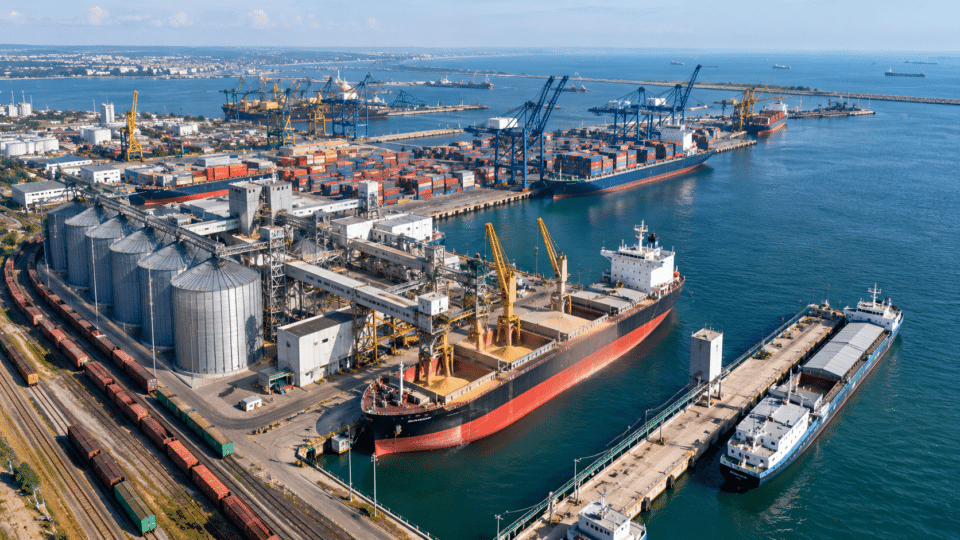
The Port of Constanța in 2026 is at an economic crossroads. After an exceptional peak in 2023, when it handled about 92.5 million tonnes of cargo, traffic fell to 77.5 million tonnes in 2024 and 67.6 million tonnes in 2025. In the first quarter of 2026, the comparable indicator in a shareholder report was 14.7 million tonnes, about 9.6% below the same period a year earlier. But those figures alone do not show who is losing out, who is benefiting, or what remains in the local economy.
To understand the shift, it is necessary to consider cargo volumes, handling revenue, logistics costs and value added in Romania separately. A terminal may handle more tonnes while earning less. A company may take in more revenue even as port traffic declines. And an increase in Ukrainian exports through the port does not mean that the full value of the exported grain becomes income for Constanța.
For further context, see Romania ranks third in the EU for risk of poverty: what Eurostat’s 27.4% figure means and who is affected most, which examines an issue directly related to this subject.
This InfoBuz.ro economic investigation draws on Fondul Proprietatea’s Q1 2026 reporting, the European CCNR report published in October 2026, COMVEX’s financial report, and European Commission data on alternative routes to Ukraine. It compares like-for-like indicators and makes clear where sources use different methodologies.
Port of Constanța in 2026: the 2023 traffic record and a return to a tougher market
| Period | Reported total port traffic | How to read it |
|---|---|---|
| 2022, full year | 75.6 million tonnes | The first major shifts in regional flows |
| 2023, full year | 92.5 million tonnes | A historical peak in the shareholder’s series, driven by regional transit |
| 2024, full year | 77.5 million tonnes | A correction after Ukrainian sea routes reopened |
| 2025, full year | 67.6 million tonnes | 13.0% below 2024, according to the same series |
| Q1 2025 | 16.3 million tonnes | The first quarter, not the full year |
| Q1 2026 | 14.7 million tonnes | 9.6% below Q1 2025 |
Comparing the annual values in the same presentation, 2025 traffic was about 26.9% below the 2023 level. The decline is not evidence that the port has lost its relevance; it shows how strongly wartime conditions influenced transit flows. The 2023 peak cannot be treated as “guaranteed operating capacity” for every future year.
There is also a methodological point to bear in mind. Some publications use figures from the Constanța County Directorate of Statistics that refer strictly to the Port of Constanța, while others use the Maritime Ports Administration and shareholder series. Their geographical scope, periods or included categories may differ. We do not combine two series to calculate an annual growth rate. Likewise, maritime tonnage should not be confused with river traffic or with volumes carried exclusively on the Danube–Black Sea Canal.
Five distinct economic flows: who can benefit from one vessel
Consider a hypothetical grain shipment. A producer sells the goods to a trader; a carrier brings them by barge, rail or truck; a silo stores and prepares them; a port operator loads them; and a shipping company carries them to the buyer. The port authority provides infrastructure and services under its regulatory framework and tariffs. Each participant may invoice for a different service, but none automatically receives the full value of the goods.
| Economic actor | Potential source of revenue | What can reduce its benefit |
|---|---|---|
| Port infrastructure administrator | Port charges, concessions/leases, and regulated or contractual services | Maintenance costs, investment, traffic mix |
| Terminal operator | Handling, loading/unloading, storage, processing | Negotiated tariffs, utilisation rates, fixed costs, competition |
| River, rail or road operator | Transport, traction, operations and related services | Waiting times, fuel, bottlenecks, empty return journeys |
| Freight forwarder or logistics broker | Multimodal organisation, documentation and coordination | Thin margins, delays, contractual risks |
| Trader and producer | Trading margin or the price of goods sold | International prices, financing, quality and price risks |
For the economy, the distinction between tonnage, turnover, profit and value added is fundamental. One million tonnes in transit cannot become one million tonnes of Romanian output, nor can it translate into a fixed amount of public revenue. Part of the goods’ value belongs to foreign suppliers, while logistics services are bought from different companies, some Romanian-owned and others international.
A verifiable example: COMVEX handled more grain but had lower total turnover
A relevant case is COMVEX’s 2025 Board of Directors report. The company operates both a grain terminal and a minerals terminal. In 2025, its grain terminal handled 5,091,923 tonnes, compared with 4,788,101 tonnes in 2024, an arithmetic increase of about 6.3%. The report also records 125 seagoing vessels handled, compared with 99 a year earlier.
| COMVEX indicator | 2024 | 2025 | Approximate change |
|---|---|---|---|
| Tonnes handled – grain terminal | 4,788,101 | 5,091,923 | +6.3% |
| Seagoing vessels – grain terminal | 99 | 125 | +26.3% |
| Turnover – grain terminal | RON 109.47 million | RON 107.28 million | −2.0% |
| Turnover – minerals terminal | RON 167.79 million | RON 141.14 million | −15.9% |
| Turnover – COMVEX total | RON 277.26 million | RON 248.41 million | −10.4% |
This illustrates the difference between volume and monetisation. More grain passed through the terminal, but turnover attributable to the grain terminal was slightly lower, while reduced minerals activity weighed heavily on the overall result. The company’s report points to changes in storage revenue and the mix of services. These five lines do not allow net profit per tonne of grain to be calculated, nor do they establish that tariff cuts were identical for every customer.
COMVEX also reported capital expenditure of around RON 52.63 million in 2025, mainly for expanding grain-storage facilities. A silo-cell project intended to add about 12,000 tonnes of capacity was declared complete in 2025. This is an example of a documented investment; it does not mean that all projects announced by other operators have already been built.
The Danube and the war in Ukraine: a strategic corridor, but not Constanța’s monopoly
The European Union launched the “Solidarity Lanes” in May 2022 to maintain Ukraine’s imports and exports via land and river routes after some Ukrainian seaports were blocked. For Romania, the link between the Danube, Sulina, Galați and Constanța became highly important. Efficiency measures included navigation management, data sharing, coordinated border controls and solutions to reduce waiting times.
On 2 February 2026, the European Commission reported that, from May 2022 to the end of 2025, the Europe-wide Solidarity Lanes system had enabled exports of around 209 million tonnes of Ukrainian goods, including 98 million tonnes of agricultural products. These volumes cover multiple European countries, transport modes and routes, not the Port of Constanța alone. That distinction is essential to a sound analysis.
The Commission also reported that in December 2025, around 20% of Ukrainian exports of grain, oilseeds and related products passed through the Solidarity Lanes, compared with about 80% through the Black Sea. The return of seaborne transport through Ukrainian ports changes the appeal of transit through Romania. It does not mean the Danube corridor has ceased to matter: an alternative route can be vital to resilience even when it is not used at full capacity.
River data published in 2026: 13.1 million tonnes in 2025, but a different measure from total traffic
The European report by the Central Commission for the Navigation of the Rhine (CCNR), prepared in cooperation with the European Commission and published in October 2026, says that 9,343 inland-waterway vessels arrived at the Port of Constanța in 2025, down from 11,085 in 2024. River cargo handled at the port came to 13.1 million tonnes in 2025, a decline of 23.8%.
In the same reporting, river transit fell by 38.4%, while dry bulk accounted for almost 80% of inland-waterway traffic. The CCNR series describes inland-waterway activity at the port, rather than the combined maritime and river total of 67.6 million tonnes in the shareholder report. These values are not added together, since the river component is already included in certain logistics totals and the definitions need to be reconciled.
| Statistical series | 2025 | What it measures |
|---|---|---|
| Total port traffic – shareholder reporting | 67.6 million tonnes | The total in the Fondul Proprietatea series |
| River cargo handled at the port – CCNR | 13.1 million tonnes | The inland-waterway transport component under the CCNR definition |
| Danube–Black Sea Canal traffic – County Directorate of Statistics indicator | 14.5 million tonnes | Goods transiting the canal, rather than solely the quantity handled by the same terminals |
How much does the port authority earn? Revenue, profit and traffic do not move in step
In Fondul Proprietatea’s presentation, the port authority’s operating revenue for 2025 is approximately RON 504.6 million, compared with RON 522.0 million in 2024, a fall of 3.3%. The relative decline in revenue was smaller than the fall in total tonnage. That does not demonstrate improved profitability, because costs and revenue composition also matter.
Another useful detail is that in Q1 2026, the same presentation records operating revenue of RON 134.3 million, 4.2% higher than in Q1 2025, although comparable tonnage was down 9.6%. The issuer partly explains the revenue change through rebilling items related to electricity-supply activities. It would therefore be inaccurate to write that “the port earned more because transport tariffs rose”: the source does not establish such a direct link.
Routes that matter for Constanța: from Romania to global markets and back to Central Europe
The Port of Constanța is connected to the trans-European transport network, TEN-T, and the Rhine–Danube Corridor, which links Central and South-Eastern Europe with the Black Sea through rail, road, port and inland-waterway infrastructure. Its strategic advantage lies in the ability to combine transport modes, not simply in water depth at the quayside.
- Agricultural exports: grain and oilseeds from Romania and countries in the Danube basin can reach seagoing vessels bound for overseas destinations through silos and terminals.
- Industrial imports: ores, fuels, equipment and other materials can be transshipped to industry by train, barge or truck.
- Regional transit: goods to and from Ukraine, the Republic of Moldova and Danube countries use alternative routes depending on time, cost and security.
- Containers and general cargo: these require infrastructure, services and commercial frequencies different from those needed for bulk grain.
- Energy products: these require specific terminals and safety rules, and should not be confused with Romanian gas or oil production.
In its own report, COMVEX lists Saudi Arabia, Jordan, Iran, Nigeria, the Netherlands, Spain and Türkiye among destinations for grain in 2025. These examples show the international role of one particular terminal, but they do not represent the leading destinations for all exports from the Port of Constanța. For the energy side of the Black Sea economy, see also InfoBuz’s analysis of the Neptun Deep project, which concerns a separate economic chain.
Bottlenecks: when a capable port loses time before cargo reaches the ship
A port’s efficiency is not measured only by the capacity of a crane. It also depends on how many rail wagons can reach terminals, how many barges can navigate without interruption, what documents are required at the border, how long unloading takes, and whether cargo can be stored until the next vessel arrives. An operator that saves two hours at the quay may lose that advantage if a train waits for days.
In October 2026, port and inland-shipping operators’ organisations reported a blockage on the Danube at kilometre 280, following an incident on 6 October, and called for dredging and the restoration of navigability. This is dated information reflecting their report from that period; we do not state that the sector remained blocked on 14 November 2026 without subsequent official confirmation. The episode nevertheless shows how one vulnerable point can disrupt an entire logistics chain.
For an analysis of risks related to water depth and river flow, InfoBuz published “The Danube at low flow for a year”. It is used here as explanatory context, not as evidence that every decline in port traffic was caused by river levels.
Rail: modernisation projects must be assessed by the lines actually available
One documented infrastructure example is the modernisation of the Valu lui Traian rail junction and access routes to the Port of Constanța. European documents from 2023 described a project for a new group of tracks and the electrification of infrastructure to improve freight capacity. This information sets out project objectives; it does not in itself prove that all lines had entered service by November 2026.
Assessing the works’ efficiency requires publication of the number of accepted and usable tracks, average dwell times, the number of trainsets that can be handled each day, and whether infrastructure upgrades outside the port are keeping pace with terminal capacity. That is where it becomes clear whether an investment is creating real capacity rather than simply generating a press release.
Investment for 2026–2027: between announced projects and confirmed benefits
In 2026, the port authority described works and projects for dredging, road infrastructure, quays and utility networks. A separate project, E-COLD (Cold Ironing), is presented as having a value of EUR 29.63 million and aims to provide shore-side power to ships at 10 berths, reducing emissions and noise while vessels are alongside. These are published project targets, not proof that all 10 berths were already operational.
At European level, the CEF Transport call launched in June 2026 made EUR 1.1 billion available for eligible projects in the EU and partner countries. The call’s budget is not money automatically allocated to the Port of Constanța. To establish that a local project has received funding, the list of beneficiaries, the signed contract and implementation status are required.
Geostrategic risk does not guarantee permanent profits
When trade routes in the Black Sea become riskier, some cargo may be diverted to alternative ports and corridors, increasing demand for logistics services. But the same risk can raise ship-insurance costs, security costs, fuel expenses and waiting times. There is no mechanism by which higher risk automatically produces profit for every operator in Constanța.
For maritime-security context, see InfoBuz’s analysis of damaged vessels near Sulina and risks in the Black Sea. This article considers economic effects without attributing a change in tonnage or revenue to an individual incident where the documents do not demonstrate that connection.
Who benefits in 2027? Three scenarios, without invented forecasts
Scenario A: Ukrainian flows continue largely through Ukraine’s own ports
Constanța may remain an important regional route for grain, minerals, fuels and transit, but without the exceptional volumes of 2023. Operators able to offer competitive costs and diversified services may have an advantage; this is a market scenario, not an official profit estimate.
Scenario B: alternative routes become more sought after again
A change in the security, cost or availability of Ukrainian routes could direct more cargo towards the Danube and Constanța. In that case, the actual reserve capacity of rail wagons, barges, silos and quays matters more than announced capacity. If infrastructure becomes congested, additional demand can bring delays and penalties rather than only new revenue.
Scenario C: diversification reduces reliance on a single flow
Investment in containers, industrial products, rail infrastructure and digitalisation could make revenue less dependent on grain from a single region. But success should be demonstrated through contracts, actual traffic, shorter operating times and financial results—not by the combined value of projects that exist only on paper.
Seven indicators of whether the port’s advantage reaches the local economy
- 1. Traffic by cargo type and transport mode: maritime, river, rail and road, with published methodologies.
- 2. Actual tonnes loaded and unloaded per terminal: not only theoretical capacity, nor simply the number of vessels.
- 3. Total transit time: border crossing, navigation channel, waiting, unloading, storage and loading.
- 4. Service revenue and margins: administration, operations, transport and storage, without confusing turnover with profit.
- 5. Local jobs and wage levels: in port activities and related services, compared over time.
- 6. Spending actually carried out and works accepted: separately from budgets, proposed projects and funding lines.
- 7. Route resilience: days of disruption, spare capacity and the return to operations after incidents.
A statement such as “traffic rose by 10%” is incomplete until it is clear which traffic is meant, over what period, against what base, and who provided the services. This is why Romania can have a port of major geostrategic importance without every resident of Constanța automatically experiencing the same economic benefit.
Frequently asked questions about the Port of Constanța
How many million tonnes did the Port of Constanța handle in 2025?
In the series used by Fondul Proprietatea, total traffic in 2025 was approximately 67.6 million tonnes, compared with 77.5 million tonnes in 2024. Other statistical series may have different scopes, so they should be read alongside their source definitions.
Why did traffic fall after the 2023 record?
A major factor identified by the CCNR and operators is the resumption of direct transport through Ukrainian ports, which reduced exceptional transit through Constanța. Prices, demand, output and logistics costs also play a part; it would be wrong to attribute the whole decline to one cause.
How much of the 209 million tonnes of Ukrainian goods passed through Constanța?
The figure of 209 million tonnes in the Commission’s February 2026 reporting refers to all European Solidarity Lanes from May 2022 to the end of 2025. It does not, by itself, identify the amount passing solely through the Port of Constanța.
If a terminal handles more tonnes, does it automatically earn more?
No. The COMVEX example shows that its grain terminal handled more cargo in 2025, while that terminal’s turnover declined slightly. Tariffs, storage, the mix of services and costs all affect the outcome.
Is the Port of Constanța connected to Central Europe through the Danube?
Yes. It is a node on the European Rhine–Danube Corridor, with inland-waterway and land-transport connections. Actual efficiency depends on navigation conditions, rail and road infrastructure, and terminal availability.
Have all investments announced in 2026 already been completed?
That cannot be inferred from a project list. For each project, approved financing, the contract, construction, acceptance and commissioning must be distinguished.
Does traffic growth mean more jobs in Constanța?
It may support hiring and related activity, but this does not follow automatically from tonnage. Automation, operators’ structures, hours worked and productivity affect job numbers and wages. Comparable employment data are needed.
Primary sources and methodology
- Fondul Proprietatea – Q1 2026 results presentation, 29 May 2026; traffic series and port-authority financial data.
- CCNR and European Commission – Inland Navigation in Europe, annual report, October 2026; inland-waterway traffic in Constanța.
- European Commission – Solidarity Lanes, data through December 2025, published 2 February 2026; volumes for the entire European corridor, not the Romanian port alone.
- COMVEX – Board of Directors report for 2025; activity, turnover and investment.
- European Commission – Rhine–Danube transport corridor; TEN-T connectivity.
- European Commission – CEF Transport call of 19 June 2026; EU-level objectives and funding.
- AGERPRES – 9 October 2026 report on operators’ notification of the Danube blockage; contextual episode, not an up-to-date verification of navigability.
Editorial note — 14 November 2026: Comparative percentages derived from reported figures are InfoBuz.ro calculations. All volumes are explicitly attributed to the company or institution that published them. Figures on Ukrainian corridors are not confused with traffic exclusively through Constanța. Investment projects are not presented as accepted or completed without evidence. We did not conduct interviews, site inspections, independent accounting analyses or our own traffic forecasts; the 2027 scenarios are illustrative.


Discuția cititorilor
Ai o opinie sau o întrebare despre acest articol? Spune-ne ce crezi.
Fii primul care deschide discuția.
Te rugăm să păstrezi un limbaj civilizat și să discuți la subiect. Comentariile spam sunt filtrate automat.