
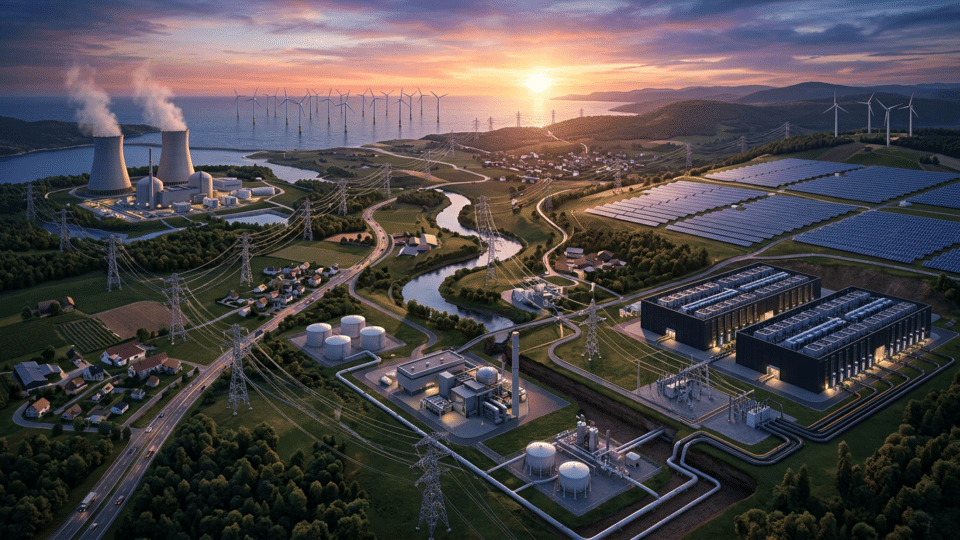
AI data centres have become one of the largest new sources of electricity demand in the global economy. In 2026, competition in artificial intelligence is no longer confined to models, chips and software. It is rapidly shifting towards physical infrastructure: power plants, transmission grids, transformers, cooling systems, water, land and access to electricity available around the clock.
Major technology companies are investing hundreds of billions of dollars in data centres, while governments are trying to attract this infrastructure as a new strategic industry. But there is a constraint that software cannot work around: an AI model can be copied in seconds, while a power line, power plant or transformer substation takes years to build.
How much energy do AI data centres actually consume?
The International Energy Agency estimates that data centres consumed around 485 TWh of electricity in 2025 and that demand could rise to roughly 950 TWh by 2030. In practical terms, global data-centre electricity use could almost double in just five years.
For more information on AI, see AI energy use reaches city scale: what happens when artificial intelligence hits the electricity limit, which offers complementary details on the subject.
Growth is much faster in the AI-focused segment. According to the IEA, electricity consumption at data centres geared towards artificial intelligence rose by around 50% in 2025, while the capacity of so-called “AI factories” tripled in just 18 months.
The reason is straightforward: training and running large models rely on accelerators with extremely high energy density. In the coming years, a modern AI server rack may reach a power demand comparable to that of dozens of households using electricity at the same time. The IEA estimates that by 2027, a single advanced rack could have peak power demand comparable to around 65 homes.
The challenge is no longer only electricity generation, but the grid
For a large data centre, it is not enough for power to exist “somewhere” in the system. It must be possible to deliver it at the required capacity to that specific location, without compromising grid stability.
This is where one of the biggest bottlenecks emerges. The IEA estimates that around 20% of planned data-centre projects could be delayed by grid-connection problems. Building new transmission lines can take between four and eight years in advanced economies, while delivery times for transformers and other critical equipment have lengthened sharply.
In the United States, the Department of Energy warns that additional transmission infrastructure is urgently needed because of new large consumers: hyperscale data centres, advanced manufacturing plants and other industrial loads.
Why energy has become AI’s new “currency”
During the first phase of the AI boom, competitive advantage was defined by access to GPUs. In the next stage, competition is shifting towards a far more complex package: chips + energy + land + grid + cooling + capital.
- GPUs can be ordered and installed relatively quickly;
- an electrical substation handling hundreds of megawatts may require years of permitting and construction;
- a new power plant requires far more capital and approvals;
- local grids can become saturated even if a country has sufficient energy overall;
- water and cooling systems can become additional constraints in drought-prone areas.
Google, OpenAI and other major players seek power directly at the source
In 2026, technology companies accelerated direct deals with energy producers and infrastructure developers. On 5 November, Google announced a $17 billion investment in its first data centre in Wyoming, alongside a 702 MW energy project based on fuel cells and carbon capture.
Google also announced an agreement with Constellation Energy in October for 890 MW of additional nuclear capacity on the PJM grid. The company says its recent agreements have enabled more than 1.5 GW of nuclear capacity to be unlocked through upgrades and restarts.
Through its Stargate project, OpenAI began in 2025 with the aim of securing 10 GW of AI infrastructure in the United States by 2029. In April 2026, the company said it had already exceeded that contractual threshold. In Michigan, OpenAI and its partners began construction on a 1 GW campus.
Nuclear is back in the conversation because of AI
Data centres need continuous power. For that reason, nuclear energy has returned prominently to technology companies’ discussions. Nuclear provides stable generation and low carbon emissions, but comes with the disadvantage of lengthy permitting and construction timelines.
That is why, in the immediate period ahead, upgrading existing reactors, extending their operating lives and restarting units may matter more than entirely new projects. Over the longer term, AI developers are also watching small modular reactors, or SMRs, but these must demonstrate that they can be built at competitive costs and quickly enough.
Natural gas is also back in the mix
Although major technology companies have signed large renewable-energy contracts for years, the speed at which AI demand is growing makes it difficult to cover all consumption with solar and wind alone. The IEA notes that numerous on-site natural-gas generation projects have been announced in the United States.
The reason is flexibility: a gas-fired power plant can be built faster than a nuclear one and can provide controllable power. The problem is the impact on emissions and the risk that the AI boom will prolong reliance on fossil fuels.
Renewables remain essential, but need storage
Solar and wind will continue to play a major role. In the first half of 2026, data-centre operators worldwide signed power-purchase agreements totalling around 45 TWh. Variable generation, however, does not align perfectly with the near-constant load of an AI data centre.
The solution is a combination of renewables, batteries, the grid, controllable generation and, in some cases, flexibility in computing workloads. The IEA estimates that around 20–25 GW of battery storage could be installed at data centres by 2030.
The US has the advantage of capital and AI infrastructure
The United States starts with a clear advantage. It is home to the largest concentration of companies developing frontier models, the biggest hyperscalers and a significant part of the data-centre financing ecosystem.
But the technological advantage also creates an energy problem. The IEA estimates that data centres could account for almost half of US electricity-demand growth through 2030.
China has a different advantage: it can build energy systems and grids quickly
China has an enormous energy sector and highly developed industrial supply chains for electrical equipment, batteries, solar power and grid infrastructure. Official Chinese data illustrate how fast digital consumption is rising: in the first eight months of 2026, electricity consumption by internet data services increased by 42.5% compared with the same period in 2025.
Europe wants AI Gigafactories, but energy may be the real constraint
The European Union is trying to narrow the gap with the US and China. In July 2026, the European Commission launched a programme for up to seven AI Gigafactories, with up to €10 billion in European and national public support and an estimated minimum of €20 billion in private investment.
These facilities are intended to combine more than 100,000 AI accelerators, high-speed networks, software and energy-efficient data centres. The EU already has a network of 19 AI Factories.
The European Commission says it intends to triple data-centre capacity in the EU over the next five to seven years. In September 2026, the Commission launched a consultation on minimum energy-performance standards for data centres, with a legislative proposal planned for 2027.
Water becomes the second major issue after electricity
AI servers generate very large quantities of heat. As rack density increases, air cooling becomes insufficient for some configurations, making liquid-based systems more important.
In regions where water is scarce, communities may end up competing indirectly with data centres for the same resource. This is why new projects are being pushed towards closed-loop systems, low-water-use designs and the reuse of waste heat. OpenAI announced in November 2026 that, for future campuses it owns and operates, it will publish data on water and electricity consumption and prioritise closed-loop or low-water-use cooling.
Why not every country can become an AI hub
- sufficient and predictable energy;
- rapid grid connection;
- redundant power supplies;
- high-capacity, low-latency fibre-optic connections;
- available land and cooling infrastructure;
- technical staff and clear rules;
- political and legal stability.
In practice, competition for AI is also becoming competition between national energy systems.
What chance does Romania have in this race?
Romania has several genuine advantages: a diverse energy mix, nuclear generation, hydropower, natural gas, growing wind and solar potential, a favourable position in Eastern Europe and competitive digital connectivity.
But for AI data centres requiring hundreds of megawatts, the key issue is not only annual national generation, but locally available power and grid capacity. This distinction is also explained in InfoBuz’s analysis of Romania’s energy mix and in its report on why Romania sometimes exports cheap electricity and imports it at a higher price.
If Romania wants to attract significant AI infrastructure, investment in transmission, substations, storage and flexible generation will matter as much as tax incentives. Without it, projects will turn towards regions where energy can be delivered faster and more predictably.
AI could help the very grid that it puts under pressure
Artificial intelligence can be used to forecast renewable generation, carry out predictive maintenance, optimise power flows, reduce congestion and manage consumption. In 2026, the European Commission launched the AI.grids project to develop European AI models for planning and operating electricity grids.
Who will win the race?
It is unlikely that a single type of energy will solve the problem. The regions with an advantage will be those able to rapidly combine several sources: nuclear, renewables, gas, storage and robust grids.
The US has capital and a technology ecosystem. China has construction speed and vast industrial supply chains. Europe has mature energy infrastructure and strict rules, but needs to speed up investment and permitting. Countries such as Romania can benefit from the new wave only if they turn theoretical energy advantages into capacity that is actually available to major digital consumers.
In the coming years, the decisive question for a multibillion-dollar AI project will no longer be only “how many GPUs can we buy?”, but also “where can we find 500 MW, 1 GW or even more, available on time?”
Frequently asked questions about AI data centres and energy
How much electricity do data centres consume worldwide?
The IEA estimates around 485 TWh in 2025 and almost 950 TWh in 2030 in its central scenario.
Why does AI consume more energy than conventional digital services?
Modern AI models use very powerful accelerators, while applications such as video generation, complex reasoning and autonomous agents can require far more computation than an ordinary web query.
Can data centres run only on solar and wind energy?
Annual consumption can be matched with renewables, but permanent power supply requires storage, a grid connection and/or controllable sources.
Why are AI companies interested in nuclear energy?
Because nuclear provides large-scale, stable, low-carbon power suited to data centres that operate continuously.
Can Romania attract large AI data centres?
Yes, but decisive factors include local grid capacity, connection speed, available generation, land, cooling, fibre optics and predictable regulation.
Sources consulted
- International Energy Agency – Powering Artificial Intelligence, 2026
- International Energy Agency – Key Questions on Energy and AI, 2026
- International Energy Agency – Electricity 2026
- European Commission – AI Gigafactories, 2026
- European Commission – Energy performance of data centres
- Google – Wyoming data-centre investment, 5 November 2026
- OpenAI – Building the Compute Infrastructure for the Intelligence Age, 2026
- U.S. Department of Energy – 2026 National Transmission Needs Study








Discuția cititorilor
Ai o opinie sau o întrebare despre acest articol? Spune-ne ce crezi.
Fii primul care deschide discuția.
Te rugăm să păstrezi un limbaj civilizat și să discuți la subiect. Comentariile spam sunt filtrate automat.