
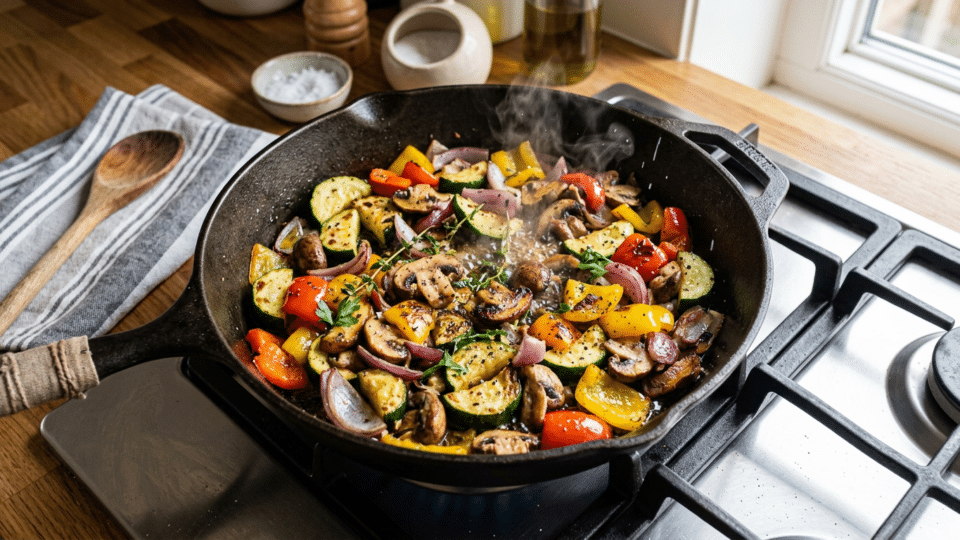
A pan can be properly preheated before cooking and still fill with liquid a minute after you add the vegetables. The explanation is not simply the initial temperature. Water appears when the moisture brought in and released by the ingredients temporarily exceeds the capacity of the pan and burner to evaporate it.
In short: as long as there is a visible layer of liquid, vegetables are cooking mainly in steam and their own juices. For browning, their surface needs to become relatively dry and hot again. A wider pan, smaller batches, thoroughly dried vegetables and adding ingredients one at a time will usually solve the problem more effectively than simply turning the heat to maximum.
Watery vegetables in the pan: what is really happening
Two processes in a pan compete for the same energy: water evaporation and browning. Evaporating water takes a great deal of heat energy. As long as the surface of the vegetables is wet, its temperature tends to stay close to water’s boiling point, which is too low for sustained browning.
The Maillard reaction, one of the reactions involved in producing brown colour and cooked flavours, requires a hotter, drier surface. Kansas State University gives about 140°C as a general reference point for its onset, with the implicit qualification that results vary according to the food, its composition and cooking time. Not every brown patch on vegetables is produced exclusively by the Maillard reaction: sugars may caramelise, while other heat-driven reactions can contribute to flavour and colour.
In practice, the pan goes through two stages. First, the vegetables release or bring in water, which has to disappear. Only then can contact with the hot metal create the desired browning. If you add too many cold, wet ingredients at once, the first stage lasts so long that the result resembles accidental boiling.
Three different sources of the water you see in the pan
Not all liquid comes from the same place, and the remedy depends on its source.
| Likely source | Easy-to-spot sign | What helps |
|---|---|---|
| Water left after washing | Immediate loud sizzling, splattering and steam before the vegetables have had time to settle | Drain and dry thoroughly with a clean towel or salad spinner |
| Water released from the vegetables’ tissues | Liquid appears gradually after a few minutes; common with mushrooms, courgettes, onions and aubergines | Smaller batches, a thin layer and patience while it evaporates |
| Ingredients added at the same time | Some pieces soften before others colour; a great deal of steam builds up beyond the pan’s capacity | Add ingredients successively, according to their moisture content and cooking time |
| Frozen vegetables | A large amount of liquid forms quickly; the pan’s temperature visibly drops | Cook in small batches; thaw and drain when the recipe allows, or deliberately accept a steaming stage |
Washed vegetables do not need to be left dirty in order to brown. The point is simply that they should not go into the pan with visible droplets on them. A clean kitchen towel or paper towel deals with surface water, but neither can remove water already inside the cells of a courgette or mushroom.
This is where a common misunderstanding arises: vegetables can be perfectly dry on the outside and still release liquid. Heating changes their structure, making water in their tissues available. Mushrooms, courgettes, aubergines and onions are familiar examples, though the amount also depends on freshness, how they are cut and how long they spend in the pan.
A hot pan is the start, not the whole solution
University of Kentucky Cooperative Extension recommends preheating the pan, using a thin film of fat and arranging vegetables in a single, uncrowded layer. The useful temperature for sautéing is generally described as medium to medium-high, rather than maximum heat in every situation.
That distinction matters. Very high heat can burn oil, garlic or the edges of small pieces before their centres are cooked. Medium-high heat, combined with space between the pieces, gives water a route to evaporate and gives the pan time to regain its temperature.
The Professional Cooking manual, used by Escoffier School of Culinary Arts, explains the same principle: an overcrowded pan loses too much heat, and ingredients may boil rather than sauté. A heavy pan may retain more heat, but it cannot indefinitely compensate for a large quantity of cold, wet vegetables.
Signs that separate sautéing from boiling in their own juices
You do not need a thermometer to notice the shift between the two stages. When sautéing, you hear a lively sizzle, while liquid is scarce or disappears quickly. The pieces are in direct contact with the bottom of the pan and begin to develop golden patches.
Once the pan has moved into the wet stage, the sound becomes gentler, a layer of liquid is visible between the pieces and steam is constant. The vegetables move easily through the water and become glossy and soft, without browning. At that point, constant stirring does not speed up browning; it often prevents evaporation and sustained contact with the pan.
Water is not automatically a failure. For a sauce base, softened onions or vegetables intended for a reduced stew, the wet stage may be deliberate. It becomes a problem only when the goal is a browned side dish with firm edges and concentrated flavour.
For more information on a directly related topic, see Cook once, eat for three days: 10 basic dishes turned into completely different meals.
Salt: when it speeds up liquid release and when it is useful
The rule that “salt should only be added at the end” is too rigid. For vegetables you want to brown quickly, salting near the end or after colour has developed is a prudent approach: it avoids adding another factor that can draw out moisture early in cooking.
There are, however, cases in which salt is deliberately used beforehand. Using aubergine as an example, Exploratorium explains that salting and then pressing can help draw out some liquid through osmosis. This is a particular case: salted aubergine needs to sit for a while, then be drained and dried before it goes into the pan. It does not show that the same procedure is necessary for all vegetables.
For a pan of mushrooms, peppers and courgettes, a balanced approach is to cook the higher-moisture vegetables separately in batches, season them once the liquid has reduced, then combine them. If you need garlic, herbs or spices that burn easily, add them towards the end, after the evaporation stage.
Ingredient order controls moisture
A pan containing onions, mushrooms, courgettes and tomatoes should not be treated as though it held a single ingredient. Adding everything at once means water is released simultaneously, while each ingredient has a different cooking time. Tomatoes and frozen vegetables are generally best added last when browning is the aim, because they bring in a great deal of moisture.
- Start with vegetables that tolerate direct contact with the pan better: peppers, more thickly sliced onions, thinly sliced carrots or properly prepared aubergine.
- Cook very watery ingredients separately or in small batches: mushrooms, courgettes and frozen vegetables.
- Add garlic, herbs and delicate spices towards the end: they need little time and may burn while you wait for the water to disappear.
- Add tomatoes once you accept a sauce stage: they are not the right choice for the beginning of a dry sauté.
Cut size also changes the pace. Smaller pieces have more exposed surface area and cook faster, but can release moisture more quickly if the pan is already too full. Cutting vegetables small is no substitute for leaving space between the ingredients.
How to rescue vegetables after the pan has already filled with water
The first instinct is often to raise the heat and wait. That can work when there is little liquid and the pan is wide. If the layer of water is deep, however, all the vegetables boil until it evaporates, and those at the bottom risk becoming too soft.
- Stop adding more wet ingredients. Do not add tomatoes, sauce, butter or frozen vegetables to a pan that is already boiling.
- Spread the vegetables into a wider layer. If the pan is full, remove about half to a warm bowl and allow the rest to shed their liquid.
- Let the liquid evaporate without a lid. Stir infrequently, only enough to prevent sticking. Constant movement cools the food and prevents browning.
- Do not automatically discard the liquid. If it is flavoursome and the dish can become a sauce or soft side dish, you can reduce it. If you want a browned texture, temporarily separating the vegetables is usually more effective.
- Resume browning only when the bottom of the pan is almost dry again. Add oil then only if necessary, and leave the pieces for several dozen seconds without turning them.
The lid has its place, but not at this stage. It retains steam and is useful when you want to soften food or cook it more gently. For browning, keep the lid off until the liquid has reduced.
A comparative method you can try at home
There is no single result that can state how many grams of vegetables fit in every pan, because the actual diameter of its base, its material, hob power, ingredient temperature and cut all matter. Rather than using a falsely precise figure, you can observe your own pan-and-hob combination with a simple test.
This is a proposed method, not an experiment carried out or measured by InfoBuz. Choose the same vegetable — mushrooms or courgettes, for example — and cut four equal portions. Use the same amount of oil and the same hob setting for each round.
- Put the first portion into a cold pan.
- Put the second into a preheated pan, in a single layer.
- Put the third into a preheated pan, but in double the quantity or a more crowded layer.
- Salt the fourth before cooking, solely to observe the difference for that vegetable.
Note the time until liquid appears, the time until the bottom of the pan is nearly dry again and how much colour the vegetables have at the end. Do not turn the observation into a universal conclusion: the test is affected by the type of pan and hob. It can, however, show why the same vegetable may brown in one batch and boil in another.
The principle readily carries over to recipes. For example, in pasta with browned mushrooms, garlic and parsley, the mushrooms need space and a clear evaporation stage before the garlic and parsley are added. In dishes such as frittata made with leftover vegetables, draining or separately browning very wet vegetables also helps avoid a watery result.
The useful rule is neither “maximum heat” nor “never salt”. It is to keep released moisture below what the pan can evaporate at that moment. When you do that, water disappears faster and browning becomes a possible stage rather than an end-of-cooking hope.
Frequently asked questions
Why do mushrooms release so much water in the pan?
Mushrooms contain a great deal of water, which they release when heated. If there are many of them in a small pan, liquid accumulates more quickly than it can evaporate. Cooking in smaller batches and without a lid helps move more quickly towards browning.
Should I wash vegetables before putting them in the pan?
Yes, but it is useful to drain and dry them well after washing. Surface water is not the only cause of liquid in the pan, but it lengthens the evaporation stage.
Should I salt courgette before frying it?
It depends on the result you want. For quickly browned courgette, it is usually simpler to salt it towards the end and cook it in small batches. Salting in advance may make sense only if you allow it to release liquid, then drain and dry it before it goes into the pan.
Can I brown frozen vegetables directly in the pan?
It is possible, but they generally bring additional water and ice, so a steaming stage is likely. Use a wide pan and small batches, and allow the liquid to evaporate before attempting to brown them. For some recipes, thawing and draining are more suitable.


Discuția cititorilor
Ai o opinie sau o întrebare despre acest articol? Spune-ne ce crezi.
Fii primul care deschide discuția.
Te rugăm să păstrezi un limbaj civilizat și să discuți la subiect. Comentariile spam sunt filtrate automat.